


INFANTRY AT-WEAPONS PART 1:
Molotov Cocktails & Satchel Charges
Molotov Cocktail
Using fire as a weapon is an ancient invention and this use had continued in more or less refined forms for ages. Filling bottles with easily flammable liquid and throwing enemy with them was not new in any way either. In fact such incendiary bottles had also been used as antitank weapon at least in Second Abyssinian War (1935 - 1936) and Spanish Civil War (1936 - 1939). However, generally speaking earlier petrol bombs were very simple compared to more refined Finnish factory-produced versions. When petrol bombs had been used in Abyssinia they had been simply filled with alcohol or petrol and had been used by first throwing the bottle and then throwing burning piece of fabric tied to stick after it. With this method it was necessary for both throws to hit the target to achieve the required result. Petrol bombs of Spanish Civil War were simpler to use then the ones earlier used in Abyssinia. The bottles used there were still alcohol or petrol filled, but now a piece of fabric was usually tied to the bottle and was just set on fire before throwing. Thanks to this now the target needed to be to hit only once. The first unit to use petrol bombs as antitank weapons in Spanish Civil War was Spanish Foreign Legion fighting in Nationalist side in autumn of 1936.

PICTURE: Finnish Molotov cocktail with storm matches. Time has made its thing and the mix is no longer
well mixed up - when new, the colour of mix was presumably black. If the mix in this particular bottle is the real thing
(probably not) the reason for the discoloration is tar getting settled on bottom of the bottle. Notice that the storm
matches have been isolated from the glass bottle by putting pieces of tape between them - this was made because heat of
the burning matches could otherwise crack the glass bottle prematurely. (Photo taken in Panssarimuseo).
CLICK THUMBNAIL TO SEE LARGER PIC (82 KB).
By late 1930's Finnish military had become aware that infantry needed some sort of antitank weaponry of its own. Finnish military intended to acquire antitank rifles for this use, but as introducing them was delayed also other alternatives were taken in consideration. Some Finns had contemplated petrol-bombs for the purpose early on, like for example Sergeant Major Johan Valli from PPP 2 (Bicycle Battalion 2) - he tested petrol-bomb like weapon already in year 1932. But it was Captain (later: Major) Eero Kuittinen with his modest and unofficial development team, who can be really credited for development of Finnish molotov cocktail. Nobody had given Kuittinen or his team any orders for doing such development work and the whole thing seem to have started from their own idea. During spring of 1937 Kuittinen with help of his friend merchant Väinö Hannula and three 2nd Lieutenants started developing new version based to the petrol bombs reportedly used in Spanish Civil War. The first version they tested was a simple bottle filled with petrol and piece of cotton waste tied into it, but this proved less than ideal. The main problems of this simple petrol bomb were:
Adding pine tar to mix (about 10 - 20 cl for each half-liter bottle) proved to be a good solution to first problem, since it not only made mix to stick target, but created mixture that produced quite a bit of smoke. Additional bonuses of this mix were that the fire became more long lasting and burned with higher temperature. When it came to setting the liquid on fire, two ignition methods were developed:

PICTURE: Another sample of Finnish Molotov cocktail with storm matches. Notice also the metal wire
used to further secure the storm matches. Colour of liquid is also off in this bottle - original liquid mix seems to
have been black in color. But considering this is in a museum exhibition, the liquid content is probably not original
and what ever substance was used in it for color has since turned brown and gathered at bottom of the bottle. (Photo
taken in Sotamuseo). CLICK THUMBNAIL TO SEE LARGER PIC (43 KB).
Also Riihimäki glass factory had its part in development team of Finnish molotov cocktail, as it delivered several glass bottle types for testing of molotov cocktails. Bottles made especially for the purpose were also tested. But in these tests the normal 500-ml (half-liter) glass bottle, which had bee introduced into production in 1934 year and used for strong alcohol drinks proved to the best design. Hence it became the standard bottle used in mass-production of Finnish molotov cocktails. The bottle is glass bottle 26.5 centimeters high with diameter of 6.8 centimeters. The cork used early on was aluminium with seal capsule, later it was replaced with bakelite cork. When the bottles were mass-produced with semiautomatic and full-automatic machinery manufacturing them in large quantities was both cheap and easy.
How did the first official version of molotov cocktail (the "storm match"-version) spread to knowledge of Finnish soldiers? It may have been included already to short manuals of Engineer Corps in January or February of 1939. What is known for a certain is that it was included to manual called "Pion. Tekn. ohjeita N:o 1" (Sapper-Technical Instructions number 1) published in August of 1939. However it being mentioned in some manual does not equal for it being common knowledge. The grand majority of Finnish soldiers did not become familiar with this new weapon first known as "polttopullo" (literally translated: "burning bottle") until during Winter War.
Before the war Finnish military had planned to manufacture molotov cocktails by hand in few production small plants reserved for the purpose. Few weeks before breaking out of Winter War Finnish military started making preparations for molotov cocktail production by buying large quantities of glass bottles. Finnish military had organised five bottling plants of its own for the work. These were presumably somewhat similar as one located in Sorvali near Viipuri. In Sorvali plant 40 women were manufacturing molotov cocktails to 2nd Army Corps under leadership of 2nd Lieutenant Kauko Lehtonen. But as the war started the shear volume of needed molotov cocktails proved overwhelming for these small production plants.
However, buying empty alcohol bottles in large-scale sparked interest of Alko (Finnish alcohol monopoly, state-owned company, which was the only company allowed to manufacture or sell hard liquor in Finland). This interest lead to fruitful co-operation between Alko and Finnish Army as Alko's bottling plants had several production lines with highly effective bottle filling machinery. This machinery was able to fill tens of thousands of bottles with molotov cocktail mix per day. Once Finnish military became aware of the possibility of being able to use Alko's bottling plant for the molotov cocktail production, Finnish Minister of Defence Juho Niukkanen effectively cut the red tape by directly ordering Alko to immediately bottle 40,000 bottles with molotov cocktail mix. December of 1939 Rajamäki plant of Alko hired 87 women plus five men and started producing molotov cocktails for Finnish military 24-hours a day. This first order of 40,000 molotov cocktails was filled in only couple of days, with in total bit over 200,000 bottles filled by Alko plant by end of that month. With mass-production running molotov cocktails were issued to Finnish soldiers starting December of 1939. Other parts of manufacturing process were done in Vuorela hill and in town of Riihimäki. Finnish troops suffered from shortage of better antitank weapons, but thanks to Alko's Riihimäki bottling plant and other parts of production line they at least had molotov cocktails in their disposal. During Winter War Alko's Rajamäki plant filled 542,194 bottles with molotov cocktail mix. Also other smaller plants manufactured molotov cocktails, but even their combined total production was very small compared to Alko's Rajammäki production plant.
|
Liquids and mixes used in molotov cocktails during Winter War: |
|
Petrol + tar |
|
Petrol + kerosene + tar |
|
Waste alcohol + kerosene + tar |
|
Sulfate-turpentine |
According pre-war instructions of Finnish Army the preferred method for using molotov cocktail was throwing it to front armour of the tank and blinding the tank with smoke produced by burning molotov cocktail mix. The idea for this was that impeding visibility of tank crew improved changes of using satchel charge / antitank hand grenade or antitank-mine to destroy tank. But Finnish soldiers soon realized that top of tank's engine was much better target. Tanks that the Soviets commonly used in Winter War had petrol engines and most common Soviet tank designs had openings on top of engine room. Molotov cocktail thrown on rear deck of tank spilled its highly flammable liquid on top of the hot engine through these openings. Hence if the mix was not on fire already, then the hot engine would likely ignite it. Tank engine rooms being what they were, tanks engine being Soviet "quality" and Soviet tankers maintaining the tanks being who they were, the tanks engine room had grease, petrol, oil, rubber hoses and other materials, which molotov cocktail set on fire. And as if losing mobility due to engine fire was not enough, in some Soviet tanks (like T-26 series) air intake system directed fire from the engine bay right into tank's crew quarters. When this happened the tank crew was forced to take unhappy choice: Either to burn death inside their tank or get out fast and face Finnish infantry, which was likely waiting for them to pop out.
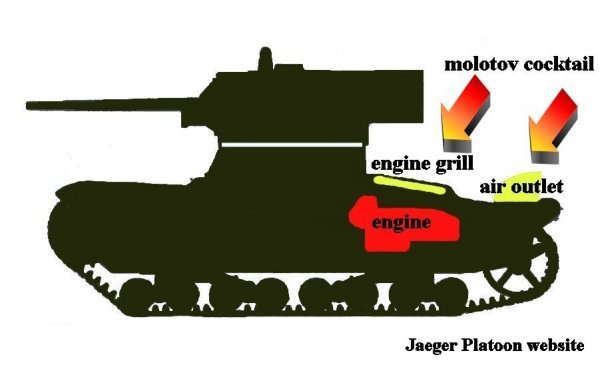
PICTURE: Drawing that shows parts of tank, which Finnish soldiers usually targeted with molotov
cocktails. The tank in the drawing is T-26, which was found especially vulnerable to
molotov cocktail attack due to its structural design. CLICK THUMBNAIL TO SEE LARGER PIC (42 KB).
Molotov cocktail proved effective weapon against Soviet tanks in Finnish hands when introduced to use in early December of 1939. It was not a super-weapon and did not change the course of war, but at least it gave Finnish infantry lacking other more sophisticated antitank-support something to fight against enemy tanks. And in many situations having at least something for fight with is what makes the true difference for fighting moral. In reality even during Winter War molotov cocktails were mostly used for demolishing tanks that had already been knocked out with other weapons - once a tank was successfully set on fire with molotov cocktail, repairing it became so difficult, that it was usually no longer a practical choice. Using weapon such as molotov cocktails against tanks was both difficult and dangerous. Getting with-in throwing distance from enemy tank demanded Finnish infantry to get very close to enemy tanks, so more cover the terrain offered, easier it was to use this sort of weapon. Open terrain and daylight were the least favorable conditions for their use. The Soviets also learned some lessons and adjusted their tactics: If their tanks succeeded getting behind Finnish trenches at daytime, they usually returned to their own lines before nightfall - and attack of Finnish infantry using cover of darkness. Soviet tanks also started covering each other and tried to avoid going too close Finnish trenches or terrain that offered too many good hiding places for Finnish infantry. Later on the Soviets even tried increasing chances of molotov cocktail not breaking by adding tree branches or wire mesh on top of their tanks. In this minor arms race the Finnish soldiers responded adding two or three stones connected with strings to bottle of molotov cocktail to make sure that it always shattered on impact and added some barb-wire around the bottle made sure it stuck to mesh. During Winter War the weapon got its famous name "molotov cocktail", however its not certain if the term was Finnish invention or originated from one of the numerous foreign journalists working in Finland during the war. Some sources also suggest that the name may have originated from Professor Alvar Wilska, who took part in further developing of molotov cocktail during Winter War. In either case the person it was named after was no other than Soviet foreign Minister Vjatseslav Molotov, for whom the Finns had less than favorable opinion. It worth noting that that according stories Molotov had publicly claimed during Winter War that Soviet bombers, which were bombing Finnish cities were not dropping bombs but bread to feed hungry population, due to which the Finns supposedly named incendiary bomb container that the Soviets were using in their bombing raids as "Molotov's bread basket".

PICTURE: Group of Finnish soldiers are being instructed how to use molotov cocktail.
Photographed in Hanko / Hango / Gangut Peninsula in July of 1941. Photographer Vilho Heinämies. (SA-kuva.fi
photo archive, photograph number 28650). CLICK THUMBNAIL TO SEE LARGER PIC (165 KB).
Molotov cocktail remained as part of Finnish antitank weaponry also for Continuation War, but saw even less use as antitank-weapon during it. Already during Winter War molotov cocktails had been as antitank-weapon used mostly for burning already immobilized or knocked out Soviet tanks instead of being used as primary antitank-weapon and by Continuation War there were other more effective weapons available for Finnish infantry. By beginning of Continuation War antitank-rifles were being issued in large-scale and antitank-guns had become available in sufficient numbers, hence in year 1941 there was lot less need for Finnish infantry to rely molotov cocktails and satchel charges for fighting enemy tanks. Also new Soviet tanks introduced after Winter War were far less vulnerable to molotov cocktails than their predecessors. Already T-28 medium tanks was difficult to destroy with molotov cocktails due to its structural design and new Soviet diesel-engine equipped tanks like KV heavy tanks and T-34 were practically impossible to destroy with molotov cocktail unless hatch happened to be open. Year 1941 the weapon type that Finnish infantry used to knock out most Soviet tanks with was antitank-rifle, which were sufficiently effective against pre World War 2 tank designs still being mostly used by the Soviet Red Army at that time. New Soviet tanks like KV heavy tanks and T-34 started appearing in Finnish - Soviet front in real numbers in year 1942, which forced Finnish Army start a reform with its antitank equipment. Anti-tank rifles and antitank-guns existing in Finnish inventory were quite useless against tanks like KV-1 and T-34, so Finnish infantry fought these new Soviet tanks to its best ability with antitank-mines and satchel charges. As part of this reform started in year 1942 Finnish Armed Forces GHQ ordered in summer of 1942 some 200,000 molotov cocktails remaining in Army inventory to be disassembled and their materials to be recycled for other purposes. For all practical purposes this seems to have marked the end for large-scale use molotov cocktails in Finnish Army. Satchel charges remained in use and starting summer of 1944 Panzerfaust and Panzerschreck bought from Germany were used along them.
During World War 2 Finnish Army introduced also a training tool version of molotov cocktail, which was size and shape of the 500-milliliter glass bottle used for molotov cocktails. But instead of glass it was made from wood and reinforced with iron bands to survive being repeatedly thrown against hard surface. This training tool version was partially filled with lead and weight about 900 grams.
Information from successful Finnish use of molotov-cocktails was widely published by international press during Winter War, becoming iconic weapon for the war and apparently influenced to some other countries, which also added molotov cocktails to their antitank weapons inventory.

PICTURE: Captured Soviet molotov cocktail, which with its ("storm match" ignition
resembles Finnish Winter War era molotov cocktail design. However glass bottle and cork differ from those used in Finland and
it has Russian-language instructions attached in side of the bottle. Photographed by Military official Sundstöm. (SA-kuva.fi
photo archive, photograph number 117303). CLICK THUMBNAIL TO SEE LARGER PIC (65 KB).
Molotov cocktails developed and/or used by some other countries during World War 2:
Sokaisupullo M/44 (Blinding Bottle M/44)
While Finnish military basically got rid off using molotov cocktails as antitank-weapons circa year 1942, it still proved to be able to make a come-back in more specialized form only two years later. The idea for special incendiary bottle designed specifically to create as much as smoke as possible had existed already during developing of molotov cocktail before Winter War, but at that time there had been no resources available for this development work. Hence this special version of molotov cocktails was not introduced until years later during Continuation War. While normal molotov cocktail had used normal glass bottles introduced pre-war by ALKO (State-owned Finnish company for alcohol monopoly) for 0,5 liter hard liquer, blinding bottle had its own special bottle shaped specifically to provide better grip for throwing. This special bottle also had bottom design similar to ones used in Champaigne bottles and inside bottle in middle of bottom was place for glass ampoule filled with self-igniting (acid-like) material. Factory Riihimäen Lasi Oy (Riihimäki Glass Factory Ltd) manufactured the bottles for this purpose. Method used with this weapon was simply to throw the bottle on front hull of enemy tank, after this the black smoke produced by burning liquid would momentarily engulf front of the tank in thick smoke - which made destroying the tank with other weapons much easier, since the smoke severely limited tank crew's ability to see outside.

PICTURE: Sokailupullo m/44 aka Blinding bottle m/44 with its carry container in the middle. Notice
canvas shoulder-strap of carry container. Normal Finnish Army molotov cocktail with "storm matches" on the left.
The plastic label glued into bliding bottle was not part of the original design. :-) (Photo taken in Museum of Reserve Officer
School, Hamina) CLICK THUMBNAIL TO SEE LARGER PIC (110 KB).
The blinding bottles were delivered in carrying devices made from and cardboard, that each contained 3 bottles. Larger transport boxes each contained 5 carrying devices (in other words: 15 bottles per transport box). The self-igniting ampoules were transported in separate boxes, which each contained 20 ampoules.

PICTURE: Perfect hit - blinding bottle m/44 is being tested against KV-1
E model 1940 Ps. 272-1 in Enso, April of 1944. Photograph taken by Military Official K. Kivi. (SA-kuva.fi photo archive,
photograph number 148991). CLICK THUMBNAIL TO SEE LARGER PIC (171 KB).
Satchel Charge / Anti-tank Hand Grenade
The basic principle of satchel charge was no longer new during World War 2. Using packages of explosives against armoured vehicles was basically just expansion of the method that had already seen use since introduction of tanks during World War 1. In its most primitive form satchel charge could be just a bundle of explosives (like dynamite) detonated with fuse wire detonator. German Army had used bundles of stick hand grenades as antitank weapons during World War 1 and the Finnish military was very much aware of this. Reportedly Finnish White Army had already used bundles of German stick hand grenades (mainly for demolition purposes) during Finnish Civil War in year 1918 and using these grenade bundles against armoured vehicles appears also in Finnish military training manuals such as Käsigranaatit (Hand grenades) published year in 1925. Considering familiarity of Finnish Army with bundles of stick hand grenades already before domestic development of satchel charge begun and it seems plausible that it may in fact have served as starting point for Finnish antitank hand grenade / satchel charge development. In fact during Winter War there were still few cases in which Finnish troops lacking any other available antitank weapons were still using bundles of stick hand grenades m/32 as ad hoc antitank-weapons.
Year 1936 Captain Kaarlo Tuurna, who served in Engineer Battalion (Pioneeripataljoona) started testing explosive charges against armour. He came to conclusion that 500 grams of TNT (trinitrotoluene, the de facto standard military explosive of that time) was enough to break 12-mm thick armour plate if pressed against it. The conclusion was that satchel charge with explosive charge corresponding 800 grams of TNT was the smallest practical useful explosive charge size for antitank-grenade to be used against armoured vehicles. This was closely equal to bundle of six old German M/1917 stick hand grenades:
6 x stick hand grenade M/17 á 125 grams of TNT = 750 grams of TNT
It is worth noting that Finnish military had two separate but equally popular names for this weapon - kasapanos (satchel charge) and hyökkäsvaunukäsikranaatti (anti-tank hand grenade), which was often abbreviated to simply as Hv-käsikranaatti. Both of these names had official status and were used in equal manner, sometimes even in the same individual military document.

PICTURE: Finnish soldier with satchel charge photographed in bushes that are in side of a road. Getting close
enough to tank for throwing a satchel charge typically required getting there without being spotted, which was no easy task.
Photo taken by Alpo Pulkki in Carelian Isthmus in August of 1941. (SA-kuva.fi photo archive, photograph number 52802). CLICK THUMBNAIL
TO SEE LARGER PIC (91 KB).
While in German use the basic satchel charge did not develop beyond this bundle of "potato smashers" (stick) hand grenades, with Finnish Army it served merely as the starting point of development which ultimately resulted mass-production of industrially manufactured satchel charges. Finnish infantry used satchel charges both in Winter War and Continuation War in huge numbers - during Continuation War Finnish Army spent about 85,000 satchel charges. Although this is for a large explained by the fact that satchel charges served also as the standard demolition charges routinely employed by Finnish sappers and infantry against enemy field fortifications such as bunkers, dugouts and heavy weapons emplacements. While no statics exist, it seems certain that grand majority of satchel charges were spent when used against fortifications. Antitank hand grenades / satchel charges remained in use of Finnish Army for whole duration of World War 2 and also served as antitank weapons for whole that time. But their use had its high points and low points. Due to shortage of antitank-guns and antitank-rifles satchel charges had major role as infantry antitank-weapons during Winter War. Year 1941 Finnish Army was notably better equipped and grand majority of Soviet tanks in Finnish - Soviet tanks were still pre World War 2 designs, against which antitank-rifles and antitank-guns issued in sufficient scale proved highly effective. That year new Soviet tanks like KV heavy tanks and T-34 were still very rare in Finnish - Soviet front, but starting the following year started appearing in larger numbers with antitank-rifles and antitank-guns tanks existing in Finnish inventory proving ineffective against these new tanks. This forced Finnish infantry to fall back into using combination of antitank-mines and satchel charges for its primary antitank-weapons against these new more heavily armored tanks. Typical tactic was first to separate infantry from tanks to make tanks loose their infantry screen, then immobilize tanks with antitank-mines and finally (preferably with cover of darkness in the next night) destroy tanks with satchel charges. New more powerful antitank-guns such as 75 K/40 introduced for use of Finnish Army in year 1943 and Panzerfaust and Panzerschreck issued to Finnish troops starting summer of 1944 proved effective against even heaviest of Soviet tanks, but satchel charges still remained in use along them for rest of the war - although in lesser practical role.
Inventory of satchel charges of Finnish military and to which units they were issued in 1st of June 1944:

PICTURE: Finnish sappers rush towards enemy positions covered by clouds of smoke and sand raised by incoming
artillery shells. Every sapper carries a satchel charge behind his back. Photo taken by Zilliacus in Hanko / Hango / Gangut
Peninsula in August of 1941. (SA-kuva.fi photo archive, photograph number 43806). CLICK THUMBNAIL TO SEE LARGER PIC (118 KB).
Finnish satchel charges can be roughly divided to two categories:
A) Factory-made satchel charges:
These were (mainly) manufactured in three sizes:

PICTURE: Finnish factory-made satchel charge without hooks. Detonator and handle used in this one seem to
to be similar to that used in Finnish stick hand grenade M/41. The marking "5 sek"
in the handle indicates that the fuse has five second delay. (Photo taken in Maneesi of Sotamuseo). CLICK THUMBNAIL TO SEE LARGER PIC
(129 KB).
When the Finns first started mass-production of satchel charges in December of 1939 the fuse system used in them was not yet very sophisticated, but reliable: Detonator number 8 with 4.5-cm long cord, which had a piece of sulphur (similar as used in ordinary matches) cast in its end. The fuse had also been coated with paraffin to protect it from moisture. This special fuse type nicknamed "tikkukaramelli" (="lollipop") was used in satchel charges manufactured in December of 1939 - January of 1940. During those two months around 250,000 - 300,000 of these fuses were manufactured for satchel charges. Troops started receiving this first version of industrially manufactured satchel charge in mid-December of 1939. But already in end of January of 1940 "tikkukaramelli"-fuse was replaced with stick hand grenade fuses more commonly used in manufacturing of Finnish satchel charges. Since components loaned from stick hand grenades made satchel charge much easier to use, this was a notable improvement to the design.
End of January 1940 the Finns adopted the handle and detonator part of domestic stick hand grenade M/32 as triggering system of satchel charge. With their simple and effective structure and 5.5 second delay these parts of M/32 stick hand grenade suited well to be used with satchel charges. Later also detonator and handle parts of Finnish stick hand grenade M/41, which also had similar 5,5-second delay, were used as detonators of factory-made satchel charges. It has been suggested that later also detonator and handle parts of German Sa/39 stick hand grenades (about half-a-million of which were bought from Germany during Continuation War) may have been used in manufacturing of satchel charges, but this seems unlikely.
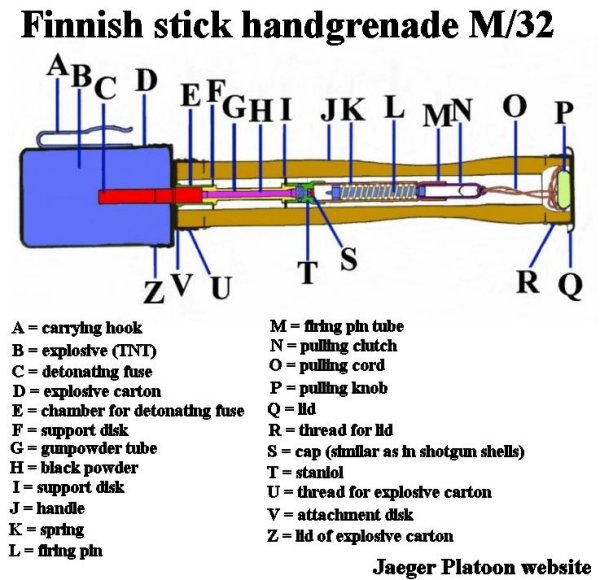
PICTURE: Structural drawing of Finnish stick hand grenade
M/32. While Finnish stick hand grenade resembles the German stick hand grenades it was smaller and has the belt
hook, which the Germans left out from their stick hand grenade designs after World War 1. As visible the fuse is
impact-type with delay offered by the blackpowder burning in the gunpowder tube. CLICK THUMBNAIL TO SEE LARGER PIC
(28 B).
The main explosive charge in factory-produced Finnish satchel charge was thin sheet metal box filled with TNT or amatol (mix of TNT and ANFO). Thin sheet metal used around the explosives produced very little effective shrapnel, making the weapon quite ineffective against infantry on the open ground, but that was also relatively safe to its users, who often had little change to get much cover before the explosion. At the same time it suited well against fortifications as sort of extra-powerful concussion hand grenade and when charge was thrown on top of armour plate it also allowed the explosive energy to transfer somewhat effectively to the armour plate underneath. Finnish military preferred to throw their satchel charges on top of the tank engine. The charge could also be thrown under or on top of the track, but this demanded more precise timing and usually did less damage, so it was less popular. The thin sheet-metal box with stick hand grenade handle & detonator version went to mass production during Winter War and remained in large-scale use of Finnish infantry until end of World War 2.
Measurements of Finnish factory-made satchel charges:
- 2 kg satchel charge:
PICTURE: Drawing showing parts of tank, which Finnish soldiers preferred to target with
satchel charges. Back deck on top of the engine was usual main target, but tank could also immobilised by
throwing satchel charge on top or under its track. CLICK THUMBNAIL TO SEE LARGER PIC (28 KB).
During Winter War Finnish military also observed effects of various satchel charges used in battle. As a result Chief of Engineers reported Finnish General HQ following in February of 1940:
During early Winter War Finns also tested satchel charges with sheet metal boxes, which had their long sides coated with special glue. The idea of this was to improve the changes of satchel charges to stay on top of armour plate. The glue-coated parts of these charges were protected with pieces of plywood, which were to be removed just before use. However field testing them soon revealed that this whole idea was far from practical. Removing pieces of plywood took time, in battlefield and varying weather conditions the glue could freeze, no longer stick into annything or even stick into wrong thing (such as soldier's own clothing). Also using these satchel charges without removing the pieces of plywood apparently reduced effect of their explosion on armour. So, ultimately this idea proved so impractical that it was soon buried and never saw large-scale production.

PICTURE: Inert practice version of satchel charge. The "warhead" has been made from wood,
reinforced with metal bands and could be loaded with a banger (small explosive charge designed to only cause loud
bang). This sort of inert versions were standard issue items used for training of antitank-personnel. (Photo taken in
Sotamuseo). CLICK THUMBNAIL TO SEE LARGER PIC (78 KB).
Another more successful improvement adopted during production were small metal hooks in front parts of sheet metal box. There appear to have been two reasons for them to be introduced. When Soviets had started covering their tanks with tree branches and wire mesh the hooks improved changes for the satchel charge to get stuck in them. At the same time the hooks made carrying of satchel charges easier as satchel charges could now been hung to a belt or leather strap.

PICTURE: Four Finnish satchel charges - probably 2 kilogram, 3 kilogram, 4 kilogram and inert
training version. Notice the two in the middle (2 kg and 3 kg versions) having the previously mentioned hooks, while
the 4 kg version in the back lacks them. The green painted training version has its "warhead" made from
wood and has hole where a banger could be inserted for training use. (Photo taken in Jalkaväkimuseo). CLICK
THUMBNAIL TO SEE LARGER PIC (130 KB).
B) "Home-made" satchel charges:
These were satchel charges build by soldiers for their own use or use of their own unit. Especially engineer units distinguished themselves in building these when needed. When compared to factory-made ones these varied more in sizes both directions (Typically homemade satchel charges covered all sizes between 1 - 6 kg). The basic explosive used in home-made satchel charges was TNT (trinitrotoluene), which was the most powerful easy-to-use explosive commonly available in large amounts for Finnish military during World War 2. The detonation mechanisms varied from charge to charge, but as hand grenade handle & detonator was suitable it was often used also in home-made satchel chages. If handle & detonator parts of stick hand grenade were not used, then usually wooden handle was made and attached to the charge to throwing it easier. Early on 1-kg satchel charge was found to be handy weapon for storming trenches and capable of damaging tank track when used skilfully. Large 6-kg satchel charges proved capable against even against the most heavily armoured of Soviet tanks.

PICTURE: Crude Finnish "home-made" satchel charge built by tying 4 large bricks of TNT
around Finnish stick hand grenade M/32. (Photo taken in Panssarimuseo). CLICK THUMBNAIL
TO SEE LARGER PIC (25 KB).

PICTURE: Another slightly more sophisticated sample of Finnish "home-made" satchel charge.
Some TNT bundled together around stick hand grenade and tied as a package with paper and thin metal wire. (Photo taken in
Sotamuseo). CLICK THUMBNAIL TO SEE LARGER PIC (50 KB).
Combat experiences and wartime development:
Development of Soviet tanks effected also to Finnish production of satchel charges. When Soviet tank production focused into manufacturing of medium and heavy tanks 2 kg factory-manufactured satchel charge became outdated as antitank-weapon, but they still remained useful against fortifications and as a basic demolition charge. At the same time 3 kg and 4 kg satchel charges remained useful against tanks. When it comes to largest factory-manufactured satchel charges 5 kg version was apparently popular against bunkers. Even 6 kg satchel charge must have been somewhat clumsy, it still remained in production until end of the war - being likely useful at least as a demolition charge.
Armed Forces wide gathered inventory list from 1st of April 1940 provides a glimse into the numerous versions of satchel charges and anti-tank hand grenades, which had been used in Winter War:
As noted 2 kg satchel charge was noted as being less than effective against new Soviet tanks and this effected to percentages of satchel charge types that were produced during Continuation War. March of 1944 Ordnance Deparment of Finnish Armed Forces GHQ made following order of satchel charges:
The last version of Finnish industrially manufactured satchel charge was a completely design planned with intent of replacing various versions of satchel charge with one satchel charge design on which the size of explosive charge was adjustable. This new satchel charge design was did not appear until late 1944. Handle section of stick hand grenade was still used in the design and explosives were packed into containers made from sheet metal. But now its warhead contained series of metal containers each had screw section in middle of them. In addition each warhead section had its own separate detonator (containing tetryl and compressed TNT) that the stick hand grenade handle section would detonate. Each section of warhead contained 1.5 kilograms of TNT. The design would have allowed frontline soldiers to easily assemble a satchel charge of specific required size from these components by attaching stick hand grenade handle section to suitable number of warhead sections. The resulting practically possible options were 1.5-kg, 3-kg, 4.5-kg and 6-kg satchel charges. Documents suggest that this design was introduced so late that it never entered mass production, with probably only 50 prototypes ever being manufactured.

PICTURE: Finnish soldiers with unusual antitank hand grenades / satchel charges, which have
cylindrical warheads for explosives. Other parts seem to be from Finnish stick hand grenades. It is possible that
these satchel charges had been built in similar manner as some Winter War era antitank hand grenades - place head
of stick hand grenade to cylindical metal tin of suitable size and fill the empty space by pouring in liquid TNT.
The Winter War era version had about 1.5 kg of TNT in it. All three soldiers wear snow camo suits, have
Suomi M/31 submachine guns, while leader in the middle has also pistol
holster for Parabellum pistol and stick
hand grenade m/32. Photographed by Military official V. Hollming in February of 1942. (SA-kuva.fi photo archive,
photograph number 74462). CLICK THUMBNAIL TO SEE LARGER PIC (89 KB).
Even if the satchel charges were industrially manufactured Finnish troops were also still building improvising "home-made" versions when needed. One sample of this were 2.4-kg, 3.2-kg and 4.8-kg satchel charges built by troops of Armour Division (Panssaridivisioona) from captured 400-gram Soviet TNT bricks in year 1944. In this case the explosives were packaged with plywood, iron clamps and tar paper.
When Finnish Army was issued with Panzerfaust and Panzerschreck starting June - July 1944, they reduced role of satchel charge as antitank-weapon for Finnish infantry for rest of World War 2. After the war the main purpose for them was seen as weapon, which infantry could use against field fortifications, but they seem to have also the status of secondary antitank-weapons at least until 1950's.
SOURCES:
Erkki Käkelä: Marskin Panssarintuhoojat.
Talvisodan historia books series.
Eero-Eetu Saarinen: Pioneerijoukkojen historia 1918 - 1968.
Military manual: Käsikranaatit ja kiväärikranaatit. Printed in 1926.
Military manual: P. Huhtala: Jalkaväen ryhmänjohtaja, Opas nuorelle upseerille. Printed in 1932.
Military manual: Upseerien ja aliupseerien kertaus- ja jatko-opiskelukirja. Printed in 1942.
Military manual: Jalkaväen Ampumatarvikkeet II by Puolustusvoimien Pääesikunta Taisteluvälineosasto.
Military manual: Käsigranaatit by N. Hernberg (printed in year 1925).
Military manual: Sokaisupullo/44 (Kss. 1041) (printed 1944)
Military manual: Väliaikainen pst.yksiköitten harjoitustekninen koulutusopas. (printed 1940)
Heinz Guderian: Achtung - Panzer!
Anthony Beevor: The Spanish Civil War
Article of Keijo Heinonen: Kuka keksi "Molotovin cocktailin?" (Who invented the Molotov Cocktail?) in Asehistoriallinen aikakauskirja 24 (Journal of Military History 24).
Article: Molotovin Cocktail eli polttopullo by Esko O. Toivanen in Ase-lehti magazine vol 4/96.
Article: Köyhän miehen pst-ase, Molotovin cocktail by Robert Brandtberg in Ase-lehti magazine 2/2010.
Article: Sokaisupullo m/44, jatkosodan sotalasia by Esko O. Toivanen in Ase-lehti magazine vol 3/98.
Article: Panssarintorjunta-aseet by Lauri Harvila in Kansa Taisteli magazine vol 10/1976.
Finnish National Archives folder T-17674/19: Ammunition Office for Ministry of Defence. Reports about acquisitions of weapons and ammunition in 1939 – 1945.
Finnish National Archives (Sörnäinen), archive folder T19052.
Finnish National Archives (Sörnäinen), archive folder T23392.
Special thanks to Panssarimuseo (Finnish Armour Museum), Parola.
Special thanks to Sotamuseo (Finnish Military Museum), Helsinki.
Special thanks to Jalkaväkimuseo (Finnish Infantry Museum), Mikkeli.