


MACHINEPISTOLS, PART 1:
Bergmann and Suomi
7,65 mm Bergmann M/20:

PICTURE: 7,65 mm Bergmann M/20 submachine gun and its 50-round box magazine. (Photo taken in
Sotamuseo). CLICK THUMBNAIL TO SEE LARGER PIC (66 KB).
|
Calibre: |
7,65 mm x 21 Parabellum (.30 Luger) |
||
|
Length: |
815 mm |
||
|
Barrel length: |
200 mm |
||
|
Weight: |
4,2 kg |
||
|
Fire-rate: |
600/minute |
||
|
Magazine: |
box: 50 |
||
|
Magazine weight: |
0,30 kg |
||
|
Official abbreviations: |
"7,65 kp/Bergmann" |
||
|
Country of origin: |
Switzerland |
||
|
Prototype: |
1916 (first version) |
||
|
Production: |
In Switzerland 1920 - 1927 (made in several countries). |
Finnish use: Suojeluskunta (Finnish Civil Guard) acquired these submachine guns and used them in between 1922 - 1939. For Winter War (1939 - 1940) the great majority of Suojeluskunta weaponry was transferred to Finnish Army, among them these submachine guns were issued to Finnish Army front-line troops during Winter War (1939 - 1940). During Continuation War (1941 - 1944) they were first issued to Coastal Defence (coastal infantry units) and later transferred to Home Front Troops.
During World War 1 Hugo Schmeisser developed submachine gun MP/18-I, which German weapons factory of Theodor Bergmann started manufacturing in year 1918. The German Army soon accepted the gun and Bergmann factory manufactured some 35,000 (or 25,000 depending source) by the end of World War 1. This gun was the first practical machinepistol / submachine gun. Even if German Army managed to issue less than 10,000 before end of World War 1 the gun gained such a reputation that Versailles peace treaty ending the war specifically listed submachine guns among guns banned from German Armed Forces. The original MP/18-I submachine gun had a weak point in form of its magazine, which was far from ideal: It used so-called snail-drum magazines, which Tatarek and Von Benkö had originally developed for artillery (lange pistole) version of Parabellum pistol).
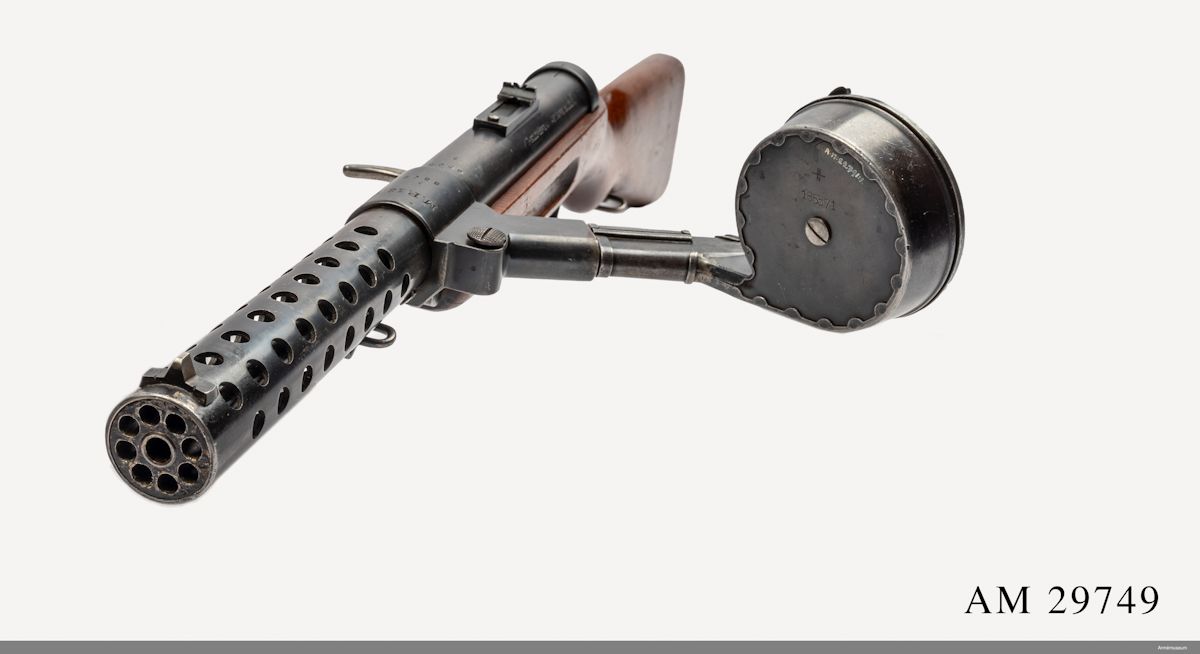
PICTURE: German MP/18-I submachine gun with its snail-drum magazine.This was the world's first mass-produced
submachine gun. Bergmann submachine gun manufactured by S.I.G. in Switzerland was directly based on it, but was equipped with
far better box magazine design. Unlike later Bergmann, original MP/18-I did not see any Finnish use. Photo source
Digitaltmuseum.se - original photo by Armémuseum (Sweden). Used with
CC BY 4.0 Creative Commons license. CLICK THUMBNAIL
TO SEE LARGER PIC (65 KB).
Soon after World War 1 Schmeisser developed improved submachinegun design directly based to MP/18-I for Bergmann factory. The main improvement of this new gun was that it used normal box magazines instead of snail drum magazines used with MP/18-I. Year 1920 Bergmann sold manufacturing license of this improved MP/18-I now known as Bergmann submachine gun to Swiss weapons factory S.I.G. (Schweitzerische Industrie-Gesellschaft). After making the deal S.I.G. started manufacturing Bergmann submachine guns in several calibers. Bergmann submachine gun manufactured by S.I.G. was exported to several countries including Japan, China and Finland between 1920 - 1927. The Japanese and Chinese Bergmann submachine guns were made in 7,63 x 25 Mauser. Also Estonian Tallinn model 1923 submachine gun manufactured in only small numbers was directly based to MP/18-I and therefore close relative of Bergmann submachine gun. Production of Bergmann submachine guns in S.I.G. factory ended year 1927. S.I.G. factory introduced improved version of the gun in year 1930, but with very little commercial success. With Bergmann submachinegun no longer finding customers, S.I.G. moved its interest to MKMO submachine gun, which was later developed to MKMS submachine gun). As a paraller development in Germany the development of improved MP/18-I led to introduction of MP/28-II submachine gun manufactured by Haenel.

PICTURE: Top view to Bergmann and MP/28-II submachine guns. The
two guns look almost totally alike, hence separating them from one another is often not easy. In this photo the gun on
the top is Bergmann, while MP/28-II is below it. In this photo the magazines are accidentally next to the gun that they not
used with - the longer 50 round magazine being correct for Bergmann. Photographed by Nousiainen in Weapons Depot 1.
(SA-kuva.fi photo archive, photograph number 113064). CLICK THUMBNAIL TO SEE LARGER PIC (65 KB).

PICTURE: Bergmann submachine gun with its equipment and some parts - possibly spare parts issued with
the gun? On top of the gun from left to right loading tool, cleaning rod, (probably) extractor and gun barrel. Below the gun
is magazine bag with four magazines. Photographed by Viljo Pietinen. Photo source Finnish
Heritage Agency (Museovirasto) and acquired via Finna.fi.
CC BY 4.0 Creative Commons license. CLICK THUMBNAIL TO SEE
LARGER PIC (119 KB).
Finnish Army was not interested about submachine guns in early 1920's, like most Armies of that time it doubted if this type of gun would be useful to military . However, Suojeluskunta (Finnish Civil Guard) was more open minded when it came to acquring new gun types and it bought first 1,000 Bergmann submachine gun already year 1922. Admitted in 1920's Civil Guard had also internal security role, due to which some of its duties were partly not that far distanced from that of a police force. By July of 1932 Suojeluskunta had acquired total 1,415 submachine guns, from which 1,410 were were in 7.65 mm x 21 and five guns in 9 mm x 19. Around that point Suomi M/31 replaced Bergmann in acquisitions of submachine guns. Once Finnish Army finally had become convinced about the excellent qualities of Suomi M/31 also Finnish Civil Guard (Suojeluskunta) decided to follow its example and from that on acquire Suomi M/31 submachine guns instead of Bergmanns, but apparently did not succeed to acquire Suomi m/31 in any real numbers before Winter War. 30th of September 1939, only two month before Winter War, Civil Guard small arms inventory contained 25 Suomi M/26 and only 20 Suomi M/31, but 1,415 Bergmann submachine guns. It is noteworthy that particularly in 1920's Civil Guards were frequently loaning their Bergmann submachine guns to Frontier Guard, which had practically no automatic weapons of its own at that point.

PICTURE: Photograph showing Corporal of Finnish Civil Guard with Bergmann submachine gun. Photographed
by Bernhard Åström. (Acquired Finna.fi - original photograph owned by
Svenska litteratursällskapet i Finland). CC BY 4.0
Creative Commons license. CLICK THUMBNAIL TO SEE LARGER PIC (214 KB).

PICTURE: Finnish ski patrol photographed in Märkäkäjärvi in February of 1940 during
Winter War. The point man of patrol has Bergmann submachine gun hanging on his chest. (SA-kuva.fi photo archive, photograph
number fu_2653). CLICK THUMBNAIL TO SEE LARGER PIC (114 KB).
During Continuation War (1941 - 1944) Finnish military first issued Bergmann submachine to Coastal Defence and saw use with Coastal infantry early on that war. But captured Soviet submachine guns soon replaced Bergmann in that use, so they were transferred to Home Front Troops. In this way they in a manner returned home as basically Home Front Troops were in large extent created around those guardsmen of Civil Guard (Suojeluskunta, who were either too old, too young or otherwise not fit for frontline duty and during the war General Headquarters of Civil Guard served as Headquarters for Home Front Troops. While Bergmann submachine guns officially remained to be property of Civil Guard, this would be as close it came for Suojeluskunta to ever get them back. One of the Soviet demands in Finnish - Soviet Armistice Treaty of year 1944 was disbanding of Suojeluskunta, which was disbanded in November of 1944. Once this happened the remaining Bergmann submachine guns became property of Finnish Army. After World War 2 Finnish military scrapped quite a lot of small arms that were in poor shape, but apparently Bergmann submachine guns, which had not seen much combat use since Winter War, were still in relatively good condition, since year 1951 inventory of Finnish Armed Forces still contained 1,307 of these guns. Finnish Defence Forces kept Bergmann M/20 mothballed for possible further use until they were sold to Interarmco in year 1960 and exported. Considering how common they used to be in use of Civil Guard, it is unfortunte that apparently only very small number was retained for Finnish collections.

PICTURE: Finnish coastal infantry packed in boats on its way to inspect island that was in Soviet
controlled area. Soldier has rested down his Bergmann submachine gun on bow of the boat. Photographed by 2nd
Lieutenant Pentti Nikulainen in October of 1941 in area around Hanko / Hango / Gangut Peninsula. (SA-kuva.fi photo archive,
photograph number 63734). CLICK THUMBNAIL TO SEE LARGER PIC (107 KB).
Lindelöf submachine gun, Finnish copy of Bergmann:
Finnish Leonard Lindelöf's machine factory got itself license for production of Bergmann submachine gun in 1922. As the name suggests Leonard Lindelöf owned the factory. submachine guns that this factory was to manufacture under license were exact copies of Swiss Bergmann M/20. Lindelöf had grand plans of large-scale mass-production of submachine guns and invested accordingly. Early on the prospects for this factory looked positive as the first order arrived swiftly - Suojeluskunta (Finnish Civil Guard) ordered 200 submachine guns identical to 7.65-mm Bergmann M/20 in December of 1922. But then Lindelöf's factory run into problems - it had promised delivery of these 200 guns in just 8 months and this proved much too little. Production-wise Bergmann-submachine gun was typical 1st generation submachine gun - complicated to produce gun with its parts machined from steel. So manufacturing them was slow and demanded large number of tools and machinery. Time needed setting up production had been seriously underestimated and even suspicion of sabotage surfaced. These delivery delays were breach of contract and because of them Suojeluskunta cancelled its order. Heavy hit came when Swiss played Lindelöf out from competition by offering Bergmann submachine guns with bargain prices to Suojeluskunta in year 1923, these bargain priced Bergmann submachine guns filled the needs of Suojeluskunta and lead into situation in which Suojeluskunta no longer had any need to buy more submachine guns for quite some time. Because of this Lindelöf's lost his most important customer and when first submachine guns made by his factory finally were finished in year 1925, the factory had sell them in small quantities to any authorities willing to buy (local level Suojeluskunta organisations, Police, Customs, Coastal Guard, Estonian Police etc...). The factory had about 160 mostly unfinished submachine guns in its storage, but no clients for them.
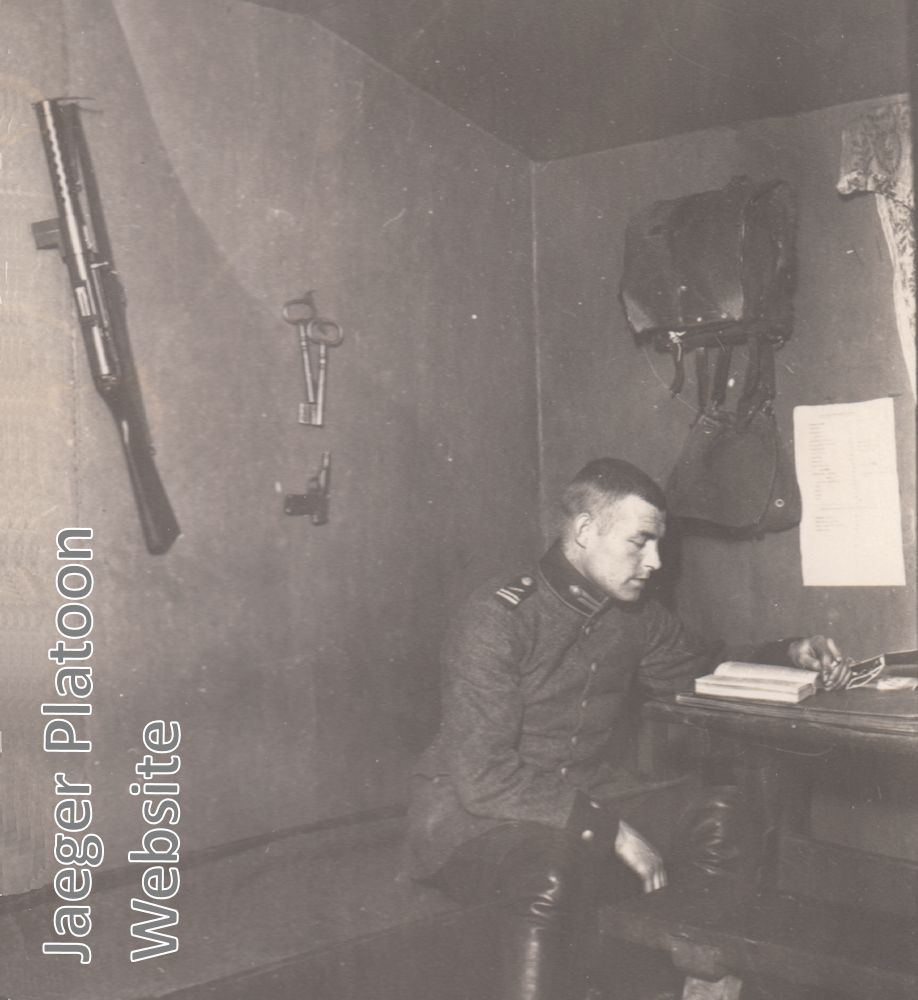
PICTURE: Photograph taken in quarters of Finnish Border Guard in Savukoski sometime in 1920's or
early 1930's. Seen hanging on the wall are either Bergmann or Lindelöf submachine gun, pistol of unknown model,
tornister-type backpack and bread bag.
Corporal of Border Guards seen the photo is wearing uniform m/22. Savukoski was/is a Finnish
municipality in northern Finland next to Soviet /Russian border. Photo crop. Photographer unknown. (Original
photograph part of Jaeger Platoon Website photo collection. Unlicensed use of photograph prohibited.) CLICK THUMBNAIL
TO SEE LARGER PIC (104 KB).
Year 1930 Lindelöf contacted Civil Guard again, trying to sell the remaining submachine guns. However Civil Guard was loosing interest as the new Suomi submachine guns were making Bergmann submachine gun look outdated. Soon after this Lindelöf's factory faced financial difficulties. Year 1932 he once again contacted Civil Guard, which decided to help the factory by ordering ten submachine guns, which the factory was to manufacture from its inventory of unfinished parts. The factory gave Suojeluskunta dozen already finished submachine guns as a pledge. But once again making good on the contract proved impossible for the factory - as earlier the delivery was delayed again and again. Finally Civil Guard had no other option than cancelling the contract and taking possession of the 12 submachine guns earlier provided as a pledge. The final nail to coffin for Lindelöf's plans was when Civil Guard that same year made decision from that on to buy only Suomi M/31 submachine guns instead of Bergmann. Lindelöf had acquired the tools and machinery made for production of Bergmann submachine guns, but now had to sell the unfinished parts and tools as junk. Lindelöf version of Bergmann submachine gun when compared to the Swiss one was not such a high quality and its magazines were not interchangeable between individual guns, but otherwise the guns were identical. The small total number of Lindelöf-produced copies of Bergmann submachine guns was used the same way as the original Swiss-made guns and experienced exactly the same fate in Finland during World War 2 and after it. The estimated total production of Lindelöf submachine guns was only about 60 or 70 guns. While Lindelöf's factory never again manufactured complete firearms, it manufactured parts for some small arms still during World War 2.
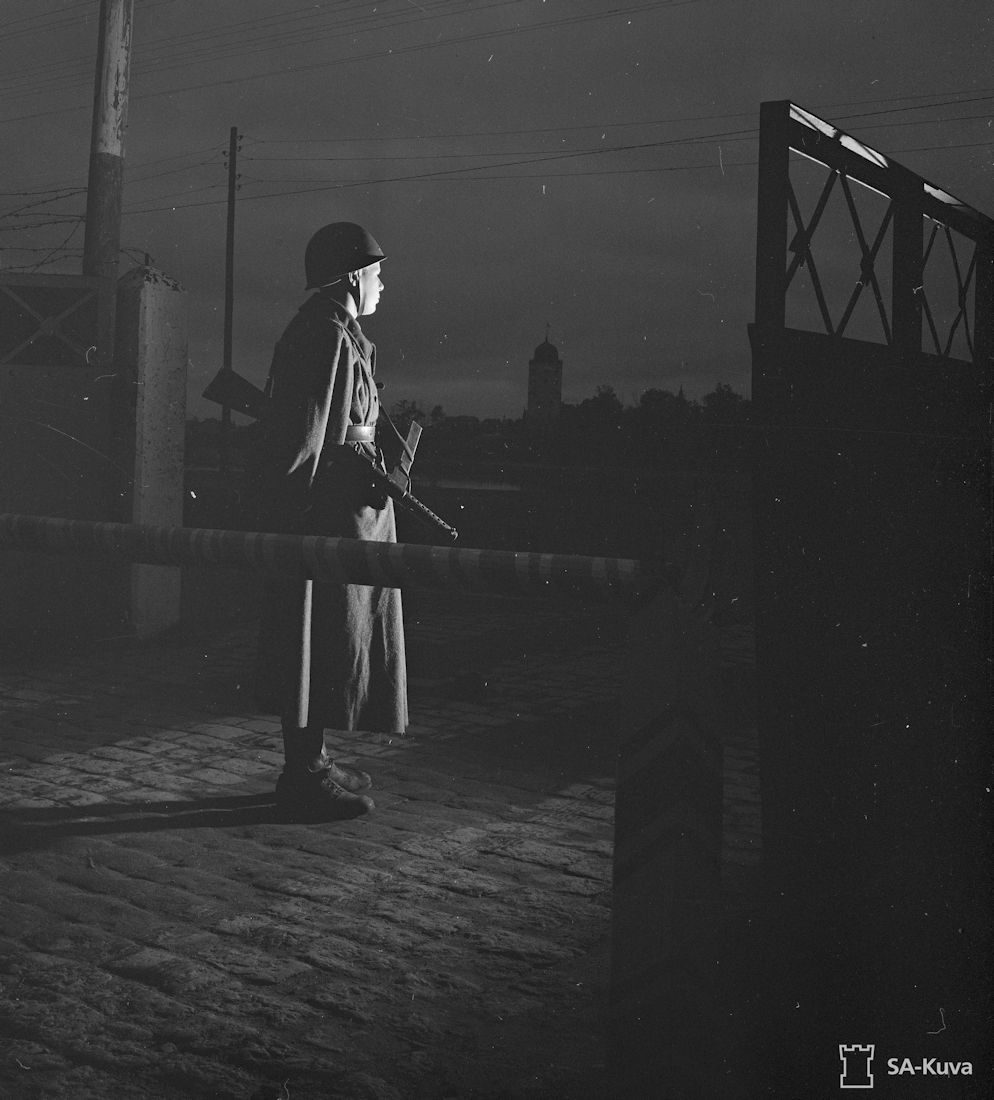
PICTURE: Atmospheric photograph showing guard with Bergmann or Lindelöf submachine gun in gate
of Prisoner of War Camp 6 in city of Viipuri. Photographed by Osvald Hedenström in September of 1942. At the time
prisoner of war camps were run by Home Front Troops. Notice silhuette of main tower of Viipuri castle in the background.
(SA-kuva.fi photo archive, photograph number 109943). CLICK THUMBNAIL TO SEE LARGER PIC (122 KB).
Suomi submachine gun:
Prototypes:
According Aimo Lahti himself interest for designing submachine gun of his own born because Bergmann submachine gun was so expensive and not very good. Lahti started thinking that he would be able to make a better submachine gun - and he proved to be right. 1st of June 1921 Aimo Lahti was hired as gun-master to Keski-Suomi Regiment and started developing his idea of submachine gun soon afterwards. First prototype he ordered was a miniature of sort in 7.65mm x 17 (Browning aka .32 ACP) calibre, only about 30 cm long and made by blacksmith in Viiala for him. The first prototype was no work of art but it proved that the basic construction that Lahti had designed was a working one.
Year 1922 he ordered the first real sized prototype (M/22), which was build by Machine workshop Leskinen & Kari in Tampere. It was in 7.65mm x 21 (Parabellum) calibre and had the same rate of fire as in later M/26. Lahti got support from commanders of Keski-Suomi Regiment Colonel-Lieutenants W. Hägglund and E. Heinricks, but they did not manage to get any state financing for this development work. Spring of 1923 the prototype was sent to Defence Ministry, but it failed to raise interest. M/22 was not exactly well made or ready for production, but it had plenty of hidden potential.
October of 1923 Aimo Lahti and Lieutenant Yrjö Koskinen, an officer serving in Keski-Suomi (Infantry) Regiment acquired patent for Suomi submachinegun. June of 1924 the established Konepistooliosakeyhtiö (= Submachine Gun Ltd) with two more officers serving in the same regiment. The other shareholders of this new business enterprise were Captain V. Korpela and Lieutenant L. Boyer-Spoof (who later changed his surname to Poijärvi). The number of shares in the company was 150 total. From those shares Lahti got 45, Korpela 45, Koskinen 30 and Boyer-Spoof 30 shares. This new company had a lot of inspiration, but very little finances. In fact some of its owners proved to be even too inspired - Lieutenant Korpela had to leave the company after trying to sell the submachine gun abroad without permission of other shareholders. Since value per share was 500 Finnish marks, at least on paper the total capital of the company was 75,000 Finnish marks. Year 1930 the company sold its patent of Suomi submachine gun to Tikkakosken Rauta ja Puuteollisuusyhtiö (= Tikkakoski Iron and Wood Industry Ltd) for 65,000 Finnish marks and 5% royalty from all Suomi submachineguns that Tikkakoski manufactured.

PICTURE: Suomi M/26 submachine gun with its rather eccentric looking 36-round magazine. Notice the fire selector switch on side of the gun and barrel jacket quick release latch on top of the magazine. (Photo taken in Suomen Metsästysmuseo - The Hunting Museum of Finland). CLICK THUMBNAIL TO SEE LARGER PIC (66 KB).
7,65 mm Suomi M/26:
Suomi M/26:
|
Calibre: |
7,65 mm x 21 Parabellum (.30 Luger) |
||
|
Length: |
930 mm |
||
|
Barrel length: |
350 mm |
||
|
Weight: |
4,18 kg |
||
|
Fire-rate: |
600/minute or 750/minute depending sources |
||
|
Magazine: |
arch: 36 |
||
|
Abbreviations: |
"7,65 kp/26" |
||
|
Country of origin: |
Finland |
||
|
Prototype: |
1924 |
||
|
Production: |
About 100 made between 1925 - 1926. |
Aimo Lahti was improving his submachine gun-design all the time making several improvements, which were all patented in Finland as soon as they had been invented and development was starting to look ready for mass-production. Konepistooliosakeyhtiö ordered one hundred submachine guns from Ab Tool Oy and at August of 1924 also Finnish Defence Ministry finally got interested. February of 1925 first batch of 13 submachine guns were inspected by Ordnance Department of Finnish Armed Forces. The guns worked reliably, but their magazines only worked with individual gun to which they had been intended, hence not being interchangeable and bores gun barrels were already slightly corroded when delivered. However, they passed the inspection regardless these minor issues. Army ordered additional ten submachine guns in October of 1925 and another 39 in March of 1926 and even bought earlier made prototypes. This proved highly useful since at that time Konepistooliosakeyhtiö and its shareholders were just about broke, so they needed every possible bit of money that they could get. From this production series of about 100 guns total most (over 60) ended up to Finnish Army, but also Suojeluskunta (Finnish Civil Guard) and Frontier Guard bought them in small numbers. In addition few guns of this series were delivered abroad as samples (among them five guns to Estonia). Later submachine guns of this production series were named as M/26 to separate them from M/31 Suomi. Suomi M/26 ended up with cost of only about 2,200 Finnish marks / submachine gun while Bergmann at that time cost usually more than double (4,500 Finnish marks).
As to be expected Suomi M/26 is select-fire submachine gun, which fires from open bolt. It is chambered to 7.65mm x 21 Parabellum (.30 Luger) cartridge, which at the time was also used in latest service pistol of Finnish military - 7.65mm pistol M/23 and used 36-round removable magazines. Arch-shaped 36-round box magazine used with Suomi M/26 was unique in that sense, that it was not used in any other gun. Weight of full magazine is about 800 grams. As to be expected M/26 is select-fire submachine gun, which fires from open bolt. The gun's bolt design is somewhat unusual with separate weight inside back of the bolt, floating firing pin and out-of-battery safety. Selector switch with three settings is on right side of receiver with three settings from back to front - safe, semi-auto and full-auto. Like later M/31 also M/26 had quick release system, which allowed changing its barrel in matter of seconds, but the design is bit different. The barrel has interrupted thread and is locked in place with barrel jacket and lever with tension screw. The gun's bolt has a separate weight inside back section of the bolt and floating firing pin with out of battery safety built into bolt design - while later Suomi M/31 has much more simple bolt design with fixed firing pin. Normally these guns were issued with spare barrel and tool pouch.

PICTURE: Sentry of Supply Training Center in Mänttä with his Suomi M/26 submachine gun. The ETP roadsign nex to him is for food items supply point. Photographed by Vuorela in January of 1942. (SA-kuva.fi photo archive, photo number 69008). CLICK THUMBNAIL TO SEE LARGER PIC (167 KB).
Suomi M/26 never saw real combat use, during World War 2 they were issued troops doing guard duty in home front. During the war they were apparently issued with only two two magazines per gun - quite likely due to limited number of magazines originally manufactured for these submachine guns. Year 1959 the remaining 57 Suomi M/26 were sold to Interarmco and shipped abroad in year 1960. This was a one of the darkest moments of Finnish firearms history as along the "ordinary" M/26 also all its one of a kind prototypes were sold without understanding their historical value. Luckily they at least were not scrapped, when they ended up to foreign museums and arms collectors.
9 mm Suomi M/31:

PICTURE: Early version of Suomi M/31 submachine gun with 70-round drum magazine. (Photo taken in Sotamuseo). CLICK THUMBNAIL TO SEE LARGER PIC (76 KB).
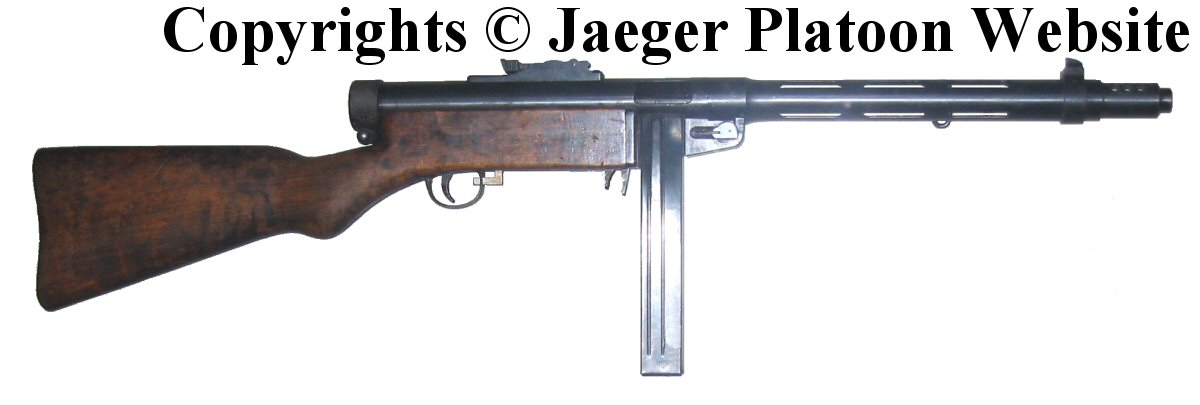
PICTURE: Late version of Suomi M/31 submachine gun aka M/31 SJR with 50-round box magazine. Notice muzzle brake in end of barrel. (Photo taken in Sotamuseo). CLICK THUMBNAIL TO SEE LARGER PIC (76 KB).
Aimo Lahti was not happy with M/26 submachine gun, its feeding process was not as reliable as it should have been and the stock was not robust enough for first grade military weapon. Submachine gun M/26 also shared several design weaknesses of foreign submachine guns like MP-18/I and MP-28/II, which Lahti succeeded fixing while developing submachine gun M/31. He eliminated the excessive room in front of bolt (which had allowed cartridge every now and then to turn sideways, which jammed the gun) and the feeding problems disappeared. The quick-release method used for attaching the barrel and barrel jacket to receiver allowed barrel to be quickly replaced if needed. Barrel of the gun also sported new tilted end, which somewhat decreased tendency of muzzle to climb during shooting. The barrel jacket around the barrel was modified to be structurally more simple and robust. However, the most important change that came with submachine gun M/31 was changing of calibre to 9 mm x 19 (Parabellum), as this new ammunition allowed development of new magazines, which would not have worked as well with bottle-necked 7.65 x 21 (Parabellum) cartridge. Lahti designed all these improvements plus new 20 round box magazine and 40 round drum magazine around 1930 - 1931. This finally spared interest of Finnish Ministry of Defence, but there was no yet factory for manufacturing this new submachine gun.

PICTURE: Empty 40-round drum magazine opened. This magazine was designed by Aimo Lahti in year 1932. Fully loaded it weights exactly the same as 70-round drum, but was also much more difficult to load, as bullets had to be placed on their tips when loaded to magazine. When this magazine design proved also somewhat unreliable, it is not surprising that its production ended already in year 1939. Nowadays 40-round drums for Suomi submachine gun are very rare and valuable. CLICK THUMBNAIL TO SEE LARGER PIC (129 KB).
Engineer Oscar Östman, who was leading Tikkakoski Rauta ja Puuteollisuusyhtiö (= Tikkakoski Iron and Wood Industry Company Ltd) at that time knew Lahti personally and was also very interested about the new submachine gun M/31. Tikkakoski was already manufacturing parts for guns such as rifle and machinegun barrels for Finnish military, so it had also some experience of firearms manufacturing and selling products to Finnish military. Shareholders of Konepistooliosakeyhtiö finally earned from their work when Tikkakoski bought the mass production rights of submachine gun M/31 as its sole manufacturer. This ended the story of Konepistooliosakeyhtiö, which now had served its purpose.

PICTURE: Fully loaded 70-round drum magazine opened. Lid of the magazine in left side of the photo. The actual maximum capacity of this magazine type is 72 rounds, even if Finnish military prefers to call it 70-round magazine. Experiences suggest that there was a reason for this - loading only 70 rounds instead of 72 seems to increase reliability of this magazine model. CLICK THUMBNAIL TO SEE LARGER PIC (158 KB).
While Suomi submachine gun was finally getting recognition it earned, the early magazines (20-round box and 40-round drum), which Lahti had developed in early 1930's proved less than ideal. 20-round box magazines existed in two versions, which actually had maximum capacity of 25 rounds, but if filled to full capacity they had reliability issues, while when loaded only with 20 rounds they worked rather well. The 20 round magazines were quite small and handy (they weight only some 0,2-kg empty and 0,44-kg when loaded with 20 rounds), but also had too small ammunition capacity and proved too difficult to fill fast, so their production was ended already before year 1939. Production of 20-round magazines was restarted during Winter War, but once Winter War ended the production was stopped again - this time definitely. 40-round drum magazine proved unreliable, but even more difficult problem was with filling it - cartridges had to be inserted in such manner that they stood on tips of the bullets. Smallest mistake would cause the cartridges felling in their side inside the 40-round drum magazine, creating mixed pile with only one solution - drop all cartridges off the magazine and start the whole process of inserting cartridges from the start. In addition 40-round drum was not terribly effective for its size and weight - it weight 1,0-kg empty and 1,48 kg full while 70-round drum weight 0,87-kg empty and 1,48-kg when fully loaded, plus the two magazines are about the same size. The magazines typically used with Suomi M/31 during World War 2 were 70-round drum and 50-round box. From these two, the 70-round drum magazine became the best known magazine for Suomi submachine gun, but not necessary the most commonly used. Yrjö Koskinen (one of shareholders in Konepistooliosakeyhtiö) designed the 70-round drum without Lahti even knowing about this new magazine type before it was finished. Koskinen's drum magazine proved to be the best magazine available for Suomi M/31 during World War 2 - it was reliable, handy (even if somewhat heavy) and offered excellent firepower. In addition unlike many other drum magazine designs this magazine did not allow cartridges loaded inside it to rattle. Downside was that much like Suomi M/31 itself, the magazine type required high quality materials and was both slow and expensive to manufacture. Koskinen's 70-round drum magazine entered production in year 1936 and remained in production until late 1944. The 50-round box magazine was Swedish design, which Tikkakoski started manufacturing under license in year 1941. Before starting of production 50-round box magazines were field-tested in late 1940 with II, IV and V Army Corps of Finnish Army each receiving 16 magazines and 8,000 rounds for testing purposes.50-round box magazine was not as good as 70-round drum magazine, but it was easier and cheaper to produce. However, the wartime use proved this box magazine to be structurally too delicate (smallest dent in the wrong place could jam it), impossible to reload anywhere near full capacity without separate loading tool and in general less reliable than 70-round drum magazines. Because of these reasons production of the 50-round box magazine was stopped in autumn of 1943, but before that happened total of 145,850 had been produced. Rest of the war only 70-round drum magazines remained in production and became the most common magazine used with Suomi M/31 submachine guns during World War 2. Some 149,900 70-round drums were manufactured for Finnish military in 1941 - 1945, but 81,000 of those were not delivered until 1944 - 1945. Before and during World War 2 Tikkakoski, who was sole manufacturer of Suomi M/31 in Finland, was also the only manufacturer for its magazines.

PICTURE: Sergeant of Finnish Army with Suomi M/31. The 70-round drum seen in this became the de facto standard magazine type for Suomi M/31 submachine gun during World War 2. The helmet is Swedish steel helmet m/37. Photographed by K. Kivi in July of 1941 in Häsälä. (SA-kuva.fi archive, photo number 27883). CLICK THUMBNAIL TO SEE LARGER PIC (129 KB).
The number of magazines that Finnish military issued with Suomi M/31 during World War 2 varied over time and actually had to be reduced towards end of Continuation War because magazine production was having problems to keep up with expanding production of the submachine gun. Still early 1943 each Suomi M/31 was to be issued with either five 70-round drum magazines or seven 50-round box magazines, but late 1943 - early 1944 the number of issued magazines had to be reduced and military units divided into different categories concerning how many magazines they were to have for their Suomi M/31 submachine guns for the purpose of transferring existing magazines to frontline infantry from those military units that were less likely to see combat. The number of magazines issued to frontline combat units dropped to four 70-round drum magazines or five 50-round box magazines. As noted from that on non-combat units needed to do with smaller number of mags - for example training centres in home front were typically left with only one drum magazine and three stick magazines per gun, while supply units were issued only two or three box magazines per gun. Even this proved inadequate to fix the supply problem, hence by September of 1944 the number of issued magazines in frontline infantry units was reduced to either three 70-round drum magazines or four 50-round box magazines. The equipment used that Finnish soldiers often used to carry drum magazines of Suomi M/31 during World War 2 was somewhat improvised combination of hooks, straps and/or rope that allowed hanging drum mags to their service belt. There were no purpose-built magazine pouches in Finnish use, so soldiers also used variety of suitable bags for this purpose. These included bread bags, gas mask bags and magazine bags originally made for carrying of ten Lahti-Saloranta light machinegun magazines. Carrying box made from plywood was developed for 50-round box magazines and manufactured for home front troops (Civil Guard) during Continuation War. Typically only home front troops used these magazine boxes since they would have suited poorly for frontline use, as they were clumsy and made noise (magazines rattled inside them) during movement. Some sources claim that drum-magazines used in Suomi M/31 would be related to ones used in Thompson submachine gun, but this is false information. The only connection was in conceptional level - both Lahti and Koskinen may were likely aware about drum magazine(s) used in Thompson, but it is unclear if this even effected to their decision of developing drum-magazines for Suomi M/31 in any way. From technical point of view both L- and C-drums used in Thompson are structurally and mechanics-wise totally different from 40- and 70-round drum magazines used with Suomi M/31.

PICTURE: 50 round box magazine for Suomi M/31 submachine gun. This magazine model was/is generally known as "coffin-magazine" because of its shape. Filling more than 50 rounds to this was magazine was strictly forbidden because that usually results magazine getting jammed. CLICK THUMBNAIL TO SEE LARGER PIC (121 KB).
Magazines Finnish military used with Suomi m/31 submachine guns:
|
Magazine: |
Capacity: |
Weight Empty / Full |
Manufactured: |
Details: |
|
20-round box |
25 |
0.20 kg / 0.44 kg |
1931 - 1940 |
Since 1941 in secondary use |
|
36-round box |
36 |
0.40 kg / 0.85 kg |
1954 - 1958 |
Swedish m/54, Finnish m/55 |
|
40-round drum |
40 |
1.00 kg / 1.48 kg |
1931 - 1936 |
Mostly in secondary use |
|
50-round box |
50 |
0.39 kg / 1.02 kg |
1940 - 1943 |
|
|
70-round drum |
72 |
0.87 kg / 1.48 kg |
1936 - 1944 |
Most common during WW2 |

PICTURE: Oops... Even if loading of 70-round drum magazine was much easier than the 40-round drum magazine, it still took only one clumsy move to make already inserted cartridges to overturn. Fixing a pile-up like this is not something that one would like to do in freezing weather or in middle of firefight. CLICK THUMBNAIL TO SEE LARGER PIC (123 KB).
It is not exactly common for small arms to be named after the country in which they are being manufactured, so in that sense this submachine gun getting named Suomi (Finland) was rather exceptional. It seems to be somewhat unclear who came up with the name first, but calling Lahti's submachine gun as Suomi submachine gun (Suomi konepistooli) had spread to Finnish military documents already in year 1925. The first public display of new 9 mm Suomi submachine gun and publicity given by Hakkapeliitta Magazine (magazine of Suojeluskunta aka Finnish Civil Guard) in September of year 1930 made Suomi submachine gun practically a household name both among Finnish military and Suojeluskunta organisation. October of 1931 Finnish Army decided to place its first order of 100 new Suomi submachine guns in 9-mm calibre - this resulted the gun getting officially named 9 mm submachine gun M/31. Tikkakoski made Suomi submachine gun M/31 available with several options that included front handle, bipod and two alternative designs for selector switch. From these options Finnish Armed Forces ordered the most simple variation and stick with it. Also Finnish Civil Guard (Suojeluskunta) followed suit and decided to acquire the same version of Suomi M/31 that armed forces had already chosen from that on. Other available options of this gun manufactured by Tikkakoski were sold only with export deals, which were far and few before World War 2, making them very rare.

PICTURE: Cut open Suomi M/31 submachine gun showing structure of the gun. (Photo taken in Sotamuseo). CLICK THUMBNAIL TO SEE LARGER PIC (57 KB).
Before World War 2 Suomi M/31 submachine gun had little commercial success. The first order made by Finnish military had been made in October of 1931 and contained 100 Suomi M/31 submachine guns, 200 magazines and 100 spare barrels - which were apparently delivered by end of year 1932. By year 1934 the now more shortly named Oy Tikkakoski Ab had delivered only 375 Suomi M/31 submachine guns to Finnish Army. When Winter War started the total number of Suomi M/31 in use of Finnish Armed Forces was not more than about 4,000 total and rapidly increasing production took its time. Only about 730 additional guns were manufactured during Winter War. Production continued and expanded in more rapid pace after Winter War and during Continuation War settled to level of about 1,400 - 1,500 guns per month. This sort of increase of production required considerable acquisitions of machinery and resulted total size personnel of Tikkakoski factory being more than quadrupled from 226 in year 1938 to 963 in year 1943.
It must be noted that equipment delivered with Suomi M/31 were also somewhat exceptional for submachine gun. Most deliveries included spare barrels. The idea was that each of these guns was equipped with two gun barrels (primary and spare), which both had quite similar point of impact. With barrel quick release this allowed changing barrel even in middle of firefight without needing to adjust sights or loosing zero. Replacing barrel of Suomi M/31 is remarkably easy and fast and obviously designed for soldier in the field to do for his gun when necessary - both gun barrel and barrel jacket are locked to gun with one single simple switch. Also disassembling and re-assembling Suomi M/31 is quite easy. In fact the only remotely difficult part of doing this is re-inserting of recoil spring, which demands certain technique to make sure that the spring does not get bent.
Suomi M/31 "standard version":
|
Calibre: |
9 mm x 19 Parabellum/Luger |
||
|
Length: |
870 mm / 925 mm |
||
|
Barrel length: |
314 mm |
||
|
Weight: |
4,72 kg / 4,9 kg |
||
|
Fire-rate: |
900/minute |
||
|
Magazine: |
boxes: 20, 50, drums: 40, 70 (72) |
||
|
Abbreviations: |
"9,00 kp/31" and "900 KP 31" |
||
|
Country of origin: |
Finland |
||
|
Prototype: |
1931 |
||
|
Production: |
Estimated 80,000 manufactured 1931 - 1953. |
During the war Finnish soldiers gave highly positive feedback about the gun, but the feedback also revealed that Suomi submachine gun was not perfect. Tendency for recoil to cause muzzle climb still existed, although it was mild - and was seen as largest remaining problem. When sudden spur of cases showing serious barrel corrosion was noticed during Winter War in January 1940 it was first believed to be result of snow and debris getting inside gun barrel, which caused necessity of finding a solution for this problem. The solution for both of these problems was to add a muzzle brake in the design. Only later on it was proved, that the corrosion had been caused by use of wet ammunition. Both 13th Weapons Repair Company and Ordnance Department of Finnish Army designed muzzle brakes for Suomi M/31. After some testing Ordnance Department selected its own version for production. This new muzzle brake was included into all Suomi submachine guns ordered by Finnish Armed Forces after February of 1943. Suomi M/31 ordered by HQ of Home Front Troops (GHQ of Civil Guard) and those made for export were not equipped with muzzle brakes even after this, they remained to be exactly same as the earlier version of M/31. The muzzle brake was 95-mm long and 28-mm thick, so it added some 55-mm to total length of the gun. Aimo Lahti was not happy about muzzle brake being added to his invention, in fact his opinion was that it only decreased muzzle-velocity and lead to poorer reliability. Letters SJR (from word suujarru = muzzle brake) were soon added to naming of muzzle brake equipped Suomi submachine guns for purposes of spare parts supply. During Continuation War Aimo Lahti designed also cheaper, faster and easier to manufacture version of 9-mm Suomi submachine gun called M/42, but it never got beyond prototype stage.

PICTURE: Suomi M/31 SJR submachine gun. CLICK THUMBNAIL TO SEE LARGER PIC (58 KB).
Bunker version of M/31 Suomi ("Korsu-kp"):

PICTURE: Bunker-version of Suomi-submachine gun. This particular gun is "mass-produced" version of this gun - one of the about 500 guns ever produced. Notice fixed iron sights in side of the barrel jacket. Photograph copyrights (c) Jaeger Platoon Website. CLICK THUMBNAIL TO SEE LARGER PIC (56 KB).
|
Calibre: |
9 mm x 19 Parabellum/Luger |
||
|
Length: |
740 mm |
||
|
Barrel length: |
314 mm |
||
|
Weight: |
4,35 kg |
||
|
Fire-rate: |
900/minute |
||
|
Magazine: |
boxes: 20, 50, drums: 40, 70 (72) |
||
|
Abbreviations: |
"900 kp/31 korsu" and "900 KORSU KP 31" |
||
|
Country of origin: |
Finland |
||
|
Prototype: |
1939 |
||
|
Production: |
500 manufactured in 1941. |
Summer of 1939 it became clear that Finnish Army needed submachine gun, which could be used shooting from vision slits or steel observation cupolas of bunkers. Ordinary Suomi M/31 submachine gun had barrel jacket, which made shooting the gun from narrow vision slits difficult and also sights and butt structure poorly suited for this use. Ordinary Suomi M/31 submachine gun was also too long to be operated efficiently inside the observation cupolas. So a bunker version with longer and narrower barrel jacket, pistol grip and sights located in left side of the gun was designed very fast. Prototypes were made and tested and the gun received official approval in September of 1939. But then starting of Winter War in November of 1939 ruined production plans, as resources necessary for producing it were needed elsewhere and starting of production got delayed.

PICTURE: Finnish soldier with Suomi M/31 bunker submachine gun and factory-produced satchel charge (probably 2 kg or 3 kg version). Photographed by Military official M. Persson in May of 1942 in somewhere in sector of River Syväri / Svir. (SA-kuva.fi archive, photo number 87500). CLICK THUMBNAIL TO SEE LARGER PIC (148 KB).
So, when Winter War started only few prototypes of this submachine gun version existed. Yet Finnish troops managed to get in their hands some Suomi M/31 bunker-submachine guns of one sort already during Winter War. Some barrel jackets of bunker versions had already been manufactured and during Winter War Finnish troops installing them to their ordinary Suomi M/31 submachine guns. The resulting gun was so long that it could not be really used in observation cupolas of bunkers, but at allowed aimed fire through other narrow vision slits used elsewhere in bunkers. During Continuation War situation of bunker submachine guns improved as in January 1941 as part of order of 9,500 Suomi M/31 submachine guns also 500 bunker-version submachine guns were ordered. The early models of bunker submachine guns made for tests had 385-mm barrel jacket, special frame and wooden grips that came in two parts. In mass-production bunker-submachine gun version barrel jacket is 435-mm in length, frame and grip structure resembled the ones used in standard version of the gun and gun's sights are more robust design. After World War 2 bunker versions of Suomi M/31 remained in Finnish guns depots of those areas of Finland that had fortifications until 1970's. After this some were transferred to museums and most went through modification process in which they were modified as standard version Suomi M/31 submachine gun.
Tank version of M/31 Suomi:

PICTURE: Version of Suomi M/31 for tank use. The total production of this rare version was probably only about 40 guns, since it was only used one tank model of Finnish Army. The special bits seen here are stock with pistol grip and special barrel jacket used to install the gun into tank's firing port. The gun is also compatible with standard barrel jacket, which can be easily swapped into it. Photographed in Kaarteen sotamuseo (Kaarre's Warmuseum - a private war museum in Lohja, Finland). (Copyrights of the photograph Jaeger Platoon Website). CLICK THUMBNAIL TO SEE LARGER PIC (68 KB).
This was a special version made for Vickers 6-ton tank (later known as T-26E after equipping the turret with captured 45-mm Soviet tank gun and DT machinegun after Winter War). Those tanks had a firing port specially designed for this submachine gun in their front hull. If crew needed, they could easily remove the gun from its firing port - when needed allowing it to be equipped with standard barrel jacket and to be used like a normal submachine gun. The tank version had a special barrel jacket designed to fit into firing port (permanently attached to the firing port) and pistol grip. While this gun with its pistol grip resembled the bunker-submachine gun version, it has normal Suomi M/31 rear sight. When used in the firing port the submachine gun was equipped with simple optical sight. Only few dozen tank-version of Suomi M/31 were made before Winter War and those were the only ones ever made. Soviet DT machineguns were captured in large numbers already during Winter War and proved to be more effective in armoured vehicle use than tank-submachine guns. So, the tank-version of Suomi M/31 never saw mass-production. The total production was probably only about 40 guns, from which 31 remained in summer of 1940. While the number was small they were intended only for 32 Vickers 6-ton tanks, from which 24 were modified as T-26E. These rare guns remained included to official Finnish Defence Forces inventory until 1980's - long after the T-26E tanks, in which they had been used, were all gone. This may have happened simply because nobody remembered to officially inform the guns not being needed anymore.

PICTURE: Finnish soldier with Suomi M/31 SJR. Photographed by Military official J.M.Vuorela in August of 1944 in Ladoga Carelia. (SA-kuva.fi archive, photograph number 156396). CLICK THUMBNAIL TO SEE LARGER PIC (107 KB).
Experiences of Finnish Army:
Suomi M/31 submachine gun proved to be excellent submachine gun: It had superb firepower, excellent accuracy, good muzzle-velocity and outstanding reliability. Only minus for its users was its weight. When introduced in early 1930's Finnish Army integrated Suomi M/31 submachine gun to existing organisation of infantry. At that time Finnish rifle platoons each had four squads - two light machinegun squads and two rifle squads. Submachine guns were issued to rifle squads with one gun per squad, with rest of squad normally being armed with bolt-action rifles. While some sources suggest that due to this Suomi M/31 would have early on been intended to serve as kind of a replacement for light machinegun, that seems be inaccurate. This misconception may originate from misunderstanding what was instructed in P. Huhtala's Kivääri ja pikakivääriryhmä taistelussa. Ryhmänjohtajan taisteluopas (Rifle Squad and Light Machinegun Squad in Combat. Combat Guide for Squad Leader), according which due to bursts of Suomi M/31 being effective even up to 300 meters, when necessary, the gun could be used as temporary substitute for light machine gun. Military manuals from 1930's suggest that main idea was to boost short-range firepower of rifle squad, which in tactical concept of "fire and movement" were mainly responsible of maneuver, while light machine gun squads provided fire support for that. Still, in this tactical concept submachine gun played important role and was at the time seen more of a squad weapon, than weapon for individual soldier. That part of the tactical concept proved to be a poor idea, but when the correct role for submachine gun was understood Suomi M/31 proved huge success. It proved remarkably effective once used as individual weapons issued to most capable soldiers. Once issued in that manner, it gave most capable soldiers excellent short-range firepower in relatively compact form, since light machineguns were notably large and heavy compared to it. Suomi submachine gun was unusually accurate gun as a submachine gun and had longer practical effective range than most other submachine guns of its time. This was thanks to quite good ergonomics, rather long barrel (when compared to other submachine guns of that time), small recoil, powerful ammunition and adjustable sights, which were quite good. Finnish 9 x 19 Parabellum / Luger ammunition produced for submachine guns was loaded with 115-grain / 7.5-gram FMJ bullet and basically as powerful propellant charge as allowed by size of cartridge case - producing muzzle velocity of about 400 - 415 meters / second. Rear sight is fully adjustable and has rather optimistically settings up to 500 metres, while front sight is drift adjustable. In Finnish forests effective shooting range of Suomi M/31 typically proved long enough and thanks to 70-round drum magazines and high rate-of-fire Suomi M/31 was able to spray more lead into air faster than grand majority of other automatic weapons of that time. Hence it is no surprise that Suomi M/31 become favoured weapon among Finnish troops as it proved to be ideal weapon for the best soldiers to make their most. Summer of 1940 armament of rifle squads belonging to Finnish infantry regiments got renewed, now every rifle squad got both light machinegun (as squad support weapon) and submachine gun for short-range firepower. The number of submachine guns needed for making this a reality was lagging behind and 1941 many Finnish infantry regiments were still unable to equip all their rifle squads with submachine gun. Autumn of 1942 Finnish Armed forces finally had all the submachine guns needed for that, but Suomi M/31 had proved so effective that at that point committee led by Lieutenant General Erik Heinricks went ahead and decided to recommend adding second submachine gun to all rifle squads as soon as possible. By end of 1943 enough Suomi M/31 submachine guns had been manufactured for this new table of organisation and equipment to be fulfilled, so then decision about providing third submachine gun for each rifle squad was made, but this did not materialise in large scale before Continuation War ended resulted halting of the Finnish weapons production. Early June 1944 number of Suomi M/31 submachine guns in use of Finnish Armed Forces had peaked to bit over 52,600 total.

PICTURE: Suomi M/31 has selector switch, which goes though front part of trigger guard. This selector switch has three settings (from front to back): automatic fire, semiautomatic fire and safe. The photo on the left shows the switch with setting "safe" while the one on the right shows it with setting "full auto". CLICK THUMBNAIL TO SEE LARGER PIC (50 KB).
Suomi M/31 submachine guns delivered to Finnish Army between 1939 - 1944:
|
year |
delivered |
|
1939 |
1172 |
|
1940 |
3600 |
|
1941 |
11475 |
|
1942 |
13067 |
|
1943 |
15933 |
|
1944 |
11600 |
|
Total |
56847 |
Notice: Guns produced for HQ of Home Front Troops (pre-war Finnish Civil Guard HQ), ordered by Ministry of Interior or exported abroad are not included to these numbers.
Losses in battle, broken weapons and weapons hidden to weapons caches after Continuation War reduced total number of Suomi submachine guns in Finnish military inventory to just little bit over 40,100 by 5th of October 1944. But with repairs and guns being returned from weapons caches the total number starting a slow climb. August of 1951 Finnish Armed Forces had in its inventory about 50,100 Suomi M/31 submachine guns and about 300 bunker-version of Suomi submachine guns. Bit more than half, some 27,800 of these remaining Suomi M/31 were the muzzle-brake equipped (SJR) version. Year 1953 Finnish Defence Ministry bought unfinished materials from Tikkakoski factory, these included 3,517 Suomi M/31 (that had not been previously finished). Summer of 1957 there were some 53,600 guns in inventory of Finnish Armed Forces. In mid 1950's new Swedish designed 36-round box magazine (which the Swedes had originally introduced for Carl Gustav m/45 submachine gun) was first bought from Sweden and soon introduced to production under license in Finland. In 1950's and 1960's these new 36-round magazines replaced old 20-round, 40-round and 50-round magazines, which had been kept in storage until that point and were now mostly scrapped. The new Swedish-designed 36-round magazine proved excellent - easy to fill with cartridges, handy and reliable. From 1960's to 1990's old 70-round drums and new 36-round box magazines were the magazine types used with Suomi M/31 submachine guns. Assault rifles replaced Suomi M/31 in most Finnish military units in 1960's and 1970's, but large number still remained mothballed for reserves of Finnish Defence Forces until late 1990's. In 1990's AKM-type assault rifles bought from Germany and China finally replaced by then very old-fashioned Suomi M/31 submachine gun. The last use for which Suomi M/31 submachine guns were stored for before being retired was as weaponry for reserve police - a supplementary police force to be activated in case of major crisis. Even today Suomi submachine gun has legendary reputation among Finns. Year 2016 in a poll Finns voted Suomi submachine gun as the second most important Finnish invention of 20th century.

PICTURE: Finnish made 36-round box magazine used in Suomi M/31 and submachine gun M/44. In Finland Lapua was the sole manufacturer of these magazines, which were known as M/55. The Swedish--produced version (known as M/54) manufactured by AB Linde Kvarnmaskiner for Finland lacks the carrying loop, which was added to Lapua-made version. CLICK THUMBNAIL TO SEE LARGER PIC (36 KB).
Export deals of Suomi submachine guns before World War 2:
The major problem that Tikkakoski factory had with large export deals was, that production-capacity especially before World War 2 was very limited and once Finland found itself in war, all production capacity was needed for its own Armed Forces. Hence even when the demand exploded during World War 2 and production capacity reached its height, for any export contracts to be delivered it had so large that it would have endangered deliveries for Finnish military contracts or particularly tempting for Finnish government when it came to what could be expected to be received in return with items such as ordnance steel and certain other metals being needed. Before World War 2 contracts of Finnish military were so small that capacity for export production still existed, so Tikkakoski offered Suomi submachine gun foreign customers. Starting from 1931 several introduction tours were done by Aimo Lahti and Tikkakoski representatives to other European countries (mainly to Germany and Baltic countries), but projects for sales to more far away countries existed also. However gaining major export deals failed at the time. There is limited amount of information about those export deliveries, but that is known likely the largest pre-WW2 export customer was Estonian Armed Forces, which in year 1937 ordered 485 Suomi M/31 submachine guns, which were delivered in September of 1938. Quite likely the 2nd most important export destination was Republican Spain, which besides international arms embargo to which Finland was at the time taking part apparently succeeded during Spanish Civil War (1936 - 1939) several hundred Suomi M/31. The total number of guns that saw use in Spanish Civil War, who supplied them and when is not known, but almost 300 total were confiscated by French authorities from remains of Spanish Republican troops that retreated from northern Spain to France in end of Spanish Civil War. Period sources suggest that 410 Suomi submachine guns may have been included to cargo of armaments shipped in by S.S. Yorkbrook to Santander in northern Spain at March of 1937, but apparently the serial numbers of Suomi M/31 that remain in Spain suggest later production date. Probably the 3rd largest customer of the period was Polish police, which acquired about 250 guns total in between 1933 - 1938, with the guns acquired for police also seeing some use with Polish military. What is known small numbers of Suomi submachine guns also found their way to Chaco War (Bolivia vs. Paraguay in 1932 - 1935). Year 1940 French military took to its own use Suomi M/31 submachine guns that it had previous year gathered off from soldiers of former Republican Spain, which had crossed border to France in end of Spanish Civil War.
When it comes to pre-World War 2 exports Tikkakoski exported Suomi M/31 submachine gun in variety of configurations and with equipment set determined by customer, which often differed from what it supplied to Finnish military. Probably the most common feature different from Finnish military guns was safety design, with most of these early exports being equipped with selector switch that is in right side of the gun. Other features found in export models include additional forward pistol grip and bipod. The export models to have most drastic changes were two export versions (both of them sometimes referred as M/33) of Suomi submachine gun Tikkakoski developed for Persia. These two M/33 prototypes had upwards pointing box-magazine on top of the gun and bipod below barrel. The main difference between two M/33 prototype versions was pistol grip, which one version had and another did not. Due to changes in Persian political situation in Persia the actual Persian order for Suomi M/33 never materialized. Police contracts provide rare glimpse into these pre-WW2 export orders by offering more detailed knowledge about features and accessories: Most if not all of the guns delivered to Poland were with selector switch in side of the gun and with each gun being supplied with six 20-round box magazines, one 40-round drum magazine and spare barrel.

PICTURE: Pre World War 2 export version of Suomi M/31 submachine gun. Both forward pistol grip
and fire selector on right side of the gun seen here were options available for export customers. Photo source
Digitaltmuseum.se - original photo by Armémuseum (Sweden). Used with
CC BY 4.0 Creative Commons license. CLICK THUMBNAIL
TO SEE LARGER PIC (45 KB).
Exports of Suomi M/31 submachine guns during World War 2:
During Interim Peace and Continuation War Tikkakoski also exported Suomi submachine guns abroad. Many of largest deals were made to insure getting vital machinery or raw materials in exchange. Unfortunately again there is only limited knowledge remaining about Tikkakoski's World War 2 era exports, with much of the documents apparently gone missing or destroyed circa 1944 - 1945. The best remaining source about the matter seem to be export permits that Tikkakoski had acquired from Finnish government. But notice that acquiring of export permit does not indicate that contract was reached about the items listed in it or that they were actually delivered - in other words acquiring export permit was a mandatory step of preparation for possible export contract and ultimately serves only as indicator of intent, not as reliable proof of actual delivery.
|
Tikkakoski's export permits in 1939 - 1944: |
|||
|
April of 1939 |
300 |
to Sweden |
|
|
August of 1940 |
220 |
to Sweden |
|
|
August of 1940 |
5000 |
to Bulgaria, may not have been delivered. |
|
|
October of 1940 |
50 |
to Sweden |
|
|
January of 1941 |
26 |
to Denmark |
|
|
December of 1941 |
5 |
to Bulgaria |
|
|
January of 1942 |
40 |
to Sweden |
|
|
March of 1942 |
1742 |
to Germany |
|
|
April of 1942 |
10 |
to Sweden |
|
|
June of 1942 |
1100 |
to Germany |
|
|
June of 1942 |
500 |
to Bulgaria, may have been delivered. |
|
|
June of 1942 |
100 |
to Sweden |
|
|
October of 1942 |
500 |
to Croatia |
|
|
November of 1942 |
100 |
to Switzerland |
|
|
April of 1943 |
7 |
to Denmark |
|
|
May of 1943 |
5000 |
to Switzerland, only partial delivery? |
|
|
July of 1943 |
750 |
to Croatia, almost certainly no actual deal made. |
|
|
August of 1943 |
200 |
to Germany* |
|
|
Total |
15350 |
||
* Ordered by Privatkanzlei des Führers, Hitlers private chancellery. Guns of this contract probably went to Waffen-SS.
Notice: Only export permits for 20 or more guns included. There were also lot of export permits for smaller batches of guns presumably acquired for testing purposes. Sources for this chart: Sotilaskäsiaseet Suomessa 1918 - 1988, part 2, page 267 and Jyri Ylönen's master's thesis.)
As noted for many of the export permits listed above, it is not known for sure if the guns were actually delivered. According those export permits Bulgaria would have been biggest export customer during World War 2 with four export permits acquired by Tikkakoski for total of 5,565 guns, but what little is known suggests that deliveries were far smaller. The first export permit to Bulgaria was acquired in January 1939 and was for 10 guns and 10,000 rounds - which was at the time apparently the typical batch that Tikkakoski was offering for testing - in total Tikkakoski applied identical export permit for 15 countries in that month. The second export permit for Bulgaria was for 5,000 guns plus 13,500 magazines and acquired in August of 1942 - Tikkakoski's own reporting suggest that from this order 3,255 guns would have been delivered in 1940 - 1941, but it remains unclear if they actually arrived to Bulgaria. The third notable export permit for Bulgaria acquired in June of 1942 and was for 500 guns plus 2,000 magazines - according Tikkakoski's reporting it was not delivered, but Bulgarian sources claim it was delivered and went to Bulgarian police.
August of 1940 Sweden expressed interest for buying 40,000 Suomi M/31 submachine guns - number so high that it was completely impossible for Tikkakoski to deliver, but did have smaller export contracts to Sweden and also delivered in addition of guns some batches of parts, which Husqvarna may have used in its license production of M/37-39 submachine gun. April of 1939 Tikkakoski had acquired export permit for 300 guns, which were apparently delivered that year. Second export permit was acquired in August of 1940 for 220 guns, which were delivered in 1940 - 1941. Following it were smaller export orders of 40 guns, 10 guns and 16 guns, which were all likely delivered in year 1942. For Denmark Tikkakoski acquired export permit in March of 1941 and delivered its 26 guns later that year. For Switzerland Tikkakoski acquired two notable export permits - first permit for 100 guns in November of 1942 and another for 5,000 guns May of 1943. Apparently 100 guns of the first export contract were delivered in 1942, but there seems to be descrepancy concerning delivery of 5,000 guns. Namely Tikkakoski's reporting suggests that 2,600 were delivered in year 1943 and remaining 2,400 in 1944 year - but according Swiss sources its deliveries were incomplete, which Tikkakoski compensated to Switzerland by providing production license on very favorable terms.
In addition Rumania wanted to buy 5,000 Suomi M/31 submachine guns in year 1942, but apparently this did not lead to actual contract - as noted the factory had limited delivery capacity beyond filling existing Finnish military contracts and apparently did not even apply export permit for supplying submachine guns to Rumania. During World War 2 Suomi M/31 saw limited use with German military. July of 1942 Finland donated 120 new Suomi M/31 submachine guns to German AOK Norwegen, which was stationed in Finnish Lapland. Large number of the submachine guns sold to Germany seems to have ended up to SS and Waffen-SS, which in general were typically issued more widely varied inventory of guns than Wehrmacht (German Army). Depending order either 50-round box magazines and/or 70-round drum magazines seems to have been exported with the guns, although 50-round box magazines appear to have been more commonly used for the purpose.
While during World War 2 Suomi m/31 submachine gun saw use in addition of Finland mostly with neutral (Sweden, Switzerland) and Axis countries, also the western allies expressed considerable interest towards it. France had ordered one gun for testing in January of 1940. 10th of June 1940 France ordered 150 submachine guns and expressed interest for buying manufacturing license, if the delivered weapons would pass testing. Due to Germany and France being at war and French surrendering less than two weeks later, this did not lead to any actual contract either. Also Great Britain expressed interest for buying manufacturing licenses of Suomi M/31 and Lahti-Saloranta M/26 light machinegun in August of 1940. Finnish Ministry of Foreign Affairs replied this request by noting that Finland can not sell manufacturing licenses of military weapons to belligerent countries. From February of 1940 to early 1941 there were also plans and negotiations about exporting and starting licensed production of Suomi submachine gun in United States - while the gun was tested on Aberdeen test ground in July of 1940, also these negotiations proved fruitless.
Licensed production and Finnish-made Suomi M/31 submachine guns in other countries:
Swedish versions:

PICTURE: Swedish submachine gun m/37 without magazine. Swedish standard magazine design for
this gun was four row 56-round box magazine with structucal design similar to 50-round "coffin" magazine.
Photo source Digitaltmuseum.se - original photo by Armémuseum
(Sweden). Used with CC BY 4.0 Creative Commons license.
CLICK THUMBNAIL TO SEE LARGER PIC (36 KB).

PICTURE: Swedish submachine gun m/37-39 with 50-round box magazine. Photo source
Digitaltmuseum.se - original photo by Armémuseum (Sweden). Used with
CC BY 4.0 Creative Commons license. CLICK THUMBNAIL
TO SEE LARGER PIC (69 KB).
Danish version:

PICTURE: Danish-manufactured submachine gun M/41. Notice pistol grip and sight brackets that protect
sight sight post. Photo source Digitaltmuseum.se - original photo by
Armémuseum (Sweden). Used with CC BY 4.0 Creative
Commons license. CLICK THUMBNAIL TO SEE LARGER PIC (54 KB).
Swiss versions:

PICTURE: Swiss Mp.43-44 submachine gun with 50-round box magazine. This was the de facto standard
magazine type, which Tikkakoski delivered with the Suomi M/31 submachine guns, that it exported during World War 2.
Notice differences in front part of the barrel jacket, if compared to Finnish M/31. (Photo provided by "Gerd
Haflinger"). CLICK THUMBNAIL TO SEE LARGER PIC (107 KB).
Soviet version:

PICTURE: According popular phrase imitation is the most sincere form of flattery. This rare Soviet KF-42 submachine gun was a cheaper and easier to manufacture unlicensed version of Finnish Suomi M/31 submachinegun. (Photo taken in Sotamuseo). CLICK THUMBNAIL TO SEE LARGER PIC (49 KB).
Unlike some sources have claimed Finland never acquired any of the license-made Suomi submachine gun versions and none of them saw any use with Finnish military. Only possible exception to this rule might be (likely very small number) of Husqvarna M/37-39 Swedish volunteer unit (SFK) might have brought among its military equipment to Finland during Winter War. As SFK left its weapons to Finnish military after that war few M/37-39 might have seen Finnish use during Continuation War, although there is evidence of such. At least some of the Suomi submachine guns delivered to Croatia (and possibly Bulgaria) during World War 2 seem to have ended to German hands during the war.
Writer's personal experiences concerning shooting Suomi M/31 submachine gun: As to be expected, the first impression tends to be how surprisingly heavy this weapon is - due to the extremely robust structure with milled steel parts. Especially the version with muzzle brake is also quite muzzle-heavy. Due to these reasons recoil is minimal. The muzzle climb still exists while shooting on full-auto mode, but considering the high rate of fire it is yet easily manageable and therefore the weapon is easy to control. Accuracy is remarkable to submachine gun firing 9 mm x 19 cartridge - in semiauto mode hitting man size target with each shot from distance of 150 meters is normal. From 50 meters keeping torso-size four falling-plate type targets down simultaniously until running out ammunition proved easy. Hitting all four targets with one long burst proved not too difficult either. Sight are simple but effective and aiming fast & simple. Triggers feel seem to be relatively heavy, but it is two-stage and the "step" is quite obvious. Old magazines are weakest part of the design - while 70-round drum magazines tend to be extremely reliable, they are difficult to load with ammunition. 50-round box magazines are impossible to load with ammunition without a proper tool anywhere near to full capacity, but once proper loading tool and technique are used, are rather easy to use. 36-round box magazine is cleardly easiest magazine design both to load with ammunition and use. As a rule any individual magazine will work in any individual weapon without a hitch - with exceptions to this rule being very rare. Reliability seems to be on par with the reputation. Shortly said - this is one of the few World War 2 era small arms, which I would not mind possibly using as a combat weapon even today.
SUGGESTED LINKS FOR MORE INFO:
Suomi SMG in Gunwriters More info about Suomi SMG
SOURCES:
Markku Palokangas: Sotilaskäsiaseet Suomessa 1918 - 1988 osat 1 - 3 (= Military Small Arms in Finland 1918 - 1988 parts 1 - 3).
Timo Hyytinen: Arma Fennica 2, sotilasaseet (Arma Fennica 2, military weapons).
Markku Palokangas and Maire Vaajakallio: Aimo Lahti, asesuunnittelun suuri suomalainen (= Aimo Lahti, the great Finn of weapons designing).
Timo Hyytiäinen and Harri Hyytinen: Suomi-konepistoolin tarina (= Story of Suomi submachine gun).
Timo Hyytinen: Aimo Lahden asekeksinnöt (= Weapons Inventions of Aimo Lahti).
Thomas B. Nelson: The World's Submachine guns (Machinepistols)
Thomas B. Nelson and Hans B. Lockhoven: The World's Submachine guns (Machinepistols), Volume I
Jan Kronlund: Suomen Puolustuslaitos 1918 - 1939 (= Finnish Defence Department 1918 - 1939).
Clement Bosson: Die Waffen der Schweizer Soldaten.
Ernst Hostettler: Hand- und faustfeurerwaffen der Schweizer Armee.
m/26 Suomi: Aimo Lahti's First Production Design on Forgotten Weapons channel in Youtube.
Suomi m/31 - Excellent Finnish Submachine Gun on Forgotten Weapons channel in Youtube.
The Swedish Suomi M-37/39 Submachine Gun on Forgotten Weapons channel in Youtube.
Danish M1941 Suomi on Forgotten Weapons channel in Youtube.
Article: Saksalainen konepistooli 1918-1945 in Ase magazine vol. 2/87.
Article: Parabellumin rumpulipas by Matti Ingman in Ase-lehti magazine vol. 1/90.
Article: Suomi-konepistoolin kehitys by Markku Palokangas in Ase magazine vol. 5/1985.
Article: Miten suomi-konepistoolin lippaita kannettiin talvi- ja jatkosodassa by Esko O. Toivonen in Ase-lehti magazine vol. 1/99.
Article: Konepistooli "Suomi" by Mika Vuolle in Kaliberi magazine vol. 7/2004.
Military manual: Jalkaväen pikatuliaseiden käyttöopas (1941).
Military manual: Konepistooli "Suomi" by P. Huhtala (1935).
Military publication: Taisteluvälinevarustuksen nimikeluettelot.
Master's thesis: Mutta yli kaiken tikkasi Rokan konepistooli kuin ompelukone - Oy Tikkakoski Ab:n Suomi-konepistoolituotanto talvi- ja jatkosodan aikana (But on top of all rattled Rokka's submachine gun like a sewing machine - Oy Tikkakoski Ab's production of Suomi submachine guns during Winter and Continuation War) by Jyri Ylönen (1997).
Finnish National Archives, archive folder T-19045/6.
Finnish National Archives, archive folder T-21417/1 c:1 sal: Classified briefings and statistics of Ordnance Supply in 1940 - 1944.
Special thanks to Sotamuseo (Finnish Military Museum), Helsinki.
Special thanks to Metsästysmuseo (Hunting Museum of Finland, Riihimäki).