


ANTITANK GUNS PART 2:
45 mm - 75 mm Guns
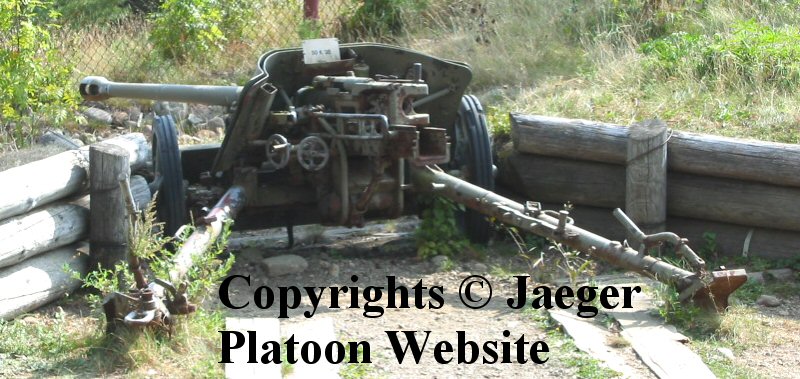
45 PstK/sov
(45 mm antitank gun M/Soviet)
45 PstK/32
(45 mm antitank gun M/32)

PICTURE: Captured Soviet 45 PstK/32 antitank gun. (Photo taken in Panssarimuseo). CLICK THUMBNAIL
TO SEE LARGER PIC (121 KB).
|
Calibre: |
45 mm x 310 R |
||
|
Length: |
426 cm |
||
|
Barrel length: |
197 cm aka L/46 |
||
|
Weight in action: |
425 kg |
||
|
Rate of fire: |
25 - 30 shots/min (maximum) |
||
|
Muzzle velocity: |
330 - 750 m/sec |
||
|
Magazine: |
None |
||
|
Traverse: |
60 degrees |
||
|
Elevation: |
- 8 degrees, + 25 degrees |
||
|
Max. range: |
8900 m (indirect fire) / 6500 m (direct fire) |
||
|
Width: |
137 cm |
||
|
Height: |
125 cm |
||
|
Country of origin: |
Soviet Union |
||
|
Ammunition types: |
Soviet APBC-HE-T 1430 g projectiles 760 m/s |
||
|
Finnish APC-T 1400 g projectile 750 - 760 m/s (1942) |
|||
|
HE 2135 g projectile 340 m/sec |
|||
|
Canister shot (Soviet Shch-210) |
45 PstK/37 and 45 PstK/38
(45 mm antitank guns M/37 and M/38)

PICTURE: Captured Soviet 45 PstK/37 antitank gun. (Photo taken in Sotamuseo). CLICK THUMBNAIL TO
SEE LARGER PIC (143 KB).

PICTURE: Captured Soviet 45 PstK/38 anti-tank gun with its limber. Triangular red reflector attached to
gun shield was added by Fiinnish military post-war for traffic code. (Photo taken in Jalkaväkimuseo). CLICK
THUMBNAIL TO SEE LARGER PIC (140 KB).
|
Calibre: |
45 mm x 310 R |
||
|
Length: |
426 cm |
||
|
Barrel length: |
197 cm aka L/46 |
||
|
Weight in action: |
425 kg |
||
|
Rate of fire: |
25 - 30 shots/min (maximum) |
||
|
Muzzle velocity: |
330 - 750 m/sec |
||
|
Magazine: |
None |
||
|
Traverse: |
60 degrees |
||
|
Elevation: |
- 8 degrees, + 25 degrees |
||
|
Max. range: |
8900 m (indirect fire) / 6500 m (direct fire) |
||
|
Width: |
161 cm |
||
|
Height: |
125 cm |
||
|
Country of origin: |
Soviet Union |
||
|
Ammunition types: |
Soviet APBC-HE-T 1430 g projectiles 760 m/s |
||
|
Finnish APC-T 1400 g projectile 750 - 760 m/s (1942) |
|||
|
HE 2135 g projectile 340 m/sec |
|||
|
Canister shot (Soviet Shch-210) |
45 mm PstK/38-41
(45 mm antitank gun M/38-41)
|
Calibre: |
45 mm x 310 R |
||
|
Length: |
412 cm |
||
|
Barrel length: |
197 cm aka L/46 |
||
|
Weight in action: |
550 kg |
||
|
Rate of fire: |
25 - 30 shots/min (maximum) |
||
|
Muzzle velocity: |
330 - 750 m/sec |
||
|
Magazine: |
None |
||
|
Traverse: |
60 degrees |
||
|
Elevation: |
- 8 degrees, + 25 degrees |
||
|
Max. range: |
8900 m (indirect fire) / 6500 m (direct fire) |
||
|
Width: |
165 cm |
||
|
Height: |
120 cm |
||
|
Ammunition types: |
Soviet APBC-T 1430 g projectiles 760 m/s |
||
|
Finnish APC-T 1400 g projectile 750 - 760 m/s (1942) |
|||
|
HE 2135 g projectile 340 m/sec |
|||
|
Canister shot (Soviet Shch-210) |
Armour Penetration:
- "Deutsche and alliierte heereswaffen 1939 - 1945"(APCR?):
|
distance |
hitting angle |
penetration |
|
500 m |
90 degrees |
60 mm |
- "Guns vs Armour website" by D.M. Honner (B-250 and BR-240 APBC-HE-T, 760 m/sec):
|
distance |
hitting angle |
penetration |
|
100 m |
90 degrees |
52 mm |
|
500 m |
90 degrees |
43 mm |
|
1000 m |
90 degrees |
35 mm |
|
1500 m |
90 degrees |
28 mm |
|
2000 m |
90 degrees |
23 mm |
|
100 m |
60 degrees |
43 mm |
|
500 m |
60 degrees |
35 mm |
|
1000 m |
60 degrees |
28 mm |
|
1500 m |
60 degrees |
23 mm |
|
2000 m |
60 degrees |
19 mm |
- "Artillery of World War Two":
|
distance |
hitting angle |
penetration |
|
915 m |
60 degrees |
38 mm |
- "Punaiset panssarit" Finnish AP-tracer, presumably 45 psav-Vj4 APC-T (750 m/sec):
|
distance |
hitting angle |
penetration |
|
500 m |
90 degrees |
47 mm |
"Punaiset panssarit" Soviet APBC-HE-T (760 m/sec):
|
distance |
hitting angle |
penetration |
|
500 m |
90 degrees |
53 mm |
|
1000 m |
90 degrees |
40 mm |
|
1500 m |
90 degrees |
30 mm |
|
500 m |
60 degrees |
44 mm |
|
1000 m |
60 degrees |
33 mm |
|
1500 m |
60 degrees |
25 mm |
|
500 m |
30 degrees |
16 mm |
|
1000 m |
30 degrees |
12 mm |
|
1500 m |
30 degrees |
9 mm |
Finnish live fire testing year 1943 (45 psa - Vj4, Finnish APC-T, 760 m/sec):
|
distance |
hitting angle |
penetration |
|
100 m |
70 degrees |
57 mm |
|
200 m |
70 degrees |
55 mm |
|
300 m |
70 degrees |
53 mm |
|
400 m |
70 degrees |
52 mm |
|
500 m |
70 degrees |
50 mm |
|
600 m |
70 degrees |
48 mm |
|
800 m |
70 degrees |
45 mm |
|
1000 m |
70 degrees |
42 mm |
|
1500 m |
70 degrees |
35 mm |
|
2000 m |
70 degrees |
28 mm |
|
2500 m |
70 degrees |
22 mm |
Finnish use: Finnish military captured maybe about 700 or so Soviet 45-mm antitank-guns during World War 2. The guns remained in Finnish antitank-weapon inventory until year 1960.
The Soviets had realised that they needed antitank-guns already in late 1920's and first bought 37-mm antitank-guns from German firm Rheinmetall. The gun design that they got from Rheinmetall in year 1930 was an early design variant of German 3.7 cm PaK 35/36. The Soviets named the gun as 37 mm antitank--gun model 1930, but also referred as K-1. Manufacturing of K-1 antitank-gun proved short-lived and rather limited in scale - it was only manufactured by one factory and only in 1931 - 1933 with total number of delivered guns being only about 500 guns. The Soviets soon started developing their own versions, which used more powerful 45 mm x 310 R ammunition. The first version of these Soviet-developed 45-mm guns was 45 mm antitank-gun model 1932 (19-K), which is basically a slightly enlarged version of K-1 - early on with wooden wheels and all. In fact the Soviet 45-mm antitank-guns look so similar, that sometimes they may get mixed to German 3.7 cm Pak 35/36 - the most notable visible difference is wheel design, since the Soviets used spoked tires with sponge rubber tires for much of the production of their 45-mm antitank-guns.

PICTURE: Closer look to systems of 45 PstK/37 antitank gun. Comparing to German
37 PstK/37 easily reveals the close relation, but also notable difference
in type of breech system. While German antitank-gun had horizontal sliding breech block the Soviet 45-mm
antitank-guns had vertical sliding breech block. Notice also captured Soviet optical sight and torsion
suspension. Box on the left is for storing optical sight when it is not in use. (Photo taken in Sotamuseo). CLICK THUMBNAIL TO SEE LARGER
PIC (181 KB).
Wooden wheels used in early production version of 45 mm antitank-gun model 1932 limited towing speed and were not suitable for motorized towing, which is the likely reason why they got replaced by spoked wheels with sponge rubber tires, but this was only the first modification that the Soviets made to their 45-mm antitank-guns to improve their mobility. Antitank-gunmodel 1932 had no spring suspension. The gun's next version was 45 mm antitank-gun model 1937 (53-K), which had traversal torsion suspension, due to which the gun ended up being about 24 cm wider. Other improvements introduced with model 1937 included improvements made to traverse gun laying mechanism and adding of push button for firing the gun into the elevation handwheel. Another major improvements were made to the gun's breech mechanism, which as usual was the type referred as "semi-automatic" (after firing a shot the breech removed used cartridge case and remained open for the next round). With gun model 1932 the semiautomatic-mechanism worked only with APHE-ammunition, requiring breech to be opened manually for the next round, which caused reduced rate-of-fire with other ammunition types (such as high explosive). All guns starting from model 1937 had improved semi-automatic mechanism, which worked as "semi-automatic" with all ammunition types. Soviet industry manufactured some 37,400 guns total during production of antitank-gun model 1937 (53-K) in 1937 - 1943. The next development version to enter production was 45 mm antitank-gun model 1938, whose main difference to earlier model 1937 are longitudinal torsion suspension being used for the gun's spring suspension - otherwise the two guns appear to be quite similar from technical point of view .

PICTURE: Side profile of 45 PstK/37 antitank gun. Notice four kill rings in gun barrel.
(Photo taken in Panssarimuseo). CLICK THUMBNAIL TO SEE LARGER PIC (177 KB).
The Soviets continued development work with 45 mm antitank-gun model 1938-41, for which they used modernized manufacturing methods by introducing autofrettaged gun barrel, which can identified from its barrel profile being slightly less tapered around front end of recoil system. During World War 2 the armour-penetration capability of existing Soviet 45-mm antitank-guns proved less than satisfactory, hence they decided to introduce 45 mm antitank-gun model 1942 (M-42), whose longer gun barrel produced higher muzzle velocity and therefore better armour penetration. This gun also has thicker gun shield intended to provide better protection for the gun crew. Circa 1942 - 1943 the Soviets replaced spoked wheels with disc wheels. 45 mm antitank-gun model 1942 was the last of its lineage by being the last 45-mm antitank-gun that the Soviets fielded. It was manufactured in 1942 - 1945 with total production of about 10,800 guns. The development work for Soviet 45-mm antitank-guns can be mostly credited to V.M. Berin (born 1897, improsoned in year 1933 and executed in year 1937) who was main designer for model 1932 gun and M.N. Loginov (1903 - 1940), who designed model 1937.

PICTURE: Captured Soviet 45 mm antitank-gun taken in Finnish use in Hyrynsalmi during Winter
War. Photographer unknown. (SA-kuva photo archive, photo number 2864). CLICK THUMBNAIL TO SEE LARGER PIC
(83 KB).
The gun model system used above is in fact the one that Finnish Army used, although it was apparently based in what the Soviets used, but just more detailed in seperating different production variants. As far as the Soviets were concerned they apparently devided their production of 45-mm antitank-guns into only three gun models:
What is known the main reason why Finnish Army decided to separate these guns to different models was the spare-parts supply - spare parts of various Russian 45-mm antitank-gun were not necessarily interchangeable between various gun models. Hence Finnish Army ended up separating these guns into following models:
In addition to these standard models, the Soviets also had one more improvised 45-mm antitank-gun model. Year 1941 they were surprised by German invasion and after suffering heavy losses found themselves with shortage of antitank-guns. In that situation they introduced improvised emergency version of 45-mm antitank-gun built in Leningrad primarely for People's militia (LANO). They named the improvised antitank-gun as model 1941, referring to it also as "Leningrad-gun". Finnish Army named the gun accordingly as 45 PstK/41 (45 mm antitank-gun model 1941). Basically 45 PstK/41 has 45 mm tank-gun installed on rudimentary improvised antitank-gun mount. Finnish Army captured four of these improvised antitank-guns, but apparently decided not to issued any of them. although the guns remained mothballed for possible use through rest of the war and all they way to 1980's. Being a stop-gap measure this improvised antitank-gun was only manufactured in Leningrad in 1941 - 1942 with total production presumed to have been about 700 guns.

PICTURE: One of the four captured Soviet 45 PstK/41 antitank guns, what is known none of these
guns saw any use with Finnish military. Notice, unlike claimed in some websites, this is not the same gun as more
traditional 45 PstK/38-41. (Photo taken in Panssarimuseo). CLICK THUMBNAIL TO SEE LARGER PIC (123 KB).
The reasoning behind Soviet 45-mm antitank-gun model 1941 was quite simple, it was introduced in hurried times of 1941, when the Soviets needed any weapons that could get fast to equip their troops. Since they already had existing stockpile of spare 45-mm tank guns, why not put them into good use as improvised antitank-guns. Later m/42 antitank-gun with its longer barrel was an effort of trying to get more muzzle velocity out of existing ammunition and therefore better armour penetration capability. When introduced in early 1930's Soviet 45-mm antitank-gun was excellent weapon, at that time its armor piercing shells had enough power to punch through both walls of typical tanks of that time. Year 1939 it still was more effective than most antitank-guns of that time and was powerful enough to be threat to all existing tanks. But fast progress of tanks during World War 2 soon passed its capability with new medium and heavy tanks proving difficult or impossible for it to kill and by end of the war it had become quite outdated as antitank-gun. However besides armour piercing shells, these guns had also high explosive shells, which were highly effective for gun of this caliber range. The Soviets routinely used their 45-mm antitank-guns for direct fire support in the frontline, so powerful HE-shells proved highly useful. All Soviet 45-mm antitank-guns were suitable both to motorized towing and being towed with horses. Two horses and a limber were needed for towing the gun.
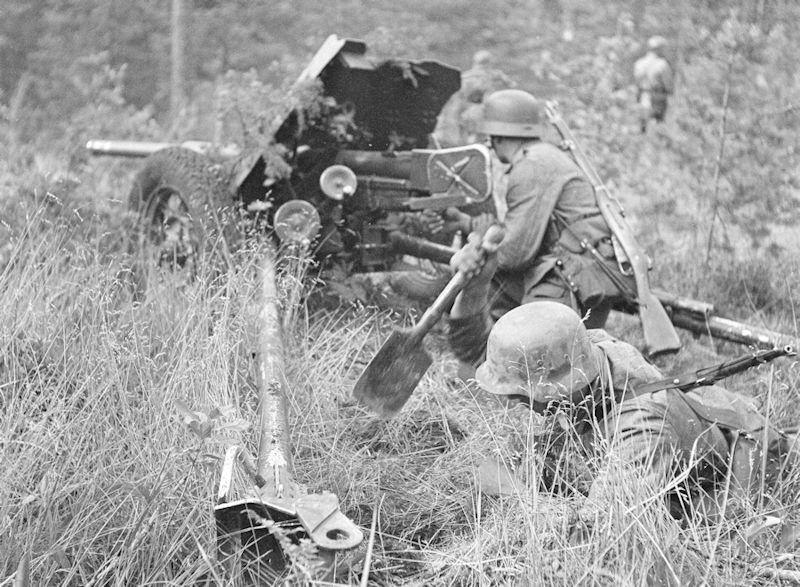
PICTURE: Finnish soldiers prepare Soviet 45 mm antitank-gun for use. Photographed by
Military official T. Nousiainen in August of 1941 in Ilmee. (SA-kuva photo archive, photo number 32383). CLICK
THUMBNAIL TO SEE LARGER PIC (130 KB).
Finnish troops captured some 125 Soviet 45 mm antitank-guns during Winter War. As the Finns had serious shortage of antitank-guns the captured guns were very soon pressed to Finnish use. Finnish soldiers compared the 45-mm Soviet antitank-guns to 37-mm Bofors guns and considered Soviet 45-mm gun to be somewhat rough on the edges when it came to manufacturing quality, but effective. It did not take long until Antitank Training Centre started training crews for captured 45 mm antitank-guns and the Finns lost couple of these guns in combat already during Winter War. June of 1940 93 of the 45 mm antitank-guns captured in Winter War remained in Finnish use and M/32 was the most common model of them in Finnish use at that time. During first three months of Continuation War in year 1941 Finnish troops captured much larger number of 45-mm antitank-guns - almost 400 guns were captured during those months. During the trench war period (Dec 1941 - June 1944) their number in use of Finnish military peaked to some 670 guns. Very few antitank-guns were captured or lost during the trench war period Continuation War in January 1942 - May 1944. Once the Soviet offensive started in June of 1944 the battles of summer 1944 proved very costly to 45 mm antitank-guns existing in Finnish use - with Finnish military losing dozens of guns. But in last battles these guns were again captured in large numbers, so ultimately the total number in Finnish use did not drop that much by end of World War 2. Even once the guns that were in worst shape had been scrapped after the war, year 1948 Finnish Army still had 475 Soviet 45 mm antitank-guns in its inventory.
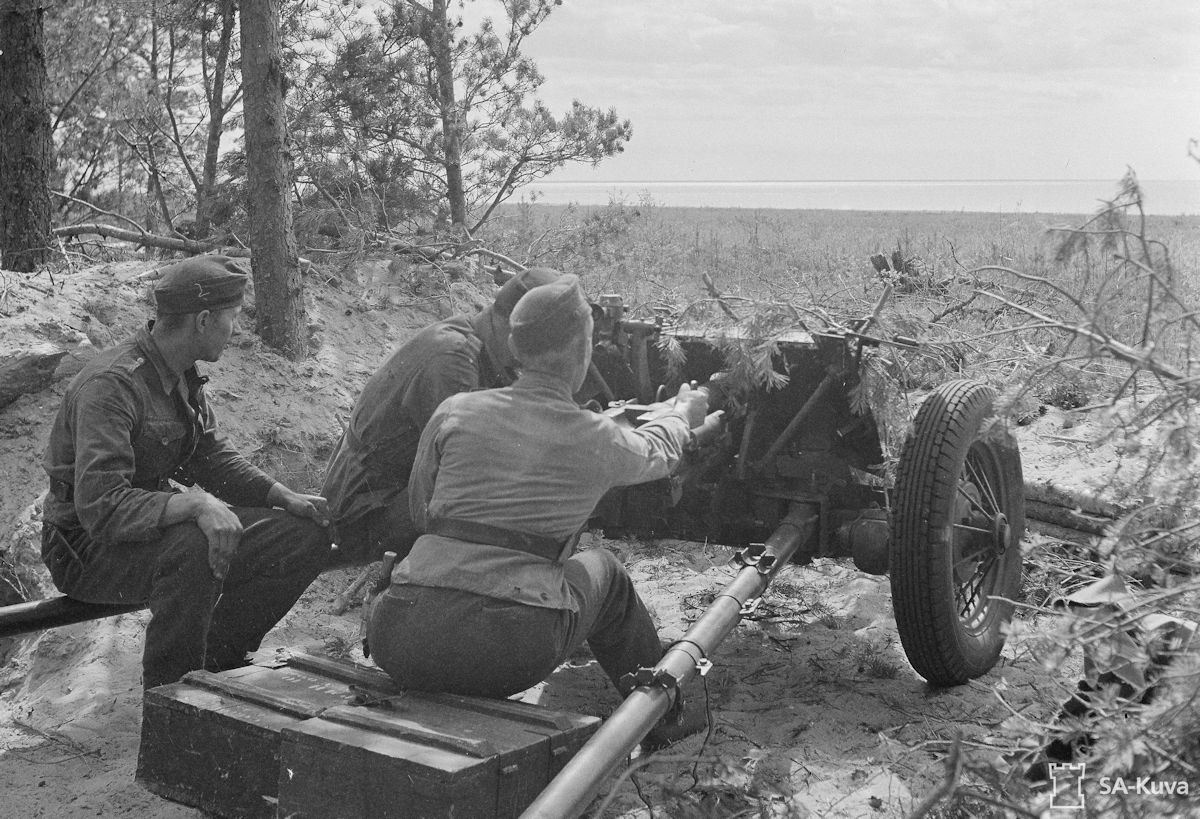
PICTURE: Captured Soviet 45mm anti-tank gun being used for beach defence in June of 1942.
Top section of the gun shield has been turned down - possibly to make the gun more difficult to spot. Photographed by Aavikko.
(SA-kuva.fi photo archive, photograph number 94781). CLICK THUMBNAIL TO SEE LARGER PIC (245 KB).
Year 1948 still 475 of captured 45-mm antitank-guns remained in Finnish inventory:
|
Model of 45 mm at-gun |
Number of guns |
|
45 PstK/32 |
203 |
|
45 PstK/37 |
79 |
|
45 PstK/38 |
133 |
|
45 PstK/38-41 |
54 |
|
45 PstK/41 |
4 |
|
45 PstK/42 |
2 |
|
Total |
475 |
Finnish Army ammunition manuals list following ammunition for captured 45-mm antitank-guns:
About half of the ammunition that Finnish military used with these guns was captured, while the other half was Finnish made. Finnish production for armour piercing high explosive tracer (APHE-T) ammunition started in VTT (Valtion Tykkitehdas = State Artillery Factory) in late 1940 and manufacturing of high explosive (HE) ammunition started year 1942. Also Finnish armour piercing capped tracer (APC-T) ammunition was introduced to manufacturing in year 1942. During World War 2 Finnish industry manufactured almost 112,000 AP-T + APHE-T rounds and over 358,000 HE rounds. In addition 15,000 HE rounds and 15,000 APHE rounds were bought from Germany in year 1944. Soviet ammunition inventory for these guns included also more potent armour piercing composite rigid (APCR) ammunition, but captured APCR ammunition is not listed in Finnish Army ammunition manuals. So it is quite likely that none or only very small number of APCR rounds was captured. Anyway Soviet production of APCR-ammunition for these guns does not seem to have started until year 1942, at which point the Finnish offensive had already stopped and capturing of Soviet equipment had become rare. Finnish troops captured only two long-barrel M/42 antitank guns. They were both captured in summer of 1944 (first one in Kuuterselkä battle in mid-June of 1944) and Finnish military never used them.
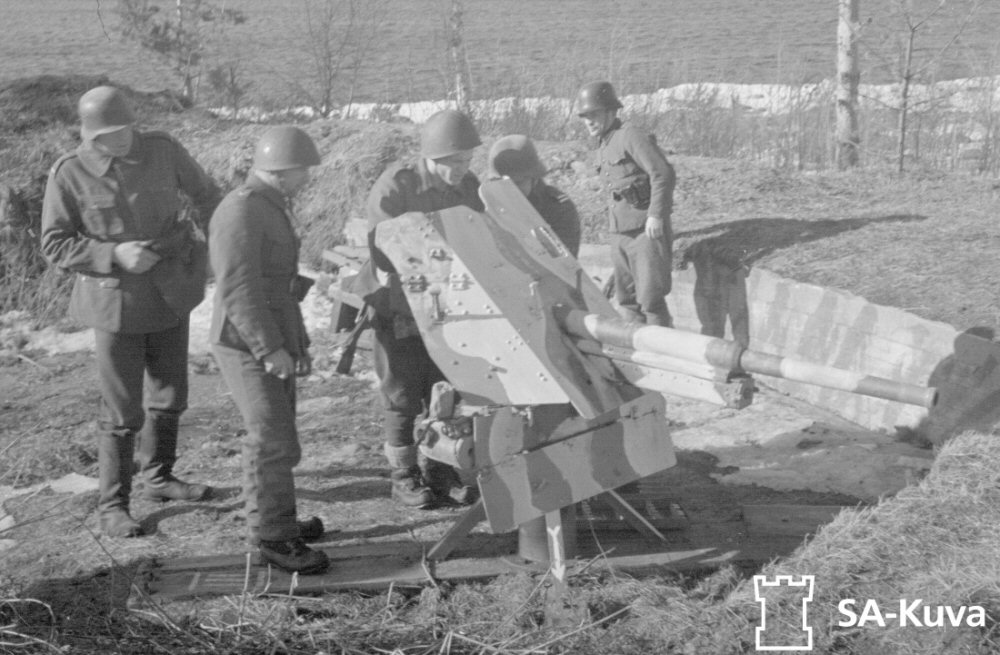
PICTURE: Captured 45-mm Soviet antitank-gun with Finnish-designed coastal gun mount.
During Continuation War Finnish military developed this sort of gun mount for fixed positions of coastal
defence. Unknown number of 45-mm antitank guns issued to coastal troops were equipped with these gun fixed
mounts and issued for beach defence role. Period photos also show that some guns were also installed with
these mounts on auxiliary gun boats. Photograph taken by Military Official M. Aaltonen. (SA-kuva photo
archive, photo number 125110). CLICK THUMBNAIL TO SEE LARGER PIC (173 KB).
Gun sights which Finnish military used with captured 45-mm Soviet antitank guns fall into three categories:
Losses of captured 45-mm Soviet antitank-guns during period 9th of June - 7th of July 1944:
|
Unit: |
Losses: |
|
|
II Army Corps |
3 |
|
|
III Army Corps |
11 |
|
|
IV Army Corps |
24 |
|
|
V Army Corps |
19 |
|
|
Aunus Group |
28 |
|
|
Finnish Navy |
16 |
|
|
Ladoga Coastal Brigade |
2 |
|
|
Total: |
103 |
As mentioned year 1948 Finnish military still had 475 of captured Soviet 45-mm antitank-guns. After the war those 45-mm antitank-guns, that still remained in inventory, were mothballed for possible wartime use. Some guns also seem to have been used for antitank-training at least in 1950's. Even if quite outdated they were still so numerous, that they remained reserved for antitank use with Finnish military until year 1960. After that they were re-named as infantry guns and their role changed accordingly. Finnish coastal defence troops had been issued number of 45-mm antitank guns already during Continuation War and since the Army no longer had need these guns, they were simply transferred to coastal defense in far larger numbers. In their coastal (beach defence) role they remained in Finnish use until late 1980's or so and presumably many more got equipped with Finnish-designed coastal artillery mount designed for fixed positions, which were normally used for beach defense. Finnish Defense Forces removed 45-mm infantry guns from their inventory in year 1993. After that much of the remaining guns were little by little transferred to museums, sold to collectors or exported.
47 PstK/35
and 47 PstK/39(47 mm antitank guns M/35 and M/39)
(Swiss 47 mm Böhler antitank gun M/35)
(Italian 47/32 Mod. 39 antitank gun)

PICTURE: Partially snow-covered 47 PstK/39 antitank-gun being used for beach defence during
winter. Soldier behind the gun has captured SVT-40 semi-automatic rifle.
Photo taken in by Military Official K. Kivi in region of Taipale Peninsula in February of 1942. (SA-kuva
photo archive, photograph number 73663). CLICK THUMBNAIL TO SEE LARGER PIC (140 KB).
|
Calibre: |
47 mm x 185 R / 47 mm x 195 R (*) |
||
|
Length: |
313 cm |
||
|
Barrel length: |
183 cm (with muzzle brake) aka L/32 |
||
|
Weight in action: |
310 kg (47 PstK/35) / 330 kg (47 PstK/39) |
||
|
Rate of fire: |
10 shots/min (practical) |
||
|
Muzzle velocity: |
535 m/sec / 595 m/sec (**) |
||
|
Magazine: |
None |
||
|
Traverse: |
50 degrees |
||
|
Elevation: |
- 10 degrees, + 60 degrees |
||
|
Max. range: |
9000 m (indirect fire) |
||
|
47 PstK/35: 2000 m (direct fire) |
|||
|
47 PstK/39: 2500 m (direct fire) |
|||
|
Width: |
102 cm |
||
|
Height: |
88 cm |
||
|
Country of origin: |
Switzerland (Austrian made) & Italy (Italian made) |
||
|
Ammunition types: |
Swiss/Austrian 47 PstK/35: |
||
|
- Swiss APHEBC-T 1764 g projectile 535 m/s |
|||
|
Italian 47 PstK/39: |
|||
|
- Italian APHE-T 1450 g projectile 595 m/sec |
(*) 47 mm x 185 R used with 47 PstK/35 and 47 mm x 195 R used with 47 PstK/39.
(**) With ammunition that was in Finnish use.
Armour penetration:
- "Die Bewaffnung des Österreichischen etc" (47 PstK/35 with Austrian APHE 1450 g projectile 650 m/sec):
|
distance |
hitting angle |
penetration |
|
500 m |
90 degrees |
44 mm |
- "Tanks vs Armour" (47 PstK/39 with Italian APHE 1440 g projectile 630 m/sec):
|
distance |
hitting angle |
penetration |
|
100 m |
90 degrees |
56 mm |
|
500 m |
90 degrees |
43 mm |
|
1000 m |
90 degrees |
31 mm |
|
1500 m |
90 degrees |
23 mm |
- "Panzerabwehrkanonen 1916 - 1977:" (Italian 47/32 Mod. 39, projectile presumably APHE-T?):
|
distance |
hitting angle |
penetration |
|
500 m |
90 degrees |
40 mm |
- "Panzerabwehrkanonen 1916 - 1977:" (Swiss 47-mm Böhler at-gun m/35, projectile presumably APHEBC-T?):
|
distance |
hitting angle |
penetration |
|
1000 m |
90 degrees |
30 mm |
Finnish use: 10 Austrian 47 PstK/35 and 12 Italian 47 PstK/39 at-guns were bought during Winter War and were delivered during Interim Peace. When Continuation War started they were issued to (antitank) gun companies of frontline infantry units, but were soon removed from this use and ended up to coastal defence.
Both of these guns were versions of infantry/antitank gun manufactured by Austrian company Böhler starting from mid 1930's. From these two gun types Austrian M/35 was the original version while, while M/39 was improved Italian version which was more focused to antitank use. Other countries that bought Böhler guns or its production license included Rumania, Lithuania and Estonia. During World War 2 the main users of these guns were Italy and Rumania, but they also saw use with Chinese, Croatian, Dutch, German (ex Austrian, Dutch and Soviet guns) and Soviet (captured Latvian guns) militaries. 47-mm Böhler guns were sold as infantry guns, but they were well-suited to be used as antitank-guns as well. Italian industry had two model versions - cannone 47/32 mod. 1935 and cannone 47/32 mod. 1939. The Italian guns bought to Finland were model 1935 version.
Structural design of thes guns was somewhat unique as far moving the gun into firing position and setting it ready for use was concerned: Wheels of the gun needed to be removed and front part of gun put on top of a plate-like foot, this gave carriage a three point stand that was both stable and low, making spotting and hitting the gun more difficult for the enemy. However this was obviously also more time consuming process than what was usual with antitank-guns of 1930's. Structure used in these guns also allowed them to be dismantled to parts light enough to be carried by men, mules or horses like a mountain gun. However, these special features did not amend the fact that their ballistics against armour was not particularly good. In addition lacking gun shield left gun crew without the small but important (partly psychological) shelter, that it would have offered against small arms fire and shrapnel.
Finland bought these guns from Switzerland and Italy during Winter War, but in both cases the guns arrived only during Interim Peace. More details of those deals:
The visible differences between the two gun-types were:
As noted the two guns did not use same ammunition even if they were ballistics-wise relatively close to each other. Also production methods used making them had differences, which made their spare parts incompatible in between guns.

PICTURE: Gun crews of anti-tank gun platoon of Finnish Army pose with their 47 PstK/35 antitank-guns.
Photo taken by Corporal E. Pöntinen in Hytti at June of 1941. (SA-kuva photo archive, photograph number
40504). CLICK THUMBNAIL TO SEE LARGER PIC (231 KB).
Year 1941 Italian 47 PstK/39 was tested in Panssaripataljoona (Tank Battalion). The test report was not particuarly favourable. Besides noting the structural details poorly suiting to Finnish use and the difficulties resulting them, the report also noted that the Italian gun sight was too complicated and the gun's armour penetration capability was rather poor for gun of this size. In addition the gun was noted lacking a semiautomatic mechanism present in most antitank-guns. Had it existed the semi-automatic breech mechanism would have allowed the gun to automatically remove cartridge case and leave the breech open after firing a shot - allowing higher rate of fire. The report ended with suggestion, that if equipped with more suitable (simple) gun sight and suitable HE-round, the gun might be suitable as a bunker gun. However the report apparently did not lead to any measures.
Parts, to which these antitank-guns could be disassembled for transport:
|
parts: |
47 PstK/35 |
47 PstK/39 |
|
gun barrel with breech |
74 kg |
80 kg |
|
gun cradle and sleigh |
73 kg |
80 kg |
|
gun carriage |
73 kg |
74 kg |
|
trails and wheels |
60 kg |
71 kg |
|
total: |
280 kg |
305 kg |
The career of Italian and Swiss 47-mm antitank-guns as antitank-weapons of Finnish Army was quite short-lived. During early Continuation War antitank-units of Finnish 2nd Army Corps used some of guns briefly. But soon they were removed from frontline use and handed over to coastal defence troops of Lake Ladoga. In spring of 1942 they were were officially transferred to Finnish Navy (which also included coastal defence) and remained in its inventory until end of World War 2. All 22 guns survived the war. After the war remaining guns were mothballed for possible further use until being sold to Interarms and shipped abroad in year 1960. Since all 22 guns were exported, unfortunately there are none in Finnish collections.
50 PstK/38
(50 mm antitank gun M/38)
(5.0 cm Pak 38)

PICTURE: 50 PstK/38 antitank gun with lower part of shield opened up. (Photo taken in
Panssarimuseo). CLICK THUMBNAIL TO SEE LARGER PIC (159 KB).
|
Calibre: |
50 mm x 419 R |
||
|
Length: |
475 cm |
||
|
Barrel length: |
300 cm aka L/60 |
||
|
Weight in action: |
830 kg (*) |
||
|
Rate of fire: |
12 - 15/min |
||
|
Muzzle velocity: |
550 - 1180 m/sec |
||
|
Magazine: |
None |
||
|
Traverse: |
65 degrees |
||
|
Elevation: |
- 8 degrees, + 27 degrees |
||
|
Max. range: |
2500 m (direct fire) |
||
|
Width: |
185 cm |
||
|
Height: |
105 cm |
||
|
Country of origin: |
Germany |
||
|
Ammunition types: |
APHEBC-T (Pzgr.38) projectile 2060 g 830 m/sec |
||
|
APCR-T (Pzgr.40) projectile 980 g 1180 m/sec |
|||
|
HE projectile 1960 g 550 m/sec |
(*) Weight 830 kg in position and 886 kg while ready for transport.
Armour Penetration:
- "Deutsche and alliierte heereswaffen 1939 - 1945"(Pzgr.40 APCR-T?):
|
distance |
hitting angle |
penetration |
|
500 m |
60 degrees |
60 mm |
- "Small arms, artillery and special weapons of the third reich":
Pzgr.38 APHEBC-T round (823 m/sec):
|
distance |
hitting angle |
penetration |
|
0 m |
90 degrees |
99 mm |
|
250 m |
90 degrees |
88 mm |
|
500 m |
90 degrees |
78 mm |
|
750 m |
90 degrees |
69 mm |
|
1000m |
90 degrees |
61 mm |
|
1200 m |
90 degrees |
53 mm |
|
1500 m |
90 degrees |
47 mm |
|
0 m |
60 degrees |
73 mm |
|
250 m |
60 degrees |
67 mm |
|
500 m |
60 degrees |
61 mm |
|
750 m |
60 degrees |
56 mm |
|
1000 m |
60 degrees |
50 mm |
|
1200 m |
60 degrees |
45 mm |
|
1500 m |
60 degrees |
40 mm |
Pzgr.40 APCR-T round (tungsten core, 1198 m/sec):
|
distance |
hitting angle |
penetration |
|
0 m |
90 degrees |
165 mm |
|
250 m |
90 degrees |
141 mm |
|
500 m |
90 degrees |
120 mm |
|
750 m |
90 degrees |
101 mm |
|
1000 m |
90 degrees |
84 mm |
|
1250 m |
90 degrees |
70 mm |
|
0 m |
60 degrees |
143 mm |
|
250 m |
60 degrees |
109 mm |
|
500 m |
60 degrees |
86 mm |
|
750 m |
60 degrees |
69 mm |
|
1000 m |
60 degrees |
55 mm |
|
1250 m |
60 degrees |
44 mm |
- "Panzerabwerhgeschütze etc":
Pzgr.38 APHEBC-T round (835 m/sec / 823 m/sec):
|
distance |
hitting angle |
penetration |
|
100 m |
60 degrees |
69 mm |
|
500 m |
90 degrees |
75 mm |
|
1000 m |
60 degrees |
48 mm |
Pzgr.40 APCR-T round (tungsten core, 1180 m/sec):
|
distance |
hitting angle |
penetration |
|
100 m |
60 degrees |
130 mm |
|
500 m |
90 degrees |
115 mm |
|
1000 m |
60 degrees |
38 mm |
- "Twentieth Century Artillery":
Pzgr.38 APHEBC-T round (823 m/sec):
|
distance |
hitting angle |
penetration |
|
500 m |
90 degrees |
78 mm |
Pzgr.40 APCR-T round (1198 m/sec):
|
distance |
hitting angle |
penetration |
|
500 m |
90 degrees |
120 mm |
- Finnish live fire testing year 1943 ("50 pspekr 22/27", German APHEBC-T, 835 m/sec):
|
distance |
hitting angle |
penetration |
|
100 m |
70 degrees |
57 mm |
|
200 m |
70 degrees |
55 mm |
|
300 m |
70 degrees |
53 mm |
|
400 m |
70 degrees |
52 mm |
|
500 m |
70 degrees |
50 mm |
|
600 m |
70 degrees |
48 mm |
|
800 m |
70 degrees |
45 mm |
|
1000 m |
70 degrees |
42 mm |
|
1500 m |
70 degrees |
35 mm |
|
2000 m |
70 degrees |
28 mm |
|
2500 m |
70 degrees |
22 mm |
- Finnish live fire testing year 1943 ("50 psl-Vj2", German APCR-T, 1080 m/sec):
|
distance |
hitting angle |
penetration |
|
100 m |
70 degrees |
95 mm |
|
200 m |
70 degrees |
80 mm |
|
300 m |
70 degrees |
70 mm |
|
400 m |
70 degrees |
60 mm |
|
500 m |
70 degrees |
50 mm |
|
600 m |
70 degrees |
40 mm |
|
800 m |
70 degrees |
25 mm |
|
1000 m |
70 degrees |
15 mm |
|
1500 m |
70 degrees |
10 mm |
|
2000 m |
70 degrees |
- |
|
2500 m |
70 degrees |
- |
Finnish use: 27 guns were imported from Germany in summer of 1942, they remained in use of Finnish frontline units until end of World War 2.

PICTURE: 50 PstK/38 antitank gun with lower part of gun shield folded up. (Photo taken in
Panssarimuseo). CLICK THUMBNAIL TO SEE LARGER PIC (87 KB).
The Germans started having doubts about effectiveness of 3,7 cm Pak already during Spanish Civil War, so Rheinmetall started development of new 5-cm antitank gun in 1938. It took until late 1940 from them to start issuing new 5 cm Pak to their troops and even than production was quite slow early on (still in 1st of June 1941 German troops located to east had only 107 guns of this type). 5-cm Pak proved a success, with new tungsten-cored Pzgr. 40 ammunition it was able to take out all Allied medium tanks such as T-34/76 and M4 Sherman. However, the shortage of tungsten needed for production of Pzgr.40 projectiles and ever thickening armour in tanks finally were too much for it also, so production of these guns was ended in year 1943, by that time over 9,500 guns had been made. As typical to German antitank-guns this gun had semi-automatic breech system with horizontal sliding breech block.
Finland bought 27 antitank guns of this type in two deliveries:
|
Delivery date |
Amount |
|
July of 1942 |
12 |
|
December of 1942 |
15 |
Also Finnish military became aware of need acquiring more effective antitank-guns after facing number of T-34 and KV-1 tanks in battles of year of 1941. So Finland bought 27 of these antitank-guns from Germany in year 1942. Guns of the first delivery were issued to Finnish troops in August of 1942. They were basically distributed to all main directions of Finnish front, as first delivery was issued to antitank gun companies of Groups of Maaselkä and Aunus while 12 guns from second shipment were given to (Carelian) Isthmus (Army) Group (Kannaksen Ryhm¨) and Armour Division (Panssaridivisioona). Each of these received number of (6 guns) PstK/38 to equip one antitank(-gun) company. Later on the remaining guns were re-organized to number of antitank-companies in such manner, that each company had two platoon equipped with 75-mm antitank-guns and one platoon equipped with 50 PstK/38 guns - hence resulting antitank-company having four 75-mm guns and two 50-mm guns.
PICTURE: 50 PstK/38 antitank gun in field fortified position. Note semi-automatic breech
system with horizontal sliding breech block (Photo taken in Panssarimuseo). CLICK THUMBNAIL TO SEE LARGER PIC
(136 KB).
Units with 50 PstK/38 antitank guns in 1st of May 1944:
German 50-mm at-gun worked well in Finnish hands and short shooting distances typically offered by Finnish terrain made them relatively effective even against most heavily armoured tanks. When delivered it was the only antitank gun in Finnish use capable of reliably destroying T-34 tanks, so in late June of 1944 the Finns still expressed to be willing to get these guns delivered instead of heavier 75-mm antitank guns. However, reading battle reports makes clear that knocking out T-34/85 tanks with this gun was not exactly easy. Knocking out Soviet T-34 practically always demanded a positition, that allowed shooting from side of the tank and close range to succeed. PstK/38 was the first antitank gun in Finnish inventory that was too heavy for gun crew of few men to effectively push it around, so in situations in which gun positions were about to be overrun by Soviet infantry this made taking the gun with the retreating crew quite problematic. While arranged in travel-mode 50 PstK/38 weight 886 kilograms and Finnish Army was operating the gun with gun crew of 11 men (plus two drivers for motor vehicles). Unlike lighter guns this antitank-gun had also been designed for motorized towing only, hence it could not be towed with horse(s). Considering small number of these guns in use of Finnish Army to begin with, the number of 50 PstK/38 lost in battle during summer of 1944 was very high with only 15 guns surviving the war. The small number of surviving guns may have been a factor for these guns being removed from antitank-weaponry in use of Finnish military already that same year. After World War 2 they were mothballed, but not declared obsolete until year 1986. In late 1980's three guns were sold to collectors and the rest transferred to museums. Since then some of the guns have ended up to foreign museums and collections.
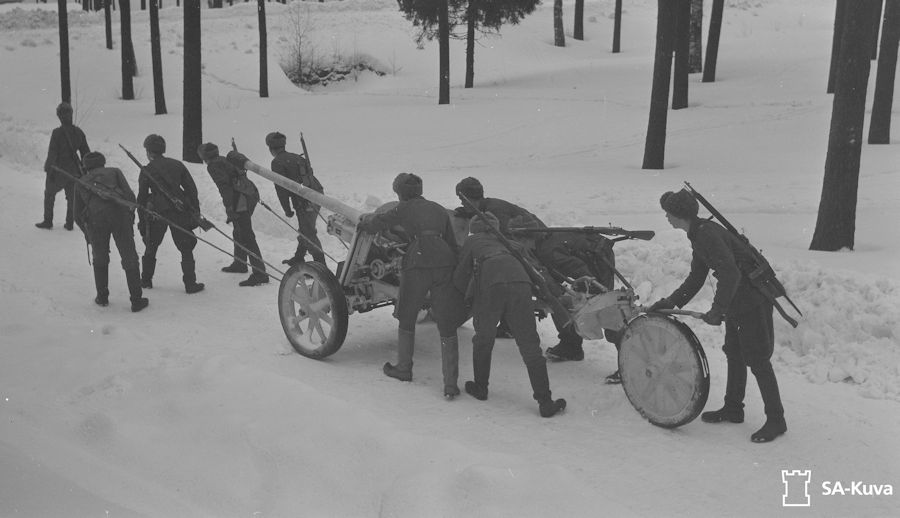
PICTURE: Gun crew manhandles 50 PstK/38 antitank-gun on snow-covered road. This gun was
heavy enough that manhandling it was very hard work even for a gun crew this large. Even of the gun was normally with a
motor vehicle, it needed to be manhandled into its position and from it. Photographed by
Sundström in February of 1942 in Jaakkima for a manual. (SA-kuva photo archive, photo number 121703).
CLICK THUMBNAIL TO SEE LARGER PIC (71 KB).
Losses of 50 PstK/38 antitank-guns during period 9th of June - 7th of July 1944:
|
Unit: |
Losses: |
|
|
IV Army Corps |
3 |
|
|
V Army Corps |
6 |
|
|
Total: |
9 |
Finnish ammunition manuals list following ammunition for 50 PstK/38 in Finnish use:
It is worth noting that there was rather limited number of 50 psl-Vj2 aka Pz.Gr 40 APCR-T in Finnish use. What is known the only delivery of this ammunition happened in June of 1942 and contained total 944 rounds. Shortage of tungsten stopped German production of ammunition with tungsten cores used in these rounds, which explains not having later deliveries. The Germans developed also HEAT-T bombquite similar to Stielgrenade 41 for their 50-mm antitank-guns, but Finnish Army never acquired any.
75 PstK/97-38 "Mulatti"
(75 mm antitank gun M/97-38 "Mulato")
(7.5 cm Pak 97/38)

PICTURE: 75 PstK/97-38 antitank gun. (Photo taken in Jalkaväkimuseo). CLICK THUMBNAIL TO SEE LARGER PIC (202 KB).
|
Calibre: |
75 mm x 350 R |
||
|
Length: |
485 cm |
||
|
Barrel length: |
272 (with muzzle brake) cm aka L/36 |
||
|
Weight in action: |
1190 kg |
||
|
Rate of fire: |
12 - 14/min |
||
|
Muzzle velocity: |
450 - 570 m/sec |
||
|
Magazine: |
None |
||
|
Traverse: |
60 degrees |
||
|
Elevation: |
- 8 degrees, + 25 degrees |
||
|
Max. range: |
9400 m (indirect fire) / ? (direct fire) |
||
|
Width: |
182 cm |
||
|
Height: |
115 cm |
||
|
Country of origin: |
Germany |
||
|
Ammunition types: |
AP (Pz Patr. K (P)) projectile 6800 g 570 m/sec (**) |
||
|
AP (pspkrv 59/66-ps) projectile 6400 g 570 m/sec (*) |
|||
|
APC-T (psa - Vj4) projectile 6075 g 590 m/sec |
|||
|
HEAT-T (Gr 38/97 HL/C (f)) projectile 4800 g 450 m/sec (**) |
|||
|
HEAT-T (75 hkr 42-18/24-38) HL/B projectile 4660 g 400 m/sec |
|||
|
HE (4 shell models suited for this gun in German use) |
(*) May not have been used with this antitank-gun. This round did fit to its chamber, but was not included into infantry ammunition manuals. Field artillery ammunition manuals had it listed for 75 K/97 and 75 K/17 light field guns.
(**) Likely not used in Finland (not included in Finnish manuals), but late war main antitank ammunitions for the Germans with this gun.
Armour penetration:
- "Panzerabwerhgeschütze etc":
AP round (570 m/sec):
|
distance |
hitting angle |
penetration |
|
100 m |
60 degrees |
61 mm |
|
1000 m |
60 degrees |
58 mm |
HEAT-T round (450 m/sec):
|
distance |
hitting angle |
penetration |
|
any |
60 degrees |
90 mm |
- "Marskin Panssarintuhoojat, page 378":
AP round (590 m/sec):
|
distance |
hitting angle |
penetration |
|
300 m |
90 degrees |
92 mm |
HEAT round:
|
distance |
hitting angle |
penetration |
|
any |
90 degrees |
93 mm |
- Finnish live fire testing year 1943 ("75 psa - Vj4", APC-T, 590 m/sec):
|
distance |
hitting angle |
penetration |
|
100 m |
70 degrees |
85 mm |
|
200 m |
70 degrees |
85 mm |
|
300 m |
70 degrees |
80 mm |
|
400 m |
70 degrees |
80 mm |
|
500 m |
70 degrees |
80 mm |
|
600 m |
70 degrees |
75 mm |
|
800 m |
70 degrees |
75 mm |
|
1000 m |
70 degrees |
70 mm |
|
1500 m |
70 degrees |
60 mm |
|
2000 m |
70 degrees |
50 mm |
|
2500 m |
70 degrees |
45 mm |
Finnish use: 46 guns were bought from Germany and delivered in 1943, they remained in use of Finnish frontline units until end of World War 2.
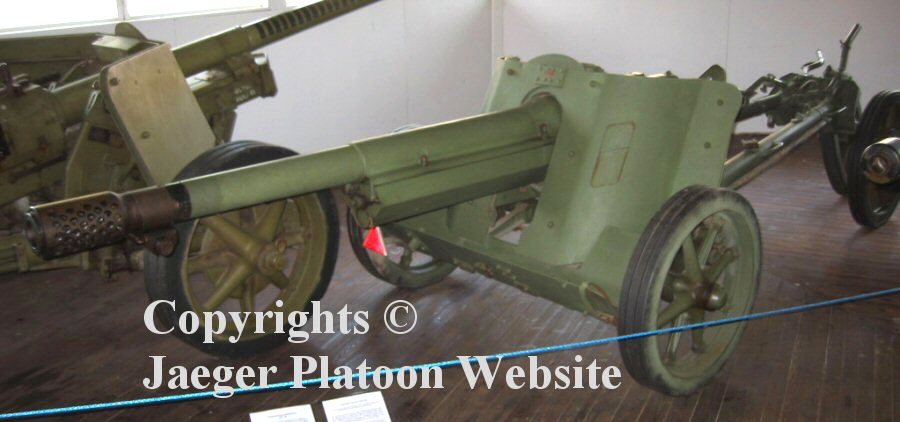
PICTURE: 75 PstK/97-38 antitank gun ready for transport. German 50-mm and 75-mm antitank guns all
had basically the same system with third wheel for towing. Notice the wheel and folded up lower part of gun shield.
(Photo taken in Panssarimuseo). CLICK THUMBNAIL TO SEE LARGER PIC (98 KB).
After running to new Allied medium and heavy tanks (such as Soviet T-34 and KV-1) the Germans found out that they needed antitank guns more powerful than 50 mm Pak. As a stop gap solution this 75-mm antitank gun was introduced. It basically combined gun barrel of French 75-mm model 1897 field gun equipped with muzzle-break to carriage of German 5.0 cm Pak 38. Ammunition used typically included captured French HE-rounds, captured Polish AP-rounds and German made HEAT-rounds, however using AP-rounds was not favoured and HEAT was the main ammunition type in antitank use with German troops. Reason for this was quite simple: The gun was quite unstable and recoil with AP-rounds was so fearsome that the Germans nicknamed this gun type as "Mustang". This gun was introduced to German troops in November of 1941 and in years 1941 - 1942 some 700 guns of this type were manufactured. According some sources the total production totalled about 3700 guns. 7.5 cm Pak 97/38 as Germans called it was far from perfect, but it worked and was cheap to produce (cost and need of work were about two thirds of what was needed with 7.5 cm Pak 40).

PICTURE: Closer look behind gun shield of 75 PstK/97-38 antitank gun. Note Nordenfelt eccentric
screw breech originating from French m 1897 field gun. Gun sight is missing as usual. (Photo taken in Jalkaväkimuseo).
CLICK THUMBNAIL TO SEE LARGER PIC (210 KB).
Finland had bought 48 French 75-mm field guns model 1897 (referred as 75 K 97 by Finnish Army) and 50,000 shells from France in year 1940. Barrels of the bought guns were in terribly worn down condition and dispersion in indirect fire was unacceptably large. Year 1942 all 75 K 97 field guns were gathered away from fortification artillery batteries that they had been issued. By February of 1943 the Finns had decided to check if the Germans were w illing to build them 7,5 cm Pak 97/38 antitank-guns from 60 gun barrels of 75 K 97 that existed in Finnish inventory. An agreement was achieved and the Germans manufactured 46 antitank guns for the Finns by using the gun barrels delivered to them.
Deliveries of these guns arrived:
|
Delivery date |
Amount |
|
25th of March 1943 |
30 |
|
16th of June 1943 |
16 |
Finnish soldiers quickly nicknamed these guns "Mulatti" ("Mulato") due to them having structural desinging that combined parts from two guns manufactured by different countries. Compared to other Finnish anti-tank guns at the time these guns were very powerful, so they were issued to units located the frontline and saw plenty of frontline combat. In battles of summer of 1944 seven of the guns were lost. Four of the lost guns belonged to 4th Army Corps, which fought in Carelian Isthmus. Another two belonged to Aunus (Army) Group, which fought in northern shore of Lake Laatokka / Ladoga. After World War 2 the remaining 39 guns were kept in anti-tank weapons inventory of Finnish Army until finally being declared obsolete in year 1986. Apparently the guns did not see much post-war use - possibly due to their limited total number. After being declared obsote some of the guns were transferred to museum use, while most were scrapped in year 1988.

PICTURE: Finnish soldiers practice with 75 PstK/97-38 antitank-gun. Notice snow camo pattern painted on the gun.
Both soldiers are wearing standard issue Finnish Army military uniform M/36,
fur hat M/39 and Laplander boots.
Photographed by Military official P. Jänis in March of 1944. (SA-kuva photo archive, photo number 148839).
CLICK THUMBNAIL TO SEE LARGER PIC (99 KB).
Finnish manuals list two armor piercing shells for this gun: 75 pspkrv 59/66-ps was old French M/1910 APHE-projectile loaded to 75 mm x 338R cartridge case, while 75 psa - Vj4 had new Finnish-manufactured APC-T (armor piercing capped tracer) projectile with 4 second tracer. However firing of "75 psa - Vj4" was recommended for extreme emergency only - gun carriage of 75 PstK/97-38 was not strong enough to endure lot of shooting with this ammunition. The recommended antitank ammunion for this gun was with HEAT-projectiles. In case of Finnish Army this meant ammunition with 75 hkr 42-18/24-38 (German 7.5 cm Gr. 38 Hl/B) warheads capable achieving about 75-mm armour penetration with 60-degree point of impact.
75 K/40
(75 mm antitank gun M/40)
(7.5 cm Pak 40)

PICTURE: 75 K/40 antitank gun. (Photo taken in yard of Sotamuseo). CLICK THUMBNAIL TO
SEE LARGER PIC (259 KB).
|
Calibre: |
75 mm x 714 R |
||
|
Length: |
584 cm |
||
|
Barrel length: |
345 cm aka L/46 |
||
|
Weight in action: |
1425 kg |
||
|
Rate of fire: |
12 - 14/min |
||
|
Muzzle velocity: |
475 - 990 m/sec |
||
|
Magazine: |
None |
||
|
Traverse: |
65 degrees |
||
|
Elevation: |
- 6 degrees, + 22 degrees |
||
|
Max. range: |
10500 m (indirect fire) / 2000 m (direct fire) |
||
|
Width: |
198 cm |
||
|
Height: |
126 cm |
||
|
Country of origin: |
Germany |
||
|
Ammunition types: |
APCBC-HE-T (Pzgr.39 & Pzgr. 39 AL) 6800 g projectile 750 m/s |
||
|
APCR-T (Pzgr.40) 4100 g projectile 930 - 990 m/sec |
|||
|
HEAT-T (Pz Patr. 39 HL/B) 4600 g projectile 475 m/sec |
|||
|
HE (Spr. Gr. 34) 5750 g projectile 550 m/sec |
Armour Penetration:
- "Deutsche and alliierte heereswaffen 1939 - 1945" (Pzgr.40 APCR?):
|
distance |
hitting angle |
penetration |
|
500 m |
60 degrees |
115 mm |
- "Small arms, artillery and special weapons of the third reich":
Pzgr.39 APCBC-HE-T round (792 m/sec):
|
distance |
hitting angle |
penetration |
|
0 m |
90 degrees |
149 mm |
|
500 m |
90 degrees |
135 mm |
|
1000 m |
90 degrees |
121 mm |
|
1500 m |
90 degrees |
109 mm |
|
2000 m |
90 degrees |
98 mm |
|
0 m |
60 degrees |
121 mm |
|
500 m |
60 degrees |
106 mm |
|
1000 m |
60 degrees |
94 mm |
|
1500 m |
60 degrees |
83 mm |
|
2000 m |
60 degrees |
73 mm |
Pzgr.40 APCR-T round (tungsten core, 933 m/sec):
|
distance |
hitting angle |
penetration |
|
0 m |
90 degrees |
176 mm |
|
500 m |
90 degrees |
154 mm |
|
1000 m |
90 degrees |
133 mm |
|
1500 m |
90 degrees |
115 mm |
|
2000 m |
90 degrees |
98 mm |
|
2500 m |
90 degrees |
83 mm |
|
0 m |
60 degrees |
137 mm |
|
500 m |
60 degrees |
115 mm |
|
1000 m |
60 degrees |
96 mm |
|
1500 m |
60 degrees |
80 mm |
|
2000 m |
60 degrees |
66 mm |
|
2500 m |
60 degrees |
53 mm |
- "Twentieth Century Artillery":
Pzgr.39 APCBC-HE-T round (792 m/sec):
|
distance |
hitting angle |
penetration |
|
500 m |
90 degrees |
132 mm |
Pzgr.40 APCR-T round (tungsten core, 990 m/sec):
|
distance |
hitting angle |
penetration |
|
500 m |
90 degrees |
154 mm |
"Panzerabwerhgeschütze etc":
Pzgr.39 APCBT-HE-T round (835 m/sec / 823 m/sec):
|
distance |
hitting angle |
penetration |
|
100 m |
60 degrees |
98 mm |
|
1000 m |
60 degrees |
82 mm |
Pzgr.40 APCR-T round (tungsten core, 1180 m/sec):
|
distance |
hitting angle |
penetration |
|
100 m |
60 degrees |
126 mm |
|
1000 m |
60 degrees |
67 mm |
HEAT round:
|
distance |
hitting angle |
penetration |
|
any |
60 degrees |
90 mm |
Finnish use: 210 antitank-guns were bought from Germany and delivered in 1943 - 1944. They were mainly used to replace smaller antitank guns and remained in Finnish frontline antitank guns even long after World War 2.
Development of 75-mm antitank gun had started in Germany already in 1939. 7,5 cm Pak 40 as Germans called this gun was basically scaled up version of earlier 5,0 cm Pak 38 with larger muzzle brake and more angular gun shield having two plates. Production started late 1941 and some 1,360 were sent to frontline troops in 1942. Production continued until collapse of Germany and totalled about 23,300 guns. The gun had been designed for motorised towing and could also be equipped for indirect fire. It also had breech system with horizontal sliding breech block and semi-automatic mechanism, which removed cartridge case after firing the shot and left breech open for the next round.
First Finnish contract of purchase for 75 K/40 antitank guns included 50 guns, which arrived in two deliveries:
|
Delivery date |
Amount |
|
23rd of May 1943 |
25 |
|
16th of June 1943 |
25 |

PICTURE: Closer look to systems of 75 K/40 antitank gun. Note semiautomatic breech system
using horizontal sliding wedge breech and sighs in its left side. (Photo taken in Jalkaväkimuseo). CLICK
THUMBNAIL TO SEE LARGER PIC (224 KB).
Second deal of purchase was negotiated in March of 1943. Deliveries following it:
|
Delivery date |
Amount |
|
21st of February 1944 |
40 |
|
4th of March 1944 |
20 |
|
20th of March 1944 |
20 |
Soviet offensive in Karelian Isthmus in summer of 1944 lead to further deliveries:
|
Delivery date |
Amount |
|
July of 1944 |
40 |
|
August of 1944 |
40 |
This was the most powerful antitank-gun in Finnish inventory during World War 2. Typically referred simply as 75 K/40 (75-mm cannon model 1940), it was powerful but heavy and therefore difficult to manhandle if compared to other Finnish-used antitank-guns. Finnish antitank-gun companies in year 1944 can be divided to three categories: Divisional, (infantry) regimental and those belonging (new at that time) (infantry) brigades. Divisional antitank-gun companies were the ones, which got 50-mm and 75-mm antitank guns. Antitank-gun companies belonging to infantry regiments and grigades had to do with less effective German 37-mm and Soviet 45-mm antitank guns. However, this did not mean that even some of the divisional antitank-gun companies would not have been armed with 37-mm and 45-mm antitank-guns. The number of 75 K/40 at-guns delivered to Finland after beginning of Soviet offensive at summer of 1944 could only barely replace battle losses. Hence there was little chance of replacing older and less effective antitank-guns with them in any real significant scale.

PICTURE: 75 K/40 antitank gun in a field-fortified gun position. Summer of 1944 when these guns saw
most combat use with Finnish Army grand majority of Finnish fortified gun positions were too small to this gun due to
be originally designed and build for earlier anti-tank guns of notably smaller size. Notice camo paint and "kill
rings" in gun barrel. (Photo taken in Panssarimuseo). CLICK THUMBNAIL TO SEE LARGER PIC (329 KB).
Finnish troops lost 60 guns of this type in battles of summer 1944. At that time this gun type was the best antitank-gun in Finnish use. Unlike other antitank-guns in Finnish inventory, 75 K/40 was powerful enough to be punch throught frontal arch of almost all Soviet tanks. However large weight of these guns made manhandling them to position and off with men practically impossible. This resulted the need to pick the gun position very carefully each time, since the towing vehicle would have be able to get to the gun and gun crew had to prepare for leaving the position with little warning time if situation started looking too risky. Also captured Komsomolets A-20 towing tractors (which the Finns used as towing vehicles of antitank guns in many units) barely had enough power for towing them even on road. Finnish Army operated 75 K/40 antitank-gun with gun crew of 13 men (plus two drivers for motor vehicles). The gun had two sights for direct fire (main telescopic sight and emergency backup sight) and was also equipped for indirect fire, although Finnish military using them for indirect fire seems to have been rare at best.

PICTURE: 75 K/40 antitank-gun in use of Finnish Army. The soldiers seen in this photograph
belonged to antitank-gun company of Estonian volunteers - the unit presumably being one of the antitank-companies of
Infantry Regiment 200. The photograph shows what the prepared antitank-gun position normally used by Finnish Army
at the time looked like. Not visible in the photo is a ramp that allowed gun to be pushed in and from the position
when needed.Photographed by Lieutenant Pekka Kyytinen in June of 1944. Photo crop. (SA-kuva photo archive,
photograph number 153239). CLICK THUMBNAIL TO SEE LARGER PIC (290 KB).
From those 60 guns lost in summer of 1944 48 belonged to 4th Army Corps (which fought in Carelian Isthmus), 11 belonged to Aunus (Army) Group (located north of Lake Ladoga) and only 1 belonged to 3rd Army Corps (in northern parts of Carelian Isthmus). 75 K/40 was the last antitank-gun acquired by Finnish Armed Forces and remained as backbone of Finnish long-range antitank weaponry until being replaced by recoilless rifles and antitank missiles. In 1960's they remained as only antitank-gun model, which the Finns still kept reserved for antitank use. By that time time all other World War 2 era antitank-guns in Finnish inventory had already been reserved to other duties. 75 K/40 guns stayed in training use also after the war and remained in antitank weapons inventory of Finnish military until being declared obsolete in year 1986. After that most of the remaining 141 guns were sold to collectors, given to museums or used as monuments.
Finnish Army used all the four ammunition types listed above, but Pzgr.40 APCR-T round was very rare in Finnish use. This is because only small number of this ammunition type was delivered in Finland (at least one shipment seems to have arrived in June - August of 1943). Besided the ammunition listed here the Germans had also less effective Hl/A and more effective Hl/C HEAT-rounds, but these does not seem to have been delivered to Finland. Ammunition Finnish military used with 75 K/40:

PICTURE: German 75 K/40 antitank-gun being towed by captured Soviet Komsolets A20
armoured tractor / prime mover. Finnish Army used these captured vehicles routinely for towing antitank-guns and
they were the best vehicles available in Finnish inventory for that task. But due to weight of the gun, Komsomolets
A20 had barely the horsepowers needed for towing it. This photo belongs to same series of the photos as the previous
one and was taken in combat training of Estonian volunteers presumably serving in Infantry Regiment 200 (JR 200)
commonly referred as soomepoisid (Boys of Finland) in Estonia. Photo crop. Photographed by Lieutenant Pekka
Kyytinen in June of 1944. (SA-kuva photo archive, photograph number 153242). CLICK THUMBNAIL TO SEE LARGER PIC (157 KB).
One might wonder how successful 75 K/40 could have been as antitank-weapon for example in 1960's. The Cold War era tank development kept tank development going hard and new generation of better armoured tanks would have been a hard nut to crack with world War 2 ammunition used in 75 K/40. Finnish military was aware of this and circa 1960 - 1961 it was testing new APDS-type ammunition capable for 220-mm armour penetration from shooting distance of 1,000 meters with 90-degree angle of impact. However apparently this new ammunition type did not see mass production.
SOURCES:
Werner Haupt: Panzerabwehrgeschütze 3,7 cm - 5,0 cm - 7,5 cm - 8,8 cm-Pak 1934 - 1945 ohne Selbstfahrlafetten.
Alex Buchner: Deutsche and alliierte heereswaffen 1939 - 1945.
Erkki Käkelä: Marskin Panssarintuhoojat.
Markku Palokangas: Itsenäisen Suomen jalkaväen raskaat aseet ja ryhmäaseet.
Article of Markku Palokangas: Anti-tank guns used by Finnish Army (Journal of Military History 17).
Article of Markku Palokangas: Sotiemme aseveteraanien myöhemmät vaiheet (Ase-lehti magazine edition 2/95).
Article of Risto Erjola: Ampumatarvikkeet sotien 1939 - 1945 aikana Suomessa (Tiede ja Ase, Suomen sotahistoriallisen vuosiseuran julkaisu N:o 48, 1990).
Pekka Kantakoski: Punaiset panssarit.
Jyri Paulaharju: Itsenäisen Suomen kenttätykit 1918 - 1995.
Article of Lauri Harvila: Panssarintorjunta-aseet (Kansa taisteli magazine edition 10/1976).
Terry Gander and Peter Chamberlain: Small arms, artillery and special weapons of the third reich.
Chris Chant: Artillery of World War II.
Ian Hogg: Twentieth-Century Artillery.
Ian Hogg: German Artillery of World War Two.
"Panzerabwehrkanonen 1916 - 1977" by Franz Koser.
Rolf M. Urrisk: Die Bewaffnung des Österreichischen Bundesheeres 1918 - 1990.
Kurt Sallaz and Peter Riklin: Bewaffnung und Ausrüstung der Schweizer Armee seit 1817, Panzer und Panzerabwehr.
Article: 75 K/40, Panssarintorjunnan selkäranka kesällä 1944 by Kari Kuusela in Suomen Sotilas magazine vol. 4/2004.
Article: Panssarintorjuntamme kehittyminen 1944 - 1964 by Jouni Laari (Journal of Military History 26).
Military manual: 45 mm Jv. tykkiopas by Päämaja. (Printed 1940)
Military manual: Ampumatarvikenimikkeistö by Puolustusvoimien Pääesikunta Taisteluvälineosasto (printed 1941).
Military manual: Kenttätykistön ampumatarvikkeet by Puolustusvoimien Pääesikunta Taisteluvälineosasto (printed 1940, updates added until 1947).
Military manual: Jalkaväen Ampumatarvikkeet I by Puolustusvoimien Pääesikunta Taisteluvälineosasto (printed 1941, updated until September 1944).
50 mm panssarintorjuntakanuuna vuodelta 1938 (50 K/38), (published 1943).
Military manual: 50 K/38:n ja 75 K/40:n koulutusopas (väliaikainen), (published 1944).
Military manual: 75 mm:n panssarintorjuntakanuuna vuodelta 1940 (published 1943).
Military manual: Väliaikainen 75 K/40 harjoitus- ja taisteluopas (published 1945).
Finnish Military Archives folder T19052/2.
Finnish military archives, archive references T20206/F9, /F10 and /F11.
Finnish military archives, archive reference T10910
Battles of Winter War website (website no longer active) and special thanks to its webmaster Sami Korhonen. Documents from folder T/20207 /F16 sal in Sota-Arkisto (Finnish Military Archives). Special thanks to Sotamuseo (Finnish Military Museum), Helsinki. Special thanks to Panssarimuseo (Finnish Armour Museum), Parola. Special thanks to Tykistömuseo (Finnish Artillery Museum), Hämeenlinna. Special thanks to Jalkaväkimuseo (Finnish Infantry Museum), Mikkeli.
Last updated 18th of October 2025
Webmaster: JTV jtvalias@hotmail.com
Copyrights (text and graphics): Jaeger Platoon Website. Copyrights of photographs vary on case to case basis and are marked along each picture.