


RIFLES PART 4:
Semiautomatic and Automatic Rifles
7,62 mm Automatic Rifle M/36 Simonov:
(Avtomaticeskaja Vintovka Simonova obr. 1936 g. AVS-36)

PICTURE: Soviet AVS-36 automatic rifle (Photo taken in Sotamuseo). The rifle can be maybe best
identified from its massive muzzle brake. CLICK THUMBNAIL TO SEE LARGER PIC (54 KB).
|
Calibre: |
7,62 mm x 54 R |
||
|
Length: |
1232 mm |
||
|
Barrel length: |
612 mm |
||
|
Weight: |
4,3 kg |
||
|
Fire-rate: |
25 - 40/minute (practical) |
||
|
Magazine: |
15, removable |
||
|
Official abbreviations: |
"7,62 aut. kiv/36" |
||
|
Country of origin: |
Soviet Union |
||
|
Prototype: |
1931 |
||
|
Production: |
1934 - 1940, mass-production 1937 - 1940 |
Finnish use: Captured and used by Finnish troops in small numbers during WW2. Rifle was never as popular as Tokarev rifles were among Finnish troops.
Automatic rifle using 7, 62 mm x 54 R ammunition had been in wish list of Soviet military from the start, development work had been started soon after revolution, but results were slow to surface. First tests were arranged already in 1926, but useful weapon was not found in it and situation didn't get better in tests of 1928 nor tests of 1930. Best weapons-developers, like Degtjarev, Fedorov and Tokarev participated to these tests, but none of the designs was impressive enough to get into production. However, 1930 tests led into decision that future automatic rifle should be gas-action weapon, because of this rifles with other action-systems were dropped from further tests and all those who continued development by concentrating to gas-action.
Yet another tests were organised in 1931, this time both Tokarev's and Simonov's rifles were promising enough for test series of 400 to be made in 1934 - 1935 and tested after that. Simonov's rifle became the one that was accepted to mass-production. Izhevsk arsenal started mass-producing AVS-36 year 1937. Most sources agree that only some 33,000 - 34,500 Simonov automatic rifles were manufactured before the production ended in summer of 1939. Only one source (Soviet Small-Arms and Ammunition) claims total production having been about 65,800 rifles and it to have continued until year 1940. Anyway, problems started to appear soon, the weapon proved to be difficult to both manufacture and use because of its complicated mechanism. In use it proved to be near impossible to control when fired on full-auto mode. The Soviets found also it its bolt mechanism to be sensitive to dirt and extreme weather conditions. As these would have not been enough, also variations in ammunition could jam the weapon.

PICTURE: Finnish soldier with captured Soviet AVS-36 rifle on skis during Winter War.
Photographed by Koskinen in March of 1940. (SA-kuva.fi archive, photo number 11360). CLICK THUMBNAIL TO SEE
LARGER PIC (228 KB).
As mentioned Simonov AVS-36 is select fire gas-action rifle. The selector switch is located to front part of trigger guard. The safety system is not terribly secure, but simple it is - since it physically blocks movement of trigger. The 15-round magazine was removable, but could also be loaded from the top without removing the magazine by using the same 5-round cartridge clips as with Mosin-Nagant rifles. The rear sight was tangent type with settings all the way up to (rather optimistic) 1,500 meters. The rifle had cleaning rod attached to its right side and very large muzzle brake in end of the barrel.
Soviet military soon got more than enough negative user experiences. The new automatic rifle was not working as it should have. New tests were organised already in year 1938. This time Tokarev's rifle, improved version of Simonov's AVS-36 and Rukavishnikov's rifle participated to tests with Tokarev winning the tests. These tests and their aftermath proved to be quite a colourful play. Soviet high command (including Stalin) mixed into selection and the final decision that favoured Tokarev's rifle seems to have been politically influenced. To be exact this means that Stalin decided to favour Tokarev (possibly because of Tokarev being more successful that far than Simonov) and did not leave any room for other opinions. Tokarev SVT-38 started replacing Simonov AVS-36 in production around year 1939, but also already manufactured AVS-36 rifles remained in use of Soviet military. The Soviets issued also small number of AVS-36 sniper version, which was equipped with PE (PT) rifle scope. The PE (PT) scope used in this sniper version was installed off centre to left side of the rifles receiver. The Germans called AVS-36 Selbsladegewehr 257 (r).

PICTURE: Finnish sentry with captured Soviet AVS-36 rifle on Ristisaari Island in June of 1942.
Photographed by K. Kivi in March of 1940. On the background 120/50 V coastal
gun in its gun pit. (SA-kuva.fi archive, photo number 94960). CLICK THUMBNAIL TO SEE LARGER PIC (190 KB).
Finnish - Soviet Winter War was the high point for use of AVS-36 among Soviet military. Needless to say it also offered just the extreme weather conditions, which had already proved problematic to AVS-36 already before World War 2. Finnish troops captured hundreds of AVS-36 rifles both during Winter War and early part of Continuation War, but it never got very popular among Finnish troops either, even if the captured rifles saw use with Finnish soldiers. Unreliability and shortage of spare-parts were seen such major problems, that during Continuation War these rifles were gathered off from troops and warehoused for repairs, which never came. Instead getting repaired large number of captured AVS-36 were scrapped around 1943 - 1944 and the rest soon after ending of World War 2. While Finnish Army was not too favourably impressed about AVS-36 automatic, many Finnish soldiers during World War 2 seemed to have been used one and have been rather happy with the rifle.
Sako factory tested captured AVS-36 rifle and reported about it in June of 1940. The somewhat unofficial report written by Niilo Talvenheimo (Master Armourer in Sako and well-known marksman) notes that the gun had been found pleasant to shoot and muzzle brake appeared to function well with short bursts plus accuracy was found to be good with Finnish high-quality ammunition. However thin rifle barrel used in it heated easily, which caused dispersion that reduced accuracy. Magazine design of AVS-36 he considered to be a success. In addition of thin rifle barrel main another major problem of the design for his opinion was recoil spring, which was exposed to dirt and other debris, which it easily passes to rifle's mechanism. Both rifle's receiver and bolt system were considered to rather complicated and expensive to manufacture.
7,62 mm Semiautomatic Rifles M/38 and M/40 Tokarev:
(Samozarjadnaja Vintovka Tokareva obr. 1938 g. SVT-38)
(Samozarjadnaja Vintovka Tokareva obr. 1940 g. SVT-40)
7,62 mm Automatic Rifle M/40 Tokarev:
(Avtomatizeskaja Vintovka Tokareva obr. 1940 g. AVT-40)

PICTURE: SVT-38 semiautomatic rifle (Photo taken in Sotamuseo). CLICK THUMBNAIL TO SEE LARGER PIC
(52 KB).
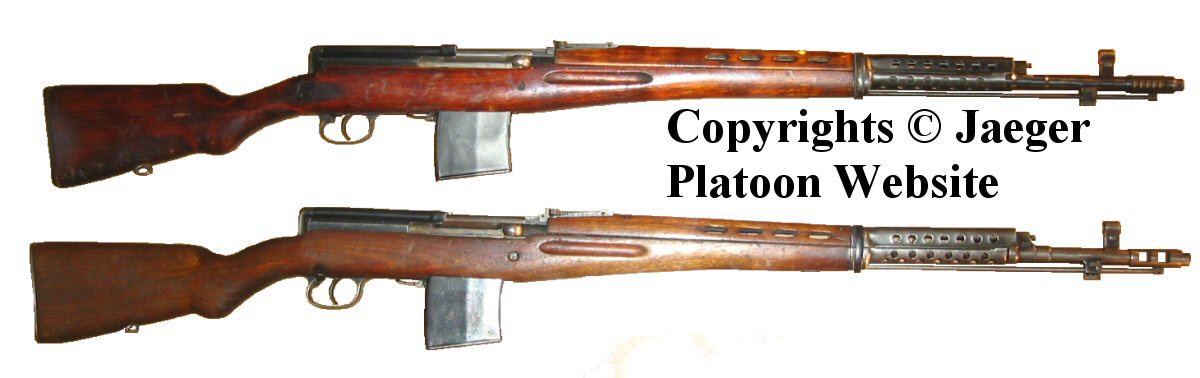
PICTURE: SVT-40 (top) semiautomatic rifle and AVT-40 (below) select-fire rifle. Notice the
differences in front-stock area when compared to SVT-38 above and location of cleaning rod under the barrel. Typical
AVT-40 had more robust rifle stock and muzzle brake with two large ventilation holes on each side. (Photo taken in Sotamuseo).
CLICK THUMBNAIL TO SEE LARGER PIC (92 KB).
|
Calibre: |
7,62 mm x 54 R |
||
|
Length: |
1225 mm |
||
|
Barrel length: |
620 mm |
||
|
Weight: |
4,2 kg (M/38) / 3,9 kg (M/40) |
||
|
Fire-rate: |
25/minute (practical) |
||
|
Magazine: |
10, removable |
||
|
Official abbreviations: |
"7,62 kautkiv/38" and "762 KAUTKIV 38" |
||
|
"7,62 kautkiv/40" and "762 KAUTKIV 40" |
|||
|
Country of origin: |
Soviet Union |
||
|
Prototype: |
1933 |
||
|
Production: |
SVT-38: 1939 - 1940. SVT-40: 1940 - 1942. AVT-40: 1942 - 1945. |
Finnish use: Finnish troops captured some 3,000 rifles SVT-38 during Winter War. Another 17,000 or so SVT-38, SVT-40 and AVT-40 were captured during Continuation War. Finnish frontline troops used these captured rifles, but their durability proved so weak that most broke or worn down and were warehoused for repairs, which never came. Only about 6,000 or so remained in use of Finnish fronts until end of Continuation War.
This Tokarev rifle won the Soviet automatic rifle tests of year 1938 and got officially approved to use of Soviet military in February of 1939. It also replaced Simonov AVS-36 in production in 1939 - 1940 and the Soviet leadership made plans for really large-scale production (by 1943 the yearly production would have been 2 million SVT-38 rifles per year). Manufacturing of rifle parts seems to have started in February of 1939 with first rifles being assembled in Tula at August of that year (in Tula, Izvesk apparently assembled its first rifles in October). Manufacturing started with two main manufacturers Tula and Izvesk, which produced about 31,400 in year 1939 and 160,500 in year 1940. From these two manufacturers Tula was the main one, manufacturing about 63.4% of the total number of almost 192,000 rifles. The third manufacturer was Podolsk, which started SVT-38 production only in year 1940 and manufactured only about 1,400 rifles. Also a scoped version of this rifle was introduced already in April of 1939, but apparently did not see mass-production. Just like with AVS-36, Finnish - Soviet Winter War proved to be a high mark for SVT-38 in Soviet use. Experiences gathered in combat during Winter War lead into designing of improved SVT-40, which replaced SVT-38 in production already in May - July of 1940.

PICTURE: Three Finnish soldiers photographed on skis in Harlu in March of 1940. The weapons that they
have (from left to right) are captured Soviet AVS-36 rifle, Finnish
Lahti-Saloranta M/26 light machinegun and captured Soviet SVT-38 rifle. All three men
appear to have standard issue military unform m/36, two of them have field cap m/36 and
soldier in the middle has fur cap m/39. Two of the soldiers also have with their belt Y-harnesses, which were issued
in rather limited numbers. Photographer unknown.(SA-kuva.fi archive, photograph number 6760). CLICK THUMBNAIL TO SEE
LARGER PIC (176 KB).
SVT-40 was lighter, had a new (one-part vs. two-part used in SVT-38) rifle stock design and was also slightly easier to manufacture. Early on the rifle looked very good in tests so the Soviet leadership decided to put into mass production - later this proved to be serious mistake. The Soviets started manufacturing of SVT-40 in three factories, which all shifted into manufacturing it from manufacturing of SVT-38 - Tula, Izvevsk and Podolsk. Once started, production of SVT-40 increased fast and largest production numbers are from year 1941 with over 1.1 million SVT-40 rifles made that year. Year 1941 was also the year when Germany invaded Soviet Union and caused Soviet military massive losses of soldiers and military equipment. This resulted the Soviets making major changes to their military small arms production. which would have major effect to manufacturing of self-loading rifles. Once combat experiences started to pile up SVT-40 did no longer look so good. Its parts proved to have durability issues, the shooting accuracy typically was not too great either and also reliability proved worse than expected. The durability issues were probably linked to problems, which the Soviets had with metallurgy in manufacturing of high-quality steel required for these rifles. It took some time until the Soviets noticed the problems and before that happened they already had mass-production of SVT-40 running at a full swing. They found that fixing the problems would have required so extensive changes to structure of the rifle, that they did not make sense. And due to being quite complicated to manufacture, mass-producing SVT-40 in factories with no previous experience about manufacturing small arms would not have been easy, which was not the case with submachine guns. Year 1942 Soviets started shifting resources of their small arms production to submachine gun production with rifle production focusing on manufacturing of easy to manufacture, cheap and reliable rifle M/91-30. Manufacturing of SVT-40 declined in drastic manner with both Tula and Izvesk stopping manufacturing of self-loading rifles in October of 1941 and shifting their production in manufacturing of bolt-action rifles (rifle M/91-30, carbine M/38 and carbine M/44). Also Podolsk stopped manufacturing of SVT-40 in October of 1941 and concentrated in manufacturing of light machineguns and other automatic weapons. What remained of the resources that the Soviets had dedicated to manufacturing of self-loading rifles were moved to Mednogorsk and Zlatoust - both of them near southern tip of Ural Mountains. Mednogorsk factory was based to Factory number 314 evacuated from Tula (located near Moscow). From these two new manufacturers Mednogorsk succeeded starting production, but Zlatoust failed in it. Mednogorsk produced about 115,000 SVT-40 in year 1942 before AVT-40 replaced SVT-40 in production. Captured Tokarev rifles seemed to have enjoyed some popularity among German soldiers, who knew these rifles as Selbsladegewehr 258 (r) and Selbsladegewehr 259 (r). This rifles are rather finicky and far more complicated to maintain than bolt-action rifles, which seems to partially explain their popularity with better trained forces, but much of the Soviet Red Army units enlisted during World War 2 did not really belong to that category.

PICTURE: Corporal Tauno Savolainen poses for photograph with his SVT-38 rifle. Hanging from his
belt are holster for Nagant m/1895 revolver and
puukko knife. Tauno Savolainen (1913 - 1944) was farmer and mapper, who was awarded with Mannerheim Cross in October
of 1941. While serving as combat messenger (runner) in Infantry Regiment 3 he in two occations had firefights against
enemy groups of more than ten men, won both firefights single-handedly and took number of prisoners of war. In somewhat
usual manner his uniform tunic still has Civil Guard district patch in it and also
has Civil Guard pursuit badge and Finnish Army marksmanship badge for submachine gun. Photographer 2nd
Lieutenant K.O. Räntilä. (SA-kuva.fi archive, photograph number 57804). CLICK THUMBNAIL TO SEE LARGER PIC
(207 KB).
Just like Simonov AVS-36 also SVT-38 and SVT-40 are gas-action rifles, but they are capable for semiautomatic fire only. Tokarev SVT rifles also have similar tangent-type rear sight as in AVS-36. SVT-38 has two-part rifle stock while SVT-40 had new one-part stock. The two rifles can easily separated from location of their cleaning rod (located right side of rifle in SVT-38 and below barrel in SVT-40) and differences in front part of their stocks. Both rifles have 10-round removable box magazines, which when the bolt was open can also be reloaded from the top with the same 5-round cartridge clips as used with Mosin-Nagant rifles. This reloading process was easy as after firing and ejecting the last round bolt stopped locked the bolt open. SVT-38 has muzzle brake with vertical six vent holes on each side. The same muzzle brake design was early on used also in SVT-40 until late version with two larger vent holes replaced it in late 1941. Safety switch is located in rear part of trigger guard and when engaged physically block movement of trigger. There are three known safety switch variations - first version introduced with SVT-38 and two versions used with SVT-40 & AVT-40.
Besides normal "plain vanilla" SVT-40 and AVT-40 the Soviets introduced also sniper rifle versions of these rifles. From these two SVT-40 sniper rifle was manufactured in much larger number than AVT-40 sniper rifle. However both of these had their own share of problems. Sniper version had short scope (basically the same as PU scope later used in M/91-30 sniper rifle, but with slight structural difference), which did not interfere loading and used cartridge case ejection processes of the rifle. The Soviets stopped manufacturing of M/91-30 sniper rifles in favour of SVT-40 sniper rifle year 1940, but this proved to be bad decision. While bore of the sniper version was more high quality work than usual, its other parts and structure were not on par for sniper use - the accuracy of SVT-40 sniper rifles proved less accurate than the M/91-30 sniper rifle that it replaced. Some 58,000 or so SVT-40 sniper rifles were manufactured before the Soviets decided to undo their earlier decision. October of 1942 they stopped manufacturing of sniper rifle version of SVT-40 and restarted production of M/91-30 sniper rifle variant. What is known suggests that no more than few hundred (probably 300) AVT-40 sniper rifles were manufactured - all of them in year 1943.

PICTURE: Finnish soldier in snow camo suit with captured
SVT-40 sniper rifle. Photo taken by Military Official H. Tornia near village of Osta (located in northern parts
of river Syväri / Svir) March of 1942. (SA-kuva photo archive, photo number 76622). CLICK THUMBNAIL TO SEE
LARGER PIC (139 KB).
AVT-40 select-fire rifle (capable for both semiautomatic and full-automatic fire) was accepted to manufacturing in May of 1942 and the first weapons came out of production line already in July of the same year. Mednogorsk was the sole manufacturer of AVT-40 and produced about 501,000 rifles in 1941 - 1945. When the production shifted into making AVT-40, this also resulted manufacturing of normal SVT-40 rifles ending in late 1941. The reason that allowed AVT-40 to enter production so fast was rather simple - the changes required for making SVT-40 select-fire automatic were only minor. Only real change happened with trigger group used in these rifles. While in SVT-40 the safety switch had only two settings - (semi auto) fire and safe, in AVT-40 the switch had also third setting for automatic fire. However, it is likely that AVT-40 rifles were mostly used in semi auto mode, since full automatic fire proved quite difficult to control and its use caused serious durability issues with the rifle. All the reliability issues of SVT-40 were still included to the design and now the automatic fire caused additional problems. When it comes to period photos muzzle brake design serves as fairly reliable detail for identifying AVT-40 - these rifles were all equipped with late muzzle brake design which has two large vent holes on each side. In addition new sturdier (read: beefier) rifle stock version was introduced for AVT-40 with only early production AVT-40 still using similar (thinner) rifle stocks as SVT-40. It is worth noting that refurbished SVT-40 rifles may contain variety of parts originating not only from SVT-40, but also SVT-38 and AVT-40. Manufacturing of AVT-40 ended with estimated 1,000 rifles or so being manufactured in January of 1945.
Finnish troops captured over 3,000 SVT-38 rifles during Winter War. Additional 17,000 SVT-38 and SVT-40 were captured during early part of Continuation War. These rifles were very popular among Finnish troops (hundreds were estimated being taken home as war souvenirs), which often took immediately captured Tokarev rifles to their own use. Sniper versions of both Tokarev rifles were very rare finds among weaponry captured by the Finns. However shortage of spare-parts was constant problem with these rifles, so before end of Continuation War over 14,000 of them had been handed over by the troops that had captured them and had been warehoused. Most of these rifles had ended to warehoused because of worn out barrels and/or other broken parts and waited repairs, which were never done. The reasons why these broken rifles were not repaired during the war were probably related to limited Finnish industrial capacity and not having any other source for spare parts than cannibalising some of the rifles for parts. But considering that the most common problems seem to have included broken rifle stocks and worn out barrels, which there the parts that Finnish industry could have rather easily manufactured, best guess is that limited industrial capacity with likely low priority value compared to other firearms in Finnish inventory resulted them being left them in warehouses for rest of the war. One of the reasons why so many of the captured semiautomatic and select rifles broke down during the war was likely Finnish standard issue ammunition (with 13-g/200-gr D166 bullets and cartridge cases made from brass), since these rifles had been designed for ammunition which had much lighter (9.6-g/148-gr) bullets and cartridge cases made from steel. January of 1945 Finnish military ordered all Tokarev rifles not fit for combat to be scrapped. In 1950's remaining Tokarev rifles were used for training with several thousand rifles being repaired for this purpose. Due to not having other source of spare parts they were typically fixed with parts cannibalised from other captured broken Tokarev rifles. Hence the resulting rifles tended be mix of parts originating from numerous rifles. Even plans about recycling their parts for manufacturing of new Finnish combat rifle surfaced around that time. But as intentions soon focused to assault rifles the whole plan for developing Finnish semiautomatic rifle based to SVT rifles was buried. Year 1958 remaining Tokarev rifles were declared obsolete and sold abroad via Interarms around 1959 - 1961.

PICTURE: Two Finnish soldiers take a aim with their rifles. Photo taken by Manninen on Kuhavuori
hill in city of Sorvala in August of 1941. The rifles seen in this photo represent the two extremes of rifle models
in use of FInnish military at that time - infantry rifle M/91 and SVT-40. Infantry
rifle M/91 had first been introduced to military use 50 years earlier, while SVT-40 had been introduced the previous
year with first of its kind falling to Finnish hands in year 1941. Steel helmets that the soldiers are wearing appear
to be Hungarian M/38 with steel wire attached for camouflage and Czechoslovakian M/34. (SA-kuva.fi archive, photo
number 34115). CLICK THUMBNAIL TO SEE LARGER PIC (182 KB).
While Tokarev automatic rifles seem to have been popular among Finnish soldiers during World War 2, Finnish Army was not quite as impressed about these rifles. Official wartime Armed Forced Ordnance Department report notes that while benefits of semiautomatic rifle (vs. bolt-action rifle) are obvious, durability and reliability of these captured rifles was still considered poor for combat use. The report lists following details:
Finnish Army captured also few hundred select-fire AVT-40 rifles (mainly in summer of 1944) and as with other Tokarev rifles Finnish troops usually took them immediately to their own use. In Finland these rifles got the same fate as Tokarev semiautomatics. Finnish troops captured also small number of SVT-40 sniper rifles. As Finnish troops suffered constant acute shortage of sniper rifles these were pressed immediately to their own use. As usual the soldiers, who captured them also took many of the captured SVT-40 sniper rifles home as "war souvenirs".

PICTURE: Finnish soldier photographed while cleaning sand from his SVT-40 rifle. Photo
taken by Military official P. Jänis in Rukajävi region in August of 1944. Soldier in the photo
appears to be wearing German or Austo-Hungarian World War 1 era steel helmet with camouflage attached on
top of it with steel wire and greatcoat M/36. (SA-kuva.fi archive, photo number 156775). CLICK THUMBNAIL TO
SEE LARGER PIC (231 KB).
Tests made by Sako factory with captured SVT-38 in year 1940:
Finnish military was so interested about captured Soviet automatic rifles, that it ordered research of them from Sako factory. Sako tested and researched captured SVT-38 rifle and reported back in November of 1940. While not mentioned in the report the timing of tests and certain details (such as mentioning two part rifle stock and two barrel bands) indicate that the rifle Sako made this report from was indeed SVT-38. Findings of Sako testing personnel are quite interesting - even if they seem to partly reflect the (overly?) high accuracy standards set by Sako for military rifles. The main content of this report:
First SVT-38 based prototype made by Sako - TaPaKo
Sako report from November of 1940 also contained list of recommended improvements and Sako also manufactured from SVT-38 their own prototype rifle, which contained many of the suggested improvements. This Sako prototype rifle was unofficially named TaPaKo, a name containing first letters from last names of the persons, who mainly took part designing it. These persons working in Sako were N. Talvenheimo (Ta), O. Paronen (Pa) and N. Koivula (Ko). This Finnish version makes interesting comparison with the improved rifle based to SVT-38 that the Soviets introduced - SVT-40. According one of those three persons that mainly designed TaPaKo-prototype, Niilo Talvenheimo, already in June of 1940 captured SVT-38 was at the time considered highly promising design, which with some improvements could have had its main problems solved and had potential of being capable to be produced at about similar cost as Finnish Mosin-Nagant rifles, although that would have included the cost of manufacturing receiver and bolt, which the Finns recycled from earlier produced Mosin-Nagant rifles instead of manufacturing them.
The Sako list of improvements and info about Sako prototype rifle compared to SVT-40:Sako tested its modified prototype rifle before delivering it. The test results showed that the prototype showed the accuracy approximately the same as with M/28 and M/28-30 rifles, whom Sako had manufactured. Just introducing heavy one part rifle stock and improving attachment of receiver to it, reduced vertical dispersion of shots in target to one third of the original. Finnish Armed Forces Ordnance Department tested this rifle against original SVT-38, VKT L-39 prototype and Pelo automatic rifle prototype as comparison weapon in autumn of 1941. Only one prototype of TaPaKo was ever manufactured. Even if the Sako prototype had proved quite favourable in tests this did not lead to further production. Finnish military captured some 17,000 Tokarev semiautomatic rifles year 1941. While this might have made sense modifying captured SVT-rifles with improvements suggested by Sako would have demanded much too work and would have been too expensive for limited Finnish industrial capacity during the war. However the effect of Tokarev SVT rifles was such that Finnish industry kept designing new automatic rifle prototypes based to Tokarev rifles as late as year 1956. But in the end none of these prototypes saw production beyond prototype stage.

PICTURE: SVT-40 disassembled for routine maintenance. Gas piston and trigger mechanism have not been removed, because the photographer was lazy and the rifle clean. :-) While cleaning the rifle removal of gas piston and its careful cleaning are highly recommended. CLICK THUMBNAIL TO SEE LARGER PIC (108 KB).
Author's personal experiences concerning shooting with SVT-40 Tokarev rifles: As you have probably already noticed, both accuracy and reliability of these rifles have been debated over and over again. Based to author's own experiences of shooting with SVT-40 rifles, which had good bores, these rifles have more than enough accuracy for hitting man-size targets from typical combat distances. In fact in my opinion for practical combat use the difference in accuracy between these rifles and bolt-action rifles of World War 2 era is basically negligible. While most scoped SVT-40 probably would not have passed the accuracy requirement of western sniper rifles, the typical scoped SVT-40 was likely accurate enough to fit use not very different to rifles used today in fire support sniper and designated marksman roles. Reliability-wise these rifles have certain issues, but with good maintenance and proper ammunition they are not as unreliable as often blamed. Due to fluted cartridge chamber I recommend steel cased ammunition for gaining good reliability. Also, it is highly recommendable to use ammunition loaded with light bullets (Only ammunition type listed in Soviet manuals for this rifle was their standard ball ammunition with 9.6-gram/148-grain bullets). Likely first impression for anybody first time taking SVT-40 in their hands are its considerable length and light weight giving (somewhat rightfully so) impression of fragile and delicate rifle. As noted in reports, above the attachment of receiver and barrel to rifle stock is rather flimsy - locked in place by crossbolt on the other end of receiver and trigger guard + receiver combination in the other end.
Reloading magazines and inserting/removing them to/from rifle is easy as long as one remembers to insert the cartridges into magazine in such manner that it does not cause rim-lock. Safety switch (which physically blocks movement of trigger) is idiot proof in its simplicity, but difficult to use with gloves on. Sights with M/91-30 type tangent rear sight and front sights are fully adjustable. Rifle's point of balance is somewhat front of magazine, close to location of cross-bolt. Front sight has both windage and elevation adjustments for zeroing in the rifle. Elevation adjustment in front sight requires a tool (most if not all AK-47 and SKS sight adjustment tools will work for this). In addition also gas-regulator requires its own tool, which can be difficult to find, but luckily reproductions have been made in USA. Sight picture with good U-notch on rear sight and reasonable large square bead in front sight surrounded by front sight hood is pretty good both for fast and accurate shooting. Trigger is somewhat heavy but perfectly workable two-stage with some creep. I have noted that the groove in the rifle stock intended for the weak hand is too far front in the stock for most shooters - grabbing either front part of magazine or the part of stock just in front of it works better for my left hand. As already noted carrying the rifle on shoulder with its sling for extended periods of time is not very comfortable, since the attachment points for rifle sling are rather poorly located. Original Soviet magazines are expensive and are not compatible with all rifles, but seem to work fairly reliably. Also reproduction magazines have been manufactured, but may require some fitting to get ot even lock into magazine well properly. As to be expected basic maintenance disassembly and re-assembly of this rifle is much more complex than with bolt-action rifles, but still manageable and relatively swift process after getting used to it. For basic maintenance the rifle breaks into about 18 - 20 parts, depending if trigger mechanism is removed and if spring is removed from rear spring guide. If cleaning rod is used the correct way (from the rear) for cleaning the barrel, it must be rather thin to get through hole in the rear receiver. The original cleaning rod works like this, but all after-market cleaning rods may not. Cleaning rod attachment of this rifle is somewhat weak and recoil may release the cleaning rod, in which case it is smarter to shoot the rifle without it.
SOURCES:
Markku Palokangas: Sotilaskäsiaseet Suomessa 1918 - 1988 osat 1 - 3 (= Military Small Arms in Finland 1918 - 1988 parts 1- 3).
Timo Hyytinen: Arma Fennica 2, sotilasaseet (Arma Fennica 2, military weapons)
D.N. Bolotin: Soviet Small-Arms and Ammunition.
Bruno Bogdnovic and Ivan Valencak: Das Groze Buch der klassischen feuerwaffen.
Jan Kronlund: Suomen Puolustuslaitos 1918 - 1939 (= Finnish Defence Department 1918 - 1939)
Timo Räätäli: Kolmen linjan kivääristä automaattiin (= From Three Line Rifle to the Avtomat).
Article: Puna-armeijan automaattikivääri malli 1936, Simonovin erävoitto by Mika Vuolle in Kaliberi magazine vol. 2/1996.
Article: Kerta-automaattikiväärit malli 1938 ja 1940, Tokarevin pitkä tie by Mika Vuolle in Kaliberi magazine vol. 1/1996.
Article: Tokarev SVT-kiväärien heikkoudet by Matti Ingman in Ase-lehti magazine 3/2005.
Article: Toveri Tokarevin SVT-38 by Mika Pitkänen in Kaliberi magazine vol. 8/2011.
Aleksandr Borisovitsh Zhuk: Ase-Atlas, Maailman käsiaseet (= Weapons Atlas, World's Handguns)
Special thanks to Sotamuseo (Finnish Military Museum), Helsinki.