


REVOLVERS & PISTOLS PART 1:
Parabellum & Lahti L-35
7,65 mm Pistol M/23 and 9 mm Pistol M/08 Parabellum:
(Selbstladepistole "Parabellum", kaliber 7,65 mm)
(9 mm Parabellum-pistole Modell 1908, P-08)

PICTURE: Parabellum M/23 with shoulder stock attached. This pistol is standard M/23 pistol - with its
normal barrel. When equipped with shoulder stock the pistol basically become small carbine of sort, which is easier
to shoot in extended ranges than just pistol. When not in use shoulder stock was carried attached to pistol
holster, but apparently made carrying the pistol somewhat clumsy, which is probably why the shoulder stocks are often
missing in wartime photos. (Photo taken in late Viestimuseo). CLICK THUMBNAIL TO SEE LARGER PIC (55 KB).

PICTURE: Parabellum M/23 in its normal original form - 7.65 mm x 21 caliber and with gun
barrel slightly shorter than four inches. (Photo taken in Sotamuseo). CLICK THUMBNAIL TO SEE LARGER PIC (71
KB).
|
Calibre: |
7,65 x 21 Parabellum (.30 Luger) |
||
|
Length: |
210 mm / 213 mm / 215 mm / 225 mm (*) |
||
|
Barrel length: |
95 mm / 98 mm / 100 mm / 120 mm (*) |
||
|
Weight: |
890 g |
||
|
Magazine: |
8, removable |
||
|
Official abbreviations: |
"7,65 pist/23" and "765 PIST 23" |
||
|
Country of origin: |
Germany |
||
|
Prototype: |
Parabellum m/1900 prototype in 1898 |
(*) Originally German manufacturs had manufactured two barrel lengths for these pistols - 95-mm and 98-mm. Later Finnish manufacturers Sako and Tikkakoski manufactured also 100-mm and 120-mm long replacement barrels for them.

PICTURE: Parabellum M/08. This pistol has safety on, which reveals the
German-language text GESICHERT (SAFE), which is blocked by safety switch when it is off. Finnish
Army listed 7.65-mm Parabellum pistols as pistols M/23, while 9-mm Parabellum pistols were listed as
pistol M/08. This particular pistol seems to have Tikkakoski-manufactured 9-mm barrel, which is 96-mm long.
(Photo taken in Sotamuseo). CLICK THUMBNAIL TO SEE LARGER PIC (118 KB).
|
Calibre: |
9 mm x 19 Parabellum/Luger |
||
|
Length: |
214 mm / 210 mm / 234 mm (**) |
||
|
Barrel length: |
102 mm / 96 mm / 120 mm(**) |
||
|
Weight: |
900 g |
||
|
Magazine: |
8, removable |
||
|
Official abbreviations: |
"9,00 pist/08" and "900 PIST 08" |
||
|
Country of origin: |
Germany |
||
|
Prototype: |
Parabellum m/1900 prototype in 1898 |
(**) Original barrel length for normal P-08 pistol was 102-mm. Tikkakoski made 9 mm x 19 calibre replacement barrels were manufactured in two lengths: 96-mm and 120-mm.
Finnish use: Finnish military acquired 8,000 7,65-mm Pistol M/23 in 1920's. The first delivery of 2,000 arrived in July of 1922. Small number of 9-mm pistol M/08 also saw use with Finnish military. 7,65-mm pistol M/23 was the most numerous pistol used by Finnish front-line troops during World War 2. They remained in use of Finnish military until 1980's. During Continuation War and later M/23 pistols with worn barrels were modified to 9 mm x 19 cartridge by replacing barrel and return spring - modification which in effect made them pistol M/08.
The name Parabellum originates from old Latin phrase "Si vis pacem, para bellum" ("If you want peace, prepare for war"). Another name, with which the pistol is commonly known (especially in the US) is "Luger" coming from the name of the person who invented this pistol - Georg Luger. The toggle-mechanism used by Georg Luger in his parabellum pistol was based to one used in Borchardt C93 pistol. First country to accept Parabellum pistol as military weapon was the Switzerland, whose military used Parabellum pistol models 06 and M06/29 chambered for 7.65 mm x 21. However also 9 mm x 19 cartridge had been developed for this pistol already year 1902. The two cartridges were pretty much interchangeable when it comes to Parabellum pistol - changing the pistol from one cartridge to another required only replacing of barrel and return spring. 9 mm x 19 ammunition started its way to worldwide standard when German Navy accepted 9 mm Parabellum pistol with 150-mm long barrel in year 1904. But the really large German military contract did not appear until German Army selected 9-mm P-08 pistol as their official sidearm in year 1908, with the pistol being named P-08. Standard German Army P-08 in its original form had 102-mm barrel. P-08 and its lange pistole 08/artillery- (with 20-cm long barrel) and Navy version (with 15-cm barrel and rear sight with two range setting options for 100 and 200 meters) remained in production until end of World War 1. As the names suggest Navy Luger was manufactured for German Kriegsmarine (Navy), while Lange Pistole (LP 08) / Artillery version was intended for field artillery units of German Army. Before and during World War 1 German armaments industry (basically DWM and Erfurt factories in this case) manufactured some 1.5 - 2.0 million Parabellum pistols (depending source). About 178,000 of these pistols were lange pistole 08, which really only entered into production during World War 1..

PICTURE: Senior Sergeant Kejonen inspects his Parabellum pistol. Pistol's magazine can be seen on
his knee. Considering barrel length the pistol in probably M/23 in 7.65 mm caliber. Notice that the pistol's grip panel
has place for unit disc. Before World War 2 Finnish military commonly used brass unit discs indicating military unit in
its pistols and rifles, but practically all of these discs were removed during the war. Photographed by Military
official V. Hollming in May of 1942. (SA-kuva.fi archive, photograph number 86605). CLICK THUMBNAIL TO SEE LARGER PIC (165 KB).

PICTURE: Parabellum M/23 with (7.65-mm caliber) longer (120-mm) replacement barrel. Also
front sight post seem to have probably been replaced with larger one. Notice that Swiss M1900 Parabellum, which was
as well in 7.65 mm x 21 was with 120-mm pistol barrel. (Photo taken in Sotamuseo). CLICK THUMBNAIL TO SEE LARGER PIC
(53 KB).
Finnish Army had shortage of military pistols in early 1920's. Large number of pistols had been bought from France in year 1919, but had proved less than ideal for military use. So decision was to purchase Finnish military new military pistol. At 1920's large part of Finnish officer corps was "Jaeger officers", who had served in German Prussian Jaeger Battalion 27 during World War 1 and had formed officer corps after their return in middle of Finnish Civil War in 1918. They had previous good experiences and very favourable opinions about P-08 Parabellum pistol, so naturally Parabellum P-08 was the obvious first choice to be considered as new standard issue sidearm for Finnish military. Not that it would have been poor choice for the purpose in early 1920's. Finnish company N.C. Fabricius Oy was used as a intermediary. It soon become apparent that only Parabellum pistol available from Germany was 7,65 mm pistol M/20. At that time 9-mm Parabellum pistols would have been available from Belgium, but they would have been much more expensive and their delivery schedule would have been considerably slower. The Finns decided to buy the 7,65-mm Parabellum pistols from Germany and the first shipments of 2,000 pistols arrived in July of 1922. Year 1923 additional 2,000 pistols were bought and at that time Finnish Army officially named the pistol as M/23. More pistols M/23 were bought later on and by summer of 1929 Finnish Army had acquired in total about 8,000 pistols M/23. Pistols M/23 bought from Germany do not appear to have been newly manufactured guns, but in fact earlier manufactured P-08 pistols equipped with 7.65 mm calibre barrel and refurbished very nicely. After decision about developing of domestic military pistol type (L-35) was made around year 1929, purchases of M/23 were stopped. Also Suojeluskunta (Civil Guard), its members and Finnish civilians purchased Parabellum pistols in large numbers in 1920's and 1930's from commercial market.
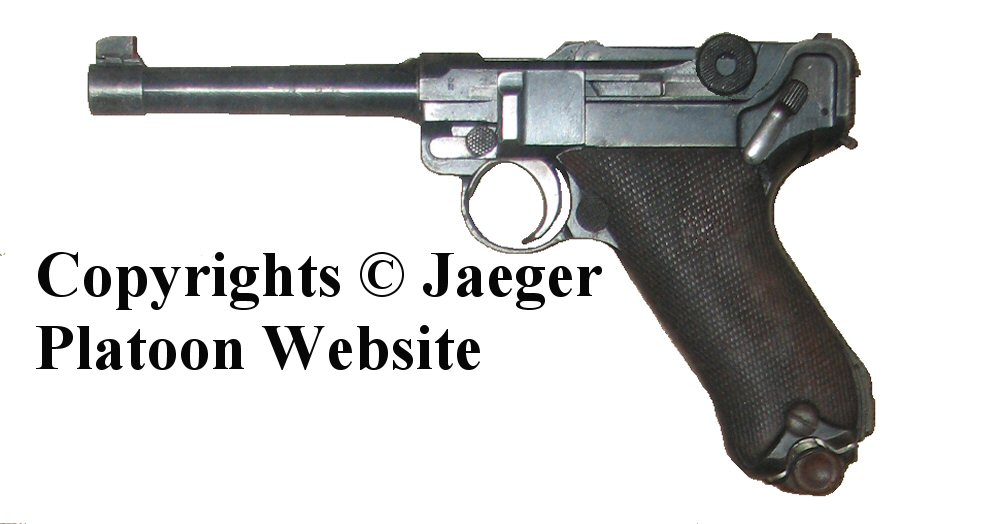
PICTURE: 9-mm Parabellum pistol with 120-mm long Tikkakoski-manufactured gun barrel. Notice also new
larger front sight post, which combined with enlargened rear sight notch gives better sight picture. This sight
improvement was typical post-war modification made to Finnish Parabellum pistols made by target shooters during late
part of military use or civilian ownership. (Photo taken in Uudenmaa/Nyland Brigade). CLICK THUMBNAIL TO SEE LARGER PIC
(63 KB).
During Winter War pistols M/23 were issued mainly to front-line troops, this resulted quite high losses and in summer of 1940 only 7,082 pistols M/23 remained. During Continuation War M/23 pistols were again mostly used by frontline-troops and this is visible in level of losses - by February of 1944 the number of remaining Parabellum pistols had dropped to only 4,850 pistols. Not only were lot of these pistols lost or broken in battles but also hard use also wear out lot of them. Yet another factor, which reduced their numbers during World War 2 was replacing original barrels with 9-mm caliber replacement gun barrels manufactured by Sako and Tikkakoski. When equipped with 9 mm x 19 calibre replacement barrel pistol M/23 turned into pistol M/08 in inventory of Finnish military. Apparently replacing original 7.65-mm barrel with 9-mm barrel became so common during World War 2, that Armed Forces Ordnance Department (*) was forced to sent a circular letter forbidding this practice in all such cases in which the original gun barrel had not either worn out or damaged. This reason behind this ban was not only avoid unnecessarily burdening industry and depots with this sort of work. But also likely because Finnish-manufactured standard issue 9 mm x 19 Parabellum ammunition available at that time was designed for Suomi m/31 submachine gun and loaded so hot, that it would make short work of breaking apart toggle of Parabellum pistol. The ammunition-related problem with 9 mm x 19 Parabellum pistols was apparently a major problem during World War 2. Year 1951 only 3,724 of the original 8,000 pistols remained. Even with its total number dwindling, pistol M/23 remained as most common sidearm in use of Finnish military until 1980's. Finally in early 1980's new Pistooli 80 (FN High-Power DA) replaced it and old M/23 pistols were sold to civilian market. Besides its 2nd hand origins pistol M/23 had very good reputation among Finnish troops and served very well during its long career.
(*) Ordnance Department of Finnish Armed Forces General Headquarters. During World War 2 this was the authority responsible of equipping Finnish military with small arms and other weapons plus their ammunition and associated equipment.

PICTURE: Leader of machinegun team points out target to machinegunner, who is operating Maxim machine
gun. The team leader, who is presumably either corporal or sergeant has Parabellum pistol in his other hand. Finnish Army
issued pistols to officers and non-commissioned officers, but there were never enough pistols for supplying pistol to
everybody who was supposed to be issued one, hence rifles were often used as substitute. The team leader appears to have
Hungarian m/38 steel helmet, while machinegunner has World War 1 era Austrian m/17 . Photographed by Erkki Viitasalo in
September of 1942. (SA-kuva.fi archive, photograph number 109249). CLICK THUMBNAIL TO SEE LARGER PIC (203 KB).
Finnish Army used also smaller number of 9-mm calibre Parabellum M/08 (P-08) pistols during World War 2. Some had been left behind from Civil War of 1918, during which Finnish White Army and Jaegers had succeeded acquired small number of them. Some had also ended up to Army later little by little (largest single wartime purchase: 56 pistols bought from Belgium in February of 1940). By summer of 1940 some 224 Parabellum pistols of 9-mm calibre had ended up to Finnish Army use. In addition to this many of the Jaegers now serving as officers of Finnish Army had privately acquired Parabellum pistols. During Continuation War small amount of pistol M/23 were modified by replacing their 7.65-mm caliber gun barrels with new 9-mm barrels (this continued in small numbers also after the war) made by Tikkakoski. Tikkakoski factory also manufactured 7.65-mm replacement barrels, so replacing the barrel did not always result to change of calibre. Besides typical P-08 like M/08 pistols Finnish military also had small number (likely between 100 - 200) of the lange pistole 08 (artillery Luger). At least 100 of lange pistole 08 had been bought from Germany in year 1918 and small number may have arrived with Jaegers during Civil War and acquired by other individuals. According one source in addition of normal P-08 pistols also very small number (at least 22) of Navy-version Parabellum pistols arrived to Finland with Jaegers in December of 1917.

PICTURE: Lange Pistole 08 also known as artillery version of Parabellum / Luger pistol. Notice
tangent rear sight and its location. What is known Finnish military had in total only about 100 - 200 of these pistols.
Photo source Armémuseum (Sweden), acquired via Digitaltmuseum.se
and used with CC BY 4.0 Creative Commons license.
CLICK THUMBNAIL TO SEE LARGER PIC (54 KB).

PICTURE: 2nd Lieutenant U. Lamminen poses to photographer with his pistol after winning
of pistol competion in October of 1943. The position in which he poses was the standard pistol shooting pose of that time.
The pistol holster seen in this photo was the standard holster type Finnish Army issued with Parabellum pistols. The
holsters originally delivered to Finland with these pistols in 1920's were surplus German World War 1 era holsters, but
similar leather holsters were also manufactured in Finland for these guns. Photographed by Military official Uuno Laukka.
(SA-kuva.fi archive, photograph number 141144). CLICK THUMBNAIL TO SEE LARGER PIC (166 KB).
Nowadays Parabellum pistols are again quite popular among those Finns who seek nostalgic, but accurate pistol. However ammunition availability is a bit difficult. Ammunition in 7.65 mm x 21 calibre can be difficult to find since only two known manufacturers remain - Fiocchi and Prvi Partizan. If a lot of shooting is done with 9 mm x 19 calibre Parabellum-pistol, then using ammunition less powerful than the European standard of these days is recommended. In Finland Lapua manufactures every now and then 9 x 19 ammunition with 8-gram/123-grain FMJ bullets and 320 m/sec muzzle velocity - this is about the maximum load that can be recommended for old P-08 pistols. Parabellum-pistols are highly valued collector's items, which reflects to their prices and availability.

PICTURE: 7.65-mm caliber Parabellum pistol disassembled for routine maintenance. This particular pistol
was been "demilitarized" by removing its stock attachment lug when it was rebuilt to 7.65-mm caliber probably in
1920's. While this sort of version was not bought by Finnish military, Parabellum pistols were popular among Finnish
civilians in 1920's and 1930' with large number of pistols going to World War 2 with their owners. This photo also gives
rather good impression about the complex structural design of Parabellum / Luger pistol. CLICK THUMBNAIL TO SEE LARGER PIC
(84 KB).

PICTURE: Finnish Civil Guard (Suojeluskunta) pistol shooting competion in year 1931. Photo crop.
Parabellum pistols were widely popular in Finnish civilian market in 1920's and 1930's. These pistols were in particular
very common among privately owned pistols among guardsmen of Civil Guard. Photographed by Pietinen. Photo source Finnish H
eritage Agency (Museovirasto), acquired via finna.fi and used with
CC BY 4.0 Creative Commons license. CLICK THUMBNAIL TO SEE LARGER
PIC (166 KB).
Author's personal experiences concerning shooting with 7.65-mm and 9-mm Parabellum pistols: First impression is of remarkably high quality of workmanship. Trigger is quite good, although often bit vague and mushy and single-stage in that sense that there does not seem to be obvious pressure point after which it breaks and trigger may vary from one indivual pistol to another. Trigger pressure varies depending individual pistol from reasonable to insanely light, with the insanely light trigger pressure likely being result of trigger-job done during civilian ownership. Do it yourself trigger job is most definitely not recommended - key components of trigger system are only surface hardened, so grinding or even polishing them is a poor idea. Original sights give very tight sight picture, which makes shooting this otherwise mechanically very accurate (no tilting barrel to effect mechanical accuracy negatively) pistol challenging. The typical post-war (civilian) modification was replacing original front sight post with larger one and opening up the rear sight V-notch to larger U-shape notch. With this sight modification the pistol the sight picture is very much improved which makes the pistol notably faster and easier to shoot, but it also causes significant drop of collector value, hence I do not recommend doing to it any Parabellum pistol which has original sights. When magazine release button is pushed, the magazine drops right off. Reliability seems to be otherwise pretty good, but loading of the first cartridge into breech has to be done in correct manner to avoid tip of the bullet hitting above breech and jamming the whole pistol. Correct way of doing this - insert loaded magazine, pull the toggle as far back as possible and release it. When this pistol is equipped with removable shoulder stock it turns into small carbine, which has notably easier to shoot accurately to especially to extended ranges than just a pistol - even the tight sight picture works well with shoulder stock. While using pistol with removable stock attached takes bit of practice to get used to, with it hitting targets from distance of 50 meters is remarkably easy. Combination of the pistol and shoulder stock is light weight, but when handled also gives impression of being somewhat fragile and notably clumsier to use than just the pistol. While handling firearms in general requires diligence and understanding of safe conduct, due to its design Parabellum pistol requires more diligence than most. Unfortunately structural design of these pistols makes possible to fire a cartridge with only receiver and toggle combination, which does not even need to be with frame of the pistol during accidental misfire. So - before starting to disassemble this pistol remember to double-check that there are no cartridges in it. (Notice: This is based to experience shooting with three individual Parabellum pistols and in some extent old pistols are always individuals - so all of the above does not always apply to all pistols of this type).
9 mm Pistol L-35 "Lahti":
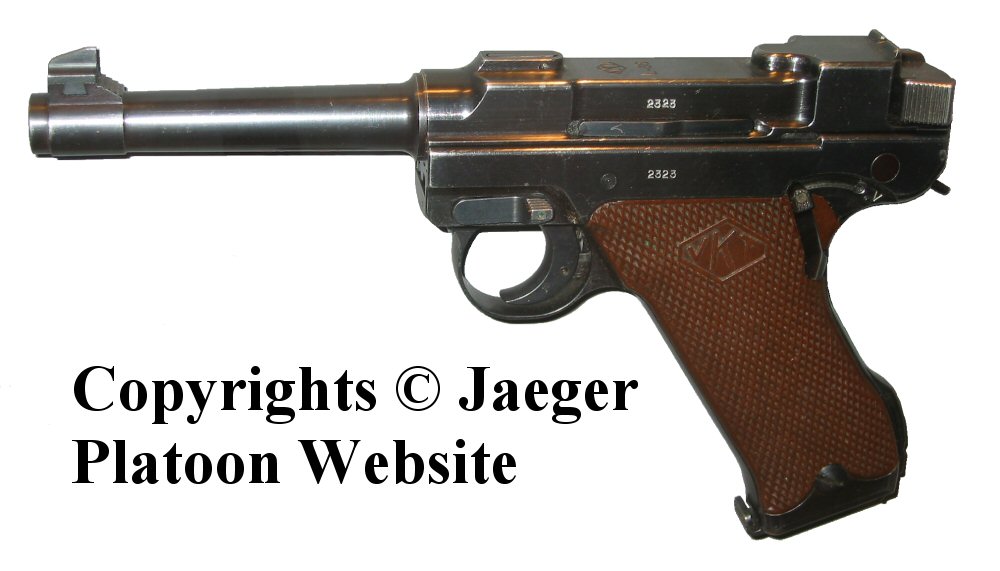
PICTURE: Lahti L-35 pistol belonging to series 1. Notice loaded cartridge chamber indicator on top
of ammunition chamber and "curve" in top of the slide. This "curve" wasn't no longer present in later
series. Finnish L-35 pistol has serial number only in three places, two of which are both visible in this photo. (Photo
taken in Sotamuseo). CLICK THUMBNAIL TO SEE LARGER PIC (71 KB).
|
Calibre: |
9 mm x 19 Parabellum/Luger |
||
|
Length: |
240 mm |
||
|
Barrel length: |
120 mm |
||
|
Weight: |
1250 g |
||
|
Magazine: |
8, removable |
||
|
Official abbreviations: |
"9,00 pist/35" and "900 PIST 35" |
||
|
Country of origin: |
Finland |
||
|
Prototype: |
1st prototype in 1929, last prototype in 1935 |
||
|
Production: |
1938 - 1945 and early 1950's. Total production about 9,000. |
Finnish use: This Finnish designed and manufactured pistol was issued to frontline-units during Winter War (1939 - 1940) in very small numbers and in growing numbers during Continuation War (1941 - 1944). After World War it remained in use of Finnish Armed Forces until 1980's.
Aimo Lahti got the idea for developing this pistol from his superiors in autumn of 1929. In those days Lahti was supervising the mass-production of Lahti-Saloranta light machineguns, so he had very little free time. To be accurate he didn't receive exact order for developing a new military pistol, it was more like suggestion for of seeing if he could develop new pistol for tests, which would be arranged in near future. The original rather vague specifications for the new military pistol were simply:
Weapon against which the new pistol would be naturally compared was German Parabellum used by Finnish Army at that time. Lahti managed to get the first version designed already in autumn of 1929 and Weapons-technical depot in Helsinki made the first prototype. Locking mechanism used by Lahti in his pistol had its roots in Parabellum, but in the new locking mechanism the bolt retreats directly backwards with its full length. Pistol has a clear visual resemblance to Parabellum, but its mechanism is very different. First prototype L-29 was in 9 mm x 19 (Parabellum) calibre, but it had been designed suitable for both 7.65 mm x 21 and 9 mm x 19 Parabellum cartridges. But soon 9 mm x 19 ammunition was selected as its future calibre because it was more suitable for submachinegun use (making large capacity magazines was easier for it). Even today the original L-29 prototype still exists, after being originally tested by shooting 6,000 rounds.

PICTURE: Major Kämäri, who was battalion commander of 2nd Battalion
of 19th (Infantry) Brigade, points map location with his Lahti L-35 pistol to Lieutenant while issuing
orders for combat. Notice open pistol holster, this sort of holsters for L-35 and Parabellum pistols appear in
Finnish Army World War 2 era photographs every now and then, they were non-standard and appear to include both
privately bought new purpose-built pistol holsters and field-modifications of standard issue holsters. Both
officers have Czechoslovakian m/34 steel helmets. Photographed by Military official Kauko Kivi in June of 1944.
(SA-kuva.fi archive, photograph number 155244). CLICK THUMBNAIL TO SEE LARGER PIC (225 KB).
Year 1931 Lahti made some improvements to blueprints of L-29 pistol. These improvements mainly concentrated removing problems, which would have hampered its mass-production. Prototype of improved L-31 pistol was manufactured, but it broke down in tests. Lahti made several further improvements, which led into test version L-29/35 in 1935. In this version the shape of slide and bolt has been modified to be more angled and a new safety switch was added.
First tests arranged with-in the Army gave a cold shower. Shooters accustomed to Parabellum-pistol found many things to complain in this new pistol. The most usual complaints were:

PICTURE: 2nd Lieutent Gustafson with his Lahti L-35 pistol. Photographed by Military
official E. Nurmi in July of 1942. (SA-kuva.fi archive, photograph number 101437). CLICK THUMBNAIL
TO SEE LARGER PIC (236 KB).
June of 1935 weapons committee of infantry and light anti-aircraft weapons decided that the pistol could be put into production as soon as the certain problems had been fixed. The trigger mechanism was improved, but the pistol remained heavier and larger than Parabellum. 28th of January 1936 order of 2,500 L-35 pistols was sent to VKT. Price per pistol was to be 650 Finnish marks. February of 1937 pistol L-35 was accepted into mass-production, but the decision demanded wooden grip panels first to be replaced with ones produced from bakelite (type of early plastic). Tests had revealed that the grip panels made from wood could become bloated after getting soaked and block pistol's trigger mechanism.
Modifications made for the design further delayed starting of mass-production and also the original cost per pistol proved to be too small. When the pistols per unit price was re-calculated in 1938 it proved to be almost double the original, being now 1,290 Finnish marks per pistol. Test series of five pistols were not finished and given to Army until March of 1938, in July of that same year a larger test series of 94 pistols was completed. Tests done with this test series in Army units revealed several problems, luckily Aimo Lahti had already predicted most problems and managed to develop improvements needed for removing them. These prototypes had wooden grip panels, all actual production pistols had brown bakelite grip panels with VKT-marking.

PICTURE: Non-commissoned officers of Finnish Army with their pistols photographed during pistol
shooting competition. Two of the soldiers seen in the photo have Lahti L-35 pistols, while the one in middle has
Parabellum. Photographed by Military official J. Taube in June of 1942. Photo crop. (SA-kuva.fi archive, photograph
number 91228). CLICK THUMBNAIL TO SEE LARGER PIC (241 KB).
July 1938 the old order of 2,500 pistols was cancelled and a new order of 7,642 L-35 pistols was introduced. The price in this new order was now 1,290 marks/pistol. VKT, which made these pistols, was to deliver them in deliveries of 1,000 pistols in every 3 months. However, the manufacturing didn't start as fast as planned and in summer of 1939 Finnish Armed Forces were still waiting for the first delivery. Whole production had been halted for checking construction of these pistols. March of that year 28 pistols with improved structural design were given to military units for tests. The test results showed that they were much better than earlier tested prototypes. The newly added 23 improvements had resulted much better pistol. Further comparison tests between L-35, Colt 1911A1, FN High Power and Swedish FN (Husqvarna) m/07 were also made in March of 1939. After this test a decision was made to hasten the production of L-35.

PICTURE: Production series 0 L-35 pistol. Production series 0 was the first production series of L-35 with bit less than 100 pistols total being manufactured for field testing in year 1938. Neddless to say nowadays pistols of this production series are extremely rare. Pistols of this series had some internal structural features, which were deemed unncessary and omitted from later production series. Photograph courtecy of Logan L. CLICK THUMBNAIL TO SEE LARGER PIC (88 KB).
Collectors usually divide production of L-35 pistol the following way:
Last L-35 pistol delivered to Finnish Armed Forces had serial number 6731. Third and less famous part of series 3 production were few hundred pistols (that have four digit serial numbers with V-prefix and no SA-marking) made from parts rejected by Finnish military and sold to civilian market. This series of few hundred pistols that has V-prefix in its serial numbers seem to have their serial numbers in between V0150 - V0400. Finnish military also bought unused L-35 parts and parts waiting finishing stage of production.

PICTURE: Series 3 L-35 pistol with replacement slide manufactured by Vammaskoski for Finnish military in late 1950's. The replacement slides have been marked with similar serial number as rest of the pistol, but identifying it as replacement part is easy: Missing loaded cartridge chamber indicator and brownish colour are easy to spot. Markings on top of the slide include only SA-marking and text "L-35". Original slides of series 1 - 3 pistols carry VKT-marking, text "L-35" and usually also SA-marking. (Photo taken in Jalkaväkimuseo). CLICK THUMBNAIL TO SEE LARGER PIC (75 KB).
As mentioned VKT (Valtion Kivääritehdas = State Rifle Factory) in city of Jyväskylä was the only manufacturer of this pistol in Finland. Name of the factory was changed as Valmet (Valtion Metallitehtaat Tourulan Tehdas = State Metal Factories Tourula Factory) after World War 2. Whole production of L-35 in Finland had a total of less than 9,000 pistols. Obviously Finnish military was the main customer - some 5,500 - 5,600 of these pistols were delivered to Finnish Armed Forces. After series 4 it had become very clear, that L-35 was too complicated and expensive for further production. After all it was pistol with practically all its parts machined from steel. Spare-parts for L-35 were manufactured until 1970's. in 1985 Valmet Oy Tourula Factories made a 50-year commemoration series of 100 L-35 pistols with serial numbers 50001 - 50100. This was the last production series of L-35 pistol.
Finnish Army routinely issued L-35 with pistol holster, two magazines, loading tool and cleaning rod. The loading tool can also used as screw driver for grip panel screws. In total there were three leather holster versions, which Finnish military issued with L-35 pistols. The earliest of those three was early version only issued in small-scale with pistols of production series 0 (field test series) - it has basic design notably different from later versions and has been made from brown leather with spare magazine pocket, cleaning rod attachments that leave the rod visible and snap-fastener in strap. The second version was early standard issue holster version with basic appearance quite similar to Parabellum/Luger holsters, attachment system with stock holster, tubular attachment for cleaning rod next to spare magazine pocket, tool pocket inside the holster and strap, which is locked with small roller buckle. This second version is made from brown leather, which was normally painted green-grey. The third version was late version of standard issue holster also made from brown leather and most often painted green-grey, it is otherwise quite similar to second version, but has normal belt loops made from leather behind the holster instead of more complicated belt attachment that earlier version had for shoulder-stock, which never got manufactured beyond few prototypes. The holster stock design developed and tested with L-35 pistol is quite similar to one issued with Parabellum pistols. Reproductions of the shoulder stocks for L-35 have later been produced and repros are by far more common to find in the market nowadays than few originals. There are also high quality reproduction holsters and repainted original holsters in the market, so buyer be aware. Leather holsters similar to second and third version L-35 pistol holster were also manufactured for Parabellum pistols which have 12-cm / 4.7 inch barrel - for which pistol these holsters are made for can be identified from type of tool pocket, since tools used with Parabellum and L-35 are notably different. Year 1940 Major Birger Linkomies designed for this pistol a wooden holster, which could be used as shoulder stock, but just like wooden shoulder stock only prototypes were made and it was never manufactured in any real numbers, while reproductions exist in the market.

PICTURE: Early version standard issue leather holster for L-35 opened up. Notice spare magazine pouch, tubular cleaning rod attachment and end of leather strap, pulling of which lifts the pistol from its holster. The attachment strap for shoulder stock have been cut off at some point. The tool pouch is visible in holster hatch. The green-grey paint has mostly worn off, but is still visible in certain parts of the holster. CLICK THUMBNAIL TO SEE LARGER PIC (63 KB).
Finnish L-35 pistol was also known with nicknames Lahti-pistooli (Lahti-pistol) and Suomi-pistooli (Suomi-pistol) among Finnish military. It was reliable, accurate and sturdy pistol, but also one of the largest and heaviest 9-mm military pistols ever manufactured. Structure of the this strong looking pistol had its week point: Powerful submachinegun-ammunition often used by Finnish troops with these pistols could crack the pistols slide quite easily. As all 9 mm x 19 ammunition manufactured during World War 2 in Finland was hot loaded submachinegun-ammunition using this ammunition also pistols of same calibre unfortunately wasn't exactly unusual during World War 2 and years after it. When the slides of L-35 broke down in larger numbers Finnish military soon found itself needing replacements for them. Because of this many series of replacement slides were manufactured for Finnish military after World War 2. As you probably have noticed most of these pistols (all but series 4) have shoulder stock attachment lugs. While the Finns developed and tested wooden shoulder stocks and wooden shoulder stock holsters for these pistols, these were never manufactured in real numbers and the pistols were issued without them.

PICTURE: Slides of L-35. Left to right are slides of production series 1 - 3 and after them
the replacement slides manufactured after World War 2. (Photo taken in Sotamuseo). CLICK THUMBNAIL TO SEE LARGER
PIC (126 KB).
Production series of replacement slides manufactured for L-35 pistols:

PICTURE: Early series 4 pistol with moving parts pulled back. Notice missing stock attachment lug - only series 4 pistols does not have it. The loaded cartridge chamber indicator was left out around serial number 8000. Series 4 pistol slides have Valmet emblem and L-35 text. CLICK THUMBNAIL TO SEE LARGER PIC (84 KB).
Lahti-pistol was not exported in large numbers until 1950's. Before that the only even somewhat worth mentioning export deliveries were:
Both Estonian and Latvian military had been interested to get L-35 pistols for testing purposes in year 1935, but VKT had not been able to deliver any, so they ended up buying their pistols from FN instead. Around 1951 - 1955 a batch of 600 L-35 pistols was delivered to Israeli military, although the particular export does not seem to have been exactly official. In addition to this number of L-35 pistols were sold abroad to civilian market in 1950's.
Production license of L-35 pistol was sold to Swedish Husqvarna factory in 1940. Husqvarna made some changes to pistol and named it M/40. Documents suggest that early on the Swedes noticed major durability issue with their new M/40 pistols, which VKT (Valtion Kivääritehdas - State Rifle Factory, the sole Finnish manufacturer of L-35) was intructed to provide help with, although it remains unclear what kind help was provided and in which decree is helped with the issue. It is rather ironic that with the license the Swedish Husqvarna ended up manufacturing much larger number of M/40 pistols than the total number of L-35 manufactured by VKT in Finland. Swedish Husqvarna factory manufactured some 82,480 M/40 pistols in several versions. Swedish M/40 was also exported to several countries, most important of which were Denmark and Norway. Unlike some sources claim Swedish M/40 pistols were never used in Finland. Prices of Swedish M/40 tend to be notably lower than prices of Finnish L-35, so sometimes M/40 have been tried being sold as L-35 - buyers be aware. While early M/40 is basically a copy of L-35, most Husqvarna M/40 had barrel attached with barrel nut and larger trigger guard, from which they can be easily identified.
As with Parabellum M/08 also Lahti pistol should be used only with relatively mild ammunition. Originally the pistol was build for cartridge, which have 8-gram/124-grain FMJ bullet with only 290 m/sec muzzle velocity. While these pistols (both Finnish L-35 and Swedish M/40) are big and heavy and give robust first impression, unfortunately they seem to suffer from a structural weak point, which makes the slide somewhat fragile. Using too powerful ammunition can create durability problems with the slide on the long run. While using submachinegun-ammunition with pistols in not recommendable in general, using it with these pistols is exceptionally poor idea. Even moderate amount of powerful sub machinegun ammunition can break apart the slide of L-35 or M/40. If the stress fracture appears, it typically starts from notch of the accelerator in the slide.

PICTURE: Equipment for L-35 pistol. Up left cleaning rod and in its right side loading tool,
which can also be used as a screw driver. Below are Finnish made magazines for this weapon. Usually only two
magazines were issued with each pistol. Finnish-made magazines are usually "in the white", while Swedish-made
are blued. Cleaning rod seen here is T-shaped version with brass rod with steel grip-section. CLICK THUMBNAIL TO
SEE LARGER PIC (68 KB).

PICTURE: Two Finnish produced pistol magazine versions for Lahti L-35. The one on the top is extremely rare early production variant manufactured only for production series 0 pistols while the one below it is standard Finnish production variant. Notice visible differences in floor plate and button. Photograph courtecy of Logan L. CLICK THUMBNAIL TO SEE LARGER PIC (68 KB).
Author's personal experiences concerning shooting with L-35 pistol: Obvious first impression is that this pistol is a real handful - it is large and heavy for 9 x 19 pistol. As to be expected quality of work is very good. Pistol grip is rather thick for a 9 x 19 calibre pistol with single stack magazine. Triggers tend vary from good to very good - quite light and relatively short trigger travel. For right handed shooters when engaged the safety presses side of the thumb, so one cannot really avoid noticing it when holding the pistol. Sights are good for the era with somewhat tight sight picture with square front sight post and U-notch in the rear sight. Due to weight of the pistol recoil is small. Loading magazines to full capacity without loading tool can be somewhat tedious due to strong magazine springs. Mechanical accuracy (the accuracy for which the pistol is technically capable) tends to be very good if compared to other World War 2 pistols. This is also one of the easiest pistols of that era to disassemble for routine maintenance and put back together after it. The pistol breaks into just four (five if magazine included) parts for routine maintenance. While putting the gun together notice that locking stirrup has an arrow marking - tip of the arrow needs to point towards muzzle of the gun, since it is impossible to assemble the pistol with stirrup placed inside it the wrong way.
Luger Forum Discussion forum specialised to Parabellum / Luger pistols.
SOURCES:
Markku Palokangas: Sotilaskäsiaseet Suomessa 1918 - 1988, 1 - 3 (= Military Small Arms in Finland 1918 - 1988 parts 1 - 3)
Timo Hyytinen: Arma Fennica 2, sotilasaseet (Arma Fennica 2, military weapons)
Jan Kronlund: Suomen Puolustuslaitos 1918 - 1939 (= Finnish Defence Department 1918 - 1939)
Ian Hogg and John Wells: Pistols of the World
John Walter: Luger
Small Arms of WWI Primer 145: Swiss Luger 1900 on C&Rsenal channel in Youtube.
Small Arms of WWI Primer 023: German Pistole 08 "Luger" on C&Rsenal channel in Youtube.
Small Arms of WWI Primer 024: German Lange Pistole 08 "Luger" on C&Rsenal channel in Youtube.
The Luger in Finland on Forgotten Weapons channel in Youtube.
Commercial German .30 Caliber DWM Luger on Military Arms Channel channel in Youtube
Lahti L-35: Finland's First Domestic Service Automatic Pistol on Forgotten Weapons channel in Youtube.
Article: Lahtipistoolin korjausmallit by Jussi Peltola in Ase-lehti magazine vol. 5/2005.
Article: Parabellum Pistooli 08 by Heikki Pohjolainen in Ase magazine vol. 6/1984.
Article: Parabellum Pistooli 23 by Heikki Pohjolainen in Ase magazine vol. 3/1985.
Article: Suomeen toimitetut Parabellum-pistoolit by Dr G.C. Stevens in Ase magazine vol. 4/89.
Article: Parabellumin tarina, Osa 1 - Keisarillisen Saksan pistooli by Mika Vuolle in Kaliberi magazine vol. 4/1997.
Article: Parabellumin tarina, Osa 2 - Kohti Kolmatta Valtakuntaa by Mika Vuolle in Kaliberi magazine vol. 6/1997.
Article: Keisarillisen laivaston parabellum by Mika Vuolle in Kaliberi magazine vol. 4/2003.
Article: Pitkä Pistooli 08 by Mika Vuolle in Kaliberi magazine vol. 6/2003.
Article: 50-vuotias Lahtipistooli by Taisto Kuortti in Ase magazine vol. 2/1985.
Article: Aimo Lahden sotilaspistooli by Mika Vuolle in Kaliberi magazine vol. 4/2004.
Military manual: Pistoolit 23 ja 19. Rakenne, huolto ja käsittely by Sotaväen Esikunta (1925).
Special thanks to Sotamuseo (Finnish Military Museum), Helsinki
Special thanks to Jalkaväkimuseo (Finnish Infantry Museum), Mikkeli
Special thanks to late Viestimuseo (Finnish Signal Museum), Riihimäki