


REVOLVERS & PISTOLS PART 3:
Ruby M/19 and FN pistols
7,65 mm Pistol M/19 "Spanish":
(Pistola automatica "Ruby" 7.65 mm)

PICTURE: Spanish pistol M/19. This individual pistol is marked with " 7,65
1914 model automatic pistol" and manufacturers name Beistegui Hermanos (Photo taken in Sotamuseo). CLICK
THUMBNAIL TO SEE LARGER PIC (139 KB).
|
Calibre: |
7,65 mm x 17 (.32 ACP) |
||
|
Length: |
160 mm (typically, varies from one pistol to another) |
||
|
Barrel length: |
81 - 94 mm |
||
|
Weight: |
About 850 g |
||
|
Magazine: |
9, removable |
||
|
Official abbreviations: |
"7,65 pist/19" and "765 PIST 19" |
||
|
Country of origin: |
Spain |
Finnish use: About 10,000 bought from France in 1919. The first pistol model acquired for Finnish Army. Mainly used in Finnish home front during World War 2, but also few frontline units got these pistols issued.
During World War 1 both French and Italian Armed Forces had shortage of pistols and were buying this quite heavy 7,65 mm blowback pistol manufactured around Eibar in Spain. During World War 1 France suffered from shortage of military small arms and found itself unable to provide enough pistols for its troops, hence it approved this pistol design manufactured by Spanish company Gabilondo y Urresti as Pistolet Automatique de 7 millimet. 65 genre "Ruby". Original French order for Gabilondo y Urresti was for 10,000 pistols a month, but this ballooned first to 30,000 a month and later to 50,000 a month - much beyond the production capacity of the company. Hence Gabilondo y Urresti re-arranged production by getting four other Spanish companies as its partners for filling the contract. Ultimately France ended up making contracts with at least 45 Spanish companies total and Gabilondo y Urresti also had seven partner companies taking part to contract that it had with French military. The Spanish companies involved were all small companies in Eibar and Guernica in Basque region, which became major production hub of this pistol during World War 1.
Early manufacturers for the pistol:
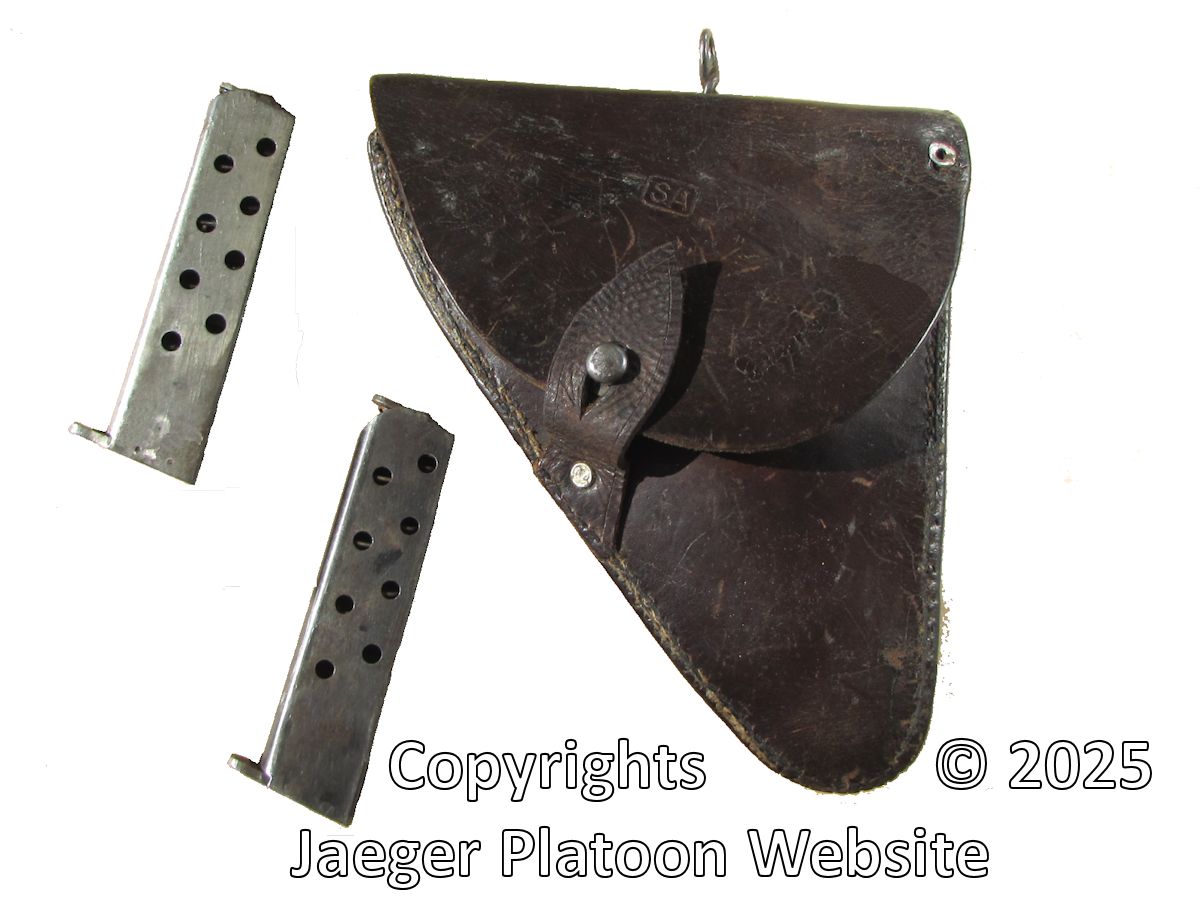
PICTURE: French pistol holster for pistol M/19 and two magazines from different manufacturers of
the pistol. Finnish military received these holsters with the pistols and this type of holster was the standard holster
design that Finnish military issued with these pistols. The left side magazine is stampled with I in a circle indicating
it belonged to pistol with trade mark Izarra, while magazine on the right is stamped with I.G in a circle indicating that
it belonged to pistol manufactured by Isidro Gaztanaga.(Photo copyrights (c) Jaeger Platoon Website). CLICK THUMBNAIL TO
SEE LARGER PIC (127 KB).
Having large number of small-scale manufacturers with varying production quality and quality control caused pretty serious problems. While there were blueprints and approved standard pistol design for this pistol, in reality manufacturers taking part in its production ended up producing slight variations of the pistol design and parts of pistols made by different manufacturers were not interchangeable - there was no spare part supply or even cannibalising parts from broken pistols to repair some of them did not necessarily work. When 7,65 mm x 17 ammunition used was also quite weak it was no surprise that France was willing to sell these pistols after World War 1, although the pistol also remained in French use in World War 2 and beyond. What is known the total number of pistols approved by French military during World War 1 was about 710,000. While French military was the main customer, there were also others militaries that used this pistol. Serbia received 5,000 Ruby pistols during World War 1 and later Yugoslavian military bought more between 1931 - 1933 - naming the pistol as Pistolj 7,65 mm/VTZ 1933. French manufacturer Unique manufactured higher quality versions of Ruby pistol after World War 1. During World War 1 the French introduced set of stamped markings for the purpose of keeping track which individual pistol and which magazines originated from the same trade name or manufacturer. Another markings typically stamped to those pistols delivered to French military are pair of stars stamped next to magazine release. In addition pistols delivered to French military during World War 1 were often equipped with rather large river-like knob added to left side of slide - which was apparently added to prevent of safety swith being dragged against holster and accidentally disengaged when the pistol was drawn from its pistol holster.
Trade names and manufacturers of M/19 pistols:

PICTURE: Finnish cavalry soldiers photographed during weapons maintenance. Two of the soldiers have
pistol M/19 in hand, while others seem to be cleaning parts of Madsen M/20 light machine gun.
Place seems to be some sort of storage space with some skis visible behind the soldiers. Photographer unknown. The photo is
probably from 1920's. (Original photograph part of Jaeger Platoon Website photo collection). CLICK THUMBNAIL TO SEE LARGER
PIC (254 KB).
As noted these pistols are simple blowback design based on Colt model 1903 Pocket Hammerless pistol. The pistol has single action trigger and is internal hammer fired with firing pin. Safety switch in left side of frame next to trigger and is also being used to lock slide in its rear position for disassembly. Magazine release is heel of the grip. Details in mechanics of the pistol and also size of their fixed sights tends to vary in between manufacturers. The pistols also have lanyard ring in left side of grip. Year 1916 French military introduced triangular leather holster for this pistol and it was the holster type delivered with the pistols to Finland and issued by Finnish Armed Forces with these pistols. When it comes to basic disassembly and re-assembling the gun, it is good to aware that installing recoil spring package the wrong way, assembling rest of the pistol and racking the slide can jam it completely.
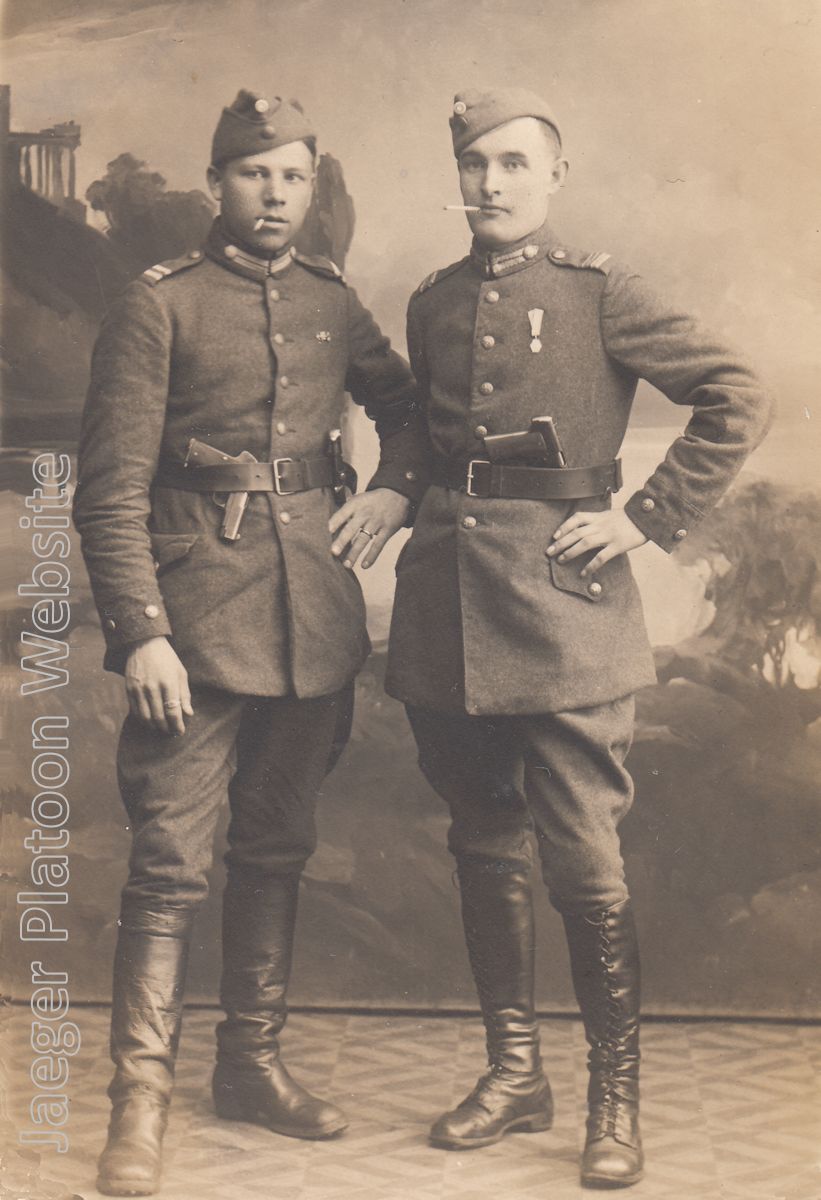
PICTURE: Two corporals of Finnish Army pose in photo studio. Both have pistol M/19 tugged under their
belt and soldier on the left has also puukko-pistin m/19 dagger
hanging from this belt. Both soldiers are wearing military uniform m/22. Soldier on the
right has leather gaiters, which were non-standard at the time. Photograph probably from 1920's. Photographer unknown.
(Original photograph part of Jaeger Platoon Website photo collection). CLICK THUMBNAIL TO SEE LARGER
PIC (170 KB).
At 1919 Finland was shopping new weapons for its newly born Army in France. Finnish Ministry of War was foolish enough to be tempted by these cheap pistols and bought 10,000 pistols worth, what soon proved to be maintenance nightmares. Pistols were shipped to Finland in July of 1919 and were distributed to Finnish military units, becoming the first standard issue pistol design acquired for Finnish military. It did not take long for those military units and weapons depots to find out just how problematic pistols M/19 were. While not having interchangeable parts between individual guns in small small arms still was not exactly unheard during World War 1, in case of these pistols the level of incompatability borderlined ridiculous. Pistols M/19 manufactured by different manufactures simply did not necessarily have any part, that was compatible with pistol M/19 manufactured by other any other manufacturer - and in some cases this included even magazines, which is why the French started had marked both pistol and magazines supplied by each manufacturer with similar markings reserved for each manufacturer. Another matter is level of worksmanship and quality control, level of which varied considerably between manufacturers being in some cases apparently so sketchy that it made even properly disassembling the pistol for basic maintenance either difficult or impossible. Another common complaint was poor shooting accuracy. As noted by slight hindsight one can note that 7.65 mm x 17 / .32 ACP has been generally considered underpowered for use in military sidearm for a very long time. For a pistol of .32 ACP caliber pistol M/19 was quite large and heavy - partly due to longer grip required by nine round magazine, but also due to low quality steel used in production, which resulted pistols to be rather bulky. On the other hand when compared to other notably smaller pistols of the same caliber due to its large size Ruby pistol at least has good size grip.

PICTURE: Three Finnish officers photographed sometime during Winter War. The officer on the left has
French triangular pistol holster, which were delivered to Finland with pistols M/19 and which Finnish Army
used with the pistol. Officer on the right has holster for Parabellum pistol
with shoulder stock. Photographer unknown. (SA-kuva.fi archive, photograph number 10682). CLICK THUMBNAIL TO SEE LARGER
PIC (224 KB).
Since Finnish Armed Forces did enough pistols to completely replace them with anything better, pistol M/19 remained in use through 1920's and 1930's to World War 2. During the war even some unfortunate combat-units got issued with them, even if intention was apparently not to issue them only for units stationed in home front. Year 1943 some 4,500 pistols M/19 remained in Finnish military inventory, but by year 1951 their number had dropped to 2,581. Even after World War 2 they remained mothballed for possible further use until grand majority of them (2,342 pistols) were sold to military personnel and some Finnish collectors around 1965 - 1971. Last of these pistols were not removed from Finnish military inventory until year 1986, when some were handpicked for museum collections and the very last 68 pistols sold & exported. From collector's point of view the value of M/19 pistols can be considered as contradictory - they were poor quality pistols with questionable reputation, but also the first official military pistols of Finnish Armed Forces and still had surprisingly long service career with Finnish military.
Finnish military usually issued pistols M/19 with rather unusual looking (triangular) brown leather pistol holsters of World War 1 era French origin, which had been delivered with the pistols. Later on also other pistols holsters saw use with these pistols, with brown leather holster typically issued for variety of .32 ACP caliber pistols existing in Finnish military inventory at the time presumably being common. Variances in detail of these holsters suggest that they may have been produced in depots of Finnish Armed Forces instead of commercial manufacturers.
7,65 mm Pistols M/1910 FN and M/1910-22 FN:
(Pistole Automatique, Mle 1910)
(Pistole Automatique, Mle 1910/22)

PICTURE: FN M/1910 pistol (Photo taken in Sotaamuseo). CLICK THUMBNAIL TO SEE LARGER PIC (73 KB).

PICTURE: FN M/1910-22 pistol (Photo taken in Sotamuseo). CLICK THUMBNAIL TO SEE LARGER PIC (70 KB).
|
Calibre: |
7,65 mm x 17 (.32 ACP) |
||
|
Length: |
152 mm (M/1910) / 178 mm (M/1910-22) |
||
|
Barrel length: |
89 mm (M/1910) / 114 mm (M/1910-22) |
||
|
Weight: |
570 g (M/1910) / 730 g (M/1910-22) |
||
|
Magazine: |
7, removable (M/1910) / 9, removable (M/1910-22) |
||
|
Official abbreviations: |
"765 PIST 10 FN" |
||
|
"765 PIST 22 FN" |
|||
|
Country of origin: |
Belgium |
||
|
Prototype: |
1908 |
||
|
Production: |
M/1910: 1912 - 1983 |
Finnish use:
M/1910 was simple and functional blowback pistol designed by John Moses Browning. FN (Fabrique Nationale located in Herstal, Belgium) manufactured this pistol from year 1912 till 1940 in very large numbers. And after World War 2 its production was restarted and continued until year 1983. The pistol was manufactured in two calibre: 7,65 x 17 and 9 mm x 17, commonly also referred as .32 ACP and .380 ACP, which were both cartridges designed by Browning. The 7,65-mm version was much more usual of the two - over 770,000 were manufactured by end of World War 2, while only about 138,000 pistols in 9-mm calibre were manufactured in that same period. The 7.65-mm version also has seven round magazine capacity compared to six rounds in 9-mm version. Both versions have three inbuild safeties - manual safety switch, magazine safety and grip safety. Magazine release button in heel of the grip. Sights are integrated to the pistol's slide and very small, basically being a groove on top of the slide. Unlike in earlier FN M/1900, the recoil spring in located around barrel, which allows much smaller slide to used. This pistol type enjoyed popularity among Police departments in several countries (among them Finnish Police). However the pistol was not popular among German military, which lead its production basically ending for rest of the war once the Germans had captured the factories in 1940. Copies of this pistol were made in large numbers in numerous countries. The pistol was quite modern when introduced and proved good among pistols of its size class, but by end of World War 2 new double-action pistols of the same calibre made its design look old-fashioned. Structurally the pistol is typical blow-back with recoil spring located around barrel. The pistol has three safeties: Grip safety, which disengages when grip is squeezed, magazine safety and typical thumb-operated safety switch in left side of grip. The basic appearance of M/1910 is very sleek without any sharp edges and sights machined on top of the slide.

PICTURE: Military official Sévon with FN M/1910 pistol and microphone. Enzio "Kim"
Sévon was radio reporter of Finnish broadcasting company (YLE), who served in TK-company 1 (1st
Communications Company) during Continuation War. The helmet is World War 1 era Austrian m/17 steel helmet.
Photographer, time and location unknown. The vertical swords seen in collar patches here were the rank markings for
Military official. (SA-kuva.fi archive, photograph number 2229). CLICK THUMBNAIL TO SEE LARGER PIC (224 KB).
M/1910-22 was specially developed for order of Kingdom of Serbs, Croats and Slovenians (also known as Yugoslavia) in 1923. That order of 60,000 pistols specified a pistol with at least 8-round magazine capacity and 114-mm barrel. Fabrique Nationale (FN) had no such pistol in production at that moment so lengthened version of M/1910 pistol (with longer grip and barrel) was developed. Pistol proved to be quite good as such an emergency version and sold well in commercial markets. Among pre World War 2 customers were Dutch Army, Police and Military Police, which called the pistol "M25 n:o 1". Pre World War 2 export customers included Turkish Army, French Navy, Greek Army and Air Force. During Belgian occupation of World War 2 Germans called M/1910-22 and kept it in production for their own Armed Forces. The Germans preferred 7.65 mm x 17 calibre version (Pistole 626(b) in German inventory) so they stopped production of 9 mm x 17 version (Pistole 641(b)) as soon as the factory run out of readily available parts (presumably already in 1940). During the war German military acquired some 363,000 "Pistole 626(b)". Even ending of the war didn't end production of M/1910-22, which continued well to 1960's. Total production of M/1910-22 is estimated have been around 760,000 - 800,000 (depending source).

PICTURE: Another former Finnish Army issue FN M/1910-22 pistol. Notice grip heel magazine release
and lock button for slide forward extension. (Photo taken in Viestimuseo - Museum of Signal Corps, which no longer
exist). CLICK THUMBNAIL TO SEE LARGER PIC (76 KB).
At February of 1940 Finnish Armed Forces bought 2,500 M/1910 and 2,500 M/1910-22 pistols from Belgium. During Continuation War M/1910 pistols were issued to Finnish troops stationed in home front, while M/1910-22 were used both by Finnish frontline troops and home-front troops. Just about all M/1910 were transferred to Finnish Police during and after World War 2. M/1910-22 pistols were also transferred to police, exported or scrapped soon after World War 2. Both pistol types did very short career in Finnish military and disappeared from its inventory by year 1950. However their career with Finnish Police proved much longer - some M/1910 pistols remained in use of Finnish Police until 1990's. According what is known all M/1910 and M/1910-22 pistol delivered to Finland were in 7.65 mm x 17 (.32 ACP) caliber.
Ahlberg pistol - unlicensed Finnish copy of FN M/1910
The first Finnish company to start manufacturing of automatic pistols in Finland was Ab H. Ahlberg & Co Oy established in year 1916 and located in city of Turku. During World War 1 the company run by engineer Hugo Ahlberg (1870 - 1947) had manufactured machinery and engines - and according one source also guns, although this seems uncertain. August of 1918, only months after ending of Finnish Civil War, Ahlberg offered to manufacture copies of FN M/1910 for Finnish military and provided one such pistol for inspection. Finnish military was interested and signed contract with Ahlberg for 1,000 such pistols in September of 1918. But starting the production and keeping it up proved far more complicated, than what had been anticipated - according contract the first 30 pistols were to be delivered by November of 1918, but it took the company until February of 1919 to delivered first two pistols, which also had not been blued. In addition the company had problems with manufacturing pistol magazines and acquiring springs for them. Ahlberg was able to deliver 70 pistols total in February and 58 pistols total in March of 1919 - with 20 pistols belonging to these deliveries being rejected by Finnish military. The deliveries in April and May were also no more than few dozen guns per month with similar high rejection rate. The level quality finally showed signs of improving with guns delivered in June, but by that time the deliveries were also lagging behind considerably. By June of 1919 the serial number range (which presumably had started from A 01) had reached A 600. Finnish Ministry of Defense lost its patience with low quality and constant delivery delays by May of 1919. At the time Finnish military about to make a deal with France for purchase of 10,000 pistols M/19 and Ahlberg's delivery schedule and quality control problems provided good reason for cancelling rest of the contract along further order of 3,000 Ahlberg-manufactured pistols, which had been discussed earlier, but no contract had been made of it.

PICTURE: Early production (serial number A 79) Ahlberg pistol. Ahlberg-pistol can be identified from
having barrel and slide about 1.5 cm longer than normal FN M/1910, wooden grip panels and usually having poor quality
blued finish. These pistols were only made in 7.65 mm x 17 Browning Short (.32 ACP) calibre and highest spotted serial
numbers are around A 1250, with serial number range having gaps presumably being caused by large number of pistols being
marked with serial number being rejected already at factory. Photo source
Digitaltmuseum.se - original photo by Armémuseum (Sweden). Used with
CC BY 4.0 Creative Commons license. CLICK THUMBNAIL
TO SEE LARGER PIC (58 KB).
After military contract was cancelled, Ahlberg succeeded selling number of pistols to Finnish Civil Guard (Suojeluskunta) and other Finnish authorities such as Police. Already suffering from previous financial issues, this failed contact and embezzlement by its accountant. Year 1920 Ab H. Ahlberg & Co Oy seized to exist as a company with its production facilities being sold as distress sale by auction. Ahlberg's former machine works was bought by Auran konepaja Oy (Aura Machine Works Ltd), who instead of guns manufactured scales for shops. During World War 2 few hundred Ahlberg pistols that existed in inventory of Finnish Armed Forces were mostly issued to home front supplies units and military police. Ahlberg pistols do not seem to have had interchangeable parts, so part(s) taken from individual pistol do not necessary work another individual pistol. The number of Ahlberg pistols remaining in serviceable condition seem to have declined rather fast, this was likely due to somewhat combination of somewhat haphazard manufacturing quality, non-interchangeable parts and manufacturer no longer existing - and therefore no spare parts being available they could not be even cannibalised from broken guns. Due to this apparently Ahlberg pistols, which broke down were routinely scrapped, which caused high loss rate during their service life. After World War 2 number of pistols bought by Police got transferred from Police to Finnish military, which again boosted their total number in military inventory. Circa 1965 - 1971 last remaining 125 Ahlberg pistols were sold to military personnel, with the most worn out pistols being scrapped. Nowadays Ahlberg pistols are rare and hard to find collector's items even in Finland.
9 mm Pistols M/03 FN and M/07 Husqvarna:
(Pistole automatique Browning, modele 1903)
(9 mm pistol m/07)

PICTURE: FN pistol M/03. Markings in side of the frame indicate that this individual pistol had
served in regiment I26 (Vaxholms Genadjärregemente) of Swedish Army before its arrival to Finland with
volunteers during Winter War. Notice stylized "FN" in grip panels. (Photo taken in Sotamuseo). CLICK
THUMBNAIL TO SEE LARGER PIC (102 KB).

PICTURE: Husqvarna pistol M/07. Notice Husqarna emblem (stylized "H" in a ring with
crown on top of it) in grip panels. Also notice magazine release in bottom of the grip. Markings indicate that
this individual pistol had served in regiment I2 (Göta Livgarde) of Swedish Army before arriving with
volunteers to Finland.(Photo taken in Sotamuseo). CLICK THUMBNAIL TO SEE LARGER PIC (69 KB).
|
Calibre: |
9 mm x 20 SR browning long |
||
|
Length: |
203 mm |
||
|
Barrel length: |
128 mm |
||
|
Weight: |
930 g |
||
|
Magazine: |
7, removable (10, removable) |
||
|
Official abbreviations: |
"9,00 pist/07 FN" |
||
|
"900 PIST 07 FN" |
|||
|
Country of origin: |
Belgium (M/03) /Sweden (M/07) |
||
|
Prototype: |
1902 |
||
|
Production: |
M/03: 1903 - 1914 and 1918 - 1927, about 58,000 manufactured |
||
|
M/07: 1917 - 1942, about 94,700 manufactured |
Finnish use: Less than 100 cumulated at 1918. Used by Swedish (SFK) Volunteer Force during Winter War. When SFK returned to Sweden after Winter War it left behind 860 FN M/03 and Husqvarna M/07 pistols, which were issued to the Finnish front-line troops during Continuation War.
This pistol developed by John Moses Browning was unusual in being blowback weapon using such a powerful cartridge (9 mm x 20 SR Browning Long cartridge is almost as powerful as 9 mm x 19 Parabellum/Luger). Early on it was called Modèle de Guerre (war-model) and Grand Modèle. Several countries (including Imperial Russia, Turkey and Sweden) bought these pistols as sidearms for their military before World War 1. The first Swedish order of 9,000 pistols made in summer of 1907 carried notable historical significance. By that time FN had manufactured only a handful of these pistols and had declined some smaller military orders - presumably because they might have not covered additional expenses related to starting manufacturing of new pistol model. There is also a possibility that FN had left open the possibility for the first buyer to request minor changed to the design without extra expenses. Once the production really started for Swedish military in year 1907 it continued in FN (Fabrique National in Herstal Belgium) factory until World War 1 and once re-started after it continued to year 1927. Even German occupation of Belgium during World War 1 merely succeeded to pause the manufacturing for couple of years. But, since this pause also stopped deliveries to Sweden, Swedish military had to find new source for additional pistols, which resulted Swedish Husqvarna factory to starting to manufacture the pistol. Husqvarna manufactured M/07 pistol (as the Swedish military called it) from year 1917 till 1942 (production was not constant) making in total of about 94,700 pistols. Some 88,600 of these Husqvarna manufactured pistols were delivered to the main client - Swedish Armed Forces. The pistol remained in Swedish use even long after World War 2. It is rather ironic that Husqvarna ended up manufacturing more M/07 than the total number of M/03 pistols manufactured by FN. Total production of model 1903 pistol in FN factories was about 58,400. There were apparently several Russian orders with pistols going mainly to police use. From pistols ordered by Imperial Russia most (about 7,000) were issued to Gendarme units, some 3,100 pistols to Moscow Police Department and few hundred to railway police units. The pistol had two safeties: grip-safety and thumb-operated safety switch in left side of the weapon. Additional equipment available for these pistols to those customers willing to purchase included 10-round magazines and holster-stock, which depending exact version of M/03 pistol could be attached to rear part of grip or to this extended magazine. For obvious reason the 10-round magazine and stock holster attached to it were not exactly the most ideal combination, as when they were attached replacing magazine (part of normal reloading process) meant also removing the stock holster with it. Post World War 1 FN model 1903 customers included at least Estonia, El Salvador, Paraguay and Turkey. Only known export deal made by Husqvarna for M/07 pistol seems to have been to Columbia in 1930's. Both FN M/03 and Husqvarna M/07 made a very long career in use of Swedish Armed Forces, until finally being replaced with Glock 17 pistols in late 1980's.

PICTURE: FN pistol M/03 with 10 round magazine and holster-stock. This pistol and the holster stock
had once been property of railway security of North-West Railways of Imperial Russia and had probably been captured in
year 1918. (Photo taken in Sotamuseo). CLICK THUMBNAIL TO SEE LARGER PIC (70 KB).
The tests that the Swedes organised for selecting service pistol to their military in year 1903 were broad. The tested pistols included: 7.65-mm Parabellum model 1900 with 12-cm barrel, 7.65-mm FN model 1900, .38 Colt calibre Colt-Browning, 7.63-mm Mannlicher model 1901, 7.65-mm Mannlicher carbine-pistol model 1903, 6.5-mm Hamilton, 9-mm Browning (model 1903) and 8-mm Frommer. These pistols also tested against old Nagant revolvers - Swedish Nagant model 1887 and Russian Nagant model 1895. From these weapons Parabellum proved most accurate, but otherwise the FN model 1903, which was still called "experimental-model" at that time, ruled the tests. So, the Swedes selected 9-mm Browning "experimental" as their new military pistol and it got named model 1903. While the pistol was officially approved for Swedish military use in 1904, the actual first order to FN was apparently delayed due to debate concerning if Swedish officers should be equipped with automatic pistols or pistol carbines.

PICTURE: Lieutenant (later: Captain) Soini Mikkonen with Swedish Army M/1908 holster. This was the
standard holster design used by Finnish military with FN M/03 and Husqvarna M/07 pistols, since the pistol holsters had
arrived with SFK's pistols. The holster can be easily identified from two mag pockets. Soini Mikkonen (1911 - 1944) served
as company commander in Infantry Regiment 6, Infantry Regiment 12 and Jaeger Company of 6th Division. Early
snowfall has apparently surprised him, since he is still wearing summer cap M/39 in this photo. He was awarded with
Mannerheim Cross 2nd Class in October of 1941. Photographed by Sundström in October of 1941.
(SA-kuva.fi archive, photograph number 59999). CLICK THUMBNAIL TO SEE LARGER PIC (130 KB).
During Finnish Civil War of 1918 small number of these pistols was captured or otherwise acquired from various sources, but the total number did not reach even 100 pistols. So at that time they got just listed among "pistol miscellaneous" and remained warehoused until end of Winter War. During Winter War Swedish - Norwegian volunteer force SKF brought hundreds of these pistols to Finland among its weaponry and used them. When SFK returned home after Winter War in year 1940, this unit handed over its weapons to Finnish Armed Forces. Grand majority of the weapons used by SFK had been financed with donations of Swedish private citizens, who had wanted to help Finnish defense financially. Hence equipment acquired for SFK with donations were considered to be Finnish property. SFK had been equipped with standard issue Swedish military small arms of that time. So among the weapons handed over by SFK to Finnish military were some 860 ex Swedish Armed Forces FN M/03 and Husqvarna M/07 pistols. Transferring them to ownership of Finnish Army increased the total number of M/03 and M/07 pistols in inventory of Finnish military to well over 900 pistols. This number was substantial enough for them to be issued to Finnish Army front-line troops during Continuation War, even if it was the only weapon in Finnish inventory to use 9 mm x 20 ammunition. Spring of 1944 about 772 of these pistols still remained, but when the most seriously worn out pistols were scrapped by year 1951, the total number dropped to mere 331 pistols. The remaining pistols M/03 and M/07 were sold (mostly to military personnel) between 1965 - 1971.
9 mm Pistol M/35 FN "GP":
(Modele 1935 pistole automatique, Grand Puissance)

PICTURE: FN High-Power M/35 pistol. All M/35 pistols bought for Finnish military had early tangent
rear sight. The hammer is in unusual position (these pistols have no half-cocked notch) - possibly to allow safety being on.
(Photo taken in Sotamuseo). CLICK THUMBNAIL TO SEE LARGER PIC (81 KB).
|
Calibre: |
9 mm x 19 Parabellum/Luger |
||
|
Length: |
197 mm |
||
|
Barrel length: |
118 mm |
||
|
Weight: |
900 g |
||
|
Magazine: |
13, removable |
||
|
Official abbreviations: |
"9,00 pist/FN" |
||
|
"900 PIST FN" |
|||
|
Country of origin: |
Belgium |
||
|
Prototype: |
First in 1923. Later (Saive designed) in 1928. |
Finnish use: 2,400 bought from Belgium in February - March of 1940. Finnish frontline troops used some during the last weeks of Winter War and in larger scale during Continuation War. Also issued in large numbers to Finnish pilots during Continuation War.
Better known in English speaking word as High-Power this pistols design was started by John Moses Browning and after his death (1926) finished by D.J. Saive. Name Grand Puissance (= high power) came from magazine capacity, which was larger than other pistols of 1930's. In this magazine cartridges were in interlocking array, which made magazine quite short but allowed it to carry large amount of cartridges at the same time. Otherwise the basic structure of pistol used basically same "tilting barrel" concept, that Browning had used earlier in Colt M1911, but the concept had been somewhat modified. The pistol had two safeties: Magazine-safety (which unfortunately often have somewhat poor trigger with uneven trigger pull) and thumb-operated safety switch in left side of the grip. Unusual for European pre World War 2 pistols was also location of the magazine release switch - typically it was located below grip in European pistols of that time, but in FN GP it was located next to trigger guard. The pistol was immediate success, during the few years before World War 2 some 70,000 (or 56,500 depending sources) were made and sold to Armed Forces of Belgium, Estonia, Lithuania, China and Peru. During World War 2 this pistol was used by both sides and manufactured both in occupied Belgium for the Germans and in Canada for the Allies (mainly UK, British Commonwealth and China). During 2ndnd World War some 319,000 were made in Belgium by FN and some 150,000 by John Inglis & Co in Canada. The Germans knew the pistol as Pistole 640(b) and Allies mostly called it "Browning High Power". After World War 2 FN continued their production and high-power pistols were purchased by dozens of countries (among them Belgium, Denmark, Great Britain, Netherlands, Austria and West Germany) in addition of Belgian military and police. The pistol being highly popular that time it was manufactured with or without license in several countries like Argentina (FM), Hungary (FEG), Indonesia (Pindad), Canada, Nigeria, Venezuela, United States and Israel (Kareen). Later versions of this pistol are still used by authorities in many countries even today. FN did not end manufacturing of FN HP pistols until year 2012.

PICTURE: FN High-Power M/35 pistol with holster-stock. This was the standard holster type
with FN M/35 pistol in Finnish use. (Photo taken in Sotamuseo). CLICK THUMBNAIL TO SEE LARGER PIC (95 KB).
The pistol was also one of the participants in Finnish pistol tests of 1939, whose winner was VKT L-35 pistol. During Winter War one of the shortages that Finnish military suffered from was shortage of pistols, due to which Finland bought some 2,400 FN M/35 pistols from Belgium, 900 of them arrived in February of 1940 and 1,500 in March of 1940. Number of pistols were issued to Finnish pilots during Continuation War, probably because in particular with the shoulder stock it was the best pistol available for the purpose. Those pistols that went to Army were issued mostly to frontline infantry. The pistol proved to be not only very reliable and accurate, but also very structurally durable - what is known they were the only only pistol model in Finnish use that could be used with Suomi M/31 submachine gun ammunition, which had 115-grain FMJ bullet and had been loaded very hot. The pistols delivered to Finland had adjustable rear sights with sight tangent settings up to very optimistic 500 meters. FN did not have a specific serial number range for 2,400 pistols delivered to Finland, but most have serial numbers in 11000 - 15000 serial number range. The holster-type Finnish military used with FN M/35 during World War 2 were supplied by FN with the pistols and had leather holster attached to wooden holster stock. But apparently wooden stock was often removed and only leather holster was being used - probably because wooden stock made the pistol holster rather clumsy to carry. Presumably due to being having so high profile when used by Air Force, the pistol is unofficially also known as "lentäjä FN" ("pilot's FN") in Finland - although apparently only about 500 pistols out of 2,400 total were issued to Air Force. World War 2 era Finnish photographs often show air crews with FN HP pistol holsters, which have been modified by removing wooden stock from holster and adding a long leather strap going across chest and back and over a shoulder.

PICTURE: Two officers of Finnish Army equipped with FN High-Power M/35 pistols. Officer on
the left has his pistol hanging from some sort of lanyard just pushed into his waistband, while the soldier
on the right has the pistol in its holster with holster-stock and all. Officer on the left has also
stick hand grenade m/32 in his waistband. Both are wearing
snow camouflage and officer's version of fur
hat M/39. Photographed by Military official V. Hollming in January of 1942. (SA-kuva.fi archive, photograph
number 69892). CLICK THUMBNAIL TO SEE LARGER PIC (179 KB).
Hard wartime use was visible in survivability rate of this pistol in Finnish use. Year 1951 only 1,378 pistols remained. They remained in use until 1985 - 1986, at which time they were decommissioned and sold away. Early 1980's Finnish Defence Forces selected a further double-action development of High-power pistol called FN HP DA (better known as Pistol 80 in Finland) as its new service pistol. Unlike the earlier single-action High-Power M/35 version, the double-action version has gained rather poor reputation in Finland, even with later improvements after which it was renamed as Pistol 80-91. While it has been partially replaced by Pistol 2003 (Walther P99) and Pistol 2008 (Glock 17), Pistol 80-91 has remained to be in use of Finnish military to this day (July 2020).

PICTURE: 2nd Lieutenant of Finnish Air Force with FN HP pistol holster modified with
strap going over a shoulder. The pilot seen here is Ossi Marttila, who served in Lentolaivue 12 (Number 12
Squadron) of Finnish Air Force. He is wearing pilot's fur-lined coveralls. Photographed by 2nd Lieutenant
K. Borg. (SA-kuva.fi archive, photograph number 85174). CLICK THUMBNAIL TO SEE LARGER PIC (185 KB).
Writer's personal shooting experiences with FN High-Power pistols: This particular version was the oldest mass-produced version of FN High-Power pistol and while ahead of its time due to good double-stack magazine combined with effective cartridge, had room for improvement. The basic ergonomics are good and by standards of its time this pistol is reliable and sturdy design, but safety switch is tiny by modern standards and sights are not that good either. The sights are small, sight picture crowded and the tangent rear sight makes little sense especially if not used with the stock-holster, which basically turns the pistol into mini-carbine of sort. The magazine disconnect safety tends to ruin what could otherwise be much better trigger. The Browning's locked breech basic design with tilting barrel is solid and nowadays basically a industry standard in its various versions. Still even with all its limitations I consider FN High-Power to be the best military service sidearm of World War 2. But personally I prefer the pistol's later versions, practically all of which have at least better sights. It might be worth noting that while these pistols were delivered to Finland with stock-holsters, seeing the stocks being used or even carried may not have been that common even during World War 2.
SOURCES:
Markku Palokangas: Sotilaskäsiaseet Suomessa 1918 - 1988 osat 1 - 3 (= Military Small Arms in Finland 1918 - 1988 parts 1 - 3)
Timo Hyytinen: Arma Fennica 2, sotilasaseet (Arma Fennica 2, military weapons)
Ian Hogg and John Wells: Pistols of the World
Edward C. Ezell: Handguns of the World
Article: Browning "kymppi", FN Mle 1910 by Jussi Peltola in Ase-lehti magazine vol. 5/96.
Article: FN Mle 1910/22 by Jussi Peltola in Ase-lehti magazine vol. 6/96.
Article: Ruotsalainen sotilaspistooli m/07 eläkkeelle in Ase magazine vol 3/88.
Article: FN 1903, tuntematon suuruus by Jussi Peltola in Ase-lehti magazine vol. 3/96.
Article: Lisenssiwanhus, FN M/03 - Husqvarna M/07 by Ari Nirri in Rekyyli magazine vol. 6/2006.
Article: Nollakolmosesta Husqvarnaan, Fabrieque Nationalen Ruotsin pistooli by Mika Pitkänen in Kaliberi magazine vol 8/2009.
Article: Browning High Power, maailman suosituin sotilaspistooli? by Jussi Peltola in Ase-lehti magazine vol. 1/97.
Article: FN High Power pistooli Mle. 1935 by Matti Ingman in Ase-lehti magazine vol. 6/2000.
Article: Kymppi ja napakymppi, FN 1910 ja 1910/22 by Mika Pitkänen in Kaliberi magazine vol. 5/2009
Military manual: Pistoolit 23 ja 19. Rakenne, huolto ja käsittely by Sotaväen Esikunta (1925).
Small Arms of WWI Primer 004*: Ruby 1915 on C&Rsenal channel in Youtube.
Ruby, Ruby, Ruby, Ruby! episode in Bloke on the Range channel in Youtube.
Ruby stuck?,No problem! episode in Bloke on the Range channel in Youtube.
The Complete Ruby teardown episode in Bloke on the Range channel in Youtube.
Small Arms of WWI Primer 058: Belgian FN 1910 on C&Rsenal channel in Youtube.
Finland's First Domestic Handgun: the Ahlberg on Forgotten Weapons channel in Youtube.
Small Arms of WWI Primer 056: Belgian FN 1903 on C&Rsenal channel in Youtube.
Special thanks to Sotamuseo (Finnish Military Museum), Helsinki.
Special thanks to Ilmatorjuntamuseo (Finnish Antiaircraft Museum), Tuusula.