


AT-RIFLES PART 1:
Finnish domestic designs
Antitank-rifle or antitank-machinegun and in which caliber?
As many projects development of Finnish antitank-rifles and antitank-machineguns started with a discussion and an argument. The argument concerning antitank-rifle was related type of the weapon - rifle or machinegun and to its caliber. Some officers of Finnish Army wanted 12.7-mm weapon, some wanted 13.2 mm weapon and others wanted 20 mm weapon. Part of the problem was that Finnish military had intended the same ammunition and possibly even weapon design to be used both for antitank- anti-aircraft purposes. Since (flawed) calculations of that time suggested that 13.2 mm and 20 mm guns would be equally effective in anti-aircraft use and since 13.2-mm ammunition was obviously cheaper and weapon in that caliber more mobile than 20-mm alternative, many military experts favoured it in 1930's. The discussion and argument about the matter divided large part of Finnish officer corps into several camps. Problem with accepting 20-mm weapon early on seems have been mainly the low muzzle velocity of the 20-mm ammunition existing at that time. Aimo Lahti, was the leading designer of guns for Finnish military and worked in State Rifle Factory (Valtion Kivääritehdas / VKT) was responsible for developing this weapon. Lahti preferred 20-mm caliber for the purpose, since he considered armour-penetration of both 12.7-mm and 13.2-mm ammunition to be too poor and unhappy with that fact that ammunition with tracer was not available for either of these. While 12.7-mm caliber had some support among officers, it was least popular of the three alternatives and it remains questionable if any Finnish prototypes in this caliber were actually ever made. Although British-manufactured Vickers Class D machinegun was acquired for testing around 1932 - 1933 and apparently the cartridge case used in its 12.7-mm x 120 SR ammunition served as a starting point for development of Finnish 13.2-mm ammunition. The 13.2-mm caliber ammunition on the other hand was a very serious contender as anti-tank weapon caliber with wide support among Finnish military. Hence 13.2-mm ammunition saw great deal of development and testing starting year 1934. Since he considered existing 13.2-mm and 20-mm to be unacceptable, Lahti went and developed his own ammunition, with this development resulting to creation of 13.2 mm x 118 B, 13.2 mm x 120 B and 20 mm x 113 B ammunition. Lahti started his ammunition development work by developing 13.2 mm x 118 B, but its cartridge case proved to have to small internal volume for the propellant load that was needed to push the muzzle velocity to level of 1,000 meters/second, which had been earlier calculated as necessary for achieving the required armour penetration. Hence summer of 1936 he designed cartridge case for 13.2 mm x 120 B cartridge, which had the needed internal volume needed for achieving this. Around 1936 - 1937 also developing 15 mm x 120 B ammunition was considered as one alternative, with its blueprints made at that time, but unlike 13.2 mm ammunition, it was apparently never manufactured - not even for testing purposes.
As the argument about caliber would not have been enough, Lahti got into argument with Colonel Tuomas Raatikainen (head of Weapons Design Committee for Finnish Armed Forces and Head of Ordnance Department in Ministry of Defence / General Headquarters of Finnish Armed Forces in 1937 - 1946) about weapon mount of the new antitank-weapon. Raatikainen wanted the mount to be similar as the one that the Germans had for 20 ItK/30 (2.0 cm Flak 30) anti-aircraft gun. The German gun-mount had been originally planned to be suitable both to antiaircraft- and antitank-use, but Lahti considered the gun mount design to be poorly suited for antitank purposes. Another disagreement surfaced when Raatikainen and Saario (member of Weapons Design Committee) wanted Swiss Oerlikon design to be officially approved (which made Lahti to suspect them for representing Oerlikon and possibly having personal financial interests in this matter) for Finnish Army. Aimo Lahti was very much against this, as he considered Oerlikon to have too low muzzle velocity and due to that having too poor armour-penetration capability.
Finally live fire tests performed in summer of 1939 proved that 20-mm ammunition had superior armour penetration when compared to 13.2-mm ammunition. These tests resulted to a decision of choosing 20 mm as calibre of Finnish antitank rifles and development of 13.2-mm guns ended. Aimo Lahti received his final instructions for developing 20-mm antitank-rifle and come up the design in just three weeks. But by that point a lot of time had been lost and time proved to be exactly the commodity, which Finland was about to run out. Once the first order for mass-produced 20-mm L-39 antitank-rifle was finally made in 29th of September 1939, there were mere two months to outbreak of Finnish - Soviet Winter War.
Aimo Lahti's 13.2-mm machinegun prototypes manufactured included:
All these prototypes were manufactured in VKT (Valtion Kivääritehdas = State Rifle Factory), where Aimo Lahti worked. 13.2 mm L-38 antitank-rifle was made 1938 - 1939 and probably also one prototype of L-39 at-rifle was manufactured in 13.2-mm x 118 B calibre. Lahti designed this 13.2-mm prototype of gas-action semiautomatic antitank-rifle, which weight about 25-kg, fired from closed bolt, was equipped with a bipod and could use 8 and 15 round magazines. Weapons Design Committee had tested already previous year an improvised full-auto version, which had been built by stripping all non-essential parts from one of the machinegun-prototypes. But the test results had showed that shooting accuracy of this improvised version was unacceptably poor, possibly at least partly due to the weapon being open-bolt firing design.
13 mm antitank machinegun L-35/36:
|
Calibre: |
13,2 mm x 118 B (*) |
||
|
Weight: |
70 - 75 kg |
||
|
Fire-rate: |
600 shots/minute (theoretical) |
||
|
Muzzle velocity: |
950 m/sec |
||
|
Magazine: |
15 round strip, metal belt or drum magazine (*) |
||
|
Maximum range: |
5,4 km |
||
|
Ammunition weight: |
160 g (AP) (whole cartridge) |
||
|
Bullet weight: |
50 g (AP) |
||
|
Ammunition types: |
AP, HE-tracer |
||
|
Basic principle: |
Full automatic gas-recoil |
||
|
Country of Origin: |
Finland |
(*) The two guns used in armoured cars used 15-round drum magazines.
Finnish use: Only some prototypes made, three of the prototypes saw combat use with Finnish military during Winter War (one as anti-aircraft machinegun, second in Landsverk 182 armoured car and the third one as heavy machinegun/antitank-machinegun). As far as known none of them saw any combat use after Winter War. The one used in Landsverk 182 was replaced with 20-mm antitank-rifle L-39 after Winter War. The 4th machinegun of this type was used as main weapon of Sisu armoured car of Finnish Police.
13.2-mm ammunition used with these guns was loaded with VKT-made armour piercing (AP) bullets. B = belted cartridge case. Bottleneck cartridge cases used for it were Aimo Lahti's own design. It is notable that other ammunition of same calibre class used at that time (such as 13.2 mm x 99 Hotchkiss, 12.7 mm x 99 and 12.7 mm x 108) did not reach muzzle velocities nearly as high. 13.2 mm x 120 B cartridge cases (which had longer neck when compared to 13.2 mm x 118 B) were first tested with experimental bullets. Later Lahti designed 13.2 mm x 120 B cartridge cases, apparently because 13.2 mm x 118 B failed to produce the required 1,000 m/sec muzzle velocity. Most 13.2 mm x 118 B cartridges cases had been manufactured by Tikkakoski. State Rifle Factory (VKT) was not equipped to manufacture cartridge cases in this caliber in any real numbers and 500 cartridge cases ordered from privately owned Finnish manufacturer Oy Sytytin proved unsatisfactory. The largest manufacturer for 13.2 mm x 118 cartridge cases was German D.W.M. which manufactured 15,000 of them and apparently delivered them in summer of 1939. In addition Tikkakoski manufactured about 4,200 cartridge cases for 13.2 mm x 120 B ammunition. Neither 13.2 mm x 118B or 13.2 mm x 120B ammunition got ever really mass-produced, hence they were very much experimental ammunition designs.
Bullets used in Finnish 13.2 mm x 118 B (and 13.2 mm x 120 B) ammunition:
Some earlier sources mention also Hungarian-made AP-incendiary bullets, but this information might be incorrect.
The 13.2-mm ammunition was manufactured by VKT (= Valtion Kivääritehdas = State Rifle Factory). Majority of ammunition was loaded with VKT-made bullets. These AP-bullets manufactured by VKT had steel core and jacket made from tombac (zinc-copper mix). Some ammunition were also loaded with French Hotchkiss bullets delivered by Manufacture de Machines du Haut-Rhin. Also Finnish manufacturers Oy Tikkakoski Ab and Oy Sytytin manufactured 13.2 mm x 118 B cartridge cases made from brass in limited scale.
Armour penetration:
Marskin panssarintuhoojat:
Early theoretical estimate for 13.2-mm AP-round (muzzle velocity 1,000 m/sec):
|
distance |
angle of impact |
penetration |
|
300 m |
60 degrees |
22 mm |
|
500 m |
60 degrees |
18 mm |
|
1000 m |
60 degrees |
12 mm |
Test results from live fire tests (muzzle velocity 950 m/sec):
|
distance |
angle of impact |
penetration |
|
300 m |
60 degrees |
15 mm |
|
500 m |
60 degrees |
13 mm |
|
1000 m |
60 degrees |
7 mm |
When Winter War started Finland had only two prototypes of 20-mm antitank-rifle and six 13.2 mm guns (made circa 1934 - 1939) to use. Both 20 mm prototypes and three out of six 13.2 mm machineguns saw use in that war, from these both 20 mm rifles and one 13.2 mm antitank-machinegun were used in Metsäpirtti and Taipale area. In battles fought there 20-mm antitank-rifles were found to be very good guns while 13.2-mm machinegun proved to be ineffective. The other two 13.2-mm antitank machineguns served in different uses: One as main weapon of single Finnish Landsverk armoured car and another as anti-aircraft machinegun.
Some quotes from reports, which basically resulted burying of 13.2 mm as possible antitank calibre for Finnish use for good (source: Marskin panssarintuhoojat):
These experiences verified 20-mm calibre as only surviving option for Finnish antitank rifle and proved that the decision of 20-mm antitank rifle L-39 going to production had been a wise one, even if reaching that conclusion had taken too long. In test of real battlefield 13.2-mm guns had proved too ineffective to be a viable alternative.
20 pst kiv/39 "Norsupyssy":
(20 mm Antitank-rifle L-39 "Elephant gun")
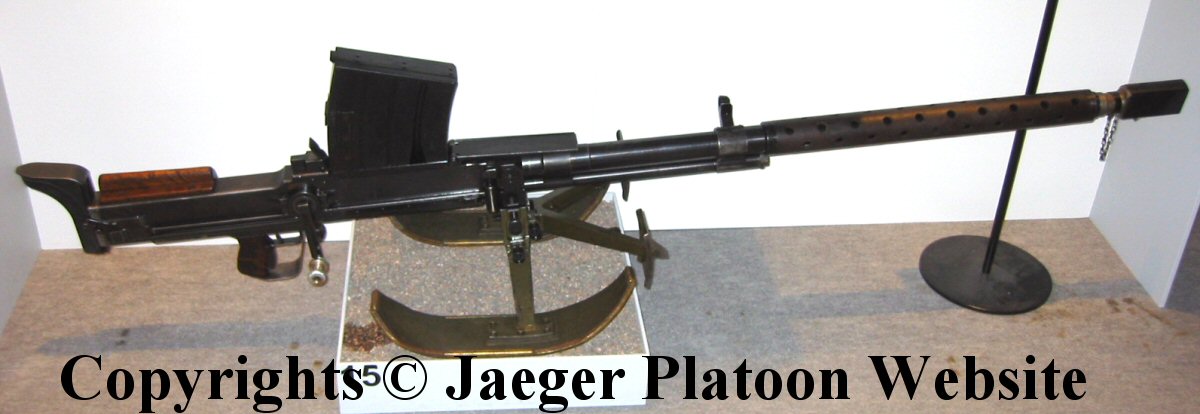
PICTURE: 20 mm at-rifle L-39. (Photo taken in Sotamuseo). CLICK THUMBNAIL TO SEE LARGER PIC (101 KB).
|
Calibre: |
20 mm x 138 B (Rheinmetall-Borsig) (*) |
||
|
Length: |
224 cm |
||
|
Barrel length: |
130 cm |
||
|
Weight: |
49,5 kg/51,4 kg |
||
|
Fire-rate: |
15/30 shots/minute (practical/maximum) |
||
|
Muzzle velocity: |
800 - 840 m/sec |
||
|
Magazine: |
10, removable box |
||
|
Maximum range: |
6,5 km |
||
|
Ammunition weight: |
337 g (AP) (whole cartridge) |
||
|
Bullet weight: |
152 g (AP) |
||
|
Ammunition types: |
AP, APHE-T (rare), AP-T, HE-T (rare), Phosphorous-T (rare) |
||
|
Basic principle: |
Semiautomatic, gas-action |
||
|
Country of Origin: |
Finland |
Finnish use: Only two prototypes chambered to 20-mm ammunition of Lahti's own design used in Winter War. The real production did not start until after Winter War. Some 1,850 manufactured during Interim Peace and Continuation War. These guns saw large-scale use with Finnish troops during Continuation War. With large variety of ammunition they proved to be very versatile and remained useful even when their best days as antitank-weapon were gone. These new uses included bunker busting, long range sniping and use as improvised anti-aircraft weapon.
(*) Two prototypes of this antitank-rifle were manufactured in 20 mm x 113 Lahti calibre. They saw combat use during Winter War and managed to destroy four Soviet tanks. All later L-39 antitank-rifles were manufactured in 20 mm x 138 B caliber.
Armour penetration:
Marskin panssarintuhoojat (AP, 800 m/s):
Theoretical estimate:
|
distance |
angle of impact |
penetration |
|
300 m |
60 degrees |
20 mm |
|
500 m |
60 degrees |
16 mm |
|
1000 m |
60 degrees |
12 mm |
Test results from live fire tests (made in year 1943):
|
distance |
angle of impact |
penetration |
|
300 m |
60 degrees |
20 mm |
|
500 m |
60 degrees |
15 mm |
|
1000 m |
60 degrees |
9 mm |
Finnish Army military manual Panssarintorjuntakiväärit (Antitank-rifles):
|
distance |
angle of impact |
penetration |
|
200 m |
60 degrees |
20 mm |
|
500 m |
60 degrees |
16 mm |
Finnish Army manual 20 mm:n panssarintorjuntakivääri L/39:
|
distance |
angle of impact |
penetration |
|
200 m |
60 degrees |
20 mm |
|
500 m |
60 degrees |
16 mm |
Finnish live fire testing year 1943 (AP-T round, 830 m/sec):
|
distance |
angle of impact |
penetration |
|
100 m |
70 degrees |
28 mm |
|
200 m |
70 degrees |
25 mm |
|
300 m |
70 degrees |
23 mm |
|
400 m |
70 degrees |
21 mm |
|
500 m |
70 degrees |
18 mm |
|
600 m |
70 degrees |
17 mm |
|
800 m |
70 degrees |
13 mm |
|
1000 m |
70 degrees |
10 mm |
|
1500 m |
70 degrees |
6 mm |
Early on Finnish military considered several 20 mm ammunition types for the new 20-mm antitank rifle. Among those considered were Madsen and Bofors rounds, but finally 20 mm x 113 ammunition of Lahti's own designed was chosen in 5th of May 1939. Lahti designed the weapon in just three weeks and soon had two prototypes made and tested. Summer of 1939 the prototypes of 20-mm antitank rifle easily beat the 13-mm prototypes in tests. 6th of September 1939 new 20 mm antitank-rifle was officially approved to weaponry Finnish Army with name L-39. The first order about 410 of these antitank-rifles was made already during that same month. At this point order of German 20 mm antiaircraft guns, which the Finns had also recently made, complicated things. 2nd of October 1939 the Finns decided to manufacture all further 20 mm antitank rifles in 20 mm x 138 B (Rheinmetall-Borsig / Solothurn long) calibre (to allow same ammunition being used in both AA-guns and AT-rifle). This made ammunition supply obviously much easier, since ammunition in this calibre was already manufactured for example in Germany and Italy, while 20 mm x 113 round would have been unique to Finland. However according book 20 mm Suomessa... by Pitkänen and Simpanen this was not the only reason. According it the propellant charge, which VKT wanted to use to reach required muzzle velocity, could not be contained in 20 mm x 113 cartridge case, while 20 mm x 138 B cartridge case was large enough for it. Hence 20 mm x 138 B round would have been selected due to larger capacity of its cartridge case. As mentioned 410 of L-39 antitank rifles had been ordered from VKT, but as it turned out, that had happened too late. Finnish - Soviet Winter War started in end of November 1939 and changed the situation totally - the whole production got delayed as production capacity of its intended manufacturer VKT (Valtion Kivääritehdas = State Rifle Factory) was more urgently needed mainly for repairing other already existing guns. There was no available manufacturing capacity for manufacturing of L-39 antitank-rifle at that time. As noted only two prototypes of L-39 were manufactured in this caliber, while mass-produced version was in 20 mm x 138 B caliber.

PICTURE: 20-mm antitank-rifle L-39 in action near city of Viipuri / Wiborg / Viburg August of 1941.
Wartime photos often show the rifle being shot with shooting position than prone. Photograph taken by 2nd
Lieutenant Pentti Nikulainen. (SA-kuva photo archive, photograph number 40588). CLICK THUMBNAIL TO SEE LARGER PIC (160 KB).
So, the manufacturing of L-39 could be started only after Winter War. Due to serious shortage of antitank-weapons this was obviously a priority for Finnish military. First pre-production series of 10 L-39 was finished in 10th of April 1940 - less than a month after ending of Winter War. Total production was of L-39 antitank-rifle about 1,850 guns. The only manufacturer of this antitank rifle was VKT (Valtion Kivääritehdas = State Rifle Factory) in town of Jyväskylä. This antitank-rifle proved highly effective during first year (1941) of Continuation War, proving highly effective against Soviet tank fleet, which at that time was still mostly older pre-war tanks such as T-26 series and BT-series tanks., with tanks such as T-34 and KV being still rare in Finnish - Soviet front at the time.
From 1st of July 1941 to 11th of December 1941 ammunition expenditure of L-39 antitank-rifles was:
During early part of Continuation War L-39 replaced British Boys antitank-rifle also commonly used by Finnish Army that time. However, in the same time L-39 was getting outdated, as new Soviet T-34 and KV tanks were becoming more common in Soviet use and had armour thick enough for them to be practically immune to antitank rifles. But this did not end the use of L-39 antitank-rifle. It was still a real threat to lighter Soviet tanks, which still constituted the large majority of Soviet tanks in Finnish - Soviet front in year 1941 and well-placed shots fired by a good shooter could still damage even heaviest of Soviet tanks. Another reason for keeping L-39 antitank-rifle in active combat use were new uses that Finnish soldiers had invented for it: It had proved accurate up to 500 - 600 meter range and with its AP (armour piercing) and HE (high explosive) ammunition was effective against targets such as bunker portholes and landing crafts. In addition it was quite capable putting bullets through gun shields of antitank guns, which the Soviets were routinely using for direct-fire fire support. And when placed on improvised anti-aircraft mount it presented a threat that Soviet ground-attack aircraft pilots had to take under consideration. Finnish troops nicknamed the weapon "norsupyssy" (= "elephant gun") and the weapon developed a good reputation for its accuracy.

PICTURE: 20-mm antitank-rifle L-39 with its equipment in its transport crate. Notice how the gun is
partially disassembled. Four identical plywood boxes with folded shoulder straps set around the gun are magazine boxes,
each of which contained two 10-round magazines. Photographer unknown. (SA-kuva archive, photo number 166821). CLICK
THUMBNAIL TO SEE LARGER PIC (93 KB).
Finnish Army made four orders for L-39 anti-tank rifles:
What is known suggest that the mass-production of L-39 rifles (rifles of 1st order) started from serial number 501 and run as single serial number sequence, which continued uninterrupted with production of L-39/44 anti-aircraft rifle. Hence with total of 1,852 antitank-rifles being produced the production shift from L-39 to L-39/44 may have happened around serial number 2350. The largest known serial number for L-39/44 is 3017, which is probably very close to ending of its production.

PICTURE: 20-mm antitank-rifle on a march. The gun was so heavy that if possible it was transported
in a vehicle. Carrying just the antitank-rifle required two men, while other soldiers did carry its ammunition.
Soldier on the left appears to have rifle m/91-30 and Czechoslovakian steel helmet
m/34, while the soldier on the right appears to have dragoon rifle M/91 and
Civil Guard summer cap M/36. Photographed by Military Official R.
Sierla near Ontajoki River in August of 1941. (SA-kuva archive, photo number 35577). CLICK THUMBNAIL TO SEE LARGER PIC
(128 KB).
As mentioned L-39 was gas-action semiautomatic, but it was not purely semiautomatic in common sense meaning of the term. When a shot was fired and the bolt retreated back, it did not return forward for next shot until being released with bolt release switch located front section of the weapon's pistol grip. Apparently releasing the bolt could be done just immediately firing the shot as this supposedly reduced the feel of recoil. Mechanism of L-39 was cocked from the crank-like handle located in right side of the weapon. The weapon fired from a closed bolt. Presumably the bolt not returning forward had been added design to improve cooling of the weapon. As common to antitank-rifle designs of the era for obvious reasons L-39 antitank-rifle had both bipod and muzzle brake. Amount of gas getting to gas-action mechanism was adjustable (four settings: 1.5, 1.8, 2.2 and 2.5 indicate diameter of hole to gas-action mechanism). Magazines used in the gun are not exactly light either - magazine weight 3.37-kg empty and when fully loaded some 6.7-kg. Experienced gunner could achieve rate of fire as high as 15 shots/minute. The protective arch in front of the trigger guard is there for a good reason - the weapon extracts used (heavy and hot) cartridge cases downwards below the weapon just in front of the trigger guard. Sights are fully adjustable with rear sight settings from 200 to 1,400 meters. Because of the magazine located on top the gun the sights are located to left side of the gun. Typical equipment included three or four magazine pouches or boxes each containing two magazines - in other words typically L-39 antitank-rifle was issued with 6 or 8 magazines. Once the anti-aircraft use of these guns became common during Continuation War simple anti-aircraft mount (allowing the gun to be attached on head of a pole pointing upwards) were manufactured and delivered for them. Before this happened some of the Finnish troops build improvised mounts suitable for this kind of use. With use of L-39 antitank-rifle becoming common, year 1944 Finnish military introduced full-auto version, which was named as 20 mm anti-aircraft rifle L-39/44.

PICTURE: Lahti L-39 antitank-rifle in action somewhere near villages of Tokari and Latva in June
of 1942. Photographed by Military Official Martin Persson. (SA-kuva archive, photograph number 91096). CLICK THUMBNAIL
TO SEE LARGER PIC (101 KB).
The total number of antitank-rifles L-39 in use of Finnish military reached its high point of use just before starting of Soviet offensive in June of 1944. At that time Finnish military had 1,789 of these antitank-rifles in inventory. Losses of the antitank-rifles were quite substantial in summer of 1944, as the gun was too large and heavy for one man to carry it or drag it alone. However Finnish military was able to replace the lost antitank-rifles quite fast, so when the war ended Finnish troops still had some 1,650 antitank-rifles L-39 and anti-aircraft rifles L-39/44. After the most worn out guns had been scrapped in year 1951, there was 1,333 guns still remained in inventory. In 1960's Finnish Army got interested about anti-aircraft rifle as possible anti-helicopter gun, this lead to remaining L-39 antitank rifles being mothballed for such possible use until year 1986. That same year most of the remaining 645 L-39 and L-39/44 were scrapped and some sold to collectors and museums. Between 1960 - 1961 about 1,000 L-39 antitank-rifles were sold and exported to United States via InterArms Inc. In USA they were available to private citizens, but apparently did not not sell too well early on and only gained popularity later. Due to later date US legislation categorising them as "destructive devices" many of L-39 sold to United States have later been modified to fire 12.7 mm x 99 (.50 BMG) ammunition. Not that the 20 mm x 138 B ammunition would have remained easily available either. Nowadays only small number of L-39 and L-39/44 remain in Finnish museums and private collections and most of them are de-activated.
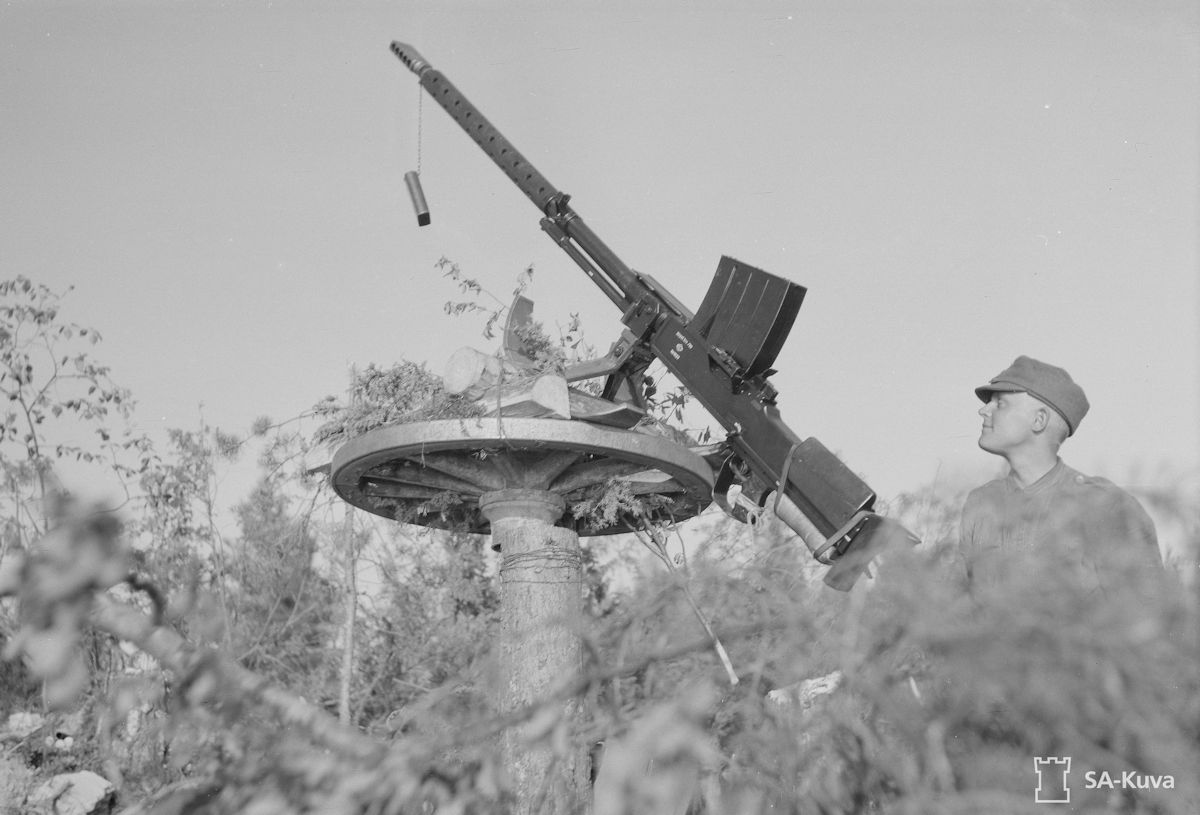
PICTURE: 20-mm antitank-rifle in anti-aircraft duty with improvised anti-aircraft gun-mount
built with cart wheel on tree stump. Photographed by 2nd Lieutenant V.E. Koskenmäki in Rukajärvi
Region in July of 1942. (SA-kuva archive, photograph number 96470). CLICK THUMBNAIL TO SEE LARGER PIC (153 KB).
Losses of 20-mm antitank-rifles during period 9th of June - 7th of July 1944:
|
Unit: |
Losses: |
|
|
II Army Corps |
1 |
|
|
III Army Corps |
3 |
|
|
IV Army Corps |
60 |
|
|
V Army Corps |
115 |
|
|
Aunus Group |
130 |
|
|
Finnish Navy |
(*) 3 |
|
|
Total: |
312 |
(*) While all other 20-mm rifles listed here are quite certainly L-39, this particular number may include some 20 mm pst kiv 18-S at-rifles.

PICTURE: Another 20-mm antitank-rifle L-39 in anti-aircraft duty with improvised anti-aircraft
gun-mount. Photo taken by Military Official Lauri Lamminmäki near Ontajoki River in June of 1944. (SA-kuva
archive, photo number 158585). CLICK THUMBNAIL TO SEE LARGER PIC (153 KB).
20 mm x 113 B ammunition had been introduced already with L-34 automatic-cannon, so it was an obvious choice for prototypes of 20-mm antitank-rifle. Apparently this ammunition was manufactured with at least armour piercing (AP), armour piercing tracer (AP-T) and high explosive tracer (HE-T) projectiles. From these AP and AP-T projectiles weight about 150-grams and were manufactured by Tikkakoski, while projectile used for HE-T shell was Italian-manufactured and apparently became available only after Winter War.
As mentioned only prototypes of L-39 antitank-rifle were manufactured in 20 mm x 113 B, since decision about manufacturing the gun in 20 mm x 138 B (Solothurn Long) was made before stating of first production run. 20 mm x 138 B ammunition types used with L-39 included AP, AP-T, APHE-T, HE-T and phosphorous shells. AP was most plentiful of ammunition types, but not that well suited for the purposes for which L-39 was used during the war. While Soviet medium and heavy tanks soon became just too heavily armour to be destroyed with this antitank rifle the well-aimed hits could still immobilise tank, damage rotation system of its turret or do damage to other vulnerable parts of medium and heavy tanks. At the same time AP-T and APHE-T projectiles fired by these guns were dangerous to even well-armoured Soviet Stormovik ground attack aircraft. Well placed shots of HE and phosphorous shells could be used for taking out machinegun nests or taking out antitank-guns, infantry guns or field guns by simply shooting their gun crews through gun shield. But they could be used be fired into vision slots bunkers for great effect and were used to keep Soviet infantry "entertained" during the long trench war period. In addition summer time phosphorous shells fired with high trajectory could be used for setting forest fires behind Soviet lines. However availability of HE, APHE-tracer and phosphorous shells with L-39 was typically more limited as these ammunition types were mostly issued for antiaircraft-guns.

PICTURE: Closer look to L-39 antitank rifle. The crank on side of the gun is
cocking lever. (Photo taken in Sotamuseo). CLICK THUMBNAIL TO SEE LARGER PIC (156 KB).
20 it kiv 39/44:
(20 mm antiaicraft rifle L-39/44)

PICTURE: Antiaircraft-rifle L-39/44. (Photo taken in Ilmatorjuntamuseo). CLICK THUMBNAIL TO SEE
LARGER PIC (165 KB).
|
Calibre: |
20 mm x 138 B (Rheinmetall-Borsig) |
||
|
Length: |
224 cm |
||
|
Barrel length: |
130 cm |
||
|
Weight: |
55,9 kg (with installing system, without magazine) |
||
|
AA-mount weight: |
9 kg |
||
|
Fire-rate: |
80 - 100 shots/minute (practical) |
||
|
275 - 325 shots/minute (theoretical, depending ammo) |
|||
|
Muzzle velocity: |
800 - 840 m/sec |
||
|
Magazine: |
10, removable box |
||
|
Maximum range: |
6,5 km |
||
|
Ammunition weight: |
337 g (AP) (whole cartridge) |
||
|
Bullet weight: |
152 g (AP) |
||
|
Ammunition types: |
AP, APHE-T (rare), AP-T, APCR-T, HE-T (rare), Phosphorous-T (rare) |
||
|
Basic principle: |
Select fire gas-action |
||
|
Country of Origin: |
Finland |
Finnish use: Finnish troops started using these antiaircraft rifles starting year 1944. The gun was mostly used as anti-aircraft gun, although most were equipped also for antitank-use.
Armour penetration:
Finnish military manual 20 It.kiv./39-44 kalusto-ohje:
|
distance |
angle of impact |
penetration |
|
300 m |
60 degrees |
20 mm |
|
500 m |
60 degrees |
16 mm |
|
300 m |
90 degrees |
25 mm |
|
500 m |
90 degrees |
20 mm |
During trench-war period of Finnish - Soviet Continuation War Finnish troops started using L-39a antitank-rifle as improvised anti-aircraft gun, which gave the idea of designing a special antiaircraft-rifle capable to full-auto fire (L-39 antitank-rifle was semiautomatic and its low rate-of-fire severely reduced the probability of hitting aircraft). One could argue that one of the reasons for this was probably Soviet IL-2 Stormovik ground attack aircraft, which was practically immune for being hit with rifle-caliber ammunition. Official order for developing full-automatic version of L-39 rifle for anti-aircraft use was made 10th of January 1944. This new version would naturally also be equipped with antiaircraft-mount and sights designed for this kind of use (two items that Finnish Army had started supplying to existing L-39 antitank-rifles as additional equipment only in year 1944). Prototype was of anti-aircraft rifle developed in January - March with prototypes being delivered in March of 1944. Production started with order made in June of 1944 for 300 kits of parts that allowed existing semiauto L-39 antitank-rifles to be modified into full-auto L-39/44 anti-aircraft rifles. As with L-39, the sole manufacturer of L-39/44 was State Rifle Factory (Valtion Kivääritehdas - VKT). No change was made in gun's markings in between the two versions - in other words L-39 and L-39/44 have similar markings.
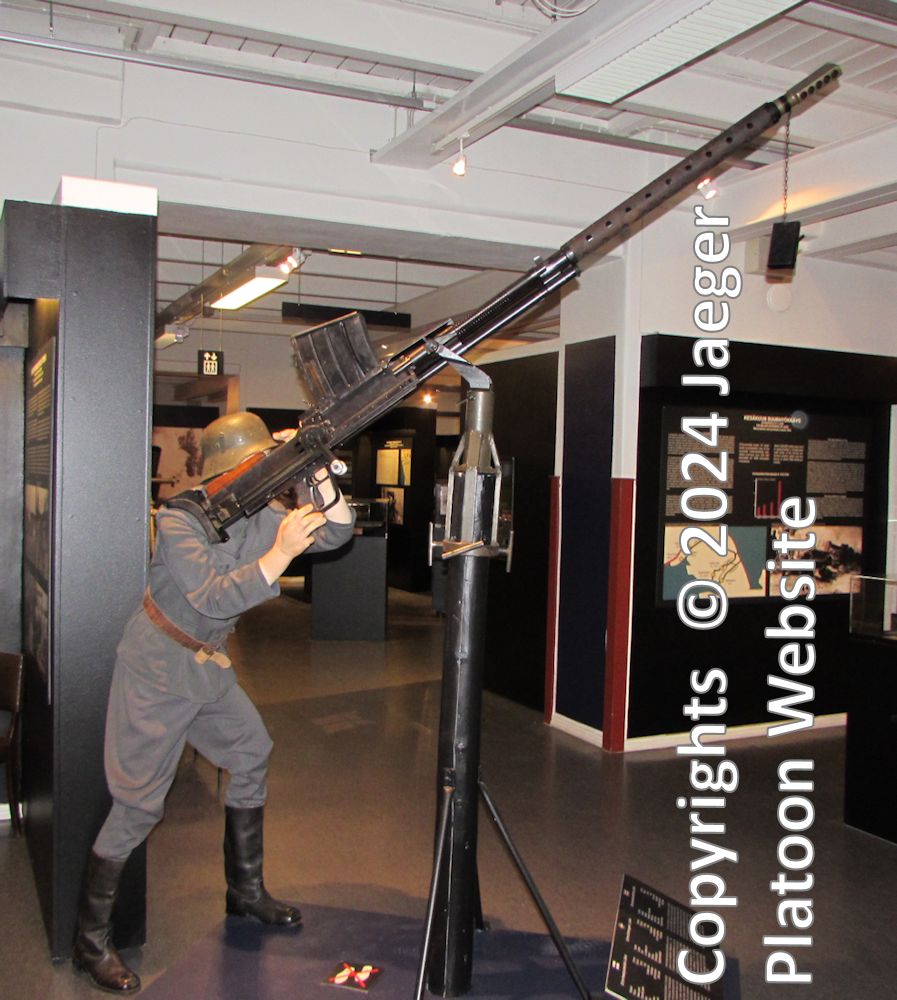
PICTURE: Anti-aircraft rifle L-39/44. Serial number (which is in 1500 range) in this suggests
that it was manufactured as L-39 antitank-rifle, but here it have it equipped with L-39/44 setup. (Photo taken in
Museum Militaria). CLICK THUMBNAIL
TO SEE LARGER PIC (153 KB).
The changes needed to modify the gun into full-auto configuration were minimal, since mechanics-wise they required only change of one part - with the original firing pin being replaced with new fixed firing pin. With fixed firing pin installed the gun was fired by pressing bolt release (located in front part of its pistol grip). Since the normal trigger was no longer needed, it was often removed from L-39/44 anti-aircraft rifles. Two fixed firing pins were delivered with all L-39/44 anti-aircraft rifles. If needed the gun could also be easily returned back into L-39 antitank-rifle configuration by simply replacing fixed firing pin with normal firing pin and re-installing trigger. As mentioned other new items introduced with L-39/44 were anti-aircraft mount and anti-aircraft sights. The mount was simple sleeve like system designed for installing the gun to upper end of suitable wooden pole (about 20-cm / 8-inch in diameter). The gun mount system included recoil buffer system with two buffer springs (coil springs in guide rods) added on both sides of gun. This recoil buffer functioned as attachment point for top part of the anti-aircraft mount. Weight of this gun mount system was 9.4 kg. Anti-aircraft sights were also relatively simple design quite similar to sights already used in Finnish 7.62 ItKk/31-40 VKT anti-aircraft machine guns. Anti-aircraft rifles L-39/44 delivered for the Army were still equipped with all equipment needed for antitank-role as well, but those delivered to Air Force lacked accessories needed for that purpose. Considering the situation one could argue if L-39/44 was really a new weapon design, or simply full-auto version of L-39 antitank-rifle with some additional accessories. But since Finnish military had a different tactical role for it and treated it as separate weapon model, it is also treated as such in here.
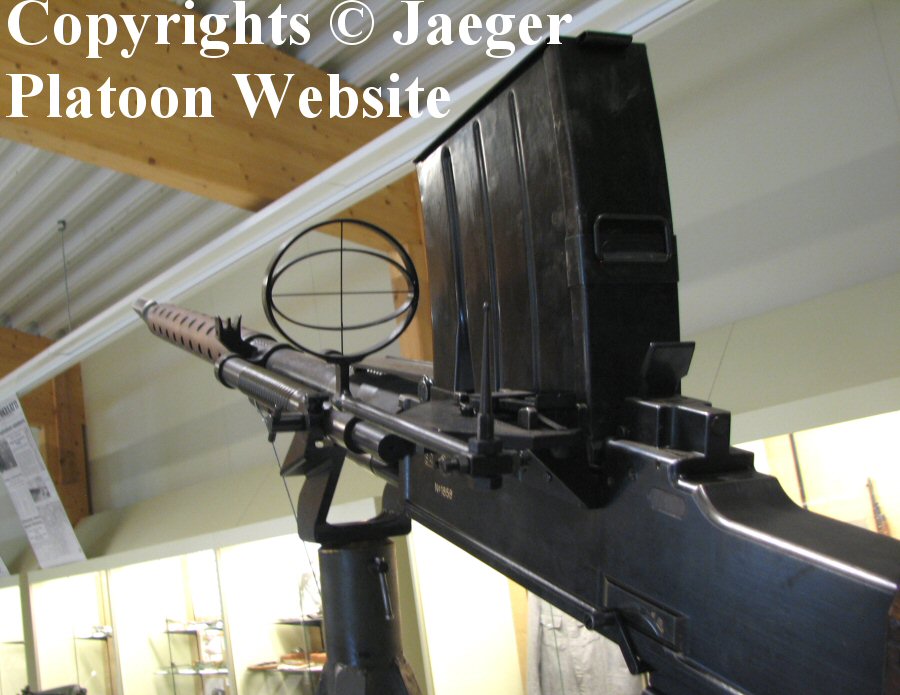
PICTURE: Sights of anti-aircraft rifle L-39/44. These tangent rear sight and front sight post
are similar as the ones used in L-39 antitank-rifle, but L-39/44 has also anti-aircraft sights (rear sight post and
spider web front sight) installed next to them. Receiver markings used for L-39 and L-39/44 are identical.
(Photo taken in Ilmatorjuntamuseo) CLICK THUMBNAIL TO SEE LARGER PIC (147 KB).
Finnish military received 325 anti-aircraft rifles L-39/44, all of them in year 1944, but most only after Continuation War had already ended and had ended immediate need for this sort of somewhat ad hoc anti-aircraft weapon. The 325 guns included 54 L-39 antitank-rifles (of L-39 3rd production series), whose parts had already been manufactured, but had not been delivered yet and were modified in L-39/44 configuration before delivery. Another 170 weapons had originally been ordered as (4th order of) L-39 antitank-rifles, but the order was changed as L-39/44 before their manufacturing was completed. In addition November of 1944 Finnish military ordered modification work for 606 of the earlier delivered L-39 antitank-rifles into L-39/44 configuration, but apparently this order was never completed and ended up getting cancelled. The equipment delivered with each L-39/44 depended to which type of troops it was delivered - those going to Army were equipped with both anti-aircraft and antitank-equipment, while those delivered to units belonging to Air Force that lacked anti-tank equipment. As noted most L-39/44 were manufactured too late to see any action in World War 2.
Structural design of this gas-action full-automatic firing from open bolt soon proved have serious durability issued when used in full-auto configuration. The most notable structural difference in between L-39 and L-39/44 was the firing pin design - L-39/44 had a fixed firing pin. Being true open bolt firing design L-39/44 bolt stopped in its rear position only when bolt release was released. While this was not necessary the best idea for shooting accuracy, it was essential feature for the design to work in full-auto model and allowed more effective cooling. And lets face it - considering this is 20-mm automatic weapon with free traverse gun mount and fired while supported to gunner's shoulder, pin-point long-range accuracy would not have really been a realistic requirement. The anti-aircraft sights used with it were also useful only for giving a summary point of aim. The sight system had been designed to provide rough aiming points advance-wise for aircraft flying 430 km/h at distance of 1,200 meters in angle of 30 or 60 degrees. Once the gunner released the bolt firing the weapon the only real way to adjust aim was by using tracers as a reference point.

PICTURE: Photo of L-39/44 taken possibly for manual of some sort in October of 1944 near town
of Kouvola. Photograph taken by Captain Leo Vepsäinen and according original photo caption the gun was in use
of 33rd Heavy Anti-Aircraft Artillery Battery. (SA-kuva archive, photo number 167128). CLICK THUMBNAIL
TO SEE LARGER PIC (148 KB).
As to be expected due being manufactured at such a late date in the war the combat-losses of L-39/44 were basically close to none. Year 1951 there were still 322 L-39/44 anti-aircraft rifles in inventory. In mid 1950's Finnish military tried solving the known durability issue by developing improvements to L-39/44. If successful, these improvements could have allowed existing L-39/44 anti-aircraft rifles to be modified to a new version with higher rate of fire and better durability. This development work produced two prototypes - 20 Itkiv/39-54L and 20 Itkiv/39-55/ST. Both of the prototypes had reinforced receivers and were designed to have higher rate of fire than original L-39/44. Increasing the rate of fire succeeded - the prototypes reached about 500 shots/minute cyclic rate of fire. But improving durability proved far more difficult. The reinforcements introduced to prototypes added another 10 kg or so into weapon's already substantial weight, but durability of the prototypes still turned out be poor. Testing done in year 1956 revealed that the cracks started appearing to bolt recuperator after no more than 250 rounds of automatic fire. When the prototypes were compared against new foreign 20-mm antiaircraft-guns (which Finnish military was also testing around that time) the shortcomings of these antiaircraft-rifles became even more apparent. Decision was made in year 1956: Developing of anti-aircraft rifles was stopped, existing L-39/44 were reserved for temporary training use and they were modified back to semiautomatic configuration, but apparently remained reserved for anti-aircraft use and remained in that use with equipment developed earlier for them. Basically this marked the end of L-39/44 antiaircraft-rifles, since they were now modified into semi-auto only configuration. However this was not a change as large as some might assume. Probably due to durability issues the use of fixed firing pins (the only essential component for full-auto fire) had already been banned by in training use end of 1940's. Hence for all practical reasons the gun had not really been used in full-auto configuration since. In their semi-auto configuration L-39 and L-39/44 remained in training use until end of 1950's.
SOURCES:
Markku Palokangas: Sotilaskäsiaseet Suomessa 1918 - 1988 osat 1 + 2.
Timo Hyytinen: Arma Fennica 2, sotilasaseet.
Guns vs Armour website by D.M. Honner (website no longer active)
Markku Palokangas and Maire Vaajakallio: Aimo Lahti, asesuunnittelun suuri suomalainen.
Erkki Käkelä: Marskin Panssarintuhoojat.
Mika Pitkänen and Timo Simpanen: Suomalaiset sotilaspatruunat 1918-1945 / The Finnish military cartridges 1918-1945.
Mika Pitkänen and Timo Simpanen: 20 mm Suomessa, Aseet ja ampumatarvikkeet ennen vuotta 1945
Article: Suomessa käytetyt keveiden panssarintorjuntaaseiden patruunat by Esa Paananen in Ase-lehti magazine vol. 6/2003.
Military manual: Jalkaväen Ampumatarvikkeet I by Puolustusvoimien Pääesikunta Taisteluvälineosasto (printed 1941, updated until September 1944).
Military manual: Panssarintorjuntakiväärit by Päämaja. (1941)
Military manual: 20 mm:n panssarintorjuntakivääri L/39 by Päämajan Taisteluvälineosasto. (1942)
Military manual: 20 It.kiv./39-44 kalusto-ohje. (1947)
Special thanks to Sotamuseo (Finnish Military Museum), Helsinki.
Special thanks to Ilmatorjuntamuseo (Finnish Antiaircraft Museum), Tuusula.
Special thanks to Jalkaväkimuseo (Finnish Infantry Museum), Mikkeli.
Special thanks to Museum Militaria, Hämeenlinna.