


WEAPONS FINNISH ARMY ALMOST HAD IN WORLD WAR 2, PART 2
Pistols and Submachine guns
PISTOLS:
9 mm Saloranta military pistol:

PICTURE: Drawing showing prototype of Saloranta military pistol. CLICK THUMBNAIL TO SEE LARGER PIC (43 KB).
|
Calibre: |
9 mm x 19 Parabellum/Luger |
||
|
Length: |
240 mm |
||
|
Barrel length: |
117 mm |
||
|
Weight: |
1105 kg |
||
|
Magazine: |
8, removable |
||
|
Country of origin: |
Finland |
||
|
Production status: |
Prototype made 1929 |
Finnish use: Never issued to military use or mass-produced. Only single prototype manufactured in Gunsmith School of Finnish Army year 1929.
In mid 1920’s Finnish military started considering possibilities of manufacturing domestic military pistol. Year 1926 Defence Ministry asked offers from Leonard Lindelöf’s machine factory concerning manufacturing of Parabellum pistol in production series of 2,000, 5,000 and 10,000 pistols. This request lead organizing of several meetings, but they failed leading into actual results. This inspired Major Arvo Ensio Saloranta (Chief of Defence Ministry Ordnance Department at that time) on his own accord to start developing 9-mm pistol military pistol, which was somewhat resembling Parabellum. Bolt system of Saloranta pistol was directly rearwards sliding, unlike in Parabellum pistol. He designed the pistol around 1926 - 1928 and prototype of the pistol was manufactured in Gunsmith School (Aseseppäkoulu) of Finnish Army year 1929. Nowadays the prototype belongs to collections of Finnish Military Museum.
Determining proper benchmarks against which Saloranta pistol must be compared is a no-brainer - they are Parabellum and Lahti L-35 pistols. It is obvious that Parabellum pistol was the starting point for designing this pistol - both grip-section and barrel used in Saloranta pistol are almost exact copies. Magazine release button is also located to exactly the same place and Saloranta-pistol used even magazines manufactured for Parabellum pistol. However as mentioned the mechanism used in this pistol was quite different from Parabellum - but instead had some resemblance to one used in Lahti L-35. One could very debate that Saloranta-pistol may have had some influence to L-35 later designed by Aimo Lahti - similarity of the basic concept is so obvious. This is something that Aimo Lahti, who apparently really did not get along with Saloranta, would likely never have admitted, but the evidence is quite convincing. When disassembled for basic maintenance the both pistols break to four quite similar parts: Barrel + slide combination, frame, lock and U-shaped connector piece. In fact even the vitally important function of this U-shaped connection piece is similar in both designs - after shot is fired both slide and lock will move backwards together until this connector piece releases lock, which will then continue moving backwards on its own. However Saloranta's design does not have the accelerator (which in L-35 in moment of lock getting released flips and gives a whack to lock increasing its speed), that Lahti used both in L-35. Shape and location of the safety switch used in Saloranta-pistol resembles the ones used in Parabellum and L-35, but it points forward. Location of the safety switch looks promising - it is close enough for thumb of right handed shooter, but is less likely to press thumb in recoil than the one in L-35. This pistol ejects empty cartridge cases upward in Parabellum-like manner. Sights are pretty minimalist - but not necessarily unsuitable for military pistol as front sight is drift adjustable with similar tool as used with Parabellum and front sight bead replaceable. Grip panels are wood and have not been chequered at all. Unlike Parabellum and L-35 pistols (apart from series 4) this pistol does not have stock attachment lug. While as long as L-35 it is structurally somewhat more delicate and weights almost 200 grams less. From manufacturing point of view Saloranta-pistol seems much less complicated than either of its competitors. When it comes to reliability and durability its impossible to make any real conclusions, since any information about possible actual tests appears to be long gone.
What is known suggests that Saloranta seem to have developed his pistol around 1926 - 1928, while the prototype was build in Gunsmith School in late 1929 or later. Aimo Lahti was not assigned to develop a 9-mm military pistol until in autumn of year 1929, so his development work for L-35 pistol apparently started later than Saloranta's development work and it would have been possible for him to have seen Saloranta's design plans, although it is uncertain if Saloranta's or Lahti's (L-29) prototype was built first or if Saloranta intended to offer his pistol as competing design for Lahti's pistol development. However it also might be worth noticing that Lahti's pistol design supposedly developed from first plans to protype stage in mere weeks, which is remarkably fast for somebody who has never designed a pistol before.
Considering how promising the prototype looks like, why did not it ever get to production and even to further development? The reason for this was not that much due to the actual design, but in far extent related to politics of the time. Considering the situation in which Saloranta found himself at the time when he designed this pistol it is not surprising that his pistol did not get the attention it might have deserved. Around 1928 - 1930 he basically fall from grace in manner that effected his military career for quite some time. Saloranta was one of the first Finnish military officers sent abroad to study for the purpose of becoming ordnance specialists. Namely Saloranta and his three fellow military officers studied in Weapons-technical department of Danish Haerens Officerskola in 1920 - 1924. Early on he seemed to be destined going places and doing great things. It is worth noting that he became Chief of Defence Ministry Ordnance Department in age 30 when he a Captain, while both his predecessor and successor for the assignment were Colonels. He served in that duty 1925 - 1927, co-designed Lahti-Saloranta M/26 light machinegun with Aimo Lahti and then got transferred to just recently established VKT (Valtion Kivääritehdas = State Rifle Factory), serving as Chief of the factory in 1927 - 1929. But at the time when he was Chief of VKT things started to go terribly wrong for him. February of 1928 was the starting point for "relining scandal" concerning equipping military rifles with relined barrels, with tests performed resulting large percentage of relined barrels being considered substandard. Due to this persons involved the matter got sued into court of law. While Saloranta was not the only person charged in a court of law for this, in his case the legal proceedings ended up in 1930 with ruling of guilty with getting sentence of 20 days of detention and liability to pay 1.34 million Finnish marks (now equvalent of about 450,000 euros) in compensation. As if this would not have been enough starting production of Lahti-Saloranta M/26 light machinegun, basically for manufacturing of which whole State Rifle Factory had been built, had serious problems to get going. April of 1929 Saloranta was blamed for making unauthorized changes to Lahti-Saloranta M/26 and two months later he was transferred to far less prestigious duty as Chief of Gunsmith School (Aseseppäkoulu). These events seemed to have effected to Saloranta's military career basically for duration of whole 1930's, not to mention that paying the compensation of 1.34 Finnish marks from military officer's salary was just plain impossible. Still, Saloranta continued his military career and served as Chief of Gunsmith School until year 1938. Only during World War 2 did his situation start to improve. During Winter War Finnish military suffered from rifle shortage, due to which also relined rifle barrels earlier declared "completely unfit for use" were used in rifle production, due to which the legal grounds for financial compensation that had been sentenced in year 1930 now became invalid and he got reimbursed for the compensations that he had paid. During World War 2 he returned into developing ordnance materials, although at that time instead of small arms his efforts focused in developing of landmines and ammunition. His wartime developments included antitank-mines S-39 and S-40 plus ice mine m/41. In post-war era during the last few years of his career Saloranta finally got a chance to serve in duties of similar level that he had already once reached in 1920's, serving again as Chief of Ordnance Department in 1947 - 1952, as Master General of Ordnance in 1952 - 1955 and ultimately retired as Major General.
9 mm military pistol M/44:

PICTURE: Pistol M/44, this pistol with serial number 002 is one of the 25 pistols of this model ever made. Notice exposed hammer, that is partly visible and magazine relese button in heel of the magazine. The tab in top of the grip panel is slide holt open button. (Photo taken in Sotamuseo). CLICK THUMBNAIL TO SEE LARGER PIC (71 KB).
|
Calibre: |
9 mm x 19 Parabellum/Luger |
||
|
Length: |
200 mm |
||
|
Barrel length: |
110 mm |
||
|
Weight: |
1090 kg |
||
|
Magazine: |
8, removable |
||
|
Country of origin: |
Finland |
||
|
Production status: |
Pre-production test series of 25 pistols made 1944 |
Finnish use: Never issued to military use or mass-produced. This was supposed to be the solid easy and cheap to manufacture domestic military pistol, that would have solved the shortage of military pistols in use of Finnish Military. But when Continuation War ended the first pre-production test series of 25 pistols was still unfinished. This test series was finished and delivered to Finnish Army in October of 1944. That was the end for manufacturing of these pistols.
During World War 2 Finnish Armed Forces was not able to supply its soldiers as many pistols as would not have been needed. With practically whole Europe in war acquiring suitable pistols from other countries was difficult and also manufacturing of L-35 pistol too expensive and slow for solving this shortage any time soon. So new cheaper pistol design, that could be manufactured easier and faster, was needed for the purpose. February of 1943 Colonel Raatikainen, who was leader of the Ordnance Department of Finnish Army High Command gave the task of designing this new pistol for Colonel-Lieutenant Birger Linkomies. Birger Linkomies (formerly: Birger Flick) was Finnish weapons expert with long service record and he became the design chief of this pistol, which was early on referred as pistol M/43.
First blueprints for pistol M/43 were finished March of 1943. Even if the pistol was chambered for powerful 9 mm x 19 Parabellum/Luger cartridge it is a blowback pistol. While this was unusual the pistol was even more interesting from production point of view - this far Finnish small arms had been manufactured from machined (milled) parts, but after several years of war Finnish Army needed weapons that were cheaper and easier to mass-produce. To reduce costs parts of this pistol was in large extent manufactured from steel plates by pressing and welding. Frame was made from two rather think pressed parts of sheet metal, which were welded together. Pistol's slide, barrel, recoil buffer mechanism and hammer are still all milled steel components, but for example trigger guard (part of frame) and much of trigger mechanism are also sheet metal components. Trigger mechanism formed a single package very much in same manner as with Soviet TT-33, being clearly based to Soviet TT-30 or TT-33 pistol design and was one the features included to make basic maintenance as simple as possible.
Finnish military started planning possible mass-production of this new pistol design already at spring of 1943. 11th of November 1943 State Rifle Factory gave their preliminary estimation giving three possibilities for production:
However this first estimation did not include spare-parts. Bit later a second offer, that included them rather optimistically suggested even lower prices for M/44 pistols, was made:
This later offer included spare-magazine, cleaning rod and spare-parts for each pistol.
23rd of February 1943 Inspector of Artillery authorised purchasing 5,000 of these new pistols, but their route to mass-production was not yet quite open. Army Ordnance Department was hesitating about ordering the pistol, which existed only as blueprints at that time. Basically all existing Finnish industrial plants specialised for manufacturing small arms had already more work, than they had capacity and acquiring raw-materials was also getting ever more difficult. In that situation the Finns could not afford to start mass-producing something new, which could well prove to be a total lemon. So, to be safe a test series was needed and the pistol had to be tested before continuing further. 2nd of March 1944 order was made for test series of 10 – 20 pistols, which were to be manufactured and tested before acquiring materials for production run of 5,000 pistols.
VKT (Valtion Kivääritehdas = State Rifle Factory), which was to take care of manufacturing of the pistols, was authorised to suggest improvements into existing blueprints of Linkomies and Vihuri. Development work done with State Rifle Factory introduced several changes to the pistol design. The most important of these changes was new milled slide design of different shape - in original blueprints also slide would have been made from stamped sheet metal. Linkomies and Vihuri participated designing these changes with VKT. The last changes were made in September of 1943 and at that time the improvements were considered so significant that the pistol was renamed as m/44. The test series of M/44 pistol was not finished until after end of Continuation War and Finnish Armed Forces did not receive them until November of 1944. But by that time the situation had very much changed. When Continuation War ended in September of 1944 Finnish Armed Forces suddenly no longer had immediate need for new pistols and the new Allied Control commission did not look favourably continuing projects of this kind. The Soviet members of the Commission demanded detailed reports of all weapons of Finnish Armed Forces everywhere and in general were just trying to find any kind of excuse for complaint. While the Finnish authorities did their best to provide them everything in middle of and right after demobilizing wartime armed forces keeping up to date record of all existing military equipment and their locations was pretty much impossible. So when the Soviet officers belonging to the Commission visited State Rifle Factory to inspect it and spotted there in one of tables in plain sight the just finished pre-production test series of 25 pistols M/44 they just went ape-shit. Nobody had remembered to report them this small test series. After the Soviets had done plenty of yelling blaming the Finns about breach of the Finnish-Soviet armistice treaty the Finns finally succeeded calming them down.

PICTURE: Another photo about pistol M/44 serial number 002. (Photo taken in Sotamuseo). CLICK THUMBNAIL TO SEE LARGER PIC (89 KB).
Pistol M/44 never saw mass-production. In the end the above mentioned test-series of 25 pistols turned out to be the total production of pistol M/44. While ending of the Continuation War was important factor for this it was not the only one. In fact it is quite uncertain if the pistol would have reached mass-production, even if the war had continued longer. Considerable concern about durability of the pistol existed already during production of the test-series. Tests organized by Finnish military revealed that recoil of this pistol was far from pleasant and firing large number of rounds could be even potentially dangerous to the shooter. Some concern seem to have existed about the blowback system used in this pistol model - blowback pistols rely to mass of slide and power of recoil spring alone and mass of slide used in pistol m/44 was likely slightly too small for the 9 mm x 19 cartridge used and due to this the breech was sealed only marginally. Due to this reason the cartridge cases often tended to expand with heads of cartridge cases bulging because slide opened before the pressure level was safe. Although never issued the pistols belonging to test series still remained property of Finnish Armed Forces until year 1968. That year few were handed over to museums and some transferred to teaching collections of Finnish Defence Forces. After that the remaining pistols were sold to private persons (mainly officers of Armed Forces) and soon become highly esteemed collector's items. Possibility of further developing pistol M/44 was considered in late 1960’s, but that did not lead anywhere. Nowadays the few pistol M/44 that are in collector's market are extremely rare and valued items.
(*) Documents show that November 1943 Ordnance Department had calculated the number of pistols needed for fixing pistol shortage and had come up with number that was around 15,000 (14,850). So, this offer seems to reflect that.
SUBMACHINE GUNS:
9 mm submachine gun M/42 Suomi:
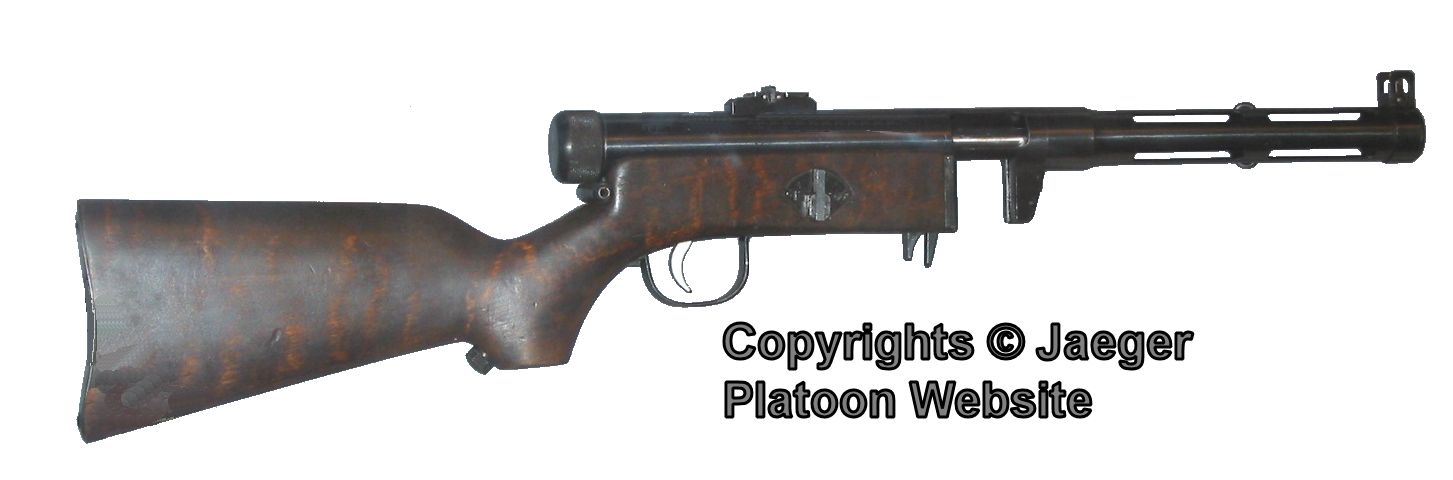
PICTURE: Prototype of Suomi M/42 submachine gun. Notice selector switch on right side of the weapon's stock and larger trigger guard.(Photo taken in Sotamuseo). CLICK THUMBNAIL TO SEE LARGER PIC (74 KB).
|
Calibre: |
9 mm x 19 Parabellum/Luger |
||
|
Length: |
800 mm |
||
|
Barrel length: |
260 mm |
||
|
Weight: |
4,0 kg |
||
|
Fire-rate: |
?/minute |
||
|
Magazine: |
box: 20, 50 drum: 40, 70 |
||
|
Country of origin: |
Finland |
||
|
Production status: |
Prototypes 1942 - 1943 |
Finnish use: Never issued to military use or mass-produced. This was privately development of Tikkakoski factory for cheaper and easier to manufacture submachine gun. The improvement was not seen to be significant enough to warrant changes needed in production. Ultimately submachine gun M/44 (based to Soviet PPS-series submachine guns) provided the Finns a better solution for the problem. Only few (at least five or six) prototypes were manufactured around 1942 - 1943.
While Finland was one of the first countries to introduce submachine guns for military use in substantial numbers during World War 2 the standard issue submachine gun selected (9 mm Suomi M/31), proved also a limiting factor in effectively increasing number of these weapons in use of Finnish military. Suomi M/31 submachine gun was weapon cherished by the soldiers using it, but it was also very expensive and difficult to manufacture compared to next generation of submachine guns, which many other countries introduced during World War 2. As an answer to this problem Tikkakoski (sole manufacturer of Suomi M/31) developed easier and cheaper to manufacture prototype of Suomi submachine gun - called submachine gun M/42. While the weapon was obviously based to earlier M/31 and the basic structure of Suomi submachine gun remained very much the same, its details were redesigned more suitable for large-scale mass-production. This meant that compared to M/31 it was designed to be easier, cheaper and faster to manufacture. As far as known at least officially Finnish military did not order development of M/42 Suomi submachine gun, but instead it was private development made by Tikkakoski factory and may have at least partially intended for export market.
The main differences of M/42 to earlier M/31 included:
It is worth noting that many of these new features seem to have appeared earlier with versions of Suomi submachine gun manufactured under license in other counties. The rear sight design with three folding blades for different range settings appear similar in basic design to that earlier introduced with Swedish M/37-39 submachinegun, while both gun stock with more aggressive pistol grip and front sight post protected by brackets from both sides are also present in Danish M/41 submachine gun.

PICTURE: Sentry presumably belonging to Infantry Regiment with submachine gun that appears to Suomi M/42 prototype. Notice protective ears for front sight, shape of pistol grip area in stock and no selector switch in trigger guard. It is not known how this prototype gun ended up into being issued to unit of Field Army. Photographed by Uuno Laukka in September of 1944 in village of Taljala. (SA-kuva.fi photo archive, photograph number 164157). CLICK THUMBNAIL TO SEE LARGER PIC (164 KB).
The new rear sight contained three leafs, each of which was for different range setting. From these three leafs the soldier using the weapon could raise the one most suitable to shooting distance. For rather obvious reasons it used the same magazines as Suomi M/31. Worth noticing is also that M/42 lacked the muzzle brake, which had been added to all Suomi M/31 ordered by Finnish military after February of 1943. Finnish military studied M/42 Suomi prototype, but early 1944 decided that it was not interested about this design. The decision certainly makes sense - while M/42 was easier and more cost-effective to manufacture than its predecessor, the improvements were not significant enough to risk existing production of proven M/31 submachine gun. Besides, Suomi M/42 still had its receiver and all the most important parts machined from steel (manufacturing method typical to 1st generation submachine guns), so the design still would not have been as cheap or easy to mass-produce as German MP-40, British Sten, American M3 or Soviet PPsh-41 and PPS-43. Ultimately Finnish military found cheaper and easier to manufacture submachine gun submachine gun M/44, which was directly based to Soviet PPS-42 and PPS-43. Because of this more expensive Suomi M/42 never saw to production in any real scale. Only few (at least five or six) prototypes were manufactured. One could ask should M/42 have been introduced to mass-production? Even with the benefit of hindsight it is quite safe to say that it would have almost certainly failed would have failed to make any real difference to cost or production numbers. The changes introduced with M/42 prototypes simply were not drastic enough to make real large difference manufacturing-wise, while they would have almost certainly disrupted existing manufacturing process of Suomi M/31 at least in some degree, when Tikkakoski would have converted its production from M/31 to M/42. From a soldiers point of view M/42 would have been unproven, it did not provide any real improvement over M/31 and some of its structural characteristics had not been tested in combat. Just about the only weakness Finnish soldiers found from Suomi M/31 was its weight, but Suomi M/42 would not have offered any real improvement in this. While it weights few hundred grams less than its predecessor it still weight more than for example the latest Finnish military rifle of that time (M/39). From the writer's point of view especially durability of the new stock and its attachment to receiver seem uncertain and untested for the rigors of battle.
9 mm submachine gun M/44 "pelti-kp":
(9 mm submachine gun model 1944 "tin submachine gun")

PICTURE: 9 mm submachine gun M/44 butt extended and with 50-round box magazine. CLICK THUMBNAIL TO SEE LARGER PIC (84 KB).
|
Calibre: |
9 mm x 19 Parabellum/Luger |
||
|
Length: |
830 mm (butt opened) / 615 mm (butt folded) |
||
|
Barrel length: |
250 mm |
||
|
Weight: |
3,0 kg |
||
|
Fire-rate: |
650/400 /minute |
||
|
Magazine: |
box: 36, 50 drum: 70 (*) |
||
|
Official abbreviations: Country of origin: |
"9,00 kp/44" and "900 KP 44" Finland |
||
|
Prototype: Production status: |
1943 (based to PPS) Some 10,400 manufactured 1944 - 1945 and 1951 |
Finnish use: Issued to use of Finnish Armed Forces soon after World War 2. This easy and cheap to manufacture submachine gun based to Soviet PPS-42 and PPS-43 submachine guns was supposed to boost number of submachine guns available to Finnish military. But the production started so late that the first delivery happened only after Continuation War had already ended and apparently none were used in Lapland War. Hence it basically became post World War 2 weapon. With World War 2 ending also the production of this weapon came to an end.
(*) This submachine gun used the same magazines as Suomi M/31. So also some 20-round box magazines and 40-round drum magazines existed, but they fell out of grace (and removed from frontline service) already during World War 2 and were no longer common in use when M/44 became available.
Summer of 1943 Finnish troops noticed that the Soviets had new kind of submachine guns in their use and soon also succeeded capturing some. These new Soviet submachine guns had most of their parts made from stamped steel parts, which had been assembled by welding and riveting. They also had folding metal butts and arch-shaped 35-round magazines. Bit later Finnish military found out that these new captured submachine guns were the ones Soviets called PPS-42. Summer of 1944 Finnish troops captured also PPS-43 submachine guns, which was more refined version based to PPS-42.
Finnish military became almost immediately interested about this new captured weapon. The Finns had been looking easier and cheaper to make alternative for Suomi M/31 submachine gun and like a god-sent the captured PPS submachine guns offered just what they had been looking for. However as the original captured weapons were build for 7.62 mm x 25 Tokarev cartridge the weapon could not be just simply copied, but it had to be redesigned for 9 mm x 19 Parabellum cartridge. Finnish military decided to start development work for 9 mm x 19 Parabellum calibre version and studying possibilities for domestic manufacturing of this new submachine gun. Result of this development work was first 9-mm prototype, which was simply captured PPS submachine gun modified to chamber 9 mm x 19 cartridges. This first prototype was tested in October-November of 1943 and the results turned out to be encouraging, even when tested against the proven Suomi M/31. Due to positive test results the Finns decided to start developing of their own submachine gun model based to PPS.
Results of tests held in October - November 1943 for Suomi M/31 submachine gun and Soviet PPS-submachine gun modified to 9 mm x 9 calibre. Hit pattern sizes (showing dispersion of bullet hits in target) for these two weapons:
|
Hit pattern from 150 meters, 25 cartridges fired in short bursts: |
|||||
|
weapon: |
height: |
width: |
|||
|
Suomi M/31 submachine gun |
32 cm |
38 cm |
|||
|
Modified PPS-submachine gun |
37 cm |
30 cm |
|||
|
Hit pattern from 150 meters, 25 cartridges fired as one long burst: |
|||||
|
weapon: |
height: |
width: |
|||
|
Suomi M/31 submachine gun |
42 cm |
43 cm |
|||
|
Modified PPS submachine gun |
43 cm |
35 cm |
|||
|
Hit pattern from 300 meters, 40 cartridges fired in short bursts: |
|||||
|
weapon: |
height: |
width: |
|||
|
Suomi M/31 submachine gun |
56 cm |
65 cm |
|||
|
Modified PPS submachine gun |
67 cm |
60 cm |
|||
|
Hit pattern from 300 meters, 50 cartridges fired as one long burst: |
|||||
|
weapon: |
height: |
width: |
|||
|
Suomi M/31 submachine gun |
85 cm |
82 cm |
|||
|
Modified PPS submachine gun |
99 cm |
80 cm |
|||
Source: Original test report attached to 4/Ordnance Department brief 3226. Finnish Military Archives folder T-19053/8.
That Finnish submachine gun based to Soviet PPS-42 and PPS-43 was 9-mm submachine gun M/44 designed by Tuure Salo and Esko Kekki. Unlike some sources may claim the weapon is not exact copy of Soviet PPS submachine guns. Instead Finnish submachine gun M/44 is directly based on PPS-42 and PPS-43 with most of its design features based on PPS-43. Finnish designed changes for the gun were relatively small and mainly created to change the caliber into 9 mm x 19 Parabellum and allow use of existing magazines already in production for Suomi M/31. Besides the change of barrel calibre also front receiver is somewhat different and the Finnish designers added the design lugs located to rear part of the lower receiver. These lugs secure the gun's recoil spring and lock during disassembly so these would not fly off once the receiver is opened.
Safety used in the weapon locked the bolt in rear position making sure it would not be able to get forward. Just like PPS-43 also Finnish M/44 is capable for full-auto fire only. Almost all charasteristics are similar in between these two guns. Just like original PPS-42 and PPS-43 also this submachine gun was made from pressed metal parts and build by welding and riveting the parts together. These characteristics include folding metal butt, rear and front sights and muzzle brake simplified to extreme. Details such as recoil spring guide working as ejector and folding butt design are basically identical to PPS-43. Safety switch is located to same place as in PPS-42 - it goes through the front of trigger guard, but is of slightly different shape, which makes it easier to use. Safety switch has only two settings: safe and (full-automatic) fire. The major obvious structural difference to original Soviet weapon is magazine attachment - while the Soviets used 35-round arch-shaped magazine in their PPS the Finns decided to use same magazines as already used with Suomi M/31 also with their submachine gun M/44. The rear sight is similar to the one used in PPS. In other words: It has similar L-shaped part, which can be switched to two positions and in these positions it has blades with slots for two settings - one for 100 meters (marked with "1") and another for 200 meters (marked with "2"). Settings for zeroing in the weapon to shoot at point of aim are all in the front sight - the horizontal setting is drift adjustable while vertical setting is adjusted by rotating the bead in it. Both disassembly for maintenance and re-assembling the weapon are very easy because the way receiver of the weapon opens up - characteristic inherited from PPS. It is quite safe to say that this made maintenance of M/44 easier than any other submachine gun used by Finnish military previously.
Designing of the submachine gun based to PPS d design may have been easy, but finding a suitable manufacturer proved much more difficult. The list of established Finnish small arms manufacturers was short to begin with - Sako, VKT and Tikkakoski. From these three Sako and VKT (Valtion Kivääritehdas = State Rifle Factory) had their hands full with previous military contracts. From established manufacturers this left Tikkakoski as only existing possibly. Dark horse for the race was "Oy Ammus" ("Ltd Ammunition"), which was also considered as possible manufacturer - even if the company had absolutely no previous experience about small arms manufacturing. Oy Ammus was one of Rafael "Rafu" Lönnström's companies and specialised in manufacturing ammunition for anti-aircraft guns, antitank guns and mortars. Both Tikkakoski and Oy Ammus expressed that they wanted manufacturing contract of the new 9-mm submachine gun and started preparing acquiring of tools and machinery needed for production. Even if starting of the mass-production had not yet even been decided for certain the concept of 9-mm submachine gun based to PPS design had sparked interest both in Sweden and Romania. The Romanians contacted the Finns in this matter already in summer of 1943. The Swedes contacted Tikkakoski asking prototypes of the weapon in exchange of tools needed for mass-producing the submachine gun - offer, which was very tempting to Tikkakoski, as it came with possibility of later getting manufacturing contract for this weapon also to Swedish military.

PICTURE: Submachine gun M/44 butt folded and with 36-round box magazine. CLICK THUMBNAIL TO SEE LARGER PIC (79 KB).
Lack of materials delayed starting of the production until summer of 1944. By July of 1944 Tikkakoski had tested its test series of 36 prototypes, which could use 70-round drum magazine of Suomi M/31 and had also ordered materials from Sweden for manufacturing 50,000 submachine guns. Oy Ammus had failed finding source of materials, which reduced its chances for became manufacturer of this new weapon. In addition Oy Ammus also seemed to have considerably overpriced its offer concerning this new submachine gun - the price per weapon in its offer was 1,500 Finnish marks per weapon (which was more than what Suomi M/31 cost and more than double the price per weapon in the final contract which Tikkakoski made with Finnish military about manufacturing of submachine gun M/44). Due to these reasons in practice Tikkakoski had already won the competition about production contract, even there still was no official order at that time.
However, there were some slight problems with Tikkakoski manufacturing submachine gun M/44, as the factory was already making previously contracted Suomi M/31 submachine gun with rate of about 1,000 weapons per month and also 70-rounds drum magazines for them. The factory simply did not have production capacity for both maintaining this production and also for mass-production of the new submachine gun. Due to this decision was made to transfer production of 70-round drum magazines to VKT (State Rifle Factory). Submachine gun M/44 was not intended to replace Suomi M/31 in production, since both weapons were expected to be produced side by side.
Since the Soviet offensive against the Finns had started in June of 1944 the matter of improving infantry firepower by increasing number of submachine guns had became urgent. But still this did not always show in decisions. Even if Marshal Mannerheim gave his approval to contact of 50,000 submachine guns M/44 Minister of Defence Walden reduced the number to 40,000 and ordered that not more than 20,000 were the ordered at that time. Commander of Weapons-HQ in Finnish Armed Forces GHQ (Päämajan Ase-esikunta) Major General Svanström protested the decision of Walden, but to little avail. August of 1944 Finnish Army Ordnance Department ordered 20,000 submachine guns from Tikkakoski. The price per weapon in this contract was 749 Finnish marks per submachine gun, about the half of the price of Suomi M/31 (calculated as 1,248 Finnish marks per weapon in year 1956). But if the real mass production had been started the production price would have likely reduced fast and the production cost of M/44 would have likely decreased to only about one quarter of Suomi M/31 production costs.
Production timetable plan of Tikkakoski for submachine gun M/44:
|
production: |
Time needed: |
|
10000 |
10 months |
|
20000 |
11 months |
|
50000 |
14 months |
Basically 20,000 new M/44 submachine guns were ordered at August of 1944, but order was decided to be limited to only 10,000 weapons as Tikkakoski at that time lacked materials needed for larger production run. The other 10,000 weapons were apparently to be manufactured once the materials would have been acquired. Price was set at 749 FIM (Finnish Marks) per weapon (compared to 1,248 FIM per weapon sometimes calculated as estimated production price of Suomi M/31). But when Continuation War ended in September of 1944 it changed plans. The immediate need for more submachine guns vanished when the war ended. The 10,000 weapon limit intended as a temporary limitation was now changed as size of the whole order - basically this meant that the existing order of 20,000 submachine guns M/44 was reduced to 10,0000 weapons. Tikkakoski manufactured the whole production run in year 1945, but the first delivery was not completed until Lapland War had already ended. At the time Finnish Army was demobilising, so the small number of Finnish troops fighting the Germans in Finnish Lapland had more than enough Suomi M/31 for their use. It is pretty safe to say that likely none of the submachine gun M/44 saw any combat use in World War 2.
After Second World War submachine gun M/44 had marginal role in use of Finnish military. When Continuation War ended Finnish military had bit over 40,000 Suomi M/31 and by year 1951 their number had increased to about 50,000 - when compared to these the about 10,000 submachine gun M/44 obviously had only secondary importance. That same year AV1 (Weapons Depot 1) assembled 398 submachine guns M/44 from earlier manufactured parts. This second production run ended up also being the last one for this weapon. Year 1956 Finnish military yet considered restarting its manufacturing (this time the planned production number would have been 11,000 submachine guns), but the final decision was against it. The chances of ever manufacturing more submachine guns for Finnish military were rapidly evaporating at that time. February of 1957 the Finns made with Interarmco a deal, which had radical effect to number of submachine guns in use of Finnish Armed Forces. Finland delivered Interarmco 74,381 Italian 7.35-mm rifle M/38, 217 Swedish 6.5-mm light machineguns M/21 and 2.117 French 8-mm Chauchat M/15 light machineguns. In exchange Finland received 76,115 Sten submachine guns Mk 2 and Mk 3 plus some 379,500 magazines (about 5 per weapon) for them in 1957 - 1958. After this deal Finnish military had plenty of submachine guns. In addition around year 1958 Finnish Defence Forces came to conclusion, that the future weapon for infantry soldier would be assault rifle - submachine gun was no longer the best weapon of choice.

PICTURE: Group of Finnish soldiers in snow camo photographed in search of coffee
smugglers in year 1951. Finland had food rationing from year 1939 to year 1954, with coffee being high-price item.
At least the soldier on the left has submachine gun M/44 with drum magazine as his personal service weapon.
Photographer U.A. Saarinen. Photo provided by Finnish Heritage Agency (Museovirasto) via
finna.fi and used with
CC BY 4.0 license. CLICK
THUMBNAIL TO SEE LARGER PIC (83 KB).
Even if submachine gun M/44 was marginally important to Finnish military at best due to its small numbers it still remained training use of use of Finnish Army until 1970's. However Finnish military did not even really bother training all conscripts for using them - likely due to fact that average Finnish soldier would have pretty small probability for getting one issued at him in mobilisation. For these weapons the high-point of their career came Finnish UN peacekeeping mission in Suez in 1957 - 1958, as the Finnish peacekeepers sent to this mission were armed with submachine guns M/44. In addition to this they saw plenty of use with Finnish Frontier Guard, where they were rather popular. Finnish soldiers gave two well-known nicknames for the weapon - "pelti-kp" ("tin submachine gun") and "peltiheikki" ("tin henry"). Unlike some sources may claim these submachine guns were never called "Suomi", that name was used only with M/31 and sometimes to its earlier version M/26, but never with submachine gun M/44. Large majority of M/44 remained warehoused until 1990's before being declared obsolete. Quite a few were sold to collectors - both fully functional and deactivated weapons have been for sale during the last few years. According some reliable sources they have now all been sold and Finnish military has none left anymore.
The obvious interesting question is: From point of view of a soldier using the weapon, how does submachine gun M/44 rank up when compared against the famed Suomi M/31? The basic problem with the estimation is that submachine gun M/44 was never in combat use and therefore did not have go the ultimate endurance and reliability testing of war. The weapon was popular with Finnish conscripts, but mainly due to its convenient size and small weight, which made carrying it much more comfortable than notably heavier Suomi M/31. It is easy to understand why it was suitable and popular weapon for frontier guards and peacekeepers - in both of these services the personnel is unlikely to ever fire a shot in anger, but they have to carry their weapons with them constantly. Unfortunately in other areas M/44 does not qualify as well. Accuracy-wise it compared surprisingly well with Suomi M/31 famous for its accuracy in full-auto mode. But in semi-auto mode there would not have been real competition (if M/44 would have had such mode). When it came to controllability "tin-henry" also had obviously more tendency to muzzle climb than its competitor, (which weight much more). During its service "pelti-kp" gained reputation as good solid submachine gun. Reliability-wise it is difficult to say how good M/44 would have proved in extreme conditions of battlefield, as it never saw combat use. But considering that PPS-43 had fair reputation and manufacturing quality of both M/44 and its magazines was better, it is fairly safe to say that likely it would have not caused any real disappointments in this regard. When comparing firepower the rate of fire in M/44 is obviously smaller, but its unlikely that these would have caused any practical difference - indeed with more tendency to muzzle-climb the slower rate of fire makes sense. Ergonomics-wise both weapons had basically the same problem - where to place the left hand for support. Taking hold with the left hand below receiver is possible with M/31, but in M/44 this hold would place fingers dangerously close to bolt arm, which is moving with the bolt while shooting. Gripping the magazine is not smart either, since bending it to any direction may cause the weapon to malfunction.

PICTURE: Submachine gun M/44 disassembled for basic maintenance. CLICK THUMBNAIL TO SEE LARGER PIC (77 KB).
As mentioned the magazines used in submachine gun M/44 were the same as used in Suomi M/31. Unfortunately the magazines most commonly used from 1945 were not exactly perfect for submachine gun M/44. The 70-round (with actual maximum capacity of 72 rounds) drum weight 1.48-kg fully loaded and 50-round box magazine also bit more than 1 kg. So from these two magazines the 70-round drum was quite heavy and clumsy for the weapon weighting less than 3 kg, while 50-round box magazine was known to be notoriously unreliable. The perfect magazine for the weapon did not come available until year 1954, when the Finns first purchased Swedish 36-round box magazines originally designed for Swedish Carl Gustaf M/45 submachine gun, and year later acquired manufacturing license for these magazines. Weighting 0.85 kg fully loaded, offering much better grip than drum magazine and being reliable at the same time the M/54 (Swedish made) / M/55 (Finnish made licensed version) 36-round box magazine and Finnish submachine gun M/44 were simply match made in heaven.
Finnish 9-mm submachine gun M/44 development produced also foreign aftermath. While neither Swedish or Romanian interest was followed by any real results, the political consequences in end of Continuation War did so. One of the terms of Finnish - Soviet peace treaty in 1944 was transferring of all German property located in Finland to Soviet ownership and interning all German citizens in Finland after certain date. As mentioned Tikkakoski factory was German-owned, which basically meant that it now became Soviet property. In addition the German shareholders now had to hurry abroad if they wanted to avoid becoming internees. In this situation attempting to salvage what was possible Tikkakoski's German (since year 1930) majority shareholder Willi Daugs took blueprints of newly developed 9-mm submachine gun M/44 with him. After World War 2 Willi Daugs ended up to Spain, where these blueprints allowed starting manufacturing of DUX submachine guns in local factory Fabrica de Arms de la Vega. Since he had lost Tikkakoski factory he now had no factory of his own for manufacturing of this weapon. Daugs succeeded selling unknown number (possibly about 1,000) of DUX submachine gun manufactured in Spain to Bundesgrenzschutz (West-German Frontier Guard) around 1953 - 1954. Around that time Willi Daugs also moved to West Germany and continued development of DUX submachine gun with several German weapon manufacturers. Year 1953 he also patented in West Germany the magazine well design that allowed using both box and drum magazines (originally developed by Finnish Army for submachine gun M/44) and safety feature that did not allow opening of the submachine gun receiver while bolt was in rear position since could produce accidental discharge (another feature developed in Finland for M/44). It seems that the first of DUX submachine guns, known as DUX-53, were basically a direct copies of Finnish submachine gun M/44. What is known that that Ludwig Vorgrimmer, whom Daugs had met in Spain, may have at least early on have taken part in developing of DUX submachine gun. Later versions of the weapon, both DUX-53 and DUX-59, were tested by West German military several times in 1955 - 1959, but these tests did not result to any real production contracts. Variety of DUX-53 and DUX-59 prototypes for these tests were manufactured by Sauer & Sohn, Anschutz and Mauser. The prototypes have notable differences in barrel shroud, sights, folding butt, trigger guard, pistol grip, recoil spring system, magazine and muzzle brake. None of the DUX submachine gun versions achieved much of a commercial success and the number of produced weapons seems to have been relatively small.

PICTURE: DUX-53 and DUX-59 submachine guns. (Photos used for making this collage provided by M. Heidler). CLICK THUMBNAIL TO SEE LARGER PIC (46 KB).
Writer's personal (limited) experiences concerning shooting with submachine gun M/44: While the mechanical accuracy of submachine gun M/44 might be good, the full-auto only design and less than excellent trigger make achieving real shooting accuracy somewhat difficult. Rate of fire is high enough to make firing single shots difficult - shortest practically possible bursts are 2 - 3 rounds. With decent amount of experience it is possible to routinely shoot two round bursts. Probably due to light weight and angle of the folding butt muzzle climb also makes shooting bursts longer than 3 rounds quite impractical - I tested various shooting techniques, but usually already fourth and fifth round go too high to hit torso size target area even from 50 meters. Sights are relatively good and the safety switch works even if somewhat heavy. Due to its small size and weight this submachine gun is comfortable to carry. While the finish is superior to one that can be usually found with Soviet PPS-42 and PPS-43, I would actually rate Finnish submachine gun M/44 as slightly inferior weapon when compared to these Soviet weapons. The main practical handicap of this weapon is the magazines and magazine well, in which area Soviet PPS-42 and PPS-43 are notably superior. The magazine well used in M/44 is rather flimsy, so pulling or pushing magazine during firing may jam the weapon. In addition this far I have spotted two submachine guns M/44, which both had very serious problems with magazine compatibility - certain magazines of various type simply got stuck into their magazine wells and were next to impossible to remove. Test-shooting with two round bursts to torso-size target produced 26 hits with 30 rounds from 50 meters, while from 100 meters the number of hits was 14 hits with 30 rounds. It was also notable that from 50 meters grand majority of bullets hit the center mass area, while from 100 meters they were all over the target.
Submachine guns of Carl Pelo:

PICTURE: Drawing showing prototype one of early submachine gun prototypes of Carl Pelo. CLICK THUMBNAIL TO SEE LARGER PIC (52 KB).
As mentioned Captain Carl Pelo was engineer, who had made short career in Finnish Army before moving to civilian life and studying as engineer. He had notable interest in developing automatic weapons and selling these designs of his to Finnish military. Besides automatic rifles and light machineguns Pelo designed also some submachine guns, but as he was well aware about excellent qualities of Suomi M/31 submachine gun, he decided to avoid competing against it. So the submachine guns he developed were not intended mainly for use of frontline infantry (like Suomi M/31), but for other military personnel, which might need smaller and lighter submachine gun. In a sense Pelo was ahead of his time in this matter by understanding the need for this kind of submachine gun. Since 1980's submachine gun-type known as PDW (personal defence weapon) has surfaced especially for that role. However what he failed to realise was that pre World War 2 Finnish military lacked the funding necessary for properly equipping even infantry with automatic weapons - and that there was absolutely no funding for equipping other troops with such weapons. So Finnish military never acquired any of his submachiguns. In fact the most interesting design concerning submachine guns that Pelo come up as part of his submachine gun development wasn't a weapon but a magazine. Around 1942 he got the idea for fixed (in other words: non-removable) submachine gun magazine, which could be reloaded fast with special cassette-like ammunition clips. The magazine had lid, which was opened for inserting the cassette-like clips and then the lid was simply closed. Reloading was equally simple - just open the magazine lid, remove the ammunition empty clips and replace them with fully loaded ones before again closing the lid. At the time Pelo was back in Finland and working for Finnish Army, so Ordnance Department gave him permission to concentrate developing his magazine and ordered Repair Shop of Weapons Depot 1 to manufacture the prototypes. Both of these on condition that Finnish Army would get the right to produce the new magazine whatever magnitude necessary. Pelo accepted this suggestion and the development continued slowly until autumn of 1944 Ordnance Department found out that Pelo had sold patent of the magazine to privately owned company "Oy Ammus" (Ltd Ammunition). This was obvious contract violation, but as Continuation War ended soon the whole matter was forgotten and this rather unusual magazine design never got to large-scale production.
SOURCES:
Sotilaskäsiaseet Suomessa 1918 - 1988 / Military Small Arms in Finland 1918 - 1988 by Markku Palokangas.
Aimo Lahti, asesuunnittelun suuri suomalainen by Markku Palokangas and Maire Vaajakallio.
Asesuunnittelijana Suomessa by Timo Hyytinen.
Arma Fennica 2 by Timo Hyytinen.
Suomi-konepistoolin tarina by Timo Hyytinen and Harri Hyytinen.
The World's Great Machine Guns by Roger Ford.
Finnish m/44 Prototype Blowback 9mm Pistol on Forgotten Weapons channel in Youtube.
M44 Submachine Gun: Finland Copies the Soviet PPS-43 on Forgotten Weapons channel in Youtube.
Article: 1944 aseiden vuosi Suomen historiassa by Markku Palokangas in Ase-lehti magazine vol. 6/94.
Article: Suomalaisen asekehittelyn alasajo vuonna 1945 by Markku Palokangas in Ase-lehti magazine vol. 1/95.
Article: Sotiemme aseveteraanien myöhemmät vaiheet by Markku Palokangas in Ase-lehti magazine vol. 2/95.
Article: Konepistooli M/44, "Peltiheikki" by Jarkko Koskinen in Rekyyli magazine vol. 5/2003.
Article: Willi Daugsin vauhdikas elämä ja DUX konepistoolit by Michael Heidler (translated by Mika Vuolle) in Kaliberi magazine vol. 4/2012.
Article: Salorannan sotilaspistooli by Mika Vuolle in Kaliberi magazine vol. 3/2005.
Article: Suomi-konepistooli m/42, outo ase by Jaakko Puuperä in Suomen Sotilas magazine vol. 5/2016.
Sotilaan käsikirja (1968)
Test reports Suomi M/31 submachine gun vs. PPS-43 modified to use Finnish 9 mm x 19 Parabellum ammunition, Finnish Military Archives folder T-19053/8.
Offer of Oy Ammus concerning producing "Russian submachine gun" dated 18th of November 1943. Finnish Military Archives folder T-19051/32.
Letter number 7346 from General Major Svanström to Head of Ordnance Department (Raatikainen).
Special thanks to Sotamuseo (Finnish Military Museum), Helsinki.