


LANDMINES PART 2:
Antipersonnel Mines
JÄÄMIINA m/41 (ice mine m/41)
(German: Flaschen-Eismine)

PICTURE: Ice mine m/41. Notice SA-marking used to mark it as property of Finnish Armed Forces
and P-marking (Pioneeri = Engineer) below it indicating it as equipment of Engineer Corps.
(Photo taken in Maneesi of Sotamuseo). CLICK THUMBNAIL TO SEE LARGER PIC (63 KB).
|
ice mine m/41: |
|||
|
Construction: |
Glass bottle containing explosive charge. |
||
|
Fuse type: |
Pressure activated fuse inside screwed lid. |
||
|
Basic principle: |
Used as fields, detonating the field creates obstacle. |
||
|
Location: |
Anchored below ice in frozen lakes and rivers. |
||
|
Bottle volume: |
1.8 litres |
||
|
Bottle height: |
26.5 cm |
||
|
Bottle diameter: |
9.6 cm |
||
|
Weight: |
2 - 3 kg depending explosive used. |
||
|
Explosive charge: |
Bottle full of anite, trinite, nitrolite or amatol (*) |
||
|
Fuse activated by: |
Pressure wave caused by nearby explosition. |
||
|
Country of origin: |
Finland |
||
(*) Some of these were sensitive to moisture, so water getting inside the bottle had to avoided at all cost.
Method of transport: Wood crates containing 15 mines each. Crate size 31 cm x 48 cm x 52 cm, inside the crate was also separate cartoon box containing wood box, which contained fuses for the mines. The crate weight around 42 - 58 kg.
|
small ice mine: |
|||
|
Construction: |
Glass bottle containing explosive charge. |
||
|
Fuse type: |
Pressure activated fuse inside screwed lid. |
||
|
Basic principle: |
Used as fields, detonating the field creates obstacle. |
||
|
Location: |
Anchored below ice in frozen lakes and rivers. |
||
|
Bottle volume: |
0.2 litres |
||
|
Bottle height: |
9.7 cm |
||
|
Bottle diameter: |
5.7 cm |
||
|
Weight: |
2 - 3 kg depending explosive used. |
||
|
Explosive charge: |
0.8 kg of TNT or amatol |
||
|
Fuse activated by: |
Pressure wave caused by nearby explosition. |
||
|
Country of origin: |
Finland |
||
Method of transport: Wooden crates each containing 60 mines.
One could argue if this weapon really belongs to category of antipersonnel landmines. It was not used on dry ground, but sunk in frozen lakes and being remotely triggered to create an obstacle. Also even the international Ottawa treaty of this day would not consider it as antipersonnel landmine. However, but since this seem to be the most fitting category for it, here its is. Often development of new weapon starts from a specific need for filling which something new is required - and this was the case with ice mines. During Winter War (1939 - 1940) the frozen lakes and rivers offered easy route of advance for light armour vehicles, soft vehicles and infantry of Soviet Red Army. Especially Soviet light tanks proved considerable nuisance in these situations, as Finnish troops had shortage of antitank guns and on open ice getting it was difficult to get close enough to use weapons such as molotov cocktails and satchel charges. So, Finnish Army needed something new to form obstacles on these frozen lakes and rivers to slow down and limit Soviet routes of advance. Exploding ice with explosive charges and even sawing it were used, but both methods demanded lot of work and took considerable time. Being so impractical these methods offered only (very) temporary and limited solution. According Finnish military manuals in southern and eastern Finland during typical winter the ice got 50 - 60 centimetres thick. In northern Finland during winter the ice got 70 - 90 cm thick and in some cases even 120 cm thick. These were all much more than what light armour vehicles required, so they could operate on ice quite safely. Ice, which is 5-cm (2 inches) thick is already enough to carry soldiers on foot, 7-cm (2.5 inch) ice was enough to carry A20 Komsomolets armoured towing tractor, T-37 / T-38 series amphibious tanks and 11-cm (4.5 inch) of ice was already thick enough for T-26 series light tanks.
The tool which solved the problem was the ice mine, which Finnish military developed around 1940 - 1941. The mine and its fuse were also known as ARSA-miina (ARSA-mine) and ARSA-sytytin (ARSA-fuse). Name ARSA was abbreviation of sort taking first letters of first names and first two names of surname from developer of this mine and its fuse - Lieutenant-Colonel Arvo Ensio Saloranta, better known in Finland as co-designer of Lahti-Saloranta m/26 light machinegun. Ice mine m/41 was the mass-produced version introduced after test-versions. The first order of 50,000 mines was made 29th of December 1941. The Finns manufactured huge number of ice mine m/41 in two sizes during Continuation War. Also German Armed Forces got interested about this unique design during World War 2, bought over 770,000 ice mines from Finland in 1943 - 1944 and also started manufacturing of their own version. German military called this mine Flaschen-Eismine and presumably used them in eastern front. Finnish and German version of the ice mine function with the same principle, but the Germans used different fuse and the glass bottles used for their mines appear to be of lower quality (with plenty of visible air bubbles). Finnish-manufactured glass bottles for ice mines typically have "SA in a box" Finnish Armed Forces property marking with "P" (for pioneeri = sapper) indicating that the item belongs to engineer supplies.

PICTURE: Structural drawing of ice mine m/41. CLICK THUMBNAIL TO SEE LARGER PIC (79 KB).
Basically ice mine m/41 was glass bottle filled with explosive charge. The bottle was closed with lid, which was screwed to its mouth. Inside the lid was ring-shaped rubber seal and the fuse was installed to hole in the wood plug, which was installed inside mouth of the bottle. Line of holes was drilled to ice with helical auger or auger drill spoon. After that the ice mines were lowed to the holes and anchored to suitable depth with about 2 meters long thin cable leading up to surface of ice were they were anchored with a piece of wood. The piece of wood in end of the cable was 26 cm long and 2.5 cm wide and in middle of it was a hole for the anchoring cable. The water in place of the line selected for the field of ice mines had to at least 2.5 metres deep and the field had had to be close enough to be observed from the shore. This meant that the field of ice mines usually was along the coastline certain distance from the shore and that the distance from the shore depended, how steep the river/lake bottom fell from the waterline. Finnish manuals specify the basic unit for building fields of ice mines as 1 NCO and 9 men. Their tasks in this unit were:
In addition typically 1 or 2 horses were needed for transporting the equipment and mines needed for the task. Building of 500 meters long field of ice mines on 30-cm thick ice took about 2.5 hours, if the work was not disturbed. However the thickness of ice effected considerably to the pace in which the work progressed.

PICTURE: Two transport crates full of icemines. The larger crate on the left has stickers
for "explosive class II" and contains normal icemines, while smaller crate on the right has Swedish-language
texts about Nitrolite and contains small icemines. Photographed by Military official J. Taube in Vammelsuu in January
of 1944. (SA-kuva photo archive, photo number 146680). CLICK THUMBNAIL TO SEE LARGER PIC (151 KB).
The typical drilling speeds of holes for ice mines:
|
thickness of ice |
time needed per hole |
continuous drilling speed |
|
30 cm |
35 sec |
1.5 min/hole |
|
50 cm |
50 sec |
3 min/hole |
|
70 cm |
1 minute 10 sec |
4 - 5 min/hole |
As mentioned ice mine was used for creating obstacles against enemy armoured vehicles and attacking infantry. However using them against small patrols was not recommended, as that would have been both wasteful and ineffective. Engineer units mostly built fields of ice mines, but sometimes also infantry did this. As can been seen from the chart above thickness of ice was a definite factor in time needed for building the field took, so the recommendation was if possible to built the fields during early winter, while the ice was still relatively thin. As mentioned the usual distance between holes containing mines was 5 meters. When normal m/41 ice mines were used typically two ice mines were installed to each hole (exception: ice thinner than 50-cm and if the field was to be detonated immediately after being finished). However, installing to mines to the same hole demanded bit of adjustment: The cable of second mine had to be shortened so the mines would hang below the ice in slightly different depths. When small ice mines were used the distances between drilled holes were only 4 meters and only 1 mine was installed per hole. The fields of ice mines had to be built far enough from each other or detonating one field might detonate also the other. Safe distance between fields was considered to be 100 meters as the tests had revealed that pressure wave of exploding ice mine might activate pressure-fuse of another mine up to 75-meter distance.

PICTURE: Icemines - small and normal size with their electically activated fuses. Photographed
by Military official J. Taube in Vammelsuu in January of 1944. (SA-kuva photo archive, photo number 146681).
CLICK THUMBNAIL TO SEE LARGER PIC (178 KB).
Detonating field of ice mines was usually done with ice mines equipped with electrical fuses, which were installed among other ice mines in the field of mines. For this use Finnish troops had ice mine lids already equipped with electrical fuses, whose parts were manufactured by Oy Koneistus and Oy Santasalo & Sohlberg Ab. These special lids came in boxes each containing 20 lids. Early on also packages each containing 15 lids seem to have been used as well. Oy Santasalo & Sohlberg Oy manufactured also the special lids used in these mines. Helsingin pahvi-pakkaus manufactured the cardboard sleeves used for supporting the fuse inside bottle. The glass bottles used for the mines were manufactured by Karhulan Lasitehdas and Riihimäen Lasitehdas Oy. Suomen Forsiitti-dynamiitti Oy provided explosives for them while Valtion Ruutitehdas (State Gunpowder Factory) and Oy Ammus took care of filling them with explosives. Before lowering the ice mines equipped with electrical fuse lids they were attached to electrical wires, which were needed for detonating the fuse. Two kind of equipment could be used to produce the electricity needed: Blasting machine or batteries connected in series. The other less usual method for detonating the field was using the old good fuse wire and suitable fuse. No matter the method used to detonate the first ice mine(s) of the field, the pressure wave caused by this explosion travelling in water activated the pressure fuses of other ice mines in the field and in blink of the eye the whole field detonated. This explosion created 5 - 10 meter wide crevasse of freezing water about as long as the field of ice mines had been. The pressure fuse got activated like this: The pressure wave hits to lid of the ice mine, the hit sets of the primer, which sets off the number 8 fuse for fuse wire, which detonated the explosive charge inside the bottle.

PICTURE: Blasting machines such as this German Duplex were used to detonate
electrical fuses installed in some of the ice mines. The explosition of these few mines created a pressure
wave, which activated the pressure fuses of other nearby ice mines. CLICK THUMBNAIL TO SEE LARGER PIC (58 KB).
The open crevasse of freezing water 5 - 10 meters wide in field of ice was insurmountable obstacle to armour vehicles - they had no chance of crossing it. However while formitable obstacle, the crevasse was not quite as effective against infantry. The explosion of ice mines was dangerous only to those soldiers on top of the field at the moment when the field was detonated. The blast threw the soldiers on top of the field and if they fall to crevasse they had good chance of drowning or soon dying to hypothermia. For those enemy soldiers, who had not been on top of the field when it was detonated the crevasse it created was a formidable obstacle, but no necessary totally impassable. Prepared and determined infantry could swim though the crevasse, but if they did not have dry clothing waiting after the swim in crevasse they would risk dyring to hypothermia. Swimming in icy water is not that dangerous for healthy adults as some might think, in fact nowadays it is hobby for lot of people in Finland and Russia. But obviously persons who do ice swimming are not doing that while wearing heavy clothing, carrying rifle and other soldier's gear and while under fire plus usually have a ladder waiting for the moment that they decide to climb out. Fields of ice mines were normally guarded and placed in such way that they they were could be placed under fire at moments notice.

PICTURE: Finnish field of ice mines is getting exploded in Bay of Pintuinen (Pindus) in spring of 1942. The text in the photo is Ansakenttä räjähtää which translates as Field of mines explodes. Photo property of Jaeger Platoon Website. CLICK THUMBNAIL TO SEE LARGER PIC (107 KB).
After reading the text above one might think, that ice mine was pretty impressive piece of equipment. Well - it was quite useful, but like all weapons it had its own share of weaknesses. The field of ice mines demanded almost constant maintenance. When ever the temperature rise above 0 degrees Celsius the surface of ice started melting and the electrical wires and fuse wire were in danger of sinking into ice. When this happened Finnish soldiers had to move the wires or otherwise they would freeze inside ice once the weather turned colder again. Also when ever it snowed, the snow had to be removed from top of those same electrical wires and fuse wires. Building of ice mine fields and all this maintenance forced own troops going on open ice, where they had no cover in case of attack. In addition if enemy would be able to find out locations for fields of ice mines, that would allow it to destroy or avoid those fields, so if possible all this building and maintenance work had to be made under conditions of poor visibility (night time, during fog etc...). In case the enemy spotting own soldiers working in the field the situation would become very dangerous indeed, as close hit of large calibre artillery shell or aerial bomb was capable of detonating the whole field. The obstacle provided by detonating the field of ice mines was also only temporary. According Finnish manuals the crevasse froze solid quite fast. Only after 24 hours the crevasse could again have enough ice to carry a soldier on foot and after 5 days the ice might be strong enough for even T-26 series light tanks to cross it. One more problem was faulty ice mines, if even one mine or pair of mines failed to detonate the rest of the field from that on did not necessarily detonate either. Once spring came Finnish troops tried to dismantle the remaining ice mine fields of that winter, but if the ice got soft too fast for doing that safely, the recommended solution was detonating the field.
POMMIANSA m/41-S (bomb anti-personnel mine m/41-S)
(Schrapnell Mine 35 / S-Mine 35)
(US: "Bouncing Betty")
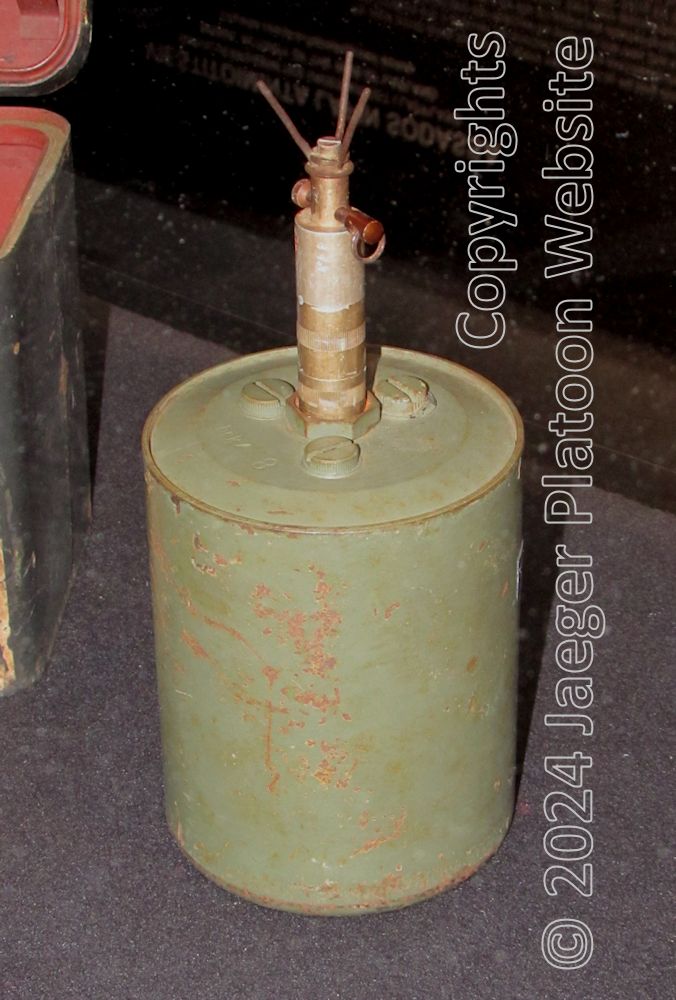
PICTURE: Pommiansa m/41-S antipersonnel mine with pressure activated fuse. This fuse design was
intended be activated by person stepping on it. Green paint on this mine was probably added by Finnish Army. (Photo taken in
Sotamuseo). CLICK THUMBNAIL TO SEE LARGER PIC (123 KB).
|
Construction: |
Cylindrical steel tin containing explosives + shrapnel material. |
||
|
Fuse type: |
Pressure or pull activated, located on top of the mine. |
||
|
Basic principle: |
Bouncing mine, when triggered gets projected up and |
||
|
detonates mid-air creating shrapnel. |
|||
|
Location: |
Buried just below ground, fuses barely above surface. |
||
|
Height of mine: |
12.7 cm without fuses, with activated pressure fuse 25 cm |
||
|
Diameter of mine: |
10.2 cm |
||
|
Weight: |
some 4 kg |
||
|
Explosive charge: |
190 g of TNT or amatol |
||
|
Fuse activated by: |
|||
|
- Pressure activated (S.Mi.Z. 35) fuse: |
Stepping on, 3 - 5.5 kg activates |
||
|
- Pull activated (Z.Z. 35 and Z.U.Z.Z. 35) fuses: |
Trip-wire activated. |
||
|
- Electrical-fuse (E.S.Mi.Z. 40): |
Detonated with electricity (*). |
||
|
Country of origin: |
Germany |
||
(*) Not mentioned in Finnish manuals, so probably not used by Finnish Army.
Transport method: Boxes each containing 3 mines. Weight of the box about 15 kg.
Year 1935 German military introduced Schrapnell Mine 35 antipersonnel mine. Design of this mine was exceptionally effective and during World War 2 it achieved really bad reputation. Unlike most antipersonnel mines used during WW2 it easily caused multiple casualties when it exploded and its effective range was much larger than with other antipersonnel mines. S-Mine had both pressure activated (activated by stepping on) and trip-wire activated (activated by walking on wire) fuses. In either case triggering the mine set off the igniter, which set the material delay pellet on fire. The material in it burned 3.9 seconds before it set off the primary charge, which threw the mine to height of 0.7 - 1.5 metres, where the main charge detonated. The whole process took about 4.5 seconds. As sides of these mines had been filled with about 360 metal balls or mild steel rods or pieces of shrapnel the blast of main charge created large number of projectiles flying to all sides in 360-degree pattern. The range these projectiles were capable creating casualties exceeded 100-meters. According some sources the lethal range was about 20 meters. This antipersonnel mine model with help of WW2-era US propaganda probably also deserves the distinction being the landmine, which created the myth of "landmine which doesn't blast until foot on top of it is removed" still commonly found in literature, movies and television-shows. In reality removing the foot from top of the mine or not didn't really matter, if the foot was still on top the S-mine when the primary charge detonated (propelling the mine to air) the blast was powerful enough to certainly remove the leg by force. After setting of S-Mine 35 remaining standing or trying to run away were also pretty certain ways of getting oneself killed - the smartest thing was getting down fast and hoping that the mine would explode as high as possible.

PICTURE: Pommiansa m/41-S anti-personnel mine with pull-activated trip-wire fuses.
The dark green paint-job is probably product of Finnish Army in post-war era. (Photo taken in Museum Militaria).
CLICK THUMBNAIL TO SEE LARGER PIC (145 KB).
In either case S Mine 35 proved to be one of the most effective antipersonnel landmines of World War 2. Its effectiveness in killing enemy infantry and reliability proved excellent, while the selection of fuses offered good selection for methods of arming it. However, at the same time it was very expensive and quite difficult to manufacture, which is probably while the Germans introduced S Mine 44 already during the war. Before its collapse Germany manufactured some 1.93-million S Mine 35 and S Mine 44. After the war many countries copied the basic concept of antipersonnel mine launching itself from the ground and detonating mid-air for their own antipersonnel mines.

PICTURE: Training version of pommiansa m/41-S with pressure activated fuse. Both being
painted blue and the markings in side of it indicate that this is training version of the mine.
These training versions built were apparently built from original mines and in addition of blue version seen in this
photograph could also be painted yellow to indicate dud training version. (Photo taken in Sotamuseo). CLICK
THUMBNAIL TO SEE LARGER PIC (105 KB).
Finnish Army started buying S Mine 35 from Germany after Winter War. Finnish military named the mine pommiansa m/41-S, which roughly translates as bomb anti-personnel mine m/41-S. The letter S in name of the mine came from word saksalainen (German). According Finnish manuals these mines were considered suitable for being installed by engineers only. The basic method for using them was building minefields in front of own frontline positions to places, which could not be covered with direct fire. Finnish troops these mines mostly with pressure-activated fuses, but also pull-activated fuses were used. Electrical fuses doesn't seem to have been used by Finnish troops, since Finnish manuals don't mention them at all. Finland bougth at least 50,000 of these mines from Germany after Winter War. Finnish troops typically installed these mines usually with about 2 meter distance between individual mines. When it comes to reliability the Finnish experiences were very favourable. The mines proved difficult to destroy with artillery fire and long term reliability was excellent. According estimates gathered in May of 1944 still 50 - 80 % of pommiansa m/41-S were fully functional after full year of building the minefield containing them. However, due to the effectiveness of these mines, unlike with other landmines, using them in minefields built inside own positions was strictly forbidden. Due to high price the Finns tried developing their own rather similar, but simpler domestic antipersonnel mine during Continuation War, but the project proved to be a failure.

PICTURE: Three Pommiansa m/41-S in their original transport box without fuses. These mines
have been painted with the colour used in live mines. (Photo taken in Jalkaväkimuseo). CLICK THUMBNAIL TO
SEE LARGER PIC (130 KB).
Finnish small scale testing done by Engineer Department I of Finnish Armed Forces GHQ in December of 1941 shows that the primary charge went off about 4.5 seconds after the mines were triggered as planned and worked as intended. However the height on which main explosives charge detonated varied quite considerably, with detonation height varying about in between 0.5 - 3 meters. Number of targets had been placed in similar pattern around each mine for testing fragementation pattern. The results suggest that those mines that detonated too high were considerably less leathal than those that detonated in about the intended height, since the mine detonating to height of 3 meters produced less than half of hits that the mines detonating in correct height produced to targets.
RASIA-ANSA M/42 (jar anti-personnel mine M/42)
|
Construction: |
Small bakelite-jar containing explosive charge. |
|
|
Fuse type: |
Pressure activated with safety switch. |
|
|
Basic principle: |
Basic antipersonnel landmine. |
|
|
Location: |
Buried just below ground or on surface hidden to undergrowth. |
|
|
Height of mine: |
4.5 cm |
|
|
Diameter of mine: |
11.0 cm |
|
|
Weight: |
? |
|
|
Explosive charge: |
200 g of TNT in power-like form |
|
|
Fuse activated by: |
Pressure of 10 - 20 kg on top of the mine. |
|
|
Country of origin: |
Finland |
|
Transport method: Boxes each containing 5 or 15 mines.
Finnish military introduced this antipersonnel mine in 1942. Apparently at least 25,000 were acquired in 1942 - 1943 from Tekko Oy and Hj. Jousi. Additional order for 70,000 mines was approved in September of 1943, there is no certainty how many of these were delivered. Price per mine was (without explosive) varied around 41 - 50 Finnish marks per mine - more than double the price of box-mine m/43. Basically it was the basic "step on and get your ankle maimed by explosition"-kind of antipersonnel mine. It had bakelite (plastic) body with shape of cylindrical jar and a lid made from the same material. The original fuse system used with it was combination of primer cap and number 8 fuse for fuse wire. The fuse was installed to the mine from its side. On top of the mine was safety switch, which could be rotated 180 degrees between two settings: Tulta (Fire) and Varmist. (Abbreviation of Varmistettu = Safe). However the manuals forbid applying pressure on top of the mine even with the safety on. The mine was placed to hole about 5 cm deep and 12 cm in diameter with the safety upwards. Typically these mines were buried to ground with 0.5 - 1.0 meters distances between them. The manuals claimed that the mine was waterproof and could be buried also to moist terrain, but later the experiences proved this untrue.

PICTURE: Structural drawing of rasia-ansa m/42. CLICK THUMBNAIL TO SEE LARGER PIC (62 KB).
Finnish soldiers started suspecting that something was wrong once they noticed cases of Soviet patrols moving through minefields of jar anti-personnel mine m/42 without triggering them. In 1944 Finnish military started testing these mines. Quick testing done for the jar anti-personnel mine m/42 taken from the minefield in use already gave alarming results: Only 8 out of 31 mines tested worked as intended. The newly produced mines had no problems working reliably. Results of tests made with 100 new rasia-ansa m/42 from 1944 tests reveal that:

Rasia-ansa M/42 antipersonnel mine. Unfortunately the mine is upsite down in this photo. Photo source
Digitaltmuseum.se - original photo by Armémuseum (Sweden),
CC BY 4.0 Creative Commons license. CLICK
THUMBNAIL TO SEE LARGER PIC (106 KB).
The tests done with earlier installed mines revealed the real problem, which was structure of the mine and the two-part fuse structure containing both primer cap and number 8 fuse for fuse wire. Finnish environment with its rains and long winter with lots of snow provided lot of moisture for landmines. The gap between the body and lid of the rasia-ansa m/42 proved to be another weak point. The gap had felt seal and protective coating, but these did not provide the protection needed. 28th - 29th of May 1944 Engineer Battalion 26 tested rasia-ansa m/42 it had removed from minefield built between 7th - 14th of May 1943. The testing method used was dropping stone weighting about 10-kg repeatedly from 1.5-meter height on top of the mine until the mine either exploded or its lid broke to pieces. The Battalion tested to 15 mines and found out that the water had seeped to their fuse-combination after dissolving the protective coating. None of the 15 tested mines exploded, in two of them the primer cap was set off but even in those two the number 8 fuse for fuse wire proved to be a dud. The moisture seeping in had spoiled the fuses in all those mines. Having the fuse-system with these two parts doubled the likelihood of either of the two parts getting spoiled by moisture. In spring of 1944 Finnish military called back all rasia-ansa m/42 manufactured by 14th of September 1943 for repairs. The mines started coming back for repairs in May of 1944. The factory was reported capable of repairing 300 mines per day. In the repair the hole for percussion cap was modified and the original fuse-combination was replaced with new fuse-combination more durable to moisture. When the Soviets started their offensive in June of 1944 the repair program still going on. The training version (which did not contain any explosives) of this mine was green.

PICTURE: Finnish sapper with rasia-ansa m/42 antipersonnel mines. Photo crop. Photographed
by Military official A. Viitasalo presumably sometime in summer of 1944. Sapper seen in the photo is wearing
standard Finnish Army military uniform m/36. The rifle appears to
likely be infantry rifle M/91. (SA-kuva photo archive, photograph number
157890). CLICK THUMBNAIL TO SEE LARGER PIC (203 KB).
LAATIKKOMIINA m/43 "penaali" (box-mine m/43 "pen-box")
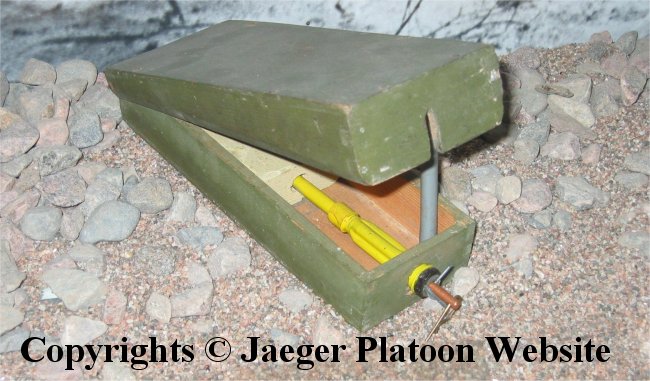
PICTURE: Rasia-ansa m/43 antipersonnel mine. They grey plastic tube has been added to show
the inside structure. Yellow colour of the fuse reveals it to be an inert practice version. (Photo taken in
Maneesi of Sotamuseo). CLICK THUMBNAIL TO SEE LARGER PIC (203 KB).
|
Construction: |
Wood box divided to upper and lower part. |
|
|
Fuse type: |
Activated by pressure closing the box. |
|
|
Basic principle: |
Basic antipersonnel landmine. |
|
|
Location: |
Set on the ground, usually just camouflaged in undergrowth. |
|
|
Height of mine: |
3.0 cm |
|
|
Width/Length of mine: |
Width 6.8 cm / Length 15 cm. (*) |
|
|
Weight: |
500 g |
|
|
Explosive charge: |
100 g block of TNT |
|
|
Fuse activated by: |
Pressure of 2 - 3 kg on top of the mine. |
|
|
Country of origin: |
Finland |
|
(*) Early version of this mine was about 8 cm wide and 18 cm long and could be equipped also with larger 200-gram TNT explosive charge.
This antipersonnel mine seems to be based to German Schutzenmine 42 and/or earlier Soviet mine known as rasiamiina m/41-R (box-mine m/41-R) in Finland. In fact the original Finnish Army decision made for ordering 100,000 mines in September of 1943 even refers them as rasiamiina m/41-R (box-mine m/41-R). All these three landmines had similar wood box and stepping on them closed their lid activating the fuse. The wood box had lower and upper half, which closed on top of the lower half. Inside the lower half were 100-gram explosive charge and fuse. Their price was set at 20 Finnish marks per mine. The commonly used nickname for the mine was "penaali" (pen-box), because its size and shape reminded wooden pen-boxes commonly used in Finland. When the upper half of the mine closes on top of the lower half it pushes out the triggering pin. Once the triggering pin is removed the firing pin is released and it hits to percussion cap, which sets off the fuse for fuse wire, which detonates the explosive charge. Typically laatikkomiina m/43 were installed with 0.5 - 1.0 meters apart.
PUTKIANSA m/42 (pipe anti-personnel mine m/42) and PUTKIMIINA m/43 (pipe mine m/43)

PICTURE: Putkimiina m/43 antipersonnel mine. However the tree might be too thin, the recommended
thickness of tree, tree stump, pole etc was 10 - 15 centimeters. Usually pipe mine M/43 was installed fuse downwards,
like in this photo, but when rough terrain demanded trip-wire to be set higher, mine would be attacked fuse pointing
upwards. (Photo taken in Maneesi of Sotamuseo). CLICK THUMBNAIL TO SEE LARGER PIC (62 KB).
|
Construction: |
Pipe-shaped iron tube, only open end closed with screwed lid. |
|
|
Fuse type: |
Concussion fuse in lower end of the mine. |
|
|
Basic principle: |
Triggered by trip-wire, detonates producing shrapnel. |
|
|
Location: |
Tied to side of the tree, barbwire obstacle post etc. |
|
|
Height of mine: |
20 cm |
|
|
Diameter of mine: |
? |
|
|
Weight: |
about 2 kg |
|
|
Explosive charge: |
175 g (m/42) / 180 g (m/43) (*) |
|
|
Fuse activated by: |
Trip-wire attached to concussion fuse. |
|
|
Country of origin: |
Finland |
|
(*) Explosive used either TNT or amatol.
Transport method: Transported in wood crates each containing 20 mines. Crate size 27 cm x 33 cm x 50 cm and weight of full crate 43 kg. Concussion fuses for the mines were packed to their own locker in the crate.
This was a simple antipersonnel mine of Finnish design. Units belonging to Finnish Engineer Corps had manufactured and used simple pipe mines already during Winter War. After this the development work continued until the officially approved putkimiina m/43 (pipe mine m/43) was finally set to industrial production in 1943. Pipe mine M/43 was pre-dated by experimental pipe mine designs, from which pipe anti-personnel mine 42 (putkiansa 42) was also apparently industrially manufactured, but in more limited numbers. Pipe anti-personnel mine 42 has a cast iron tube, which can be easily identified from its chessboard-like surface pattern. Structurally the idea for pipe mines main in the engineer units was quite simple: Suitable metal pipe was filled with available explosive, both ends of the pipe were closed and one of the ends was equipped with concussion fuse, to which the trip-wire was attached. When the mine detonated the pipe turned into lethal metal fragments. When compared to non-industrial produced earlier versions of pipe mine putkiansa m/42 and putkimiina m/43 besides better availability offered standardised structure and better fragmenting jacket (the metal pipe) than what normal metal pipes offered. The lethal range of pipe mine m/43 was about 10 meters and it was dangerous up to 100-meter distance. As mentioned the pipe was cast iron and closed from one end, the other end was closed with cast iron lid screwed into it. Removal of the lid was forbidden. The lid contained hole to which the concussion fuse was screwed. During storage or transport the hole was sealed with wood plug. The concussion fuse had been made either from metal or bakelite and it had two pins: Safety pin and triggering pin. Safety pin was removed once the mine had been installed and the trip-wire had been set, while removing the triggering pin (assuming the safety pin had already been removed) triggered the fuse detonating the mine. Touching the trip-wire anymore after removing the safety pin had been removed was extremely dangerous. Soldiers were trained to be very careful in general near the mines after removing the safety pin to avoid setting in motion any tree branch capable hitting the trip-wire. The trip-wire was iron wire 0.5 - 1 mm thick, in wintertime Finnish troops used iron-wire, which had been painted white. The iron-wire arrived in coils. For example the 8-mm wire-coil contained 300 meters of wire and weight 1.5 kg.

PICTURE: Finnish soldier is tying putkiansa m/42 to a tree with metal wire. Most
likely staged photo since the trip-wire is already attached to fuse which is also in the mine. The safe
method of handling would be to install both fuse and the trip-wire to the mine only after the mine has been
tied to a tree. Photo taken in Uuksujärvi in July of 1944. (SA-kuva photo archive, photo number 158237).
CLICK THUMBNAIL TO SEE LARGER PIC (236 KB).
The pipe mines were installed crosswise to likely route of enemy advance in 3 - 6 rows along the frontline. Later on the number was rows was suggested to be increased to 5 - 8, but often the situation did not allow increasing their number. Usually the fields of pipe mines were installed in front of the own positions into places where they could be observed and covered with direct fire. The distances between rows of pipe mines were usually 10 - 20 meters and the distances between mines in each line typically 10 - 15 meters. The mines were attached to sides of the trees, tree stumps, wooden posts etc. The tree, tree stump or post had to be about 10 - 15 cm thick and the mines were installed concussion fuse pointing downwards to reduce chances of the mine being spotted. The mine was typically attached with the same iron-wire as used in the trip-wire. If attached to side of a tree the mine could be camouflaged with a piece of tree bark attached on top of it. The trip-wire was usually 8 - 10 meters long. The fields of pipe mines were usually built into forest or scrub to make spotting trip-wires more difficult. The trip-wire was left loose because pulling it tight would have made the fuse dangerously sensitive. If needed other antipersonnel mines could be added to the minefield of pipe mines to increase its effectiveness. Entering the field of pipe mines for replacing the exploded mine was also forbidden in the manuals, because it was considered too dangerous. If needed a new field of pipe mines could be built in front or behind the existing minefield. Originally the pipe mines m/43 had been painted black, but in 1944 orders were issued for painting them with less visible colours (presumably dull green / field grey). Also training version of pipe mine m/43 existed, it was painted blue and only explosive charge inside it was small amount of black-powder. Side of the training version also had four holes for removal pressure caused by exploding the small black-powder charge inside it.

PICTURE: Finnish soldier (likely officer candidate) photographed seen in middle
of tying pipemine into a tree trunk of birch tree with iron-wire. The pipemine seen here seems to be further
development of the design used during Winter War with grooves on both end for wire. Notice concussion fuse
place next on ground against the tree. Photo crop. Photographed by 2nd Lieutenant Pnrtti Nikulainen
in Hanko / Hango / Gangut Peninsula in August of 1941. presumably sometime in summer of 1944. The steel helmet
is Swedish m/37. The rifle appears to likely be infantry rifle M/91.
(SA-kuva photo archive, photo number 31173). CLICK THUMBNAIL TO SEE LARGER PIC (203 KB).
The unit for building fields of pipe mines introduced in the manuals:
OTHER ANTIPERSONNEL MINES:
VENEMIINA (boat mine): This is another mine Major Arvo Ensio Saloranta developed during the period of peace between Winter War and Continuation War. Like ice mine it had glass bottle filled with explosives, but its fuse was somewhat different. Like the name suggests this mine was to be used against small boats. It was sunk into lake or river and with help of wire and weight it was anchored below surface to suitable depth. In lid of the mine was fuse, which was activated by a hit in the upward-pointing rod attached to the lid. However once issued to troops the mine soon proved too dangerous to soldiers installing them and was soon removed from use. The first and presumably last order of these mines was made in year 1942. The order contained 1,000 boat-mines from which 975 were delivered.
RASIAMIINA m/41-R "penaali" (box mine m/41-R "pen-box"): This is Soviet PDM-6 (Pehotnaja Mina Derevjannaja 6) antipersonnel mine. Structurally it is rather simple wooden box of two parts - lower part and upper part. The lower part contains explosive charge and fuse, when the upper part closes on top of the lower part this activates the fuse detonating the mine. During Continuation War Finnish troops captured large number of these mines. When more closely studied lot of the captured mines proved to have defect in workmanship - hole made for the fuse was too short, which made the fuse extremely stiff or even deactivated it. Germans got the idea for their own "Schutzenmine 42" from this mine and in 1943 Finnish military introduced its own "laatikkomiina m/43" based to this mine or German "Schutzenmine 42". According what is known Finnish Army also used captured m/42-R box-mines against their former owners.

PICTURE: Finnish soldier setting Soviet rasiamiina m/41R landmines ready to be
used in minefield. During World War 2 Finnish military used a lot of captured Soviet materials and landmines
were an exception to this. Cyrillic text TOL is Soviet marking for TNT. Photo taken in Lempaala (Carelian
Isthmus) August of 1942. (SA-kuva photo archive, photo number 103212). CLICK THUMBNAIL TO SEE LARGER PIC (153 KB).
POMMIANSA m/41 (bomb anti-personnel mine m/41): While the German-made pommiansa m/41-S (S-Mine 35) was otherwise excellent weapon it was also expensive. So during Continuation War the Finnish military started looking possible source for cheaper but equally effective antipersonnel landmine. The possible source Finnish military found was Finnish company Tekko Oy (Tekko Ltd) with its new domestic bomb anti-personnel mine m/41, which it claimed to be equally effective but much cheaper. When price Germany asked for pommiansa m/41-S delivered to any of the Finnish harbours was 798 Finnish marks per mine Tekko Oy offered its bomb anti-personnel mine (without explosive installed) with price of only 116 Finnish marks per mine. Colonel A.E. Saloranta and (his son) Lieutenant Martti Saloranta, who both had previous experience about developing ordnance materials, designed this mine, which was by magnitude more complicated than other Finnish World War antipersonnel devices. Also Tekko Oy was not a total newcomer in ordnance business, so the final disastrous outcome can be considered somewhat unexpected.

PICTURE: Finnish Pommiansa M/41 antipersonnel mine. (Photo from original Finnish Army
manual published in year 1941). CLICK THUMBNAIL TO SEE LARGER PIC (104 KB).

PICTURE: Two Finnish sappers with box of pommiansa M/41 antipersonnel mines. Photographed by
Military official G. Feldhoff in October of 1941. (SA-kuva photo archive, photo number 55311). CLICK THUMBNAIL TO SEE LARGER
PIC (133 KB).
The basic design cast steel body of the pommiansa m/41 seems obviously related to Finnish defensive egg hand grenades M/41 and M/43, Finnish pipe mine M/43 and even mortar shells used in 47 Krh/41 mortar. Parts of the cast steel body was manufactured by Suomi valimo (Suomi foundry) and its parts were locked to each other with steel wire. Like German pommiansa m/41S this mine was designed to first bounce into air before exploding and showering the area around it with iron fragments. The propellant charge used for propelling this mine to air was a normal 7.62 mm x 54R rifle cartridge. The mine weight about 4-kg, which included about 300 - 400 grams of explosives (chlorate-resin). Diameter of this mine was 92-mm and it was 150-mm tall. Once the fuse had been set off it detonated a rifle cartridge, which threw the mine upwards and then detonated it mid-air in height of about 2 meters. Explosion of the main explosive charge shattered cast iron body of the mine into fragments, which were typically deadly to range of about 15 - 20 meters. The fuse used in this mine was sensitive concussion fuse, which had been designed specifically for it. The fuse was used to set off number 8 fuse for fuse wire - which then detonated the main explosive charge. These mines were delivered in boxes each containing four mines.
NEXT: PART 3, Antitank-Mines