


AT-RIFLES PART 2:
Foreign designs
20 mm pst kiv/18-S:
(20 mm antitank rifle M/18-S)
(Solothurn S 18 - 100)
(Solothurn S 18 - 154):

PICTURE: 20 mm antitank-rifle M/18-S. Notice magazine on side of the receiver just above trigger
guard. (Photo taken by 2nd Lieutenant Sjöblom. SA-kuva photo archive, photograph number 115517). CLICK
THUMBNAIL TO SEE LARGER PIC (95 KB).
|
Calibre: |
20 mm x 105 B (Short Solothurn) |
||
|
Length: |
176 cm |
||
|
Barrel length: |
93 cm |
||
|
Weight: |
40 kg / 45 kg |
||
|
Rate of fire: |
? shots/minute |
||
|
Muzzle velocity: |
735 m/sec |
||
|
Magazine: |
10, removable box |
||
|
Bullet weight: |
148 g (AP-T) |
||
|
Ammunition weight: |
290 g (AP-T) (whole cartridge) |
||
|
Ammunition types: |
APHE-T |
||
|
Basic principle: |
Semiautomatic, recoil-action |
||
|
Country of Origin: |
Switzerland |
Finnish use: Small number (12) used by Finnish frontline troops from 1941 to early 1944. After that few were issued to coastal troops.
Armour penetration:
Arma Fennica 2:
|
distance |
angle of impact |
penetration |
|
100 m |
90 degrees |
35 mm |
|
300 m |
90 degrees |
27 mm |
|
500 m |
90 degrees |
23 mm |
Small Arms, Artillery and Special Weapons of the Third Reich:
|
distance |
angle of impact |
penetration |
|
100 m |
60 degrees |
20 - 22 mm |
|
300 m |
60 degrees |
15 - 18 mm |
Finnish Army Panssarintorjuntakiväärit (Antitank-rifles) manual:
|
distance |
angle of impact |
penetration |
|
100 m |
60 degrees |
20 mm |
|
500 m |
60 degrees |
15 mm |
Solothurn was Swiss company owned by German firm Rheinmetall-Borsig AG. In mid-1930's they designed very modern at the time semiautomatic 20 mm S 18-100 antitank-rifle working on short recoil principle. By early World War 2 Solothurn developed also improved semiautomatic version called S 18-1000 and later also full-automatic version called S 18-1100. Before and during World War 2 users of Solothurn antitank rifles included Czechoslovakian, Dutch, Estonian, Swedish, Romanian, Hungarian, Yugoslavian, German and Italian Armed Forces. From these the Italians acquired S 18-1000 in large numbers and captured Solothurn antitank-rifles also saw extensive use with German military during World War 2. Hungary acquired production license for S 18-100, which was manufactured by Danuvia Gepipari RT for Hungarian military. The Estonians also produced two prototypes and according some sources production run of 20 before Soviet occupation of year 1940. Notice: Most Solothurn antitank-rifles were made in 20 mm x 138 B calibre, however S 18-100 / S-18-154 series acquired to Finland used 20 mm x 105 B ammunition.

PICTURE: Top view showing one of the 20 mm S 18 - 100 antitank-rifles of Finnish Army. Lower right corner of this picture shows the coat of arms that has been engraved on top of the gun next to loading handle. Copyrights (c) Jaeger Platoon Website. (Photo taken in Panssarimuseo). CLICK THUMBNAIL TO SEE LARGER PIC (114 KB).
Finnish military had acquired one Solothurn S 18-1000 antitank-rifle for testing in August of 1939. Later in March of 1940 batch of twelve Solothurn S 18-100 antitank-rifles of sub-version S 18-154 were bought, but arrangements needed for this deal to happen proved very complicated. As part of Soviet-German Molotov-Ribbentrop Pact Germany during Winter War tried to stop all armaments deliveries to Finland during Winter War. As part of this policy Germany stopped all Finnish armaments deliveries though its own territory and the territories that it controlled. Besides this it also used diplomatic pressure in some cases to stop armaments deals from Central-European countries to Finland. Rheinmetall-Borsig AG that controlled Solothurn had specifically forbid it from selling antitank rifles to any country without its approval - and considering the political situation getting this approval was more than unlikely. During Winter War Finland sent some representatives to buy weaponry, ammunition and other equipment for Finnish military from foreign countries. One of these representatives was director B. Grönblom, who arranged this deal. As mentioned the deal was somewhat complicated in nature. Finnish side of deal was Finnish embassy in Rome (Italy) and with the Swiss Colonel Robert Fierz (Chief of Military Technical Department of Swiss Army), seller was Swiss Army and the dozen guns with equipment cost close to 100,000 Swiss Francs. Finances used for buying the dozen guns came from donations. The batch of S 18-154 delivered to Finland had been marked with coat of arms marking, which seems to centre element from Bulgarian coat of arms. Bulgaria had acquired Solothurn antitank-rifles starting year 1936, so the batch of dozen guns was apparently originally been manufactured for Bulgarian Army. The guns were new or like new, came from Solothurn factory, who officially was selling them to Swiss military. So basically Solothurn was at least officially thinking that it was selling dozen guns manufactured for Bulgaria to Swiss Army, while the Swiss immediately sold the guns to Finland. Like almost all military materials acquired by Finland from southern and Central European countries during Winter War, the shipment of these guns was shipped to Finland via Italy and Gibraltar. When the Solothurn antitank-rifles arrived to Finland in spring of 1940 Winter War had already ended. However, when Continuation War started in summer of 1941 they were issued to Finnish troops and remained in frontline use until early 1944. At that time few were issued to coastal troops and the rest were placed on storage for possible further use. At least one of these antitank-rifles was lost during battles in Hanko / Hango Peninsula year 1941 and four in battles of Viipurinlahti Bay in summer of 1944. Finnish Army acquired one Solothurn S 18-1100 select-fire antitank-rifle for testing purposes in year 1942. It was tested in 13th Weapons Repair Company (13. Asekorjauskomppania), but the tests did not lead to any further acquisitions.
According Finnish Armed Forces ammunition supply situation report in between 1st of July 1941 and 11th of December 1941 ammunition expediture of S 18--154 antitank-rifles was 13,373 rounds, while 16,981 rounds of 20 mm x 105B ammunition remained in inventory.

PICTURE: The only 20 mm Solothurn S-18-1100 in Finnish inventory photographed in October of 1942. This gun can
be easily separated from S-18-100 (S-18-154) by comparing muzzle brake / flash hider and other details in gun barrel area. It is
possible that this weapon may have given Finnish Army the idea for full-auto 20 itkiv/39-44
anti-aircraft version of L-39 antitank-rifle. In between the two soldiers is visible captured SVT-38 rifle.
Photograph taken by Military Official J. Taube. (SA-kuva photo archive, photograph number 114564). CLICK THUMBNAIL TO SEE LARGER PIC
(201 KB).
Note that the information listed in the table above is for S 18-154 antitank-rifle, which used different ammunition than internationally far more common and better known S 18-1000 and S 18-1100. Both S 18-1000 and S-1100 used 20 mm x 138 B ammunition, which was used also in most 20-mm anti-aircraft guns commonly used by Finnish Army, antitank-rifle L-39 and anti-aircraft rifle L-39/44. While the dozen S 18-154 saw plenty of use, there is no information if the lone S 18-1100 ever saw any real combat use. Due to all other weapons also using 20 mm x 138B ammunition, there would have been plenty of suitable ammunition available for it during that war. Finnish photo archive SA-KUVA.FI contains two photos (numbers 114564 and 114565) that apparently show the S-118-1000 placed anti-aircraft position in Carelian Isthmus in October of 1942, but it is not known if this was part of testing procedure or if it was actually issued to some combat unit for field testing, although this seems possible.

PICTURE: Solothurn S 18 - 154 with opened top-cover. Photograph taken by 2nd Lieutenant Sjöblom in Mikkeli.
(SA-kuva photo archive, photograph number 115515). CLICK THUMBNAIL TO SEE LARGER PIC (105 KB).
Solothurn S 18-154 pretty much belonged to same class as Finnish 20 pst kiv/39 (L-39) antitank rifle. Both of them used 20-mm ammunition, were semiautomatic and weight well over 40-kg. However S 18-100 was a bullpup-rifle and due to its caliber it lacked the versatile selection of ammunition, which L-39 had. The dozen Solothurn antitank-rifles were only weapons in Finnish inventory to use 20 mm x 105 B ammunition, so it was not wonder that only armour-piercing high explosive tracer (APHE-T) ammunition was available for these weapons in Finland. Total 20,000 rounds were acquired from Hungary in year 1940. While S 18-1000 and S 18-1100 rachet crank type of loading handle for pulling bolt back, S-18-100 guns delivered to Finland had T-shaped straight pull bolt handle with friction wheels. Also while S 18-1000 and S 18-1100 have a muzzle brake, S-18-100 have a simple conical flash hider. As typical to weapons of this type S 18-100 had bipod, but its equipment also included telescopic sight. According Swiss invoice only 16 magazines were delivered with dozen S 18-100 antitank-rifles, which is very little for semi-automatic guns equipped with removable box magazines. Empty magazine weight some 2 kg, while fully loaded it weight about 5 kg. Open sights were fully adjustable to ranges of 0 to 1,500 meters. Serial numbers of the dozen S 18-100 antitank-rifles delivered to Finland were 1 - 12. While S 18-154 apparently had smaller recoil than antitank-rifle L-39, it was also structurally more complicated and even more difficult for infantry to carry around. By year 1951 the total number of S 18-100 had dropped to only five guns. Last remaining four S 18-154 antitank rifles were sold around 1959 - 1960 to Interarmco, which then exported them.
14 mm pst kiv/37:
(14 mm antitank rifle M/37)
(0.55 Inch Boys Anti Tank Rifle Mark 1, "Boys")
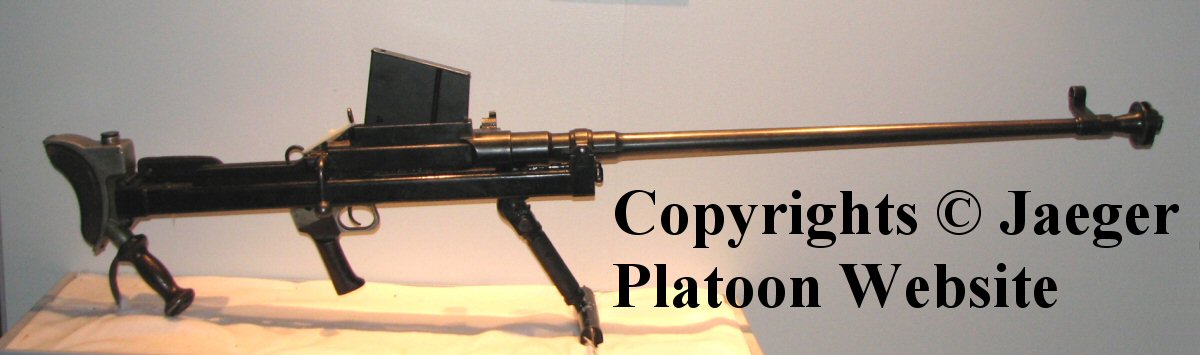
PICTURE: Boys antitank rifle Mk 1. Notice circular muzzle brake and sort of monopod-like bipod design. Copyrights (c) Jaeger Platoon Website. (Photo taken in Sotamuseo). CLICK THUMBNAIL TO SEE LARGER PIC (85 KB).
|
Calibre: |
13,9 mm x 99 B (.55) Boys |
||
|
Length: |
161 cm |
||
|
Barrel length: |
92 cm |
||
|
Weight: |
15 kg / 16,6 kg |
||
|
Rate of fire: |
5 - 7 shots/minute |
||
|
Muzzle velocity: |
745 - 760 m/sec (with Mk I ammunition) |
||
|
Magazine: |
5, removable |
||
|
Bullet weight: |
60,3 g |
||
|
Ammunition weight: |
150 g (whole cartridge) |
||
|
Ammunition types: |
AP |
||
|
Basic principle: |
repeater, cylinder lock (bolt action) |
||
|
Country of Origin: |
Great Britain |
Finnish use: During Winter War 100 used in Finland, from these 70 were used by Finnish frontline troops and 30 used by Swedish (SFK) volunteer unit. The Finns managed to get about 300 additional weapons before Continuation War. These about 400 weapons were issued to Finnish troops in start of Continuation War. They remained in frontline use until being replaced with L-39 AT-rifles around 1942 - 1943. After this some of the Boys at-rifles were issued to coastal troops.
Armour penetration
Arma Fennica 2 (760 m/s, presumably Mk I):
|
distance |
angle of impact |
penetration |
|
100 m |
90 degrees |
12 mm |
|
300 m |
90 degrees |
11 mm |
|
500 m |
90 degrees |
10 mm |
Small Arms, Artillery and Special Weapons of the Third Reich (990 m/s, presumably Mk II):
|
distance |
angle of impact |
penetration |
|
300 m |
90 degrees |
21 mm |
Twentieth-Century Artillery (990 m/s, presumably Mk II):
|
distance |
angle of impact |
penetration |
|
229 m |
90 degrees? |
15 mm |
Marskin panssarintuhoojat (990 m/s, presumably Mk II ammunition):
|
distance |
angle of impact |
penetration |
|
300 m |
60 degrees |
12 mm |
Battles of Winter War website (Mark I AP-ammunition, 760 m/s):
|
distance |
angle of impact |
penetration |
|
100 m |
70 degrees |
18 mm |
|
200 m |
70 degrees |
16 mm |
|
300 m |
70 degrees |
14 mm |
|
400 m |
70 degrees |
13 mm |
|
500 m |
70 degrees |
12 mm |
|
600 m |
70 degrees |
11 mm |
|
800 m |
70 degrees |
8 mm |
|
1000 m |
70 degrees |
6 mm |
|
1500 m |
70 degrees |
4 mm |
Finnish Army Panssarintorjuntakiväärit (Antitank-rifles) manual (presumably Mk I):
|
distance |
angle of impact |
penetration |
|
100 - 150 m |
? degrees |
16 mm |
Notice: Range from which this armour penetration was achieved varied according quality of armour plate.
Finnish live fire tests year 1943 (750 m/sec, presumably Mk I):
|
distance |
angle of impact |
penetration |
|
100 m |
70 degrees |
18 mm |
|
200 m |
70 degrees |
16 mm |
|
300 m |
70 degrees |
14 mm |
|
400 m |
70 degrees |
13 mm |
|
500 m |
70 degrees |
12 mm |
|
600 m |
70 degrees |
11 mm |
|
800 m |
70 degrees |
8 mm |
|
1000 m |
70 degrees |
6 mm |
|
1500 m |
70 degrees |
4 mm |
This British antitank-rifle completed in 1936 was first called "Stanchion", but after death of one of its designers, Captain H.C Boys of British Army, it was renamed after him as Boys antitank-rifle. Boys antitank-rifle was first issued to British Army in year 1937 and used both by British Armed Forces and troops of Commonwealth during early part of World War 2. Boys antitank-rifle was in production from year 1937 to year 1940, with total production being of about 62,000 rifles. Its first production version was Mk 1 manufactured mainly by Birmingham Small Arms Company (BSA) in Britain, while main manufacturer for later Mk 1* version was John Inglis and Company in Canada. British military also experimented with Mk 2 version equipped with shorter rifle barrel and apparently intended for paratroopers. In its core this gun is a bolt-action rifle with removable five round box magazine on top of the weapon and off-set iron sights on left side of the weapon. The design have combination of receiver and barrel that in recoil are intended to move against spring pressure on top of lower structure and rubber padded butt cushion, but the design apparently still developed quite a reputation for having punishing recoil. Mk 1 version has rather unusual monopod design with horizontal steel bar under it to make it work like a bipod, while Mk 1* has more traditional bipod. While improved armor protection of new German tanks soon made them almost immune to this gun, there were still quite a many lightly armored vehicles against which Boys antitank-rifle remained useful, while also most Italian and Japanese tanks were so lightly armored that they remained vulnerable. British and Commonwealth armies started replacing it in European theater with PIAT antitank projector in year 1943. Small number of Boys antitank-rifles also action with US Marine Corps in Pacific starting year 1941 and some served with Chinese National Army against the Japanese. Around year 1942 the British were delivering these antitank rifles also to Soviet Union, but the Soviets were so unimpressed for poor armor penetration capabilities of the gun that they apparently never bothered to issue Boys antitank-rifled delivered to them.

PICTURE: Boys antitank rifle Mk 1*. Notice the bolt and the off-centreline sights. Notice that
unlike earlier Mk 1 this version has a proper bipod and "harmonica" muzzle brake. This version was not used
by Finnish military. (Photo credit Gun Pictures.net website). CLICK THUMBNAIL TO SEE LARGER PIC (63 KB).
The large differences in measured muzzle velocities in many sources are likely be at least partially explained by having two different ammunition designs, which many sources seem fail to separate from one another. Two British ammunition models existed for this weapon - W Mark I and W Mark II. The non-Finnish armour data listed above is probably for W Mark II ammunition. But according "Finnish Military Cartridges 1918 - 1944" ammunition delivered to Finland seems to have all been W Mk I, so Finnish statistics are apparently for it. W Mk I ammunition had 60.3-gram (930-grain) bullets and steel jacket covered with cupro-nickel. Core of the bullet was special steel and thin layer of lead had been applied between core and jacket. Muzzle velocity was around 745 - 760 meters/second. Later W Mark II ammunition had lighter 47.6-gram (735-grain) tungsten-core bullet and much higher muzzle velocity of about 945 - 950 meters/second, but as noted it was not available to Finnish military.
According Finnish Armed Forces ammunition supply situation report in between 1st of July 1941 and 11th of December 1941 ammunition expediture of Boys antitank-rifles was 45,118 rounds, while 86,568 rounds remained in inventory.

PICTURE: Finnish soldier with Boys antitank-rifle in May of 1942. The soldier has
tunic for field uniform M/27 and Hungarian steel helmet m/38. Photograph
taken by Military Official P. Jänis in Rukajärvi region. (SA-kuva photo archive, photograph number
87643). CLICK THUMBNAIL TO SEE LARGER PIC (122 KB).
During Winter War Great Britain donated 100 Boys antitank-rifles to Finland, they arrived in January of 1940. 30 rifles of this first batch were issued to Swedish-Norwegian volunteer force SFK and the remaining 70 saw front-line use with Finnish troops, which at the time had practically no other antitank-rifles yet, since production of L-39 antitank-rifle. had not started yet. Only six of the 100 rifles were lost during Winter War, but number of rifles also got damaged, some of them beyond repair. During Interim Peace in between Winter War and Continuation War another batch of 100 Boys antitank-rifles (sent before ending of Winter War, but too late to arrive before it ended) arrived from UK and later during Interim Peace Finland also bought 200 additional guns from the Germans (who called them Panzerabwehrbusche 782 (e)). 200 Boys antitank-rifles bought from Germany arrived 10th of December 1940. When Continuation War started in June of 1941 these at-rifles were issued to Finnish front-line infantry (typically to company level antitank-rifle squads), who used them until domestic 20-mm L-39 at-rifles and satchel charges replaced them around 1942 - 1943. Boys antitank-rifles did not impress Finnish soldiers that used them, since armour penetration capability proved to quite poor and after armour effects were not too remarkable either, but it was still better than nothing. After Boys antitank-rifles had been gathered off from frontline infantry, some of them were issued to coastal troops and the rest were mothballed for possible further use, which never came. Losses of these guns had been remarkably low, as in summer of 1944 there was still 336 of total 400 originally received remaining in inventory. After World War 2 remaining guns were kept mothballed until being sold to United States in year 1956.

PICTURE: Finnish soldier (officer?) photographed firing Boys antitank-rifle. Photograph taken by
Military Official Martin Persson in Tokari - Latva region in June of 1942. (SA-kuva photo archive, photograph number 91100).
CLICK THUMBNAIL TO SEE LARGER PIC (186 KB).
The maximum rate of fire for this at-rifle varied around 5 - 7 shots/minute. Empty magazine weight 450 grams, while fully loaded one weight 1.2 kg. Rear sight in Mk 1 was peep sight type with settings for 300 and 500 yards. Front sight has sight post inside circular sight protector, with the combination providing good sight picture. Equipment supplied with the gun included magazine box, which contained 8 magazines. Practical after-armor effect of 14-mm projectiles was so small that for practical purposes bullets had to be aimed to crew members of the targeted armour vehicle. As typical to weapons of its class, this antitank rifle had both (in its case monopod-like) bipod and muzzle brake. But even with the muzzle brake the muzzle flash was visible enough for Finnish military manuals to especially warn about that. The manual does not mention this, but the muzzle brake has three vent holes, which vent the gases basically all around, hence it tends to throw up any sand, snow or debris that is located below muzzle of the gun. Manual also contain warning informing that the bolt does not close on top of the empty magazine and replacing magazine demanded first pulling bolt as far back as possible.
8 mm pst kiv/38
(8 mm antitank rifle M/38)
(Maroszek model 35)
(Pz.B.35)

PICTURE: 8 mm antitank-rifle M/38 being used for combat training in Niinisalo Training Centre July
of 1942. Another soldier seen in this photo appears to have infantry rifle M/91. Soldier
with antitank-rifle German m/16 steel helmet, while another soldier has more modern German or Hungarian helmet. Photograph
taken by Military Official Hedenström. (SA-kuva.fi photo archive, photo number 96252). CLICK THUMBNAIL TO SEE LARGER PIC
(128 KB).
|
Calibre: |
7,92 mm x 107 DS |
||
|
Length: |
176 cm |
||
|
Barrel length: |
120 cm |
||
|
Weight: |
9,5 kg |
||
|
Rate of fire: |
10 - 12 shots/minute |
||
|
Muzzle velocity: |
1200 - 1350 m/s |
||
|
Magazine: |
4, removable box |
||
|
Bullet weight: |
13 g (Polish bullet) (*) |
||
|
Ammunition weight: |
64,3 g (whole cartridge) |
||
|
Ammunition types: |
AP |
||
|
Basic principle: |
Repeater with cylinder lock (bolt action) |
||
|
Country of Origin: |
Poland |
(*) The ammunition used in Finland was original Polish ammunition. German bullet had weight of 14.4-grams.
Finnish use: Small number (30 guns total) bought from Hungary during Winter War, they arrived slightly too late to see action in it. Used by Finnish frontline troops in beginning of Continuation War, but withdrawn from frontline service quite early on.
Armour penetration:
Arma Fennica 2 (1,220 m/s):
|
distance |
angle of impact |
penetration |
|
100 m |
90 degrees |
15 mm |
|
300 m |
90 degrees |
14 mm |
Polish firearms website (1200 m/s):
|
distance |
angle of impact |
penetration |
|
100 m |
90 degrees? |
33 mm |
|
300 m |
30 degrees |
15 mm |
Small Arms, Artillery and Special Weapons of the Third Reich (1280 m/s, probably German modified ammunition):
|
distance |
angle of impact |
penetration |
|
300 m |
90 degrees |
25 - 33 mm |
Nowa Technica Wojskowa magazine 6/95 (1250 - 1275 m/s):
|
distance |
angle of impact |
penetration |
|
100 m |
90 degrees? |
33 mm |
|
300 m |
30 degrees |
15 mm |
Finnish Army manual Panssarintorjuntakiväärit (Antitank-rifles) (1250 m/sec):
|
distance |
angle of impact |
penetration |
|
300 m |
? degrees |
16 mm |
Finnish live fire testing year 1943 (1350 m/sec):
|
distance |
angle of impact |
penetration |
|
100 m |
70 degrees |
18 mm |
|
200 m |
70 degrees |
16 mm |
|
300 m |
70 degrees |
14 mm |
|
400 m |
70 degrees |
13 mm |
|
500 m |
70 degrees |
12 mm |
|
600 m |
70 degrees |
11 mm |
|
800 m |
70 degrees |
8 mm |
|
1000 m |
70 degrees |
6 mm |
|
1500 m |
70 degrees |
3 mm |

PICTURE: Polish 8 mm antitank-rifle M/38 in use of Finnish Army. Soldier appears to have Austrian
steel helmet m/17. Photographed by Niilo Helander in Skogsby in November of 1941. (SA-kuva.fi photo archive, photo number
71198). CLICK THUMBNAIL TO SEE LARGER PIC (185 KB).
This Polish antitank-rifle was developed by Józef Maroszek (with T. Felsztyn according some sources) in early 1930's and was officially accepted to inventory of Polish Army in November of 1935. The rifle was bolt action with removable box magazine. It also had fixed rear sight and laterally adjustable front sight. As typical to antitank-rifles the weapon had bipod and muzzle brake. Ammunition developed for it had very large cartridge case necked down for 7.92-mm bullet. Ammunition produced very large muzzle-velocity, but it came with a price - barrel life was very short and barrel needed to be replaced with new one after only 200 shots. If barrel got too much wear the muzzle velocity started to drop very fast. DS-ammunition had lead core bullet with steel coat. The bullet was not really designed to penetrate through armour, instead it created secondary projectile by when impact punched of a "plug"/"cork"-shaped piece from armour plate it hit. Both this secondary projectile (which typically was even 20-mm in diameter) from armour plate it hit and which actual the bullet followed inside armour vehicle. Once inside armour vehicle both the secondary projectile (piece punched from armour plate) and the actual bullet could cause damage. The Poles naturally used these antitank-rifles against the Germans in year 1939. German military captured them in relatively large numbers (at least some 6,500 had been produced) and used over 600 of them during their attack to Belgium, Netherlands and France in 1940. After that they gave large number PzB 35(p) (as they called Polish Maroszek model 35) to Italian troops that (mostly to Italian 8th Army that used them in eastern front). German also modified ammunition that Poles had manufactured for this weapon by replacing Polish DS-bullets with same tungsten-carbide/cobolt mix-cored bullets already used in their own 7.92 mm PzB-39 antitank rifles. This German modified ammunition had 1297 m/sec muzzle velocity.

PICTURE: 8 mm antitank-rifle M/38. Photographed by Nousiainen in November of 1942. (SA-kuva.fi
photo archive, photo number 113078). CLICK THUMBNAIL TO SEE LARGER PIC (68 KB).
During Winter War Finland also managed to bought 30 antitank-rifles m/38 (as Finnish Army named them) from Hungary, but they did not arrive until March of 1940 - just bit too late to be used in Winter War. When Continuation War started they were issued to Finnish frontline troops, but did not remain in frontline use very long. Apparently when first issued only 100 rounds were supplied with each gun, which fits to information according which only 3,000 rounds of ammunition were received with these antitank-rifles from Hungary. In addition according Finnish military ammunition supply report in between 1st of July 1941 and 11th of December 1941 ammunition expenditure of these rifles was in total 1,451 rounds, with only 1,163 rounds remaining in inventory in end of that period. Polish antitank-rifle m/38 had quite a short service life with Finnish Field Army - mainly due to limited number of rounds in Finnish inventory and there was no source for acquiring more ammunition. Due to small number of guns starting ammunition production would not have made sense either. Period photographs suggest that some saw training use in home front after being removed frontline use. Considering from where and when the Finns bought the rifles they probably arrived with second hand Polish ammunition. Spring of 1944 there were still 26 guns in Finnish inventory, but 17 of them were scrapped soon after the war. The last four guns were sold to USA and exported in year 1956.
14,5 mm PTRS 1941 (Simonov):

PICTURE: Soviet PTRD (foreground) and PTRS (back) antitank-rifles. (Photo taken
in Museum of Artillery, Sappers and Signal Corps, St.Petersburg, Russia). CLICK THUMBNAIL TO SEE LARGER
PIC (113 KB).
|
Calibre: |
14,5 mm x 114 |
||
|
Length: |
213 cm |
||
|
Barrel length: |
139 cm |
||
|
Weight: |
19 kg / 20,9 kg / 21,7 kg (depending source) |
||
|
Muzzle velocity: |
950 - 1012 m/s |
||
|
Magazine: |
5, non-removable |
||
|
Bullet weight: |
64,2 g (B-32) / 65 g (BS-41) |
||
|
Ammunition types: |
AP-incendiary |
||
|
Basic principle: |
gas-action, semiautomatic |
||
|
Country of Origin: |
Soviet Union |
Finnish use: Typically used by Finnish frontline troops after capture until they run out of captured ammunition. Weapons captured only around early 1943 - mid 1944. Never issued to Finnish troops and no ammunition supply organised.
Armour penetration:
Arma Fennica 2 (1000 m/s, presumably with BS-41 bullets):
|
distance |
angle of impact |
penetration |
|
100 m |
60 degrees |
30 mm |
|
300 m |
60 degrees |
27,5 mm |
|
500 m |
60 degrees |
25 mm |
Small Arms, Artillery and Special Weapons of the Third Reich (1012 m/s, presumably with BS-41 bullets):
|
distance |
angle of impact |
penetration |
|
100 m |
90 degrees |
30 mm |
|
300 m |
90 degrees |
27,5 mm |
|
500 m |
90 degrees |
25 mm |
Twentieth-Century Artillery (1012 m/s, preumably with BS-41 bullets):
|
distance |
angle of impact |
penetration |
|
500 m |
90 degrees? |
25 mm |
When German attack to Soviet Union started in summer of 1941 Red Army had no at-rifles in its use. Soviets had experimented with antitank-rifles already in early 1930's and small number of 12,7 mm and 14,5 rifles had been made for tests. Rukavisnikov's 14,5 mm rifle had even received official acceptance, but no production had been started. What is known suggests that the Soviets had come to wrong conclusion (likely due to false intelligence) and thought that the German tanks had much thicker armour than what they really had. Because they believed that the German tanks would have 60 - 80 mm of armour Soviet leadership considered antitank rifles useless.
Once the German attack to Soviet Union begun the Soviets came to notice that much of the German armour was actually quite lightly armoured and could have been destroyed with antitank-rifles, but the Soviets had none. So, soon both F.V. Degtjarev and S.G. Simonov received orders to design antitank-rifle for Red Army. Both of them used only 22 days from receiving orders to first tests with the first prototype. Both rifles were approved to use of the Red Army in August of 1941. Sergej Gavrilovitch Simonov quickly developed this semiautomatic antitank-rifle, which while being more complicated and heavier of the two also had better rate of fire. PTRS was gas-action rifle very much based to Simonov's model 1938 automatic rifle prototype. As mentioned PTRS has gas-action rifle with gas piston and fixed magazine, which could be reloaded with cartridge clips of 5 rounds. As usual it has collapsible bipod and muzzle brake. The rear sight was tangent sight with settings upto 1,500 meters, but in reality the antitank rifle was effective within range of 250 - 300 meters. Both armour-penetration capability and accuracy of PTRS were quite good, but the rifles were very roughly made and had some reliability problems (especially in cold weather). Only 77 PTRS-rifles were manufactured in year 1941 (partly due to German advance, which forced the Soviets to move many of their factories behind Urals), but production increased fast and during the next year over 63,000 were made. Production of Simonov's antitank-rifle continued until January of 1945. During the war Soviet military used PTRS antitank rifles also as improvised antiaircraft weapons. During World War 2 captured PzB 784 (r) (as the Germans called it) seem to have been also popular in use of German troops. The Soviets had two ammunition models for these at-rifles: B-32 AP-incendiary ammunition bullet had steel core, while BS-41 AP-bullet had wolfram-carbide mix core. The armour penetration statistics in here seem to for ammunition loaded with BS-41 bullets. Soviet 14.5 mm x 114 ammunition proved to be possibly the best antitank-rifle round ever developed and have remained in use with heavy machine guns to this day.
Soviet Red Army did not issue PTRS at-rifles to its troops in Finnish front until late 1942. Finnish troops captured first antitank rifles of this type early 1943. After that they were captured in small numbers every now and then with most being captured in battles of summer of 1944. As the total number of PTRS-rifles captured by Finnish troops was not more than few dozen, Finnish military did not bother to organise ammunition supply or re-issue captured weapons. Finnish frontline troops may have sometimes used the captured PTRS antitank rifles, but once they would have run out of captured ammo that was it, since there was no organized ammunition supply of their ammunition. Finnish Army never issued the captured Soviet antitank rifles for its troops, so PTRS-rifles handed over by frontline troops ended up being stored for rest of the war. Grand majority of captured PTRS were scrapped soon after World War 2 with only 15 weapons remaining to Finnish inventory after that. The last PTRS antitank-rifles remaining in Finnish inventory were sold to United States in year 1956.
14,5 mm PTRD 1941 (Degtjarev):

PICTURE: Finnish Army captain poses with captured PTRD antitank-rifles somewhere in
Rukajävi region in August of 1944. Photograph taken by Military Official P. Jänis. (SA-kuva photo
archive, photograph number 156682). CLICK THUMBNAIL TO SEE LARGER PIC (256 KB).
|
Calibre: |
14,5 mm x 114 |
||
|
Length: |
200 cm / 208 cm / 213 cm (depending source) |
||
|
Barrel length: |
123 cm / 135 cm / 139 cm (depending source) |
||
|
Weight: |
15 kg / 16,3 kg / 17,3 kg (depending source) |
||
|
Muzzle velocity: |
1010 - 1012 m/s |
||
|
Magazine: |
none, single shot |
||
|
Bullet weight: |
64,2 g (B-32) / 65 g (BS-41) |
||
|
Ammunition types: |
AP-incendiary |
||
|
Basic principle: |
single shot, cylinder lock (bolt action) |
||
|
Country of Origin: |
Soviet Union |
Finnish use: Typically used by Finnish frontline troops after capture until they run out of captured ammunition. Weapons captured only around late 1942 - mid 1944. Never issued to Finnish troops and no ammunition supply organised.
Armour penetration:
Arma Fennica 2 (1000 m/s, presumably with BS-41 bullets):
|
distance |
angle of impact |
penetration |
|
100 m |
60 degrees |
30 mm |
|
300 m |
60 degrees |
27,5 mm |
|
500 m |
60 degrees |
25 mm |
Panzerfaust website (995 m/s):
|
distance |
angle of impact |
penetration |
|
100 m |
90 degrees? |
40 mm |
|
500 m |
90 degrees? |
30 mm |
Small Arms, Artillery and Special Weapons of the Third Reich (1012 m/s, presumably with BS-41 bullets):
|
distance |
angle of impact |
penetration |
|
100 m |
90 degrees |
30 mm |
|
300 m |
90 degrees |
27,5 mm |
|
500 m |
90 degrees |
25 mm |
Twentieth-Century Artillery (1012 m/s API, presumably with BS-41 bullets):
|
distance |
angle of impact |
penetration |
|
500 m |
90 degrees? |
25 mm |
When German attack to Soviet Union started in summer of 1941 Red Army had no antitank-rifles in its use. The Soviets had experimented with at-rifles already in early 1930's and small number of 12,7 mm and 14,5 mm rifles had been made for tests by 1939. Rukavisnikov's 14,5 mm rifle had received official acceptance, but no production had been started. Both Simonov and Degtjarev received orders to design antitank-rifle for Red Army in 30 days soon after starting of German attack to Soviet Union in summer of 1941. Just like Simonov also Degtjarev designed his antitank rifle in a hurry, but succeeded in this task in only 22 days and Red Army adopted his antitank rifle along Simonov's at-rifle in August of 1941. However the two antitank rifles had very large structural differences. While PTRS already was structurally rather simple semiautomatic rifle PTRD is single-shot rifle simplified to extreme for mass-production. It has very long thin barrel (with muzzle brake), very simple bipod and in general very "bare" appearance including carrying handle, pistol grip and padded cheek piece and butt plate. The rifle has no magazine, but not quite as simple bolt-action as one might suspect first - after firing a shot its bolt opens automatically and removes empty cartridge case. This action in a way reminding some the concept used in many artillery pieces but still different, is based to barrel-recoil, which after firing a shot rotates the bolt 90 degrees and ejects spent cartridge case. After this a new cartridge has to be inserted and chambered manually with the bolt, which is cocking on closing type. Only safety in this gun is designed to bolt and firing pin, with hook-shaped end of firing that sticks out from end of the bolt being pulled back and rotated clockwise for turning safety on. Also the iron sights used in this rifle are very simple: Front sight is a simple blade and rear sight a folding frame with only to range settings available - for 400 meters and 600 meters.

PICTURE: Collection point for captured weapons in Kiestinki in May of 1942. Captured weapons seen
in this photo include two PTRD antitank-rifles. Other weapons include several 50 mm mortars
and Maxim M/09-09. Photographed by Erkki Viitasalo. (SA-kuva photo archive, photograph
number 86065). CLICK THUMBNAIL TO SEE LARGER PIC (182 KB).
Total production of PTRD was much larger than total production of PTRS - quite likely due to it being so much easier and faster to manufacture. Almost 17,700 were manufactured already in year 1941 and in year 1942 the production climbed to over 184,000 guns. First battle in which it was used in large numbers was battle of Moscow in late 1941. Production of Degtjarev antitank-rifle ended in January of 1945. Just like with PTRS antitank rifle fit and finish of this weapon can be described as rough in best. PTRD did not have reliability problems of its rival design and it soon earned good reputation is Soviet hands for its accuracy (practical shooting range was around 200 - 400 meters, but since the armor penetration was better shorter the range to target, long-range shots were probably not a major priority) and good armour-penetration capability. Captured PzB 783(r) (as the Germans called it) seem to have also been rather popular in the German use.

PICTURE: Captured PTRD antitank-rifle in use of Corporal of Finnish Army in September of 1944. The soldier
is wearing standard issue military uniform m/36 with German steel helmet and has
puukko-knife hanging from his belt. Photographed by Corporal Eino Laakso.
(SA-kuva photo archive, photograph number 160262). CLICK THUMBNAIL TO SEE LARGER PIC (103 KB).
Finnish troops captured first PTRD antitank-rifles already in 1942. Production quality of these antitank-rifles did not exactly over impress the Finns. Still it seems that it saw limited use with Finnish troops. Finnish military had no real organised ammunition supply for 14.5 mm x 114 cartridges, hence captured PTRD-rifles could only be used as long as there was captured ammunition and once troops run out of captured ammunition that was it. Bit over 250 PTRD antitank-rifles ended to Finnish inventory by end of Continuation War, once handed over by frontline they were placed on storage for rest of the war and were all scrapped already in late 1944.
Only 14.5 mm x 114 ammunition available for these PTRS and PTRD antitank-rifles was captured Soviet ammunition, which came with two bullet options - B-32 and BS-41. Both of these bullets were armor piercing incendiary (API) type, with B-32 having weight of 64 grams / 998 grains and BS-41 weight of 65 grams / 1003 grains. From these bullet types B-32 was with steel core, while BS-41 had tungsten-carbide core that offered superior armor penetration.
OTHER AT-RIFLES:
- 13 mm Mauser m 1918: This was the first antitank-rifle ever, it was first issued to German troops in year 1918 and is commonly known as T-gewehr. The weapon is basically a up-scaled single-shot version of bolt-action Mauser model 1898 infantry rifle equipped with bipod and pistol grip. Although instead curved lange visier curved tangent rear sight, this antitank-rifle has more common looking tangent rear sight with settings marked only up to 500 meters. Early on MG-08/15 bipod was used, but later on it was replaced in production with improved bipod design specifically manufactured for this gun. It is chambered for 13.2 mm x 92SR ammunition, which pretty much looks like upscaled standard German rifle round (7.92 mm x 57 IS). The total production is estimated having been about 16,500 guns being made total, from which first batch of 300 guns was equipped with shorter thicker rifle barrel. Finland bought 100 of these guns with 4,800 cartridges from Great Britain in spring of 1940. However, they were never issued and saw no combat with Finnish Army - possibly due to very limited ammunition supply - only 48 rounds per weapon would have hardly been enough for actual combat use and such a small number of old antitank-rifles would not have made starting ammunition production for them a priority either. October of 1940 one of these antitank-rifles modified to use Finnish 13.2-mm ammunition (either 13.2 mm x 118B or 13.2 mm x 120B - documentation does not specify), batch of which had been manufactured with French-manufactured armour piercing bullets and was tested by Tank Battalion (Panssaripataljoona) in comparison to 14 mm Boys antitank-rifle. While the test results were otherwise fairly positive for Mauser m 1918, much of the tested ammunition failed to fire. It was also noted that that muzzle flash and smoke were visible enough to made the weapon easier for the enemy to spot than 14-mm antitank-rifle M/37. When it came to armor-penetration the two antitank-rifle designs had quite similar performance, with Mauser firing Finnish 13.2-mm cartridge having a slight edge. In addition mechanism of Mauser was noted as being better sealed (and therefore less vulnerable to dirt), but due to being single-shot only without magazine, it also had a notably slower rate of fire. The tests did not apparently lead into further action. Also modifying of Mauser M/1918 for British 13.9 mm x 99 B and Polish 7.92 mm x 107 DS ammunition was tested in VKT (State Rifle Factory), but that did not lead to anything further either. Mauser M/1918 antitank-rifles remained stored for possible further use until being scrapped in autumn of 1944.
SOURCES:
Markku Palokangas: Sotilaskäsiaseet Suomessa 1918 - 1988 osat 1 + 3 (= Military Small Arms in Finland 1918 - 1988 parts 1 + 3)
Timo Hyytinen: Arma Fennica 2, sotilasaseet (Arma Fennica 2, military weapons)
Erkki Käkelä: Marskin Panssarintuhoojat (Tank destroyers of Marski)
D.N. Bolotin: Soviet Small-Arms and Ammunition.
Ian Hogg: Twentieth Century Artillery
Terry Garder & Peter Chamberlain: Small arms, artillery and special weapons of the third reich
Solothurn S18-1000: The Pinnacle of Anti-Tank Rifles on Forgotten Weapons channel in Youtube.
British Boys Anti-Tank Rifle on Forgotten Weapons channel in Youtube.
Boys Anti-Tank Rifle: Mk I and MK I* Improvements on Forgotten Weapons channel in Youtube.
Boys Mk I Anti-Tank Rifle at the Range on Forgotten Weapons channel in Youtube.
wz.35: Poland's Remarkably Misunderstood Antitank Rifle on Forgotten Weapons channel in Youtube.
PTRS 41: The Soviet Semiauto Antitank Rifle (aka an SKS on Steroids) on Forgotten Weapons channel in Youtube.
PTRD 41: The Simple Soviet Antitank Rifle of WWII on Forgotten Weapons channel in Youtube.
History of WWI Primer 022: German TankGewehr Anti-Tank Rifle Documentary on C&Rsenal channel in Youtube.
Article of Tomasz Nowakowski in magazine Nowa Technica Wojskowa volume 6/95 (data kindly provided by Michal Derela).
Article of Marchin H. Ochman "Karabin przeciwpanzerny Pz.B.39, Granatnik Gr.B.39" in magazine Militaria i Fakty volume 5/2002 (data kindly provided by Michal Derela).
Article: Tuntematon lahden takaa, Arsenal Tallinn by Toe Nömm in Ase-lehti magazine vol. 1/92.
Article: Unkari ja Suomen talvisota (Hungary and Finnish Winter War) by Gabor Richly in Journal of Military History 15 (1989).
Mika Pitkänen and Timo Simpanen: 20 mm Suomessa, Aseet ja ampumatarvikkeet ennen vuotta 1945 / 20 mm in Finland, Weapons and Ammunition prior to 1945.
Mika Pitkänen and Timo Simpanen: Suomalaiset Sotilaspatruunat 1918 - 1945 / The Finnish Military Cartridges 1918 - 1945.
Military manual: 14 m/m panssarintorjuntakivääri malli 1937 by Puolustusministeriön Taisteluvälineosasto.
Military manual: Panssarintorjuntakiväärit by Päämaja. (Printed 1941)
Military manual: Jalkaväen Ampumatarvikkeet I by Puolustusvoimien Pääesikunta Taisteluvälineosasto. (printed 1941, updated 1st of September 1944)
Finnish Military Archives, archive reference T-19043
Finnish Military Archives, archive reference T-10910
Finnish National archives, archive reference T-21417/1, classified summaries and statistics of Ordnance Department.
Finnish National Archives, archive folder T-19045/6.
Finnish Military Archives, archive references T20206/F9, /F10 and /F11
Special thanks to bas and his Gun Pictures.net website (website no longer active).
Special thanks to Sotamuseo (Finnish Military Museum), Helsinki.
Special thanks to Panssarimuseo (The Parola Tank Museum), Hattula..