


ARMOURED TRAINS
Part 1.4
Battles along the Railways in 1918
RAILWAYS OF SOUTHERN FINLAND
Besides the main three north - south railways also the railways of southern Finland saw quite a bit of battles with armoured trains during April of 1918. That month two German units, whose arrival resulted from Finnish Senate requesting assistance from Germany earlier, landed to Finnish south coast. While this request for help pissed off General Mannerheim and considerably complicated political relations between Finland and western nations still fighting World War 1 against Germany the units sent by Germany to Finland also proved valuable assistance to White Army. Larger of these two German units was Ostsee Division (Baltic Sea Division) of about 9,500 men strong, which was led by Major-General von Goltz and landed to Hanko at 3rd of April 1918. Another smaller German unit that took part in Finnish Civil War was Brandenstein Detachment / Brigade named after its commanding officer Colonel Otto von Brandenstein. This unit had at most some 2,500 men and landed to Loviisa four days later. The Finnish Reds were unprepared for these landings, which combined with their weak leadership, made their chanced for resisting the Germans very difficult. When in came to armoured trains of the Reds they did not prove very effective against the Germans, likely because of their better discipline, training and higher level of experience. In these battles Red armoured trains adopted the role of rear guard, which protected the retreat of their infantry, when they tried to delay German advance.
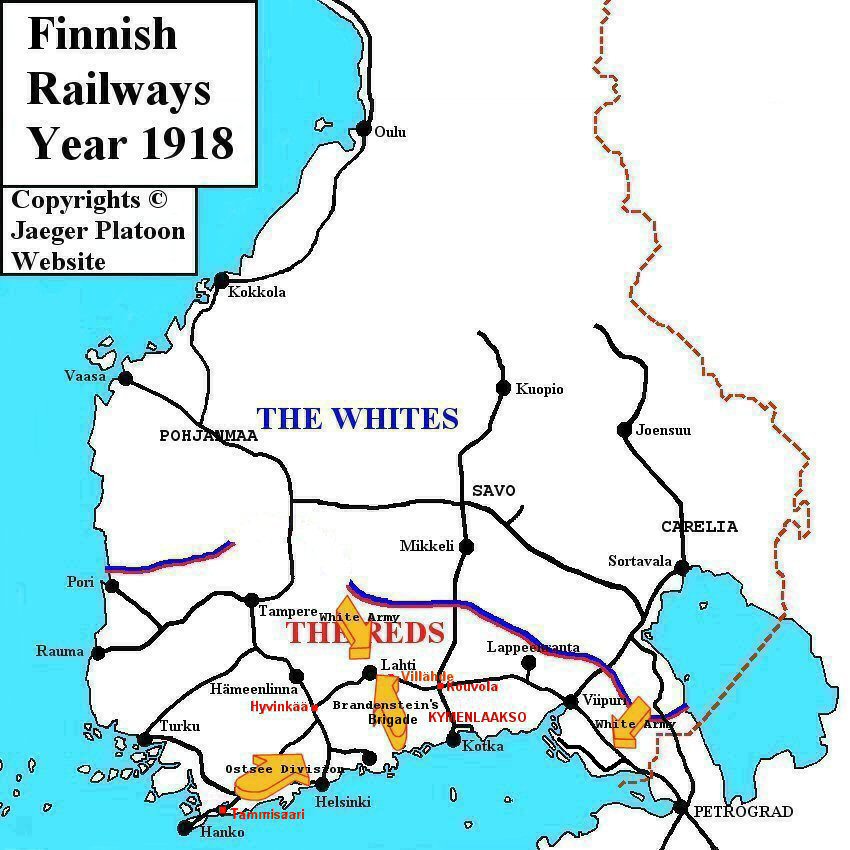
PICTURE: Offensive of White Army in Karelian Isthmus. Advance to White
Army units to Lahti from the north and advances of German troops to Helsinki and Lahti.
CLICK THUMBNAIL TO SEE LARGER PIC (135 KB).
Battles along railways of Southern Finland:
February
15th: Poorly armed unit of the Whites attacks Taavetti railway station (in Kouvola - Viipuri railway) because of rumoured storage of weapons in the station. Instead of weaponry storage they found armed and ready Reds in the railway station. Battle ensued and during it the Reds get also (Russian) armoured train for their support. Facing all this firepower the weakly armed Whites have to flee leaving even they own wounded behind in open terrain.
April
3rd: German Ostsee Division (Baltic Sea Division) of about 9,500 men landed in Hanko / Hango. The first counter-move from leadership of the Reds did not exactly impress - they published in all possible newspapers news article according which all rumours of German troops landing on Finnish soil were unfounded and claimed that only some hungry fishermen had landed in Hanko. The Germans sent patrol by rail using railway trolleys from Hanko to bridges of Tammisaari / Ekenäs, which the patrol captured after hour-long battle from small Red Guards unit. Capturing of bridges in Tammisaari secured disembarking of the whole division in Hanko harbour. Leadership of the Reds in Helsinki tried desperately to gather troops for stopping the Germans, but as they already thrown all available troops towards Tampere in attempt to break its siege and had failed to find enough troops for that direction, they found now themselves with ever more dire shortage of troops. Originally the planned first main target for Ostsee Division had been city of Riihimäki (due to being important railway crossroads), but now having faced only sporadic resistance they changed their primary target and units of Ostsee Division received orders for new destination - Helsinki.
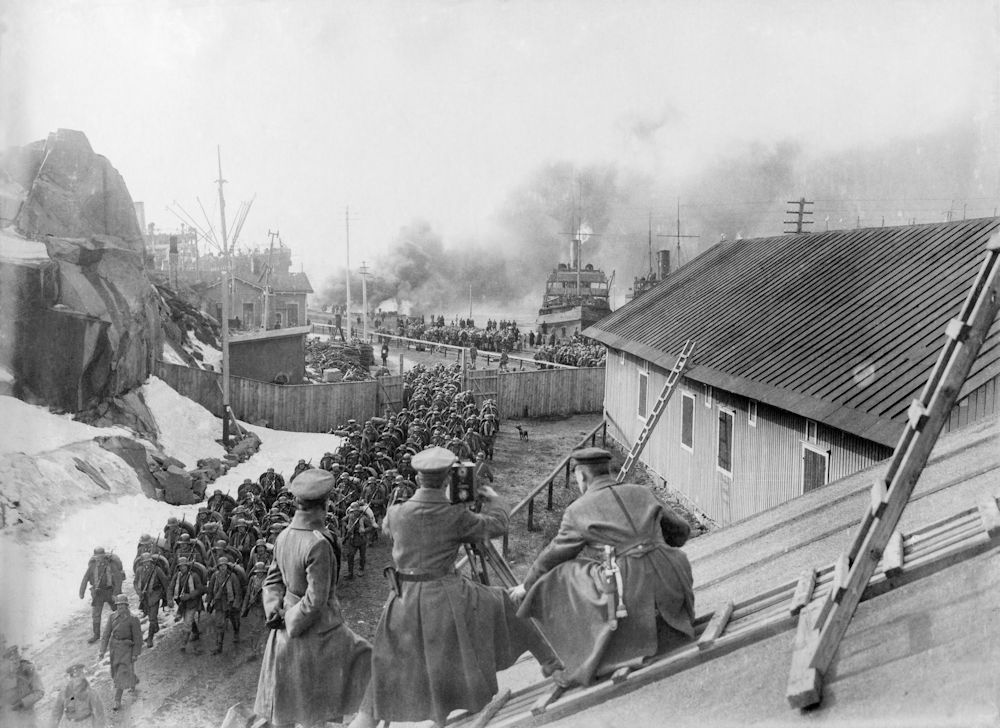
PICTURE: German Ostsee Division lands troops in harbour of Hanko / Hango.
Notice film crew filming the event in the forefront. Photographer Hoffmann, Wolff or Zimmler. Photo source
Finna.fi - photograph provided by Museovirasto and used with
CC BY 4.0 Creative Commons license.
CLICK THUMBNAIL TO SEE LARGER PIC (159 KB).
Among the units, that the Red General Headquarters in Helsinki succeeded sending against the German Ostsee Division was Armoured Train number 4, which had been in Riihimäki. The General HQ of Red Guards sent the armoured train to Tammisaari and ordered their HQ of Uusimaa region to sent all possible available troops to Karjaa / Karis. But as they had already sent just about all of their willing troops towards Tampere, they found themselves without any real reserves. Weak leadership also made it impossible for them to transfer large amount of troops from any other front, so troops-wise they ended up scraping bottom of the barrel and even then succeeded cobbling up together so little little troops, that they did not have any actual chance of success against Ostsee Division. They succeeded gathering only about 1,000 men to Karjaa. Considering German troops were much better trained and unlike the Red units sent to Karjaa had lots of combat experience the 1 : 9 combat manpower-ratio in favor of the Germans did not leave much room for guessing how a battle between the two would end. The outcome was so certain that General Headquarters of the Red Guards decided to evacuate whole Satakunta region before the Germans would be able to cut connections of the Reds to there. They ordered only Red Guard units to be evacuated, but the order resulted also much of their families of Red Guardists joining the evacuation, with slow-moving masses of civilian refugees filling the roads, which in turn slowed down movement of Red Guard units, causing them further problems for their operations.
5th: First time that the Germans fight against armoured train in Finland. Armoured train number 4 was waiting troops of the advancing Ostsee Division in Raasepori / Raseborg railway station. While this armoured train was Fredriksberg-made, it was smaller than usual - it had 100 men, one artillery piece and 2 machineguns. The battle, which ensued, was rather short - German vanguards brought artillery piece near the railway tracks and opened fire over open sights towards the train after which the train retreated. The Germans continued their advance, but they were soon to meet the armoured train number 4 again.
Three kilometres before Karjaa the Germans faced the armoured train number 4 again and this time it had a friend - another armoured train. The two armoured trains started delaying German advance.
6th: Spearhead of Ostsee Division broke defence of the Reds in Karjaa. Once the lines of the Reds had been breached and the Germans captured Karjaa, main force of the Reds retreated towards Salo, while smaller number of the Reds retreated towards Hyvinkää. Meanwhile that same day the main troops of Ostsee Division were marching from Hanko towards Tammisaari. Just like infantry units of the Reds also their armoured trains got seperated - one of them followed the evacuation trains to Hyvinkää while another train headed to Helsinki using railway running along along the coast.
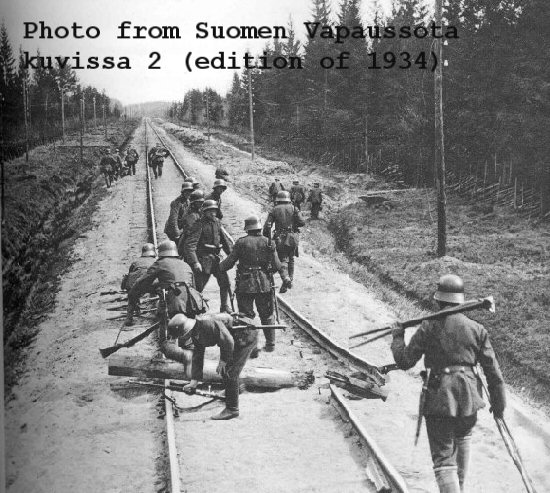
PICTURE: Engineers from German Ostsee Division repairing tracks demolished
by the Reds. Photo taken during advance of Ostsee Division towards Helsinki. Photo from Suomen
Vapaussota kuvissa 2 (edition published 1934). CLICK THUMBNAIL TO SEE LARGER PIC (83 KB).
Political and military leadership of the Reds in Helsinki no longer had false illusions about the situation. Already the same day Council of People's Representatives (Kansanvaltuuskunta, government of the Reds) fled from Helsinki to Viipuri / Wiborg. However they were not the first, some leaders of the Reds had left Helsinki already two days earlier. The next day also General Headquarters of the Red Guards left Helsinki and headed to Viipuri.
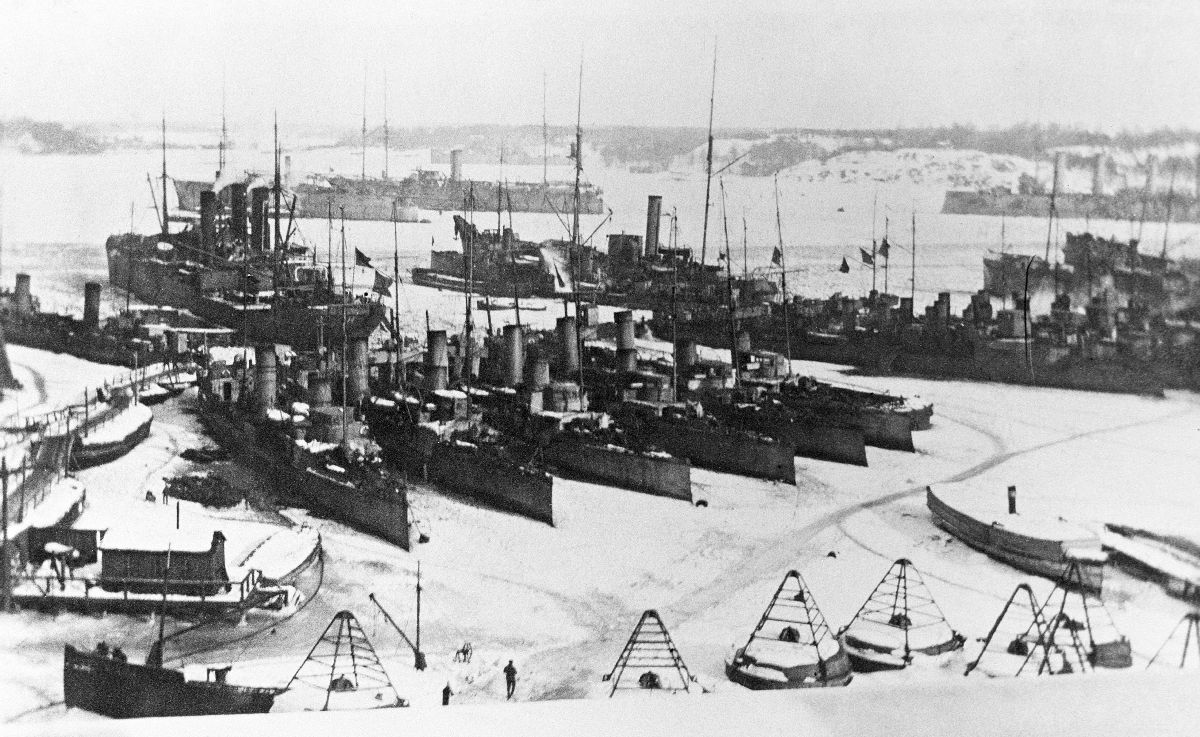
PICTURE: Russian warships in Helsinki harbor in March of 1918. During World
War 1 Helsinki was not only Finnish capital, but one of the three Russian naval bases in Baltic Sea. Its
importance as naval base at the time can be noted from multiple fortified defense lines built by
the Russians around Helsinki during World War 1. When German troops arrived to Finland in April of
1918 and headed to Helsinki Russian navy took role of bystander, which concentrated saving its ships
by taking any that were seaworthy to Kronstadt. Photographer unknown. Photo source
, acquired via Finna.fi and used with
CC BY 4.0 Creative Commons license.
CLICK THUMBNAIL TO SEE LARGER PIC (221 KB).
7th: Second landing of the German troops to Finland begins. German Brigade lead by Otto von Brandenstein landed in Loviisa / Lovisa east of Helsinki in Finnish south coast. Reds had in Loviisa unit of only 50 men, which had no chance against the Germans. Before the Reds succeeded sending even first of their units towards Loviisa about 1,100 men from Brandenstein's Brigade had disembarked. The Germans were lucky for the slow reaction capability and small number of reserves of the Reds, because the frozen sea and small number of available ships delayed German transports from Tallinn, which took several days. Once troops of the Brigade had all landed in Loviisa they started the march towards inland. Their main target was Kouvola - Lahti railway, capturing of which would effectively cut railway connection of the Reds from southern Finland to Karelian Isthmus and to Petrograd. For this task Brandenstein's Brigade received assistance when White Guards unit (White Army volunteers) of about 400 men lead by T.J. Ketonen arrived from the nearby islands and joined it.
8th: The Reds succeeded blocking advance of Brandenstein's Brigade's vanguard towards nearby city of Kotka , which had larger harbour. However this proved to be their only success against the Germans in this area. While the Red Guards succeeded bringing some units to the area they failed organising these units under one leadership and because of this they did not succeed creating effective defence. The Germans beat them piecemeal and the Reds could only continue to retreat.
9th: Troops of Ostsee Division, which had landed in Hanko, continued their march towards Helsinki. The Reds attempted stopping them again in Kirkkonummi / Kirkonäs and again they had armoured train supporting their defense. However also the ineffectiveness of armoured train and weakness of their defense remained the same. Like in Karjaa they succeeded delaying German advance, but failed stopping it. Soon troops of Ostsee Division headed again on their way towards Helsinki.
12th: Troops of German Brandenstein's Brigade for the first time run into fairly well-organised and effective defense. 300 Reds in Eskilom had taken positions in forest-covered hills, which offered them rather good defensive positions. It took several hours, artillery support and some close quarters combat until the Germans took the hills.
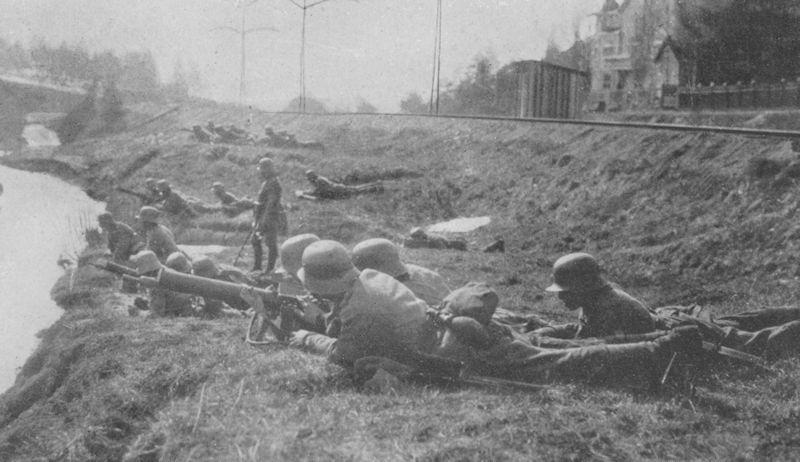
PICTURE: Troops of German Ostsee Division with their
Maxim M/08-15 machine guns in Latokartano. Older sources place this
staged photograph from spring of 1918 to Huopalahti. Photo source Finnish Heritage Agency
(Museovirasto), acquired via Finna.fi and used with
CC BY 4.0 Creative Commons license.
CLICK THUMBNAIL TO SEE LARGER PIC (88 KB).
However the main event of this day was beginning of German attack to Helsinki, Finnish capital, which had been in hands of the Reds for duration of the war this far. The attack started from around Huopalahti in the morning and continued with heavy fighting east of Huopalahti. Fiercest combat took place in Ilmala on hill of meteorological station and on rocks of Pasila. Also area around Fredriksberg Engine Works (where most armoured trains of the Reds had been built) was fight over and the Germans captured it around 1 PM. In Pasila the Germans succeeded ambushing train full of Reds coming from the Helsinki railway station.
Outside the city the Reds had armoured train and concentration of troops (which had never seen frontline service) from local Red Guard defending Tikkurila railway-station. Red Guards fighting in Tikkurila local ones, they had combat experience and had been equipped with non-standard hunting rifles. After the Germans succeeded capturing Tikkurila railway station the battle turned very one-sided. When the Reds twice attempted counter-attacking to the station the Germans basically mowed down the inexperienced Reds with their machine guns and mine throwers. The Reds lost in total some 70 - 100 men dead and another taken as prisoners, while the Germans lost only two men in the battle. The armoured train and some other trains however succeeded to escape and rolled from the battleground towards north. Capturing of Tikkurila railway station cut railway connection of the Reds to Helsinki.
The Germans captured Malmi district this day, at which point Red Guard still remaining in Helsinki lost their route towards north. Still the same day the Reds tried opening the connection again by attacking with armoured train from the north and repeated their attacks also the next day. But their attacking troops were small and failed to achieve any success.
At afternoon the German attack reached centre of Helsinki White Guard (volunteer troops of Finnish White Army), which had been hiding in the city all the time since beginning of the war, joined them for rest of the battle. Helsinki White Guard had succeeded in secrecy forming force of two full battalions and partial third battalion, which had two companies. It is Rather amazing that this local White Guard, which had been hiding right under noses of the Reds had also succeeded acquiring some 1,500 - 1,700 rifles, 500 pistols, 11 machineguns, 1,500 hand grenades, some 250,000 cartridges for rifles and 60,000 cartridges for pistols. While the Germans had been marching towards Helsinki its White Guard had started making preparations for capturing parts of the city. However the Reds noticed these preparations and some small battles broke out between small units of Helsinki White Guard and the Red Guards already day before the German troops reached Helsinki. Now units of Helsinki White Guard helped the Germans for capturing centre of the city. That same afternoon the Germans also landed troops to Katajanokka Point, where much of the Russian Navy had been anchored just days before. In fact during the battles there were still Russian warships in Helsinki harbour, but Russian Navy had negotiated in beforehand with the Germans and took the role of bystanders.

PICTURE: Squad of Helsinki White Guard (Helsingin Suojeluskunta) in the
"uniforms" that they used during Battle of Helsinki. Due to Helsinki being under control of
Finnish Red Guards, Helsinki White Guard had been work in clandestine manner. Only once German troops
arrived to liberate Helsinki was its White Guard able to risk open battle. Due to being unable to acquire
real uniforms, this White Guard used white armbands, white hat decorations and white jacket epaulets to
separate friend from foe. All but three of the rifles in this photo appear to be
Winchester M/1895, with two Mosin-Nagant (possibly
Dragoon M/1891) and guardsman with a small pistol in hand has
Japanese M/05 (Type 38) infantry rifle. Photographer Eric Sundstöm.
Photo source , acquired via Finna.fi and used with
CC BY 4.0 Creative Commons license.
CLICK THUMBNAIL TO SEE LARGER PIC (178 KB).
At least two armoured cars supported the Reds in street battles of Helsinki. Turku garrison (Turun kasarmi), Swedish theatre (Ruotsalainen teatteri), National theatre (Kansallisteatteri), Smolna, railway station (rautatieasema), Guard's garrison (Kaartin kasarmi) and Senate building (Senaatin talo) were the strongholds, which the Reds defended most fiercely. Reds defending the both theatre buildings surrendered at the evening after German troops apparently using human shields for capturing the building, but Turku garrison proved to be so costly to capture, that the Germans set its buildings on fire to force the Reds shooting from there to exit the building. Fire destroyed the garrison and Reds rushing out were shot.
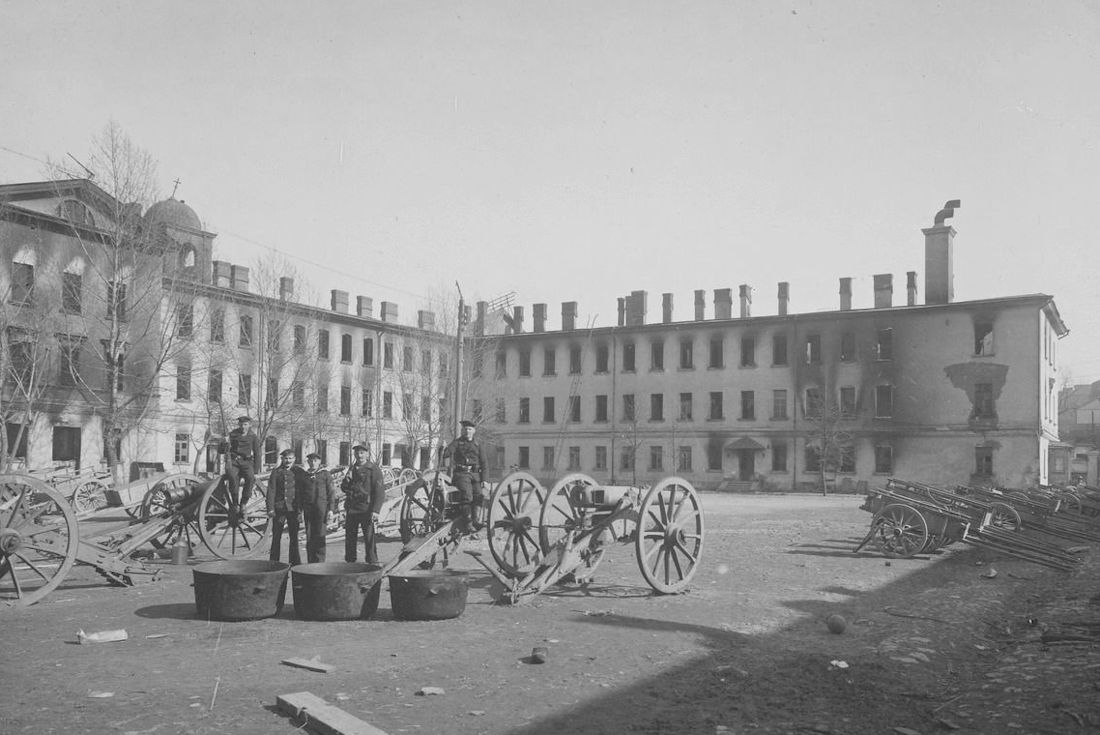
PICTURE: German naval infantry poses on top of captured Russian
87mm field guns in front of burned ruins of Turku garrison
in Helsinki after the battle. Red combatants hiding inside the garrison building had been shooting
at the Germans and refused to surrender - for which the Germans replied by setting
the building in fire and shooting everybody trying escape outside. Photo source Finnish Heritage Agency
(Museovirasto), acquired via Finna.fi and used with
CC BY 4.0 Creative Commons license.
CLICK THUMBNAIL TO SEE LARGER PIC (123 KB).
13th: Centre of Helsinki only house of Smolna, parts of railway station and Senate building remained in hands of the Reds. However they still had also parts south of Unioninkatu street plus quarters of Kruununhaka, Siltasaari, Kallio, Sörnäinen and Hermanni. Battle of Helsinki continued, but there was no uncertainty about who would win it. The Reds who had barricaded themselves to Smolna decided to surrender already at morning. Ships of German Navy took part in capturing Borgström's tobacco factory and Main Guard (Päävartio) assisting with gun fire. At afternoon the Germans attacked to Hermanni district from eastside of Kallio district. German artillery firing over Töölönlahti bay from place where the Opera house is today got several hits to People's hall (Työväentalo) in Hakaniemi, setting the building on fire.
Finally the Reds had only Kallio and Sörnäinen districts and they decided to surrender. This surrender happened in Pitkäsilta-bridge. But even after this formal surrender of Red Guards located in Helsinki some of their units continued battle in Uusimaa garrison (Uudenmaan kasarmi) and building of Swedish upper secondary school. Rest of the Reds in Uusimaa garrison surrendered after the Germans threatened to use artillery firing on open sights against its defenders. Neither Helsinki White Guard nor the Germans had dared to attack forcefully against the Swedish upper secondary school as the Reds held there the as captives men Helsinki White Guard, which they had succeeded capturing earlier. Because of this it became the last building to surrender in whole Helsinki - around 5 PM. The Germans and the Whites now had whole Helsinki under their control, but every now and then the shots fired by the Reds still hiding in the city rang in its streets during the next few days. In the end the battle of Helsinki resulted lots of prisoners of being taken, but only relatively small number of dead. The major factor for this seems to have been fleeing of Red Guards leadership to city of Viipuri - information concerning it spread very fast among ranks of the Reds and doing considerable damage to their battle morale. The total number of dead from Battle of Helsinki was about 300 Reds, 54 Germans and 17 men from Helsinki White Guard. The number of Reds captured as prisoners of war was around 6,200. Now when the Germans had captured Helsinki they headed to their next target - town of Riihimäki, one of the most important railway crossroads in southern Finland.
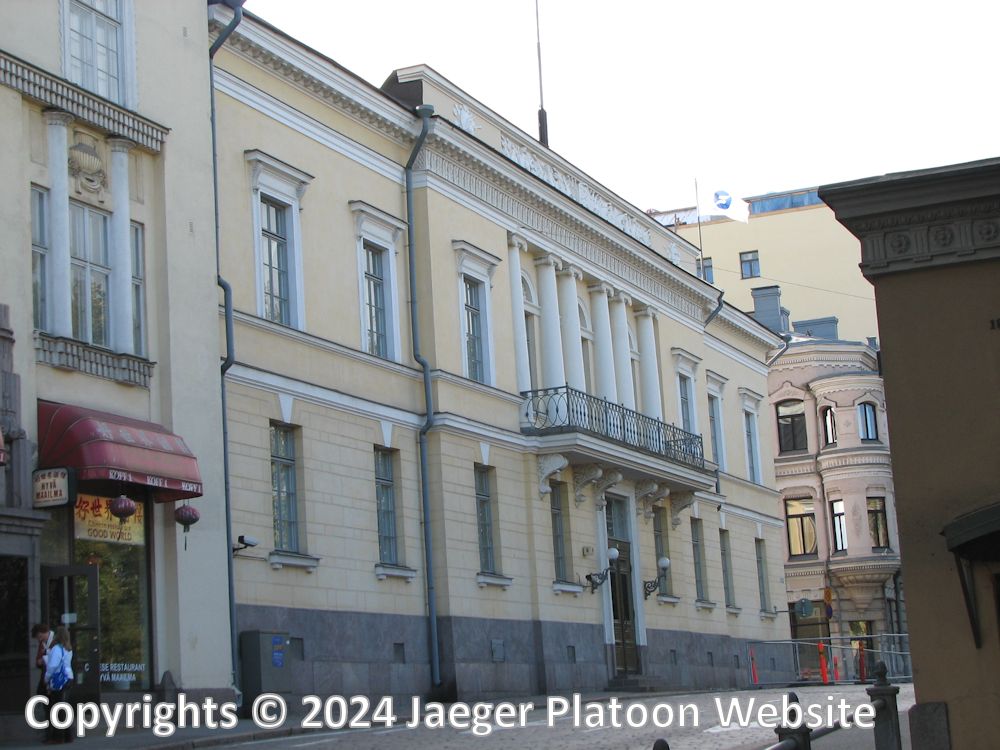
PICTURE: Smolna in Helsinki nowadays. Finnish Reds named the building as Smolna after
the building, which had been important to Bolshevik revolution in Petrograd (nowadays St. Peterburg).
During Finnish Civil War Smolna was the building used by People's Council of Representatives
Kansanvaltuuskunta, as the Finnish Reds called their government. Before Civil War the building had been residence
of Governor-General and nowadays Finnish government uses it as banquet hall. CLICK THUMBNAIL TO SEE LARGER
PIC (138 KB).
The same day White Army units captured city of Pori. The Reds fled from there to other nearby areas, which were still under their control.
14th: Troops of Brandenstein's Brigade advancing towards north reach Hyvinkää - Kouvola railway in Kausala and Uusikylä. In Kausala their control of this railway proved short-lived because of Red Guards armoured train, which attacked and forced them to leave the railway. But Uusikylä, which the Germans captured after short battle, proved much more difficult nut to crack for the Reds. The Reds attacked the railway-station from the west and were expecting another of their armoured trains to attack from the east. The Germans did proper job in damaging the tracks before the station, so when they also had well-placed artillery along the railway the Reds were to find recapturing Uusikylä railway station to demand a truly formidable effort. Red Guards started the attack for recapturing it with support of Panssarijuna number 4 and two guns already the same day, but due to damaged tracks and German artillery, proved unable to effectively use their armoured train.
15th: The Reds attack to Uusikylä station again - this time with force. The first attack of the day failed and when the armoured train supporting the attack retreated to get more water for its steam engine, the infantry it had supported snuck after the train, deserting their positions. After a while the Reds got their act back together and started their second attack for the day. This attack supported by Armoured train number 4 and three artillery pieces gaines some success early on with Reds capturing terrain next to the railway and water tower in the railway station, but the Germans succeeded keeping actual station buildings. However the situation was not easy for the Germans either, so the next night they evacuated their troops and left the railway station to the Reds, who had reason to celebrate when they found the station empty next morning. Once they recaptured the railway station the Reds also found out what had happened to their another armoured train, which was supposed to attack the station from the east - thanks to demolished railway tracks it had spent the whole battle derailed without being able to contribute anything. Recapturing these two railway-stations restored railway connection of the Reds from southern Finland to Viipuri (and Petrograd) - even if this was not to last long.
The Germans had retreated from Uusikylä railway station to Kuivanto, but they had not lost their will to fight nor ability to take initiative. Once their reinforcements had arrived they headed towards city of Lahti / Lahtis - which was located westwards along the same Hyvinkää - Kouvola railway.
19th: Troops of German Brandenstein's Brigade attacked to city of Lahti and captured most of it. The Reds had made the mistake to leave Lahti railway station unguarded, which made it easy prey for German bicycle battalion. However the battle about southern parts of the city continued whole day. 8 PM the Germans started their attack against Reds that were on Radioasemanmäki hill and in cemetery. Red Guards left Radioasemanmäki hill but one of their units kept the cemetery until next morning. German troops captured 34 machineguns and 12 artillery pieces in Lahti. Now railway connections of the Reds to the east had been cut again. However as large amounts of Reds retreating from south-west Finland started to pile up west from Lahti the relatively small troops, which Brandenstein had in Lahti were in real danger of being overrun once the Reds west from the city would start their imminent attack.
The same day east of Lahti in Villähde some 300 Reds and armoured train supporting them tried to stop one of the units belonging to Brandenstein's Brigade from advancing. But the Germans had already noticed weaknesses of the Reds - Red Guards had poor teamwork between their different units and moral of their infantry depended for support weapons to be there at all times. So the Germans hit the armoured train (which lacked infantry escort) with everything they had. Once crew of the armoured train panicked, the train retreated leaving just the infantry of Red Guards to battlefield, which made the moral backbone of the infantry to fall apart and infantry went running after the train.
20th: First contact between White Army advancing towards south and Germans advancing towards north. This contact was first achieved in city of Lahti. First White Army unit to arrive Lahti was 1st Battalion of Pohjois-Häme lead, a White Guards unit led by Captain Hans Kalm. By advancing to city of Lahti Captain Kalm intentionally failed to follow the orders given to him, but due great fame and military victories that his battalion had achieved, instead of being court-martialled Kalm was soon promoted as Major.
Troops of German Ostsee Division marching from Helsinki towards Riihimäki faced defence line of the Red Guards in Hyvinkää. The Reds had organised their defence in Hyvinkää to Åvik ridge behind bridges of Kriss. As usual supporting the defense was also armoured train, which every now and then rolled in ahead of to the frontline machine-gunning and bombarding the enemy with its cannons for a while and then rolled back behind its own infantry. The Germans attacked, but failed to gain ground.
20th - 21st: East from city of Lahti the frontline was in Villähde, where the some 1,300 Reds were attacking against troops of German Brandenstein's Brigade to reopen their railway connection from southern Finland towards city of Viipuri. Supporting the attacks during these two days were also two armoured trains of Red Guards. However the support they gave proved somewhat ineffective as they fought in this front only these two days and even then damage, which the Germans had done to the railway tracks prevented them from leading the attack too far. Also one of the two trains was damaged in these battles, for which it had to be sent it to Viipuri for repairs. Once also the second armoured train left this front, as already common, the fighting moral of about Red Guards collapsed, after which they abandoned their positions and started to retreat.
Morning of this day the German troops of Ostsee Division succeeded outflanking the Reds in Hyvinkää, after which the Reds started their retreat towards Riihimäki. Also the armoured train, which had been supporting them retreated to Riihimäki and made several attacks from there against the advancing Germans.

PICTURE: Cavalry of the Reds in Riihimäki. Photo source Finnish Heritage
Agency (Museovirasto), acquired via finna.fi and used with
CC BY 4.0 Creative Commons license.
CLICK THUMBNAIL TO SEE LARGER PIC (115 KB).
22nd: Troops of German Ostsee Division attacked town of Riihimäki with strategically important railway crossroads. One of their artillery shells fired towards Riihimäki train station hit boxcar loaded with artillery ammunition, which then explodee causing considerable damage in the railway yard. After some combat the Reds left Riihimäki retreating towards Lahti with three trains. The Germans captured Riihimäki.
Attacks of the Red Guards from the west towards city of Lahti started this day. With exodus of Reds from southern Finland heading to east towards Viipuri and Russian border some 28,000 - 30,000 Reds and civilian refugees had piled up west of the city. Maybe 12,000 - 14,000 these were very close to Lahti and about half of them were armed combatants of the Red Guards. As the Reds often retreated by rail this great retreat had gathered some 20 locomotives and hundreds of railway wagons to railway station of Herrala west of Lahti. With the Reds were also two armoured trains. Lucky for the relatively small German force (from Brandenstein's Brigade) and White Army troops defending Lahti, Commander of Ostsee Division Von Goltz had succeeded sending reinforcements for them via town of Porvoo / Borgå. Those reinforcements arrived just day before Red Guards piled up on western side city of Lahti launched their offensive towards the city.
Those attacks of the Reds from the west to city of Lahti failed. Rather ironically the area south of the city was almost unguarded and if the Reds had concentrated their attacks there, they could have been able to get through and continue towards east. However their leadership was so focused to the railway going through the city, that they were unwilling to divert units to other directions. During the following days maybe about 2,000 Reds succeeded to continue their trek towards east through the poorly guarded area south of the city, but the others attacking along the railway did not get that far.
29th: The Whites against launched their attack against lines of the Reds in between train stations of Tani and Pulsa in Kouvola - Viipuri railway. Defence of the Reds is just about to collapse, but then their armoured train arrived and its fire support boosts their fighting moral. However after White Army 7th Carelian Artillery Battery scores several direct hits to the armoured train, it retreated to Tani railway station, but proved to be a rather poor decision. Once the armoured train had arrived to Tani station the same White Army artillery battery hit it again, this time the shells wrecked one of the trains two artillery wagons maiming crew of the wagon. The seriously damaged train limped off the battlefield towards Kouvola railway station. Once the Reds no longer had the armoured train supporting them, as often seen already, it collapsed battle moral of their infantry and their defense turned into chaotic retreat.
30th: Troops of German Brandenstein's Brigade captured parish village of Hollola northwest from Lahti. This blocked the route of retreat from the Reds trying to get towards Lahti from the northwest.
May
1st: Disintegration of the remaining Red Guard units turned into surrenders in mass. West of Lahti the Whites and the Germans took about 30,000 prisoners of war and capture 20 locomotives, 350 railway cars, 30 motor cars, two armoured cars, about 50 artillery pieces and some 200 machineguns. In this area the Germans captured two armoured trains of Finnish Red Guards - one armoured train in Herrala and another in Okeroinen.
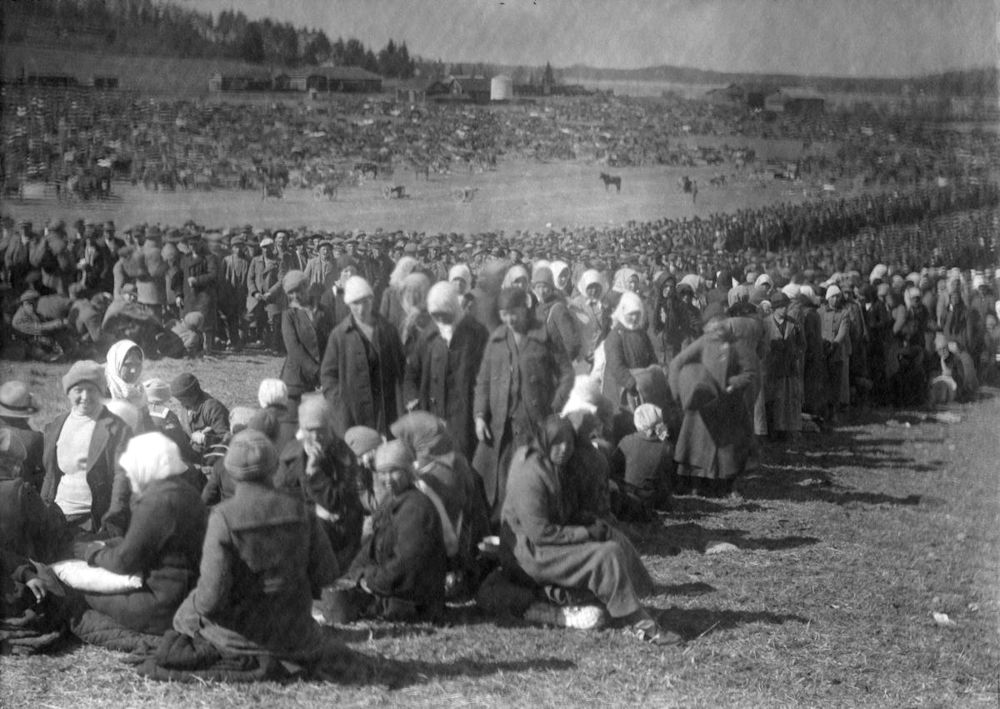
PICTURE: Fellmanin pelto (Fellman's field) was temporary ad-hoc prisoner of war
camp created by German troops after mass surrender of Finnish Red Guards west of city of Lahti. Some 22,000
prisoners of war and refugees (typically family members of Red Guard who had been heading to Russia with them)
were gathered there. This camp was poorly guarded and about third of the prisoners succeeded to escape, with
of remaining prisoners being taken to more permanent prison camps - most (about 10,900) to nearby Hennala
prison camp set up in former Russian garrison. Photo source
Lahti City Museums (Lahden museot), acquired via
finna.fi and used with CC
BY 4.0 Creative Commons license. CLICK THUMBNAIL TO SEE LARGER PIC (148 KB).
East of Lahti the Reds had retreated to region of Kymenlaakso. Now that they had lost also Carelian Isthmus and Viipuri they no longer have any connection to Russia by land. Apparently small number of Reds still succeeded getting from Kotka to Russia by rail, but the great majority in Kymenlaakso had no alternative than to die or surrender - from these two options all but few decided to prefer surrender.
3rd: White Army units commanded by Colonel Ernst Linder capture Kouvola. In Kouvola railway station they found abandoned the Red Guards armoured train, which their 7th Karelian Artillery Battery had seriously damaged few days earlier in Tani. They capture the train and remove the wrecked artillery wagon from it. Colonel Linder transfers rest of the train to use of the Germans, who sent it to contact Colonel Brandenstein in Lahti.
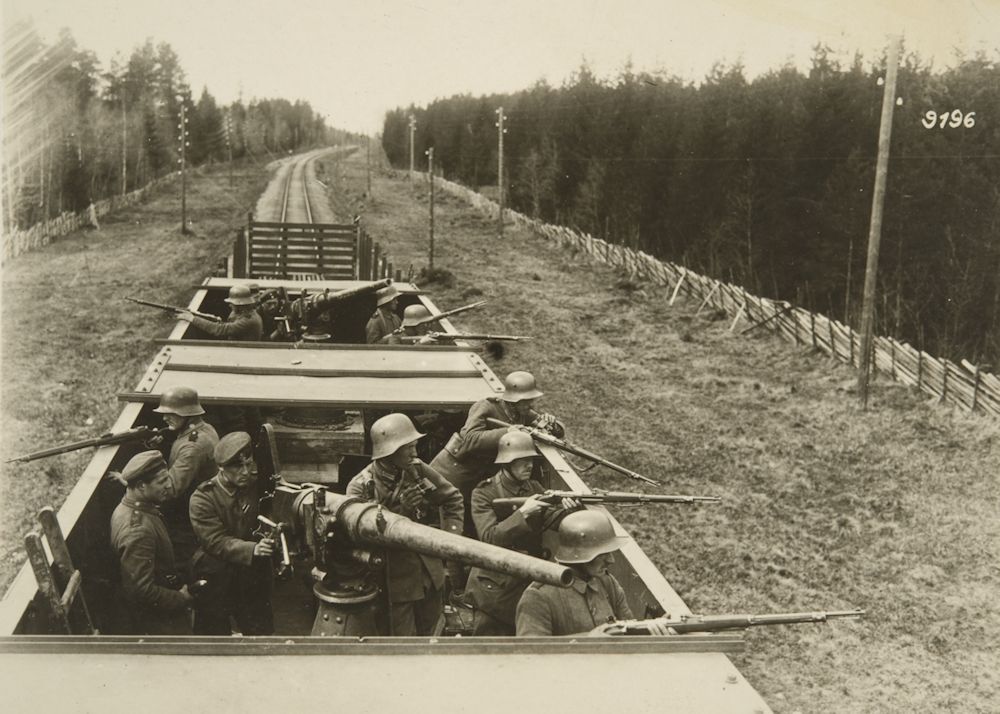
PICTURE: Armoured train with German crew in Finland in May of 1918. This photo gives idea
what the artillery wagons built in Fredriksberg Engineering Works looked like from the inside. The guns seem
to be likely 47mm Obuhov naval/coastal guns (47/40 O). Photo source
Finnish Heritage Agency (Museovirasto), acquired via finna.fi and used with
CC BY 4.0 Creative Commons license. CLICK THUMBNAIL
TO SEE LARGER PIC (148 KB).
4th: Fighting moral of the Reds in Kymenlaakso had totally collapsed. Their units now surrender to first White Army unit, which they meet, no matter its size. Their units in Inkeroinen, Hamina and Kotka surrender to White Army units, which arrive there by rail. The Whites have captured armoured trains (at least one armoured train captured in Tampere and the "armoured train of riflemen" + Putilovian artillery wagon combination captured in Kavantsaari of Karelian Isthmus) with them, but find them little use anymore, as the Reds usually surrender without the fight. However some small battles are still being fought here and there - for example in city of Kotka the female combatants of Red Guards still fight the last desperate and useless battle against the White Army unit, which captures the city.
5th: Last unit of the Red Guards in Kymenlaakso region surrendered. The Whites took about 9,000 prisoners in Kymenlaakso region. The Civil War is all over for the Reds. Nine days later the Russians evacuate their last military base (coastal fort of Ino in Carelian Isthmus) in Finland the Finnish Civil War ends. The relations between Finland and Bolshevik Russians remained strained with state of war remaining in force and the official Finnish - Russian peace treaty (Tartto / Tarto / Dorpat Peace Treaty) was not signed until year 1920.
SOURCES:
Paavo Tavio: Suomen Puolustusvoimain panssarijunat vuosina 1918 - 1939 ja niiden edeltäjät vapaussodassa in Sotahistoriallinen aikauskirja 4 (Armoured trains of Defence Forces 1918 - 1939 and their predecessors in War of Independence in Journal of Military History 4).
Jouni Eerola; Punaisen Suomen panssarijunat (Armored Trains of Red Finland) in Sotahistoriallinen aikauskirja 29 (Journal of Military History 29).
Paul Malmassari: Les Trains Blindés 1826 - 1989 (Armoured Trains 1826 - 1989).
Heikki Ylikangas: Rata Rautuun, Ratkaisutaistelu Karjalan Kannaksella 1918 (Railway to Rautu, the Key Battle in Carelian Isthmus at 1918) (published year 2012).
Sakari Viinikainen: Rautatiesota 1918. Taistelut Savon rintamalla. (Railway War 1918. Battles in Savo Front) (published year 2017).
Heikki Ylikangas: Tie Tampereelle (Road to Tampere).
Jouni Eerola: Pasilan konepaja 1903 - 2003 (Pasila Engineering Works 1903 - 2003).
Jussi T. Lappalainen: Punakaartin sota 1 - 2 (War of the Red Guards parts 1 - 2).
Vapaussodan historian komitea: Suomen Vapaussota vuonna 1918 (published 1924) (Finnish War of Liberation at Year 1918).
J.O. Hannula: Suomen Vapaussodan historia (edited edition published 1938) (History of Finnish War of Liberation).
Simo Eronen ja Antti Komonen: Karjala Vapaussodassa I (published 1930) (Carelia in War of Liberation I).
Suomen vapaussota IV (published 1924). Toimittaneet Kai Donner, Th. Svedlin ja Heikki Nurmio. (Finnish War of Liberarion part IV. Edited by Kai Donner, Th. Svedlin ja Heikki Nurmio).
Suomen Vapaussota kuvissa 1 - 2 (published 1934) (Finnish War of Liberation in Photographs, parts 1 - 2).
Stig Roudasmaa: Helsingin Suojeluskuntapiirin historia 1918 - 1944 (History of Helsinki Civil Guard District).
Jouni Sillanmäki: Panssarijunia Suomessa, suomalaisia panssarijunissa (Armoured Trains in Finland, Finns in Armoured Trains).
Maksim Kolomiec: Brona Russkoj Armii, Broneautomobili, bronepoezda v permoj mirovoj vojne (Armoured Vehicles, Armoured Cars and Armoured Trains of the First World War).
Lecture Punaisten panssarijunat (Armoured trains of the Reds) by Jouni Eerola in semilar of Association of Military History in Finland (6th of September 2008).
Armoured Units of the Russian Civil War, White and Allied by D. Bullock and A. Deryabin
Armoured Units of the Russian Civil War, Red Army by Andrei Aksenov and Peter Sarson.
Article: Panssarijunat Suomessa 1918 - 1944 (Armoured Trains in Finland 1918 - 1944), part 1 by Kari Kuusela in Kansa Taisteli magazine vol. 2/1986.
Article: Panssarijunat Suomessa 1918 - 1944 (Armoured Trains in Finland 1918 - 1944), part 2 by Kari Kuusela in Kansa Taisteli magazine vol. 3/1986
Article: Pietarilaiset joukot Suomessa 1918 (Russian troops from Petrograd in Finnish War of Independence 1918) by Ohto Manninen in Journal of Military History 17 (1998).
Article: Panssarijunakuvia vuodelta 1919 (Photographs of Armoured Trains from Year 1919) by Tuomo Schering in Resiina Magazine volume 4/1990
Article: Punaisten ja valkoisten panssarijunat 1918 (Armoured Trains of the Reds and the Whites at 1918) by Paavo Talvio in Resiina Magazine volume 4/1994
Russian Armoured Trains website by Pavel Voylov, Edited by Ben Turner and Jeremy Mac Donald (website no longer active).