


ARMOURED TRAINS
Part 1.0
Armoured Trains and Railways of Finnish Civil War
Few words about the terms used. When "White Army" in mentioned without specifying the nationality it is Finnish White Army and likewise meaning of Red Guards is Finnish Red Guards. Also in this text the Reds and The Whites also mean Finnish Reds and Finnish Whites. To be exact the Reds often had Russian or few fighting among them, but otherwise you can assume that "the Reds" in this text means Finnish Reds. The term used about Russian Reds in this text is Bolsheviks. Place names used in the text are the ones, which were used during this War. Finnish Civil War is still somewhat delicate subject. I know that all my fellow countrymen do not even agree calling this war "Civil War", but that is what it technically was. I also think it is the most impartial term possible in English about this war, which also why I prefer to use it. The source materials about this war are far from good and since nobody has written a good book about Finnish armoured trains of this period the information had to be gathered from variety of sources (which are listed in the last page). Okay, now its time for me stop and let you to read about the actual subject before I am boring you stiff.
FINNISH RAILWAYS IN 1918
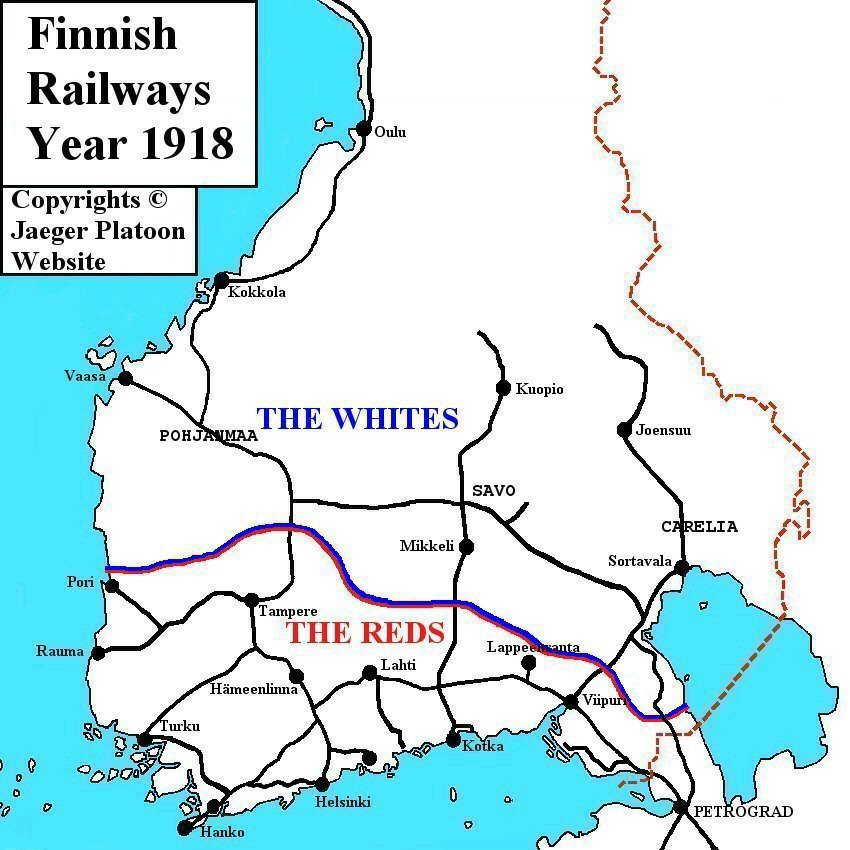
PICTURE: Map showing railways of Finland in 1918. CLICK THUMBNAIL TO SEE LARGER PIC (130 KB).
First time armoured trains were used in Finland was during Finnish Civil War (January - May of 1918). Building of Finnish railway network had been started with Helsinki - Hämeenlinna railway in year 1862 and by year 1918 the most essensial parts of Finnish railway network as it exists today had already been completed. Mainly the Finnish railroad network included three important north-south railway lines and two east-west railway lines. Viipuri - Petrograd (St. Petersburg) railway connected the Finnish railway network to other parts of Russian railway network. The other end of Finnish railway network was Oulu - Tornio railway ending to Swedish border in the north, building of which was completed year 1903. However as Finnish railway network was built to standard (60-inch/152.4-cm) Russian railway-gauge unlike Swedish railways, so the trains could not cross the Swedish border. The railway-gauge was not the only way in which the Russian influence was visible in Finnish network. Railway network of Finnish Grand Duchy had not been build merely for commercial motives or civilian traffic - the railway network offered Russian military effective tool for large transport of troops to Finland during possible invasion or internal disturbances. Due to this railway line Helsinki - St. Peterburg finished in year 1870 had massive strategic importance, but at that time Finnish railway connection ended to Finnish station in St. Peterburg and was not yet connected to railways coming from another parts of the Russian empire. This changed year 1913, when the railroad bridge crossing River Neva in St. Petersburg was finished, from that on Russian troop transport trains were able to get from other parts of the empire into Finnish Grand Duchy without hassle of disembarking from one train and re-embarking their troops to another train in St. Peterburg. Another Finnish railway line build for needs of Russian military was inland east-west railway-line Vaasa - Haapamäki - Pieksämäki - Elisenvaara finished in 1917. The way Russian military saw it earlier build Helsinki - St. Peterburg/Petrograd railway was too close to the coast and another railway-line located more inland was required for train transports to be safe from attacks, which the enemy might done from the sea. Rather ironically during Finnish Civil War Vaasa - Haapamäki - Pieksämäki - Elisenvaara railway largely benefited White Army, which ousted Russian military from Finland. Without this inland railway, which was completed just before Finnish Civil War, the war might have ended quite differently.
Once Finnish Civil War begun in end of January 1918 the frontlines formed to line Ahlainen - Vilppula - Mäntyharju - Antrea - Rautu. This divided Finland to two parts: Middle and northern Finland were controlled by White Army while Red Guards controlled Southern Finland. Even if area controlled by White Army had more area and population the area controlled by Red Guards had largest cities (with large harbours), the main parts of railway network, majority of railroad stock and most of industry. These advantages should have given Finnish Reds a very favourable situation, but because large part of railroad personnel refusing to work for them and lack of discipline among their troops they failed to use railroads effectively during the war. Maybe the most visible example to show lack of discipline and it results came with the tendency of Red Guards units sent to the frontline to keep the trains they had been transported to front with and use them for their accommodation. Because of misuse tied large amounts of rolling stock the Reds actually faced shortage of available trains before end of the war. The railroads offered main route of transporting troops and supplies for the Armies of both sides. The three main north-south railway lines (Pohjanmaa railway, Savo railway and Karelian railway) all went through the frontlines, so they were natural routes of attack on which the armoured trains were used during the war. The Helsinki - Petrograd railway line going along the southern coast was vital route of supply for Red Guards. At the same time the inland Vaasa - Elisenmäki east-west railway line was at least equally important for armament transports of the White Army arriving by ship from Germany to harbours of Pohjanmaa (Botnia) region and also for troop movements. However these railroad lines also contained the Achilles' heel for both the Whites and the Reds. Due to their locations near the frontlines the both sides could threat railway connections of each other. Haapamäki railway crossroads vitally important to White Army was very close to Vilppula frontline and only route for Red Guard to get supplies by land from the Russian Bolsheviks in Petrograd was the east-west coastal railway going through Viipuri.
Railways, locomotives and rolling stock in beginning of the war:
|
Area and population under control: |
Reds |
Whites |
Front area |
Total |
|
Percentage of area |
14.7 % |
82.1 % |
3.2 % |
100 % |
|
Percentage of population |
42.3 % |
52.6 % |
5.1 % |
100 % |
|
Railway equipment: |
Reds |
Whites |
Total |
|
|
Railway tracks (km) |
1871 km |
2296 km |
4167 km |
|
|
Railway density (km/square km) |
0.034 |
0.008 |
0.012 |
|
|
Locomotives |
465 |
95 |
560 |
|
|
Passenger cars |
1203 |
50 |
1253 |
|
|
Freight cars |
15722 |
1000 |
16722 |
(Data source: Punakaartin sota, part 1, page 119).
In addition of other railway equipment in beginning of the war all largest railway depots were located in area controlled by the Reds (or their Bolshevik supporters). These included following railway depots: Viipuri (141 men), Pasila (69 men), Petrograd (47 men) and Riihimäki (39 men).
The whole Finnish Civil War was for a large part started by arrival of one especially significant train - the so-called great weapons train (suuri asejuna). 27th of January it 1918 arrived from Petrograd bringing Finnish Red Guards much of the weaponry needed for starting their armed rebellion against democratically elected government. What is known cargo of this train included: 15,000 rifles, 30 machineguns, some 2 million rounds of ammunition for rifles and machineguns, ten 76-mm field guns, six boxcars of artillery ammunition and two armoured cars.
Due to season (winter) and shortages of equipment both sides were very much tied to the existing railroad and road networks. As a result the battles were mainly fought along the railroads and roads. Finnish Civil War was fought between end of January to mid-May, which means it started in middle of winter and ended at spring. Neither side had tents, so in middle of winter troops of both sides had to rely existing buildings to get shelter for night. Because of this the battles were fought to capture or keep some village or town even more often than usual. During winter the existing roads were covered in snow, but this was not much a problem as both sides used horse-towed sledges as their transport and supplies vehicles. Only very small number of motor vehicles existed in Finland during the war and on snow covered roads they were limited use. Both sides had some cavalry units, while among Reds the riding horses often served also as status symbols of their leaders. White side had also few small units of bicycle troops, but one can only question if they actually really used much their bikes in snow-covered roads. While the conditions would have been pretty much ideal for large units of ski-infantry, which would have been less dependent of roads and would have had better mobility, such units were rare on either side. While the Finnish ski-infantry had existed during Swedish era (pre year 1809), the Russian military never developed specialised ski units and as the result even beside the traditions, the whole concept seem to have been largely forgotten until reintroduced in 1920's.
THE TRAINS
In Finnish Civil War Red Guards and Russians were the ones mostly using armoured trains. During the war they had about 10 armoured trains in their use, while most of the war White Army had only one somewhat proper armoured train. The reasons for this were relatively simple. As Red Guards had the railway connection to their Bolshevik ally, they could ask Russian armour trains from Bolsheviks as their support and they did. The industry in area controlled by the Reds (southern Finland) had both of the two existing railway machine works - Fredriksberg Engineering Works (Fredriksbergin konepaja) in city of Helsinki and Viipuri Engineering Works (Viipurin konepaja) in city of Viipuri. These two Engineering Works allowed Finnish Reds to build armoured trains of they own, while Finnish White Army lacking proper facilities was unable to produce real armoured trains. And the Reds most certainly put this capacity to good use. However the two engineering works were not similar - the capacity of Fredriksberg Works was much larger than what the Viipuri Works and this shows also in the number of armoured trains built in them. During the Civil War the Reds were able to armour 6 - 7 steam locomotives and 12 - 13 flatcars (O-type train wagons) in Fredriksberg plus possibly 2 steam locomotives and 2 flatcars (O-type train wagons) in Viipuri. Knowing the situation it is easy to see why Fredriksberg Engineering Works located in Vallila area of Helsinki was so very important for the Reds - without it number of their armoured trains would have been much smaller. However this work order did not go in Fredriksberg Works without causing problems. As the whole nation, also employees of the engineering works were divided. Large part of employees in Fredriksberg Works supported Reds (it has been estimated that at least about third of its employees were Reds) or at least did not resist them, but the engineers belonging to executive branch of the Engineering Works were not. Middle management of the Engineering Works was divided, with part of them supporting Reds. The Reds absolutely needed some of the engineers to work for them as the usual workers lacked the skills and experience required for planning armoured trains. In Fredriksberg Works the Reds solved this problem by forcing vital members of executive personnel to work for them, while in Viipuri they succeeded finding a engineer, who was willing to help them to construct armoured trains. To give some idea about the support that the Reds had in Fredriksberg Engineering Works, it might be worth to mention that it was one of the very first places, where companies of Helsinki Red Guard were formed from volunteers in 1918. The Company number of its Red Guards company was I-I-I (First company of First Battalion of First Regiment) of Helsinki Red Guards.

PICTURE: Locomotive armoured for Red Guards in Fredriksberg Works in 1918. This
armoured train had been captured by White Army. Photographed by W. Hackman in Riihimäki in year 1918.
Photo source Finnish Heritage Agency (Museovirasto), acquired via Finna.fi
and used with CC BY 4.0 Creative Commons license.
CLICK THUMBNAIL TO SEE LARGER PIC (150 KB).
ARMOURED TRAINS OF THE REDS BUILD IN FINLAND
In hierarchy of Finnish Reds Rautatieneuvosto (Railway council) was the organisation, which ordered manufacturing of armoured trains. The first order it placed to Fredriksberg Engineering Works was for armouring of 4 - 6 locomotives and "suitable amount of wagons" was made already in 1st of February 1918 and building of the 1st armoured train started only six days later in 7th of February. This first armoured train was completed in less than a month and building of the second armoured train started already 19th of February. Fredriksberg Works successfully completed all the first four trains in early March and once the crews had been gathered for them, the armoured trains headed towards the frontlines. Gun crews and machine gun crews used in the trains were apparently either Russians or often had been recruited from Gun- and Machine Gun School (Tykki- ja kuularuiskukoulu) of Helsinki Red Guards, which was located to Kallio Elementary School (Kallion kansakoulu) and had Russian soldiers as teachers. 7th of March Rautatieneuvosto placed second order for three additional armoured trains for Fredriksberg Works, but only one of these three trains were completed and sent to battle before German Ostsee Division assisting Finnish White Army arrived and captured Helsinki in 12th - 13th of April. Just two days before arrival of the Germans to Helsinki, the Reds sent one of the two remaining uncompleted armoured trains to Viipuri, to be finished there in Viipuri Engineering Works. When the Germans captured Fredriksberg Works, they also captured the incompleted armoured train 7, which they took to their own use. Finnish Red Guards named the armoured trains manufactured for them in Fredriksberg with numbers - in other words, armoured trains 1 - 6.

PICTURE: One of the old buildings of Frediksberg (later Pasila) Engineering Works.
The buildings of this Engineering Works basically cover a whole city block in Vallila of Helsinki.
CLICK THUMBNAIL TO SEE LARGER PIC (53 KB).
The basic armouring methods used in the both engineering works seem to have been very much the same. The artillery wagons were built from 4-axle O-series wagons flatcars, which had been intended for transporting timber, had 22 ton carry capacity and were bit over 14 meters long. Large steel plates were riveted at sides and both ends of these flatcars and their attachment was reinforced with vertical angle irons. Sources provide some information about thickness of steel plates used - original order from government of Finnish Reds concerning Armour Train 1 specified armour plates to be 12mm - 15mm thick, while intelligence gathered by Finnish White Army suggested that 13mm (or one inch?) armour plates had been used for armoured trains built in Fredriksberg Works. Portholes for small arms and machineguns were added to both sides and ends of the artillery wagon. It seems to have been typical for each train to have 4 - 6 machine guns.
Artillery pieces that the Reds used as main guns of armoured trains built in Fredriksberg were provided by Centrobalt (Russian Baltic Sea Fleet Central Committee run by the Bolsheviks) and likely delivered from Russian Naval arsenal in Helsinki, which the Red Guards and their Bolshevik supporters had taken over. Steel plates used for armoring of flatcars and steam engines may have likely originated from the same source as artillery pieces. Much of the 47mm and 57mm guns used as armament for the armoured trains build in Fredriksberg Works had likely been earlier used in Russian war ships, many of which had been re-equipped with better (more powerful) naval guns after Russian - Japanese War of 1904 - 1905. While large part of these used naval guns had been placed in coastal defences, some seem to have still been in Naval Arsenal in beginning of Civil War and made available for this use. On the other hand 75mm Canet naval / coastal guns were very much up to date artillery firepower and comparable to best guns that Russian Bolsheviks were commonly using at the time for their armoured trains.
Armoured Train 4 was an exception to armoured trains built for Finnish Red Guards. It was armoured in Viipuri and apparently sent to Helsinki (Fredriksberg Works) to be equipped with guns circa 4th of March 1918. While armoured trains built in Fredriksberg Works had been armoured with single layer of steel plate, Armoured Train 4 had two thinner armoured plates with layer of coarse cloth placed in between them and when tested in Fredriksberg proved able to stop only rifle bullets fired from a distance.
Armoured trains armed with Fredriksberg Works were equipped with following naval/coastal guns:

PICTURE: One of the armoured trains build for Finnish Red Guards in Fredriksberg
Engineering Works in Helsinki. Artillery armament of this particular train appears to be two
75-mm Canet naval/coastal guns which are in its
artillery wagons. Photo source Karjala Vapaussodassa 2, page 84 (published
1934). Public domain. CLICK THUMBNAIL TO SEE LARGER PIC (170 KB).
Armoured Trains build for the Red Guards in Fredriksberg Engineering Works:
|
armoured train: |
commander of the train: |
building completed: |
headed: |
main armament: |
|
Armoured Train 1 |
G.C. Tamlander / ? |
1st of March |
to Vilppula Front |
2 x 47mm gun + 2 x 57mm gun |
|
Armoured Train 2 |
A. Nyholm / K.J. Lehtinen |
3rd of March |
to Savo Railway |
3 x 47mm gun + 1 x 57mm gun |
|
Armoured Train 3 |
J.V. Mäkinen |
9th of March |
to Vilppula Front |
2 x 75mm gun |
|
Armoured Train 4 |
A. Lehtonen |
9th of March |
to Karelian Railway |
2 x 75mm gun |
|
Armoured Train 5 |
E. Karjalainen |
29th of March |
to Lempäälä |
2 x 75mm gun |
|
Armoured Train 6 |
(Kaljunen?) |
22nd of April (in Viipuri) |
towards Petrograd |
2 x 75mm gun |

PICTURE: Photo taken from top of a artillery wagon
build for Finnish Red Guards in Fredriksberg Engineering Works. This particular wagon appears to
have one 47mm naval gun and one 57mm naval gun as its main armament. Notice differences in designs of gun
shields. Photo source Vapaussota Kuvissa 1 (published 1934). CLICK THUMBNAIL TO SEE LARGER PIC (226 KB).

PICTURE: Gun wagon of armoured train built for Finnish Red Guards in Fredriksberg Works in 1918.
The wagon is equipped with 57-mm naval guns. This armoured train had been captured by White Army with some white
soldiers presumably guarding it visible in left side of the photo. Photo provided by Museokeskus Vapriikki, Tampere.
Used with CC BY 2.0 Creative Commons license.
CLICK THUMBNAIL TO SEE LARGER PIC (135 KB).
The fixed pedestal/column-type naval mounts of these guns were simply bolted to floor or the platform of the railway wagon and they were fired over the armour plating. Floors of the artillery wagons were wood, but seem to have been reinforced for this use. Two basic versions of artillery armament existed - either the artillery wagon had two 47-mm or 57-mm naval guns or just one 75-mm naval gun. Each of the artillery wagons could also have up to four machineguns, but sometimes less when they were not available in such a large numbers. Even if these artillery wagons were partially open from the top, they still provided their crews reasonably good protection against rifle-calibre fire while they had enough firepower to typically provide the armoured train local firepower superiority. Those artillery wagons equipped with two 47-mm or 57-mm guns each placed on top of axle or one 75-mm gun set up in middle of the wagon. Top of each artillery wagon was only partially covered by roof, with wagons equipped with two guns having less cover while version with single 75mm gun had roof covering most of the wagon, Considering this partially open top attacking past high hills with enemy infantry in them could have been a bad idea - the open top left crew vulnerable for bullets fired from above. Apparently at least sometimes also sandbags were used inside the wagons to improve the protection provided by armour and reduce effects of possible ricochet bullets. Locomotives, which the Finnish Reds armoured for their armoured trains were armoured very much the same way. They selected suitable locomotive and covered its sides with armour plating. However the quality and thickness of steel/iron plates used to armour both wagons and locomotives build by the Reds seem to have varied considerably. Armoured trains were the largest weapons systems build in Finland for Civil War. Building of each armoured train in Fredriksberg demanded some 30 tons of steel, bar iron and other raw materials. The completed armoured train weight estimated 100 - 130 tons.

PICTURE: Fredriksberg Works built gun wagon equipped with 75 mm
Canet gun. This wagon was photographed after being captured in Battle of Tampere. Photo source Sotamuseo, provided via
KUMEPA. CLICK THUMBNAIL TO SEE LARGER PIC (135 KB).
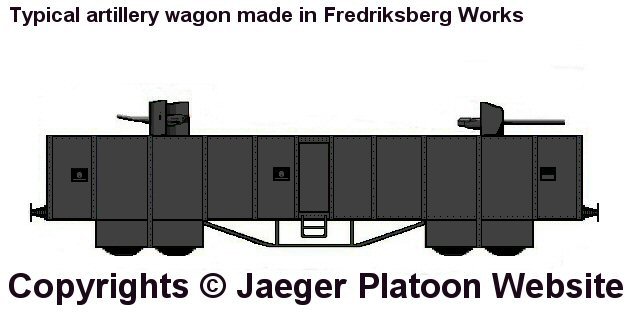
PICTURE: Example of typical artillery wagon equipped with two 47-mm or 57-mm naval guns
made in Fredriksberg Works at 1918 which makes it part of either Armoured Train 1 or 2. According period
sources at least some of these armoured trains had been painted grey, but the exact shade is not known. CLICK
THUMBNAIL TO SEE LARGER PIC (35 KB).

PICTURE: Another example of typical artillery wagon equipped with one 75-mm Canet
naval gun build by Fredriksberg Works at 1918. CLICK THUMBNAIL TO SEE LARGER PIC (35 KB).
Structure of the typical Fredriksberg-build Red armoured trains seems to have been:
1. Flatcar
2. Armoured artillery wagon (1 - 2 guns + machineguns)
3. Armoured locomotive
4. Armoured artillery wagon (1 - 2 guns + machineguns)
5. Flatcar
If needed additional boxcars or passenger cars could be attached between locomotive and artillery wagons for transporting infantry, supplies or equipment. During the war the Reds routinely started including also some infantry in their armoured trains and when the train advanced to attack on tracks this infantry advanced as "wings" on foot in line on both side of the train. Early on all the armoured trains used by Finnish Reds did not necessarily have the flatcars in their both ends, but when demolishing railway tracks became common way of limiting mobility of armoured trains these flatcars proved more than worth the trouble and using them apparently became a standard. Finnish Red Guards typically used old I-series two-axle flatcars in both ends of their Fredriksberg-build armoured trains. During the war the flatcars added in both ends of the train saved trains from derailing more seriously in several occasions.
Locomotives armoured in Fredriksberg Works for armoured trains of Finnish Red Guards seem to have all been G10 and G11 steam locomotives. To be more specific Armoured Train 1 was equipped with G10 locomotive number 358 manufactured bu Schwartzkopff in Germany at year 1901, while other armoured trains got equipped with G11 locomotives manufactured by Tampella in Finland in 1902 - 1905.

PICTURE: Photo showing crew in one of the armoured trains of Finnish Red Guard. They are seen
here in artillery wagon of their armoured train. The particular wagon, in which they are posing is
Fredriksberg Works build artillery wagon
with one 75-mm Canet naval/coastal gun. Notice one man on the
left gripping Maxim-machinegun and gun mount of 75-mm Canet gun on the background. Photo source Karjala
Vapaussodassa 2, page 85 (published year 1934). Public domain. CLICK THUMBNAIL TO SEE LARGER PIC (191 KB).

PICTURE: Inside view to gun wagon equipped with 75 mm
Canet gun. Photo source Sotamuseo, provided via KUMEPA. CLICK THUMBNAIL TO SEE LARGER PIC (105 KB).
ARMED TRAINS
Besides proper armoured trains both sides equipped and used also armed trains, which instead of armour plates relied to improvised protection with typically chest or shoulder high parapets made from bales of paper, sandbags, stacked railway sleepers, combination of brick & planks etc. Basically the parapets seem to have been made from any suitable materials, which happened to be locally available. In Karelian railway the Reds adopted protective structure of wagon side walls for armed trains build from two layers of planks and layer of brick between. They apparently copied this design of protective parapet from armed train of Latvian Riflemen, which shortly took part of fighting there. More de tailed information about improvised armoured trains is listed in following pages, which tell about battles fought along each railway during Finnish Civil War.
During World War 1 Russian Army had been operating in Finland "Combat train" (bojevoi poezd, which appears to have been armed train, which they had operated from Oulu starting year 1916 probably along Pohjanmaa railway and it may have served at least as concept-level example for armed trains equipped already early on following starting of Finnish Civil War.Russian Army apparently had year 1917 plans of disestablishing particular train, but it is unclear if that was ever done. Hence it is possible that it may have been the same armed train, which Russian Colonel Mihail Svetsnikov working as military advisor for HQ of Finnish Red Guards in Tampere sent to Vilppula Front in early February.
Also the first armoured train, which the Finnish Reds equipped in Fredriksberg Works belonged to this category early on. It was known as "armoured train of riflemen" and contained:1. Flatcar with artillery piece.
2. Locomotive (no armour).
3. Ammunition wagon (boxcar).
4. Boxcar with walls "armoured" with planks and portholes build in them.
Later the "plank-armoured" boxcar was united to same train with normal artillery wagon, which contained one artillery piece, this combined train also had armoured locomotive. It seems that at least in some point this train was also used joined to Russian-build Putilovian artillery wagon as a one combined armoured train.
RUSSIAN ARMOURED TRAINS IN FINLAND
Russian heavy armoured train equipped with gun turrets:
Thanks to their railway connection to Petrograd the Reds also received armoured trains to their support from Russian Bolshevik government. Mid-1917 Russia had only 7 armoured trains and the Bolsheviks started their revolution all the armoured trains were away in the fronts, so early on they had none. Even if the total number of armoured trains in use of Russian Bolsheviks was still very limited in beginning of year 1918, the number of armoured trains in their disposal was starting to increase rapidly. Both sides of Russian Civil War used major railway engineering works in Moscow, Petrograd, Kiev, Kharkov, Luhansk, Briansk ja Tsarysino to built armoured trains. Due to Finnish Civil War starting at end of January and ending in mid May of 1918, Russian Bolsheviks still at the time had only very limited number of armoured trains in their arsenal of weapons. But they still considered success of Finnish Red Guards so important, that they sent several armoured trains to Finland to support Finnish Red Guards, while fighting a Civil War of their own at the same time. Information about the armoured trains they sent to Finland is bit sketchy, even when it comes to the heavy armoured armoured train and separate artillery wagon (Putilovian), both of which ´Finnish White Army ultimately succeeded capturing.
Unlike armoured trains build in Fredriksberg Works for Finnish Red Guards Russian heavy armoured train had gun turrets in its artillery wagons. Name of this train had originally been General Annenkov and it had been build in Kiev at year 1915. General Annenkov had been designed by Staff-Captain Pilsudski and had been used by 2nd Zaamurska Railway Brigade lead by Major General Kolobov. Staff-Captain Pilsudski apparently also served as first commander of the train. Building of the train was completed in October of 1915 and early on it was equipped with captured Austrian weapons. However by the time the train arrived to Finland its weapons had been already been replaced with Russian ones. The train had armour varying between 10 - 20 mm thick. That much can be told with good certainty, but when it comes to where this train was and what it did before arriving to Finland, the sources do not seem agree just about anything. Even possible names of the train include in various sources Partisaani (Partisan), Voloi Kapitalism (Down the Capitalism) and Imeni Raskolnikov (In the name of Raskolnikov). Also Kerenski has been suggested as its name by some old sources, but this this must be either false information, or earlier name for the train from the times when it was in use of Russian Whites. It must be noted that there are also theories according which Partisaani and Voloi Kapitalism may have also been two separate Russian armoured trains, from which one would have succeeded returning to Russia and avoid capture.

PICTURE: Russian armoured train Voloi Kapitalism / Partisaani. The train has been photographed
immediately after being derailed and captured by Finnish White Army in Säiniö in Carelian Isthmus.
Photo source Finnish Heritage Agency (Museovirasto), acquired via finna.fi
and used with with CC BY 4.0 Creative Commons license.
CLICK THUMBNAIL TO SEE LARGER PIC (278 KB).
It must be noted that at the time Finnish railroad networks was designed mainly for rather light trains and practically all railway lines had only one set of railway tracks. Also Finnish locomotives and railway wagons had been acquired with this in mind. This Russian armoured train was considerably heavier than what the Red Guards were building in Finland during the war, hence it was not able to operate in all parts of Finnish railway network. Only Tampere - Helsinki and Helsinki - Pietari railway connections had been build for trains this heavy, hence armoured train as heavy as this one may have not been able to operate elsewhere without taking considerable risk of getting accidentally derailed. At least originally this train had a Russian crew, but there is no certainty if the original crew served in it until the train was captured by Finnish White Army.

PICTURE: Another photograph of Russian armoured train Voloi Kapitalism / Partisaani derailed
in Säiniö in Karelian Isthmus. Photo source Suomen vapaussota kuvissa (published 1934). CLICK
THUMBNAIL TO SEE LARGER PIC (93 KB).
Structure of Voloi Kapitalism / Partisaani armoured train:
1. Flatcar
2. Artillery wagon (76 K/02 field gun, Maxim machineguns)
3. Locomotive
4. Artillery wagon (76 K/02 field gun, Maxim machineguns)
5. Flatcar

PICTURE: Drawing showing likely structure of armoured train Partisaani / Voloi Kapitalism
captured in Finland in 1918. This sort of structure was typical to armoured trains - flatcars on both ends were
cheap sacrifice in case of train starting to derail and artillery wagons placed on both sides of locomotive
to protect it while being able to shoot in both directions. CLICK THUMBNAIL TO SEE LARGER PIC (60 KB).
As usual with armoured trains this structure allowed the trains to advance and fight effectively both forward and backward, but the maximum firepower could only be against targets located in either side of the train. Both artillery wagons had rotating turrets for their main weapons. Artillery wagons seem to have had 8 loopholes for machineguns (3 in both sides and 1 located each side of the rotating gun turret), but did not necessary have enough machineguns for each loophole. From these 8 loopholes 6 allowed only shooting targets located side of the train, but the 2 loopholes next to gun turret allowed also shooting along the rail. Also 76 K/02 field gun was set in turret, which had traverse limited to about 270 degrees. As noted this train seem to have been more heavily armoured than the ones Finnish Reds build in Fredriksberg. Most of its armour plating seems to have been about 20 millimetres (0.79 inch) thick, while 10 millimeter (0.39-in), 16 millimeter (0.63-in) and 18-mm (0.71-in) steel plates had been used in some parts. However this was not the most important difference when compared to armoured trains build in Finland - the biggest difference armouring-wise was that its artillery wagons had roofs made from armour plate, while Finnish made trains had open tops. As mentioned during Finnish Civil War Finnish White Army captured this train, 24th of April 1918 in Säiniö (Carelian Isthmus).
Ukrainski Revolutsija / Putilovian:

PICTURE: Ukrainski Revolutsija / Putilovian artillery wagon after White Army
had captured it. Main armament of this wagon were two 76-mm anti-aircraft guns,
one on each end of the wagon. Photo from Suomen Vapaussota kuvissa 2 published at year 1934. Public domain. CLICK
THUMBNAIL TO SEE LARGER PIC (191 KB).
Besides these two trains White Army captured also Russian armoured artillery wagon Ukrainski Revolutsija (Revolution of Ukraine), which was also later rather commonly known in Finland as Putilovialainen (Putilovian) artillery wagon. The train was called Putilovian after its manufacturer - Putilov Artillery Factory (later renamed by the Soviets as Kirov Factory). It had arrived to A HREF="TRAINS4.htm">Antrea Front in (Karelian railway) in late March. It seems to be likely that this train was the first Russian armoured train to arrive Finland for Finnish Civil War, since it likely the one sent from Petrograd to Finland in 4th of February 1918. The timing of that first Russian armoured train arrive to Finland for fits to Russian armoured train appearing to Vilppula front at that time. As name suggests this artillery wagon seem to have been manufactured in Putilov Factory, where the Russians seem to have manufactured number of somewhat similar artillery wagons typically armed with 76-mm anti-aircraft guns. This armoured artillery wagon had two 76 ItK/14 Putilov antiaircraft-guns and eight portholes in each side of the wagon for riflemen. When the wagon arrived, it lacked armoured locomotive. Finnish Reds may have armoured a locomotive in Viipuri for this artillery wagon, but that is not certain. They also seemed to have possibly sometimes used it joined to their own armoured trains. Apparently this trained had a Russian crew. Originally the Reds had intended this artillery wagon to Raisuli - Rautu railway, but since that railway was still uncompleted during the war they decided to send it to Antrea instead. There it bombarded White Army positions in Hannila village and supported attack of the Reds to Hill 56. Apparently its ammunition wagon was hit in Kavantsaari (Antrea Front in Karelian Railway) and 23rd of March it returned to Russia for repairs. It returned to Finland and took part to battles in Antrea front. White Army captured this wagon 24th of April in Kavantsaari of Antrea railway (in Karelian Isthmus).

PICTURE: Ukrainski Revolutsija / Putilovian armored train car photographed after being
captured by Finnish White Army. Photographed by Harald Natvig. Photo source Finnish Heritage Agency
(Museovirasto), acquired via finna.fi and used with
CC BY 4.0 license. CLICK THUMBNAIL TO SEE
LARGER PIC (132 KB).
SAVIOUR OF CARELIA
The only somewhat proper armoured trains that the White Army had was Armoured Train of Antrea (Antrean panssarijuna) also known as Saviour of Carelia (Karjalan pelastaja), which operated in Carelian railway (in Carelian Isthmus). The train was named after Antrea front, which was the area in where it operated, while the nickname Savior of Karelia originated from its early success. This armoured train contained only one improvised artillery wagon and somewhat armoured locomotive pushing it. While the G1 (later known as Sk1) series locomotive used in it was properly armoured with layers of thin steel plates and cardboard, the artillery wagon it was pushing was just typical 2-boogie flatcar equipped with its sides and ends equipped with walls about shoulder high. Structure of these walls was rather simple - two layers of planks and layer of bricks between them. These walls in artillery wagon had loopholes through which its crew could use their rifles and pistols. Only heavy weapon in the train was 76 VK/04 mountain gun on naval mount, which had been captured from Russian military when the Whites 27th of January disarmed Russian naval unit of Vuoksi, which had gunboats armed with these mountain guns. When the guns were captured the Russian soldiers had succeeded hiding breechblocks of their mountain guns, but Machine- and Repair Shop of Yrjö Horsma in Sortavala succeeded manufacturing new ones for them. This caused delay of several days, but once the new breechblocks were completed one by one the guns were rushed to use. Second of the guns to receive its new breechblock was used for this armoured train. The old G1 locomotive had been earlier used to assist with railway switch was armoured and equipped in Sortavala and Enso. Besides armour this locomotive received also changes to its smokestack, which had added extra tubing leading the out coming smoke low in front of the locomotive. This innovative feature was added for making spotting movements of the train from distance more difficult, since its smoke would no longer reveal its location. Persons who got this armoured train build were brothers Svensson and one of them (K.E. Svensson) served also as its commanding officer early on. Saviour of Karelia proved highly successful both in battle in the way it helped boosting moral of White Army troops in Antrea front.

PICTURE: Armoured locomotive of Karjalan pelastaja (Saviour of Carelia). The artillery
wagon used with it was not armoured, but more of thing that one might expect to find with armed trains.
Photographed by Thorvald Nyblin. Photo source Finnish Heritage Agency (Museovirasto), acquired via
finna.fi and used with
CC BY 4.0 Creative Commons license.
CLICK THUMBNAIL TO SEE LARGER PIC (111 KB).

PICTURE: Drawing showing structure of Antrea armoured train aka Saviour of Karelia.
(14 KB).
AFTERMATH - WHERE HAVE ALL THE ARMOURED TRAINS GONE?
The only armoured train of the White Army and its crew survived the war, but all armoured trains of the Reds were not as lucky. Armoured trains had proved to be most effective of heavy weapons used by the Red Guards, which seems likely have reflected to attitudes that the Whites had towards their crews. Most if not all of their crews suffered losses during the war and once they ended up prisoners of war their future did not look too bright even then. During the war White Army intelligence gathered special lists of Red Guards personnel, which were considered especially dangerous, such as leadership of Red Guards or persons suspected of crimes committed during the war. Getting in such a list did not exactly improve chances of surviving prisoner of war camps after the war - and one of these lists contained names of known commanders, technical personnel and crew members of Red Guard's armoured trains. On the other hand

PICTURE: Two Finnish White Army soldiers pose with captured Russian armoured train
Partisaani / Voloi Kapitalism after its capture. Photographer unknown. Photo source The Finnish Labour
Museum Werstas (Työväenmuseo Werstas), acquired via finna.fi and
used with CC BY-NC-ND 4.0 Creative Commons
license. CLICK THUMBNAIL TO SEE LARGER PIC (198 KB).
Where did the armoured trains of the Reds end up:
|
Name of train: |
Build in: |
Captured where: |
Who captured: |
Special: |
|
Armoured Train 1 |
Fredriksberg Works |
Toijala |
Whites |
|
|
Armoured Train 2 |
Fredriksberg Works |
Okeroinen or Herrala |
Germans |
|
|
Armoured Train 3 |
Fredriksberg Works |
Tampere |
Whites |
|
|
Armoured Train 4 |
Fredriksberg Works |
Valkeasaari |
Bolsheviks |
interned? |
|
Armoured Train 5 |
Fredriksberg Works |
Okeroinen or Herrala |
Germans |
|
|
Armoured Train 6 |
Fredriksberg/Viipuri Works |
Papula (Viipuri) |
Whites |
|
|
Russian heavy armoured train |
Russia |
Säiniö |
Whites |
|
|
Ukrainski Revolutsija |
Russia |
Kavantsaari |
Whites |
|

PICTURE: Map showing where Finnish Reds lost their armoured trains. CLICK THUMBNAIL TO
SEE LARGER PIC (128 KB).
White Army captured one of the Fredriksberg-build armoured trains (likely Armoured Train 3) in Tampere 5th - 6th of April. Another two armoured trains captured in Tampere were apparently armed trains. Locomotive cabin of the captured armoured train had been demolished by direct hit scored by White Army artillery, but the Whites still succeeded taking the train to their own use. German troops captured another two Fredriksberg-made trains in Herrala and Okeroinen west from city of Lahti 1st of May. It seems likely that these two trains were Armoured Trains 2 and 5. One of the trains was also captured by the Whites in Kouvola and given by them to the Germans who used it shortly to make contact with Colonel Brandenstein's Brigade in Lahti - but again, this seems to have been an armed train instead of proper armoured train. In addition to these trains one Fredriksberg-build train (likely Armoured Train 4) was presumably interned or taken to their own use by the Bolsheviks in Valkeasaari. This happened after Red Guard troops lead by self-appointed General Kaljunen had driven the particular armoured train through southern parts of Karelian Isthmus already captured by White Army to Russian border. What can be said for sure, is that it seems to have disappeared to Russia back then. Supporting Kaljunen's escape train was also Russian armoured train, which may have succeeded slipping to Russia as well. The partially unfinished Armoured Train 6, which the Reds sent from Helsinki to Viipuri to avoid its capture, was apparently captured in Viipuri. The Germans also seem to have captured uncompleted armoured train (possibly Armoured Train 7) while capturing Fredriksberg Works, had it completed in some extent and used it before end of the war.

PICTURE: Fredriksberg-built armoured train captured by Finnish White Army underoing repairs in
Lokomo Engineering Works (Lokomon konepaja) in Tampere. Photographed 27th of April 1918.
Photographer unknown. Photo source Photo Archive of Vapriikki (Vapriikin kuva-arkisto), acquired via
Finna.fi and used with
CC BY 4.0 Creative Commons license. CLICK
THUMBNAIL TO SEE LARGER PIC (153 KB).
Somebody might want to know what happened to the armoured trains after Finnish Civil War. Well, the story continues in Finnish Armoured Train 1918 - 1940 page of this same website. Shortly said: Best remaining parts of the armoured trains captured in 1918 were recycled to form two armoured trains, which first the Germans used for couple of months and when German troops left Finland were transferred to Finnish Army. These best parts contained artillery wagons from Russian heavy armoured train, some Fredriksberg-build armoured locomotives and some artillery wagons also from Fredriksberg-made artillery wagons, from which the artillery weapons had been removed and roofs added - making them machinegun-wagons. Later these were modified and refined to two armoured trains, which Finnish Army used still during World War 2.
FILM LINKS:
German news reel / propaganda film Wiederherstellung der Ordnung in Finnland durch Finnische Weisse Garden und Deutsche Truppen (Finnish White Guards and German Troops restore order in Finland) from year 1918. Film is on Yle Elävä muisti (Living Memory) website of Finnish National Audiovisual Institute. The film was produced by BUFA Bild und Film Amt and has Finnish texts. Starting around 02:50 the reel shows armored train in use of German troops in Finland soon after Finnish Civil War. Both end of the armored have flatcars, front of the train has armed wagon (protection built from layers of thick plants and possibly something else) artillery wagon with 75mm mountain gun, two modified box cars, locomotive and armored wagon originally built in Fredriksberg Works for Finnish Red Guards. The armoured wagon built in Fredriksberg Works appears to have two 47/40 O coastal guns and Maxim machine guns.
Russian (Bolshevik) propaganda film Krasnaja Finljandija / Finljandija v gody revoljutsii (Red Finland / Finland in year of revolution) by Mihail Koltsov. This film with Russian texts contains authentic film material showing one of the armoured trains operated by Finnish Red Guards during Civil War. Film is on Yle Elävä muisti (Living Memory) website of Finnish National Audiovisual Institute.
Thanks to Oleg Kiselev, who helped with some of the materials used for this page.