


ARMOURED TRAINS
Part 1.2
Battles along the Railways in 1918
SAVO RAILWAY (SAVON RATA)
Even if the Whites were quite numerous and relatively well armed in direction of Pohjanmaa railway along the Savo railway the situation started much more difficult for them. Pretty much all weaponry that they had received from Germany before the war had been distributed to Pohjanmaa region and while the White Guards of Carelia had been able to buy weapons in Viipuri and Petrograd the White Guards of Savo region had less access to neither source. So acquiring the necessary weaponry for even the first moves proved difficult. While disarming of Russian soldiers started in this area earlier than in Pohjanmaa region, Russian soldiers in small units that were disarmed were so few in number, so even disarming them did not offer much of an improvement to weaponry-situation.
In beginning of the war the Red Guards also had notable manpower superiority in the region. It had fair amount of industry and the Reds had formed strong Red Guards particularly in southern end of Savo railway. In start of the war in this region there were several areas rear of White Army, which had large Red Guards and clearing some of them took quite a while due to White Guards of the region having so little resources early on, that they had to heavily prioritize where they would sent their troops. Although not a city or even a town Varkaus was industrialized and in the middle of area supporting Whites and became strongpoint for the Reds due to Red Guards of surrounding areas gathering there. City of Kuopio in the north and city of Kotka had and city Mikkeli south of it both had large Red Guards, while Kouvola and Kuusankoski near it were not much behind. City of Kotka with its harbour and industry in southern end of the railway-line also belonged to "Red bastions" of the region. Hence from the three north to south railway lines, this was the one were White Guards started as obvious underdog.

PICTURE: Location of Savo front. CLICK THUMBNAIL TO SEE LARGER PIC (130 KB).
Early on General Headquarters of neither side seem to have grasped strategic importance of east to west railway running via Pieksämäki for White Army. Before the war Pieksämäki White Guard had been provided only 30 rifles and White Army GHQ had no apparent plans for securing the railway connection. The Reds were equally clueless concentrating early on into securing their own railway connection from Helsinki to Petrograd and not utalizing their superior numbers and weaponry to launch offensive early on. Who got the guns first often decided in smaller communities, which side got the upper hand with availability of guns and ammunition also played major role in Mikkeli, Kuopio and Varkaus.
Like elsewhere the first thing concerning railroads that the Whites did was destroying of selected railroad-bridges to stop their enemy attacking with troops that it would bring in with trains. In this case they damaged two railway-bridges north of Kouvola (the railway crossroads station of Savo railway and Helsinki – Petrograd railway). Three armed trains White Army used early on in this railway were small, very lightly armed and failed to make a difference, while the armed trains equipped by the Reds locally and the one which arrived with Latvians from Russia proved quite a difficult opponents to the Whites. However effectiveness of the "proper" Fredriksberg-build armoured train that the Reds got in beginning of March turned out be rather disappointing after its first success. After early success attacks of the Reds turned out to be like trying to get through stonewall by hitting it with head repeatedly - painful and bloody but with very little success. The frontline then calmed down and did not move until the Reds decided to retreat in late April because their retreats in other fronts had created dangerous situation also in this front.
The three armed trains by the Whites early on each had just one flatcar with parapets build from sandbags in them and locomotive pushing that flatcar. These armed trains were also so lightly armed that they could barely be considered as armed trains - two of them had only rifles and the third one had only one machinegun in addition of rifles. armed train of the Latvians had two flatcars and locomotive in between them. Those flatcars had chest-high sides with two layers of planks and sand between the layers. Also Finnish Reds equipped at least three armed trains, which they used in this railway. From these three trains one known as Voikoski armoured train was based to the train that the Latvians had used - it had similar chest-high sides built on flatcars from two layers of planks and sand in between them. But Voikoski armoured train was also quite well armed for being just armed train, as it had at least one artillery piece and several machine guns. This train proved serious trouble to the Whites after they had recaptured Mouhu railway station - it made fast attacks and proved remarkably successful in staying outside effective range of White Army guns at the same time. Finally the Whites established listening post to one of the railway carriages in the station. With the early warning received from there White artillery was ready and waiting when the Voikoski train attacked next time and succeeded destroying it.
Beginning of March the Reds received their first real armoured train to Savo railway - armored train 4. This train made in Fredriksberg Works in Helsinki had the usual configuration of two flatcars with armoured sides and armoured locomotive in between them. As usual sides and ends of these flatcars had armour plates attached with rivets and each of the two carriages contained two naval/coastal guns and several machineguns. Company from Helsinki Red Guards served as crew of this train, while the infantry served as infantry attached to it was from Red Guard of Kouvola, where the train was also stationed.
Both sides had number of commanders, who commanded troops in this part of the front referred as Savo Front (Savon rintama by White Army and as Central Front (Keskinen rintama) by the Red Guards. Early on nominally the highest ranking leader on side of White Army was Adolf Aminoff - a count who had served as cavalry Colonel in Russian Army. Aminoff who was absent early on due to having gone to Viipuri to take command men of White Guards sent there and had ended up with Venäjänsaari Battalion even after his return did not take command of White Guards in his district. Aminoff's substitute as District Chief was Hjalmar von Bonsdorff - another nobleman and former Vice Admiral of Russian Navy, who did not taken command either. In absence of front commander, chiefs of local-level White Guards of the region took their own initiative, which combined with limited means of communications caused complications early on. Among those to take initiative was Lars V. Lundahl, who had served in Russian Army as Captain during World War 1 before being wounded and returning to Finland, had become police cheaf of Mikkeli just before Civil War and in beginning of Civil War commanded Mikkeli White Guard, which in beginning of Civil War was pretty much the only White Guard in the region to have men who had received at least some military training and due to 103 rifles originating from first shipment delivered by S/S Equity from Germany supplied to them was also the best-equipped White Guard in the region. Another chief of local White Guard to take initiative was Martti Eklund, who was chief of Kouvola White Guard, who early on had only 50 - 60 men but succeeded effecting course of war at least in the region by demolishing railway bridge over Torasjoki River and damaging railway bridge of Hillosensalmi, which delayed offensive of Red Guards until White Guards could get their act together and secured Haapamäki - Pieksämäki railway, which proved vital for White Army to transport supplies and troops. It is worth noting that while Torasjoki railway bridge was serious damaged, due to small amount of explosives available (8 kg of dynamite) the bridge was not completely destroyed. Hillosensalmi railway bridge was turn-bridge, which was likely damaged by turning it open and breaking its turning mechanisms in some manner.
Major General Ernst Löfström, was named as commander of Savo (Army) Group 12th of February 1918 and became White Army commander of Savo (Army) Group - a front commander of the region. At April Löfström was transferred as commander of East Army (Itäarmeija), concentration of troops created for capturing of Carelian Isthmus and city of Viipuri and was replaced with Major General Ernst Linder. The first commander of Red Guards in this front was Heikki Kröger, who had served as sergeant in Army of Finnish Grand Dutchy and due to his alcohol abuse was replaced first with Viktor Teikari, who was soon replaced with Aleksei Ossipov. Ossipov, who had Russian father and Finnish mother was born in Kuusankoski (town in this region) and Finnish was his primary language. Due to his father he was Russian citizen born in Finland and had served as non-commissioned officer of Russian Army in World War 1. He proved to be surprisingly capable leader, who was also respected by the Whites due to being against shooting of prisoners.
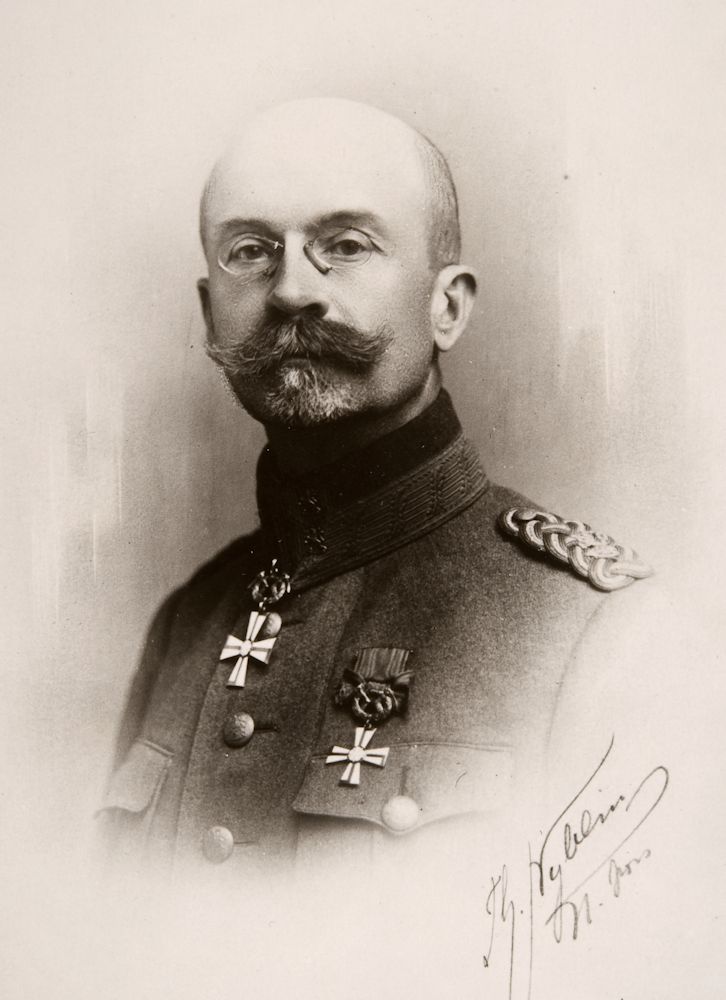
PICTURE: Ernst Löfström (1865 - 1937) . Like most senior officers of Finnish White
Army Löfström was a Finn, who had been making military career in Russian Army. In Russian Army had had
reached rank of Major General and served during World War 1 as regimental, brigade and ultimately division commander.
When Russian Army started collapsing at year 1917 he returned to Finland and joined Finnish White Army in end of
January. Although his personal relations with both General Mannerheim (commander of White Army) and Mannerheim's
2nd in command Hannes Ignatius were strained at best due to their past dealings, Löfström still
was appointed as field commander for Savo Front and later for East Army. His orders calling harsh treatment of
Russians may have been contributing factor for Viipuri massacre, in
which large number of Russians found in the city were killed in mass-execution by soldiers of Finnish White Army.
While promoted as Lieutenant General after capture of Viipuri he was not awarded the same manner as other senior
field commanders of White Army and may have been set aside by Mannerheim. Löfström retired from Finnish
Army as Infantry General in year 1928. Photographed by Thorvald Nyblin at year 1919. Photo source Finnish Heritage
Agency (Museovirasto), acquired via finna.fi and used with
CC BY 4.0 Creative Commons license. CLICK THUMBNAIL TO
SEE LARGER PIC (102 KB).

PICTURE: Map of Savo front. CLICK THUMBNAIL TO SEE LARGER PIC (55 KB).
It is worth noting that Kouvola formed likely the most bloody location of Red terror during Civil War. This was mainly due to Secret Investigation Committee of Kouvola (Kouvolan salainen tutkintakomitea), which unlike normal courts of law established by the Finnish Reds (known as vallankumoustuomioistuin - revolutionary court of law) did hand out capital sentences and also did it routinely. Those it sentenced to death either belonged to White Guards, were their supporters or suspected sympathizers and process used by the Committee apparently did not cover even the minimum requirements of proper legal process. In total the Committee handed out 125 death sentences, which included several dozen managers of Kymin Osakeyhtiö (Kymi Ltd) corporation with root reasons likely not being wartime events, but as aftermath of the bitter industrial action, which had taken place already at year 1904. Early on those sentenced to death were executed in a location, which got known as Tommola Field of Blood (Tommolan veripelto) and buried into shallow graves. But after digging graves into frozen ground proved difficult, later on those to sentenced to death by the Committee were taken to bridges of Koria and after being shot their bodies were discarded by being thrown to river. IV Company of IV Battalion of Helsinki Red Guards, which was officially assigned to guard bridges of Koria in April of 1918 gained infamy for running on the bridges the place of execution, to which Red Guards were sending people to be killed. The company was commanded by Mikko Kokko, had been created from voluntaries gathered among workers of Itämainen paperossitehdas (Oriental Cigarette Factory) in Helsinki. Mikko Kokko and his company had previously fought along Pohjanmaa railway, where he operated armed train and had later shortly fought in Lempäälä as part of units of Red Guards, which had tried to break siege of Tampere. With all the illegal killings and executions committed during the Civil War, it is worth noting that leaders of the Secret Investigation Committee of Kouvola were later caught by Finnish authorities, but besides death-toll they were responsible got their capital sentences changed to imprisonment and survived their lengthy prison sentences, while Mikko Kokko fled to Russia and died in Leningrad at year 1942.
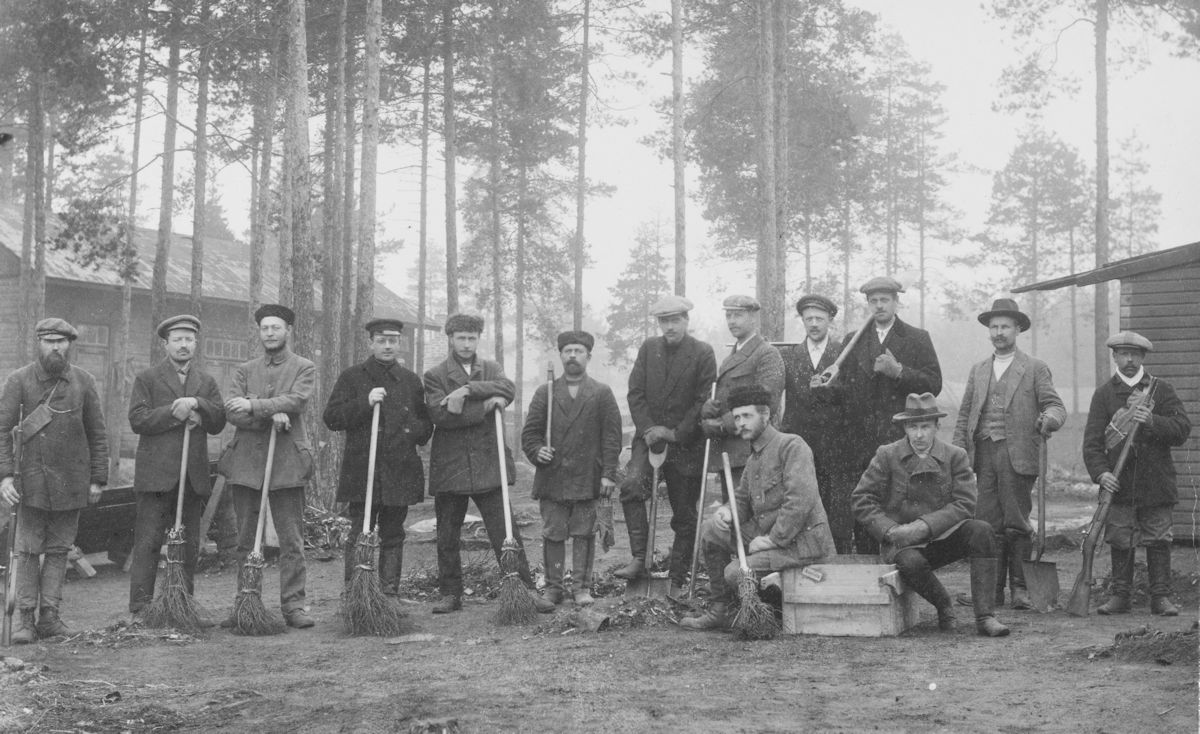
PICTURE: Prisoners of Red Guards in Kouvola at 20th of April 1918. Most of these men were
management of Kymin Osakeyhtiö (Kymi Ltd) and all but two of them were sentenced to death by Secret Investigative
Committee of Kouvola and killed. The two men to survive were policeman and master goldsmith, who had been robbed in
Petrograd, arrested by Red Guards when he tried to return to his family and probably only survived the ordeal because
when about to taken in front of committee drunk red guardist calling his name mixed it up and called false name. Possibly
photographed by Leonard Karlsson. Photo source Finnish Heritage Agency (Museovirasto), acquired via
finna.fi and used with CC BY
4.0 Creative Commons license. CLICK THUMBNAIL TO SEE LARGER PIC (195 KB).
Battles along Savo railway:
January
15
20th: Local Red Guardists informed Red Guard of Lappeenranta about the boxcar found in side-track and
Lappeenranta Red Guard sent force of 200 men to recapture it. Their plans did not unnoticed with White Guards of Luumäki
and Lappeenranta, who picked up the earlier hidden 70 rifles, removed rail and took positions on walls of old bastion
fort of Taavetti built in late 18th century. The resulting battle fougth in 21zSUP>st proved to be quite
an embarrassment for the Reds. They had about ten times the manpower but due to being scared to tracks being sabotaged had
been trampling in snow in front of their train for hours and hence exhausted. Their vanguard of five men had walked right
into White Guard positions and got taken prisoner. In the actual battle the Reds failed to do any sort of maneuver except
exchanging shots in highly inaccurate manner. After few hours of gunfight the Reds retreated back to railway station of
Taavetti, where they met passing Russian military train, whose men claimed that they had spotted large number of the
Whites heading that way from Kouvola and lost interest when came to chasing the small force they had just fought against
taking solace in having captured the boxcar that they had been sent to recapture. In the battle, or the skirmish the Reds
lost one man killed, three wounded and five lost as prisoners, while the Whites suffered only one man killed in action -
Jaeger Lauri Pelkonen, who was chief of Lappeenranta White Guard. The Reds succeded capturing some 140
Japanese rifles, which were still on it, but only 138 rounds of ammunition for the
rifles - they delivered the rifles and cartridges to Mikkeli Red Guards, which had been suffering from shortage of guns,
but not receiving more ammunition later on when the time came caused Red Guards to Mikkeli to surrender without a fight.
Surprisingly also Kouvola White Guard returned to their homes until developments at 25th of January convinced
them to flee and head north. The next day the Reds in preparation for securing railway connections for arrival of "Great
Weapons Train" from Petrograd started concentrating their troops to Kouvola. By the time the train arrived bringing
Finnish Red Guards their "starter package of armed revolution" in form of 15,000 rifles, 30 machine guns,
2 million cartridges, 10 field guns, six boxcars filled with artillery ammunition and two armored cars all to be
distributed to Red Guards along its railway route, there were almost 2,000 men of Red Guards gathered to Kouvola. 31st: Some 300 men from Varkaus Red Guard by commander of "Death Battalion"
("Kuolemanpataljoona") Alexander Pietikäinen commandeered a train and headed with it towards
Pieksämäki. "Death Battalion" a unit created from Red Guards, which had gathered to Varkaus, being
the best and possibly most fanatic part of their troops also responsible many of the civilian deaths. Force of White
Guards, which defended Pieksämäki at the time was commanded by Martti Eklund and Alvar Brejlin and was had
only about 100 men and single machine gun. With such disparity in number of men the Whites were in major disadvantage.
The Whites found out about the train and the Reds on it and decided to stop the train by sending locomotive without a
crew at full speed in the opposite direction to the same rail. However the Reds had also made precautions by adding
two flatcars loaded with stones in front of their train. When the collision happened it derailed the flatcars, but
failed to cause major damage to the locomotive, with only its tender being derailed. After this train-accident-by-purpose
the Reds were shaken enough that they decided to return Varkaus. The Whites in Pieksämäki had also asked
reinforcements from Kuopio, with those arriving just a bit too late for them to successfully attack the crash site with
only few shots being fired as train used by the Reds left heading back to Varkaus. The same day the Reds succeeded already repairing Torasjoki railway-bridge (bit north of Kouvola), one
of the two bridges that the Whites had tried demolishing. PICTURE: Soldiers of Finnish White Army photographed in Kuopio at 1918. Considering how
well-equipped they are uniforms-wise, it is likely that this photograph was taken late in the war. Soldiers
have typical uniforms of Finnish White Army and all seem to have
infantry rifles M/91. Also cloth
bandoliers were very commonly used for carrying ammunition by combatants of both sides. Photographed by
Victor Barsokevitsch. Photo source Kuopio Cultural History Museum (Kuopion kulttuurihistoriallinen museo),
acquired via finna.fi and used with
CC BY 4.0 Creative Commons license. CLICK THUMBNAIL
TO SEE LARGER PIC (141 KB). February 1st: Armed train with 800 Reds in it headed from
Kouvola north towards Mikkeli. In Hillosensalmi they faced one of the two railroad-bridges, which the
Whites had demolished earlier and started repairing it. The Whites had found out what was coming their way
and left with three small armed trains and passenger train to their
way. Each of these three armed trains had only one flatcar with cover
made from sandbags and locomotive pushing it. The Reds had just successfully repaired the bridge when the
Whites arrived with their armed trains arrived and opened fire. The battle continued until the only machinegun
that the Whites had with them jammed. As the Reds now had clear advantage in firepower the Whites decided
to retreat - their main force returned all the way to Mikkeli. The Reds continued their advance by rail
taking over train stations of Voikoski and Mouhu before stopping to wait for their reinforcements and
to make preparations for continuing their attack towards Mikkeli. 2nd: Martti Eklund's ("flying") unit (White Army) of 40 men took over
Mäntyharju railway station 70-km north of Kouvola and 40-km south of Mikkeli this day. At the time it was
the only unit of White Guards to guard and if needed to defend the railway running in between of Kouvola and
Mikkeli. 3rd: Martti Eklund e was unsure how far the Reds had advancd, so he a patrol from
Mäntyharju towards Mouhu station, where it run into recently arrived vanguard of the Red Guards commanded
by O. Lallukka.Vanguard of the Reds, which had just disembarked on the station when patrol of the Whites approached
had about 200 men and had also some heavy wepons - either 5 or 6 machine guns and 1 or 2 artillery pieces. The
short firefight ended with patrol of the Whites retreating. Eklund took his whole unit of 40 men and headed
towards Mouhu first with horse-towed sleighs and then by foot to demolish the tracks in suitable place, but run
into the earlier mentioned 200 strong Red Guards unit, whose commander tried flanking them, forcing the Whites to
retreat. 4th: Liuetenant Villiam Spåre, who had been gathering troops had arrived to
Mäntyharju with about 100 men. Hence the Whites now had about 140 men in Mäntyharju. Eklund's unit
headed south to railway stop of Varpainen with a train to demolish sections of railway with dynamite, but
meanwhile inexperinenced men among those left in Mäntyharju apparently developed panic by likely seeing
things and reporting that they had spotted the Reds flanking them. When Eklund's unit returned in the evening,
evacuation of the station was already at the full swing. Lucky for the Whites the Reds did not notice this
retreat of theirs and they could return to Mäntyharju station the next day. The Whites also demolished the railway-bridge in Kieppi (2-km north of Mäntyharju railway station)
sometimes between the 1st – 4th of February. Unfortunately the sources give at
least three dates for this. In either way they tied to demolish the bridge by 4th of February, but the
damage the exposition caused seems to have been relatively small. 7th: About 1,000 Reds were loaded into three armed trains and headed towards Mäntyharju
(which was held by White Army). In addition the Reds had also veteran unit of some 200 Latvian red riflemen, which
had arrived to Finland with armed train of their own. The Latvians were from 6th Latvian Regiment
(Tukums Regiment) and were commonly known as elite-troops of the Russian Bolsheviks. They had arrived to Finland
three days earlier. The Finnish Reds had locally constructed the other two armed
trains. What is known the Latvians were apparently also well-armed, being listed as having had three machine
guns and five artillery pieces. The Latvian unit in its train led the attack to Mäntyharju railway station
with Finnish Reds Guards following close behind. In total the Reds probably had seven field guns and ten or so
machine guns in this battle, hence enjoying notable superiority in both manpower and firepower. The railway station
was defended by unit of White Guards about 250 men strong lacking any heavy weapons and commanded by Jaeger
Captain Lars W. Lundahl. White Guards also had company of 120 men lead by Lieutenant Eklund securing their flank,
but had made a mistake of sending it to attack Voikoski before the battle, hence making it unavailable. The Whites
had taken positions beside the railway on rocks south of Mäntyharju station. . Besides having much smaller
number of men and having only rifles as armament the Whites still succeeded repulsing first attack of the Reds, but
then the Latvians disembarked and Finnish Reds started threatening their flanks. The Whites were unable to no longer
repulse their attack or keep their own positions. The Whites retreated behind Kiepinsalmi railway-bridge and
demolished the bridge with explosives. The Latvians handed their seven or eight prisoners of war to Finnish Reds,
who in the dismay of Latvians promptly executed them. Advance of the Reds ended to demolished Kiepinsalmi railway
bridge. What remained from force of White Guards, which had defended Mäntyharju station embarked to train of
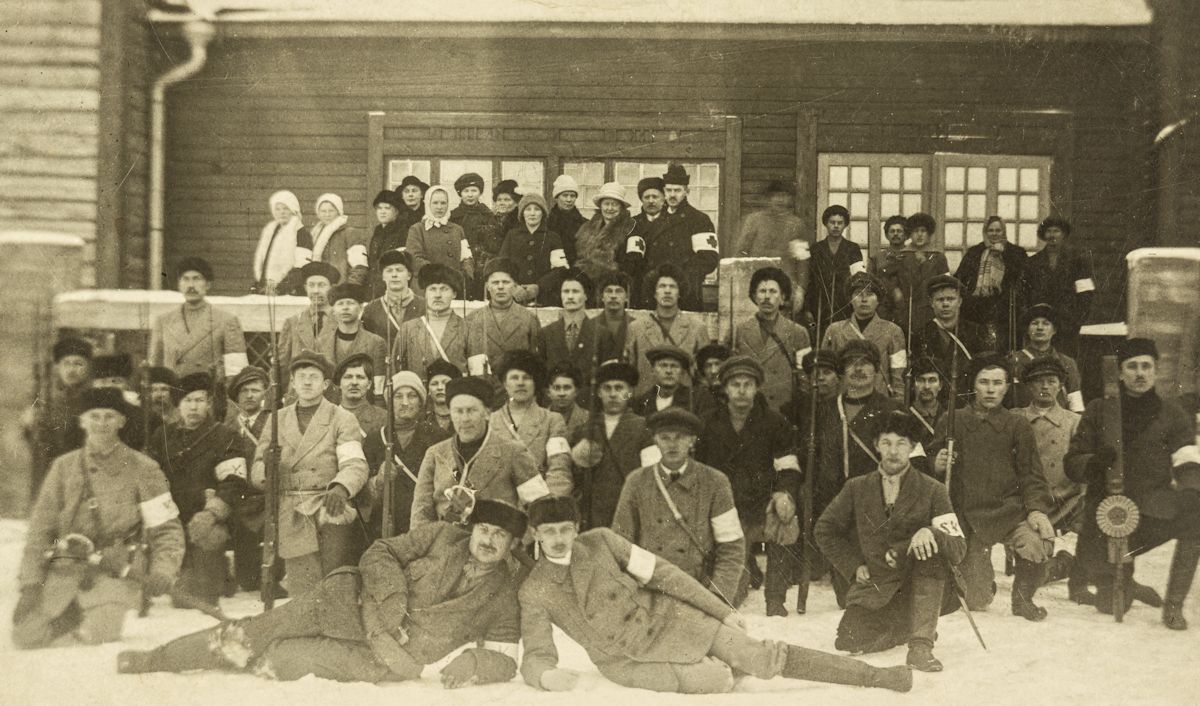
their own, which hadwaiting them and headed to Hietanen. PICTURE: Group of men belonging to Kiuruvesi White Guard about to head to front.
Considering weapons that they have this might be the group sent to Kuopio 14th of February 1918. Notice
Lewis light machine gun on the right. Photographer unknown. Photo source Finnish Heritage
Agency (Museovirasto), acquired via finna.fi and used with
CC BY 4.0 Creative Commons license. CLICK THUMBNAIL TO
SEE LARGER PIC (191 KB). 8th: White Army captured city of Kuopio following prolonged low-intensity battle that
last about a week. Kuopio Red Guard had about 400 men and had received equal number of rifles already in November of
1917, while Kuopio White Guard had only some 150 men and 40 rifles of various model and number of pistols,
but also 600 hand grenades. Both sides also had some military
training due to having leaders who had military experience - Red Guard being lead by former non-commissioned
officer of Grand Duchy Israel Närhi and White Guard being commanded by Carl Malmi, who had served
as Captain of cavalry in Russian Army and had two Jaegers, Einar Wichmann and Onni Purhonen, as his assistants.
Besides their superior numbers the Reds in Kuopio were passive, fearing dozen Lewis
light machine guns of Kuopio White Guard, unknown to them due to the guns being chambered for.303 British,
the White Guard had very little ammunition for those machine guns. Still, the threat proved powerful enough
that when the General Headquarters of Red Guards ordered their troops to start revolution and take over
cities of their regions, Kuopio Red Guard remained passive. The Reds took over only buildings of garrison
left by the Russians, while the Whites manned public buildings of the city, which included city hall,
electric station, telegraph and telephone exchange - providing them with ability to turn off power in the
city and to intercept any phone calls or telegraphs. The two guards had uneasy co-existence until 1st February the rising pressure that existed in
between them finally boiled over, with few men from White Guard forcefully taking rifle off from a cocky Red
Guardist and the event inspiring the Reds to start shooting at buildings manned by the White Guards, which
returned fire. The Reds must have noticed that the machine guns they had feared so much were not firing, but
their leader Närhi proved still hesitated with his decision until the time of day was so late, that the
Reds decided to leave their attack and taking over the city to the next day. But next morning marked change
in balance of power, when train arriving from Pieksämäki brought the Whites reinforcements -
force of two companies from Vaasa White Guard commanded by Jaeger Lieutenant Jussi Komonen and 150 rifles,
which were distributed to Kuopio White Guard. The Whites tried attacking the garrison, but it proved too
tough a nut to crack with rifles alone and the battle inside the city turned into trench war. The Whites
contacted their HQ and got permission to wait arrival of artillery support, but it took about a week to
arrive. The train with promised field guns finally arrived early in the morning at 8th of February.
The Reds had also found out about train, which was about to bring field guns to their opponents - their
unit left the garrison and tried attacking the arriving train only to find out the hard way that it was
armed train equipped with field gun plus machine gun and carried also 180 soldiers from White Guards of
Pohjanmaa and Keski-Suomi regions sent as reinforcements. Attack of the Reds towards the train met a hail of
bullets and turned into panic-stricken retreat. Field gun that the train had brought was unloaded, set into
position and started hammering buildings of the garrison around 8 AM. It fired 14 shells, but it still took
several hours until the Reds finally decided to surrender at the afternoon. Kuopio garrison was turned
into prison camp, to which White Army put some 3,000 prisoners gathered from Kuopio and nearby areas. PICTURE: 1st Company of Kuopio White Guard in Savo front. Soldier in the right
standing in front of the company is Jaeger Lieutenant Einar Wichmann (later: Vihma), who had born in city of
Kuopio at year 1893. When he was killed by Soviet artillery strike in Tali-Ihantala at August of 1944 he was
Major General of Finnish Army and Knight of Mannerheim Cross. Photographer Ivar Aleksander Ekström.
Photo source Museums of Varkaus (Varkauden museot), acquired via finna.fi
and used with CC BY 4.0 Creative Commons license.
CLICK THUMBNAIL TO SEE LARGER PIC (87 KB). 11th: Some 800 Reds, among them about 200 Latvian riflemen continued their offensive.
Kiepinsalmi railway bridge was demolished, which until it be repaired made continuing offensive along the
rail impossible, so the Reds started re-routing their offensive to use nearby roads. They had requested and
received specialists sent from Helsinki to repairs the bridge, but its repairs were expected to take few more
days, which caused them to consider other options. The Whites lead by Captain Lars W. Lundahl had taken positions
in Hietanen and to secure their flank Eklund's company took positions in village of Papinpoika, which soon
became a battlefield. At night of 8th - 9th of February first unit of the Reds possibly
lead by Ossipov appeared in front of their positions. The large-scale battle in Papinpoike village followed at
11th of February. During those few days the Whites had receiving reinforcements, which had become
available after capturing city of Kuopio. White Guard company commanded by Jaeger Lieutenant Viljo Kore and
originating from city of Jyväskylä had replaced Eklund's exhausted company along it had arrived number
of machine guns, one of which had been delivered to village of Papinpoika. Hence when the Latvians spearheading
attack of the Reds attacked to Papinpoika village, they found themselves under machine gun fire and some of Korte's
men also succeeded getting behind them, putting them in cross-fire. The fierce resistance killed 16 Latvians and
threw back the attacking Reds. The Latvians had not liked the way the Reds had earlier executed the prisoners
handed to them and the supplies situation was not too great either. So when they suffered also these casualties
having already earlier lost 11 men (3 KIA and 8 WIA) in battle just four days before it proved to be too much for them.
The Latvians decided they had seen enough and to return Russia with their train. According claim of the Whites
the Latvians actually acted as high-prized mercenaries, whose salaries (100 marks / day)) were on whole different
level than what typical combatants of Red Guards (15 marks / day) had been promised. 12th: After Whites had retreated behind heavily damaged Kiepinsalmi railway-bridge the Reds
had started repairing it and even received specialists from Helsinki for this work. The Whites decided to
demolish the bridge once again. Even if they no longer had the bridge in their hands, their positions were
near northern end of the railway bridge and uphill from the bridge. They decided to use that for their
advantage by loading railway carriages with explosives and sending them towards downhill to the bridge.
However this plan failed - the explosives destroyed some 20 metres of tracks, but did not produce any
damage to the railway-bridge. The same day the Reds and the Whites fought several small battles between Mäntyharju and Mikkeli.
The Whites succeeded surrounding the Reds already, but then the Reds succeeded breaking through and
escaping. 14th: The Whites attacked successfully capturing Mäntyharju and the Reds made
several counter-attacks to take it back, but failed. After battle nine hours long the Whites succeeded keeping
Mäntyharju. Leader of the Reds considered the situation so dangerous that he decided to retreat back
to Mouhu, which the Reds started fortifying. Repairing of Kiepinsalmi railway bridge continued, but this
time it was the Whites who were repairing it. However the damage they had succeeded doing to it was so
extensive that the repairing the bridge was not completed until 12th of March - this seriously
limited capability of the Whites to transport weapons and supplies to the frontline until fixing the bridge
was completed. Now that the Whites had succeeded stabilising the situation of front along Savo railway they could
finally concentrate destroying the last concentration of Red Guards behind their own lines - in town of
Varkaus. Ever since the Whites had succeeded capturing city of Kuopio 8th of February, they had
also been successfully besieging Varkaus. Battle of Varkaus started in 19th of February and last
of the Red Guards that had taken positions in paper pulp factory surrendered in 21st of February.
Red Guards of several nearby cities and municipalities had gathered to Varkaus and had combined manpower
of about 1,200 men - but from these only 150 had rifles and run out of ammunition by end of the battle.
White Guards that took part of the Battle of Varkaus had in total about 1,000 men, which were properly
armed with rifles and they had six machine guns and two field artillery pieces with them. In Varkaus White
Guards lost 12 men killed and 30 wounded in battle, while Red Guards lost about 15 - 20 men killed
in combat. What followed after the battle proved much more bloody. During the three weeks that Red Guards
had controlled Varkaus they had taken number of local people as hostages, had threatened to kill those
hostages if White Guards to attack them and had killed 17 people - including two of their own men. In
addition in end of the battle apparently false-surrender (perdify) took place with the Reds first signalling
surrender, but then opening fire on approaching soldiers of White Guards. The first sequence of executions
took place immediately after surrender of Red Guards with 20 suspected leaders, agitators and criminals
being picked out and being shot in factory yard and additional 60 - 70 being taken to ice of nearby lake
before being shot. The second set of executions followed after field court-martial sentenced additional
87 to be executed and 383 to be sent into prison camp. The first sequence of executions is also known as
"Lottery of Huruslahti" ("Huruslahden arpajaiset") with claims that those 60 - 70
executed in ice of Huruslahti Bay were supposedly selected at random with every tenth person being shot. PICTURE: Aftermath of executions in Varkaus. While not the first large-scale execution
of prisoners in Finnish Civil War, but what set it apart is that events in Varkaus created White Army
model for executions following victory and capturing large number of prisoners, which became widely
used for rest of the war. Photographer Ivar Aleksander Ekström. Photo source Museums of Varkaus
(Varkauden museot), acquired via finna.fi and used with
CC BY 4.0 Creative Commons license. CLICK
THUMBNAIL TO SEE LARGER PIC (116 KB). 20th: The Whites attacked to Mouhu, which had the next railway station southwards from
Mäntyharju. Their troops surrounded Mouhu station from three sides and the Reds in the station were
about loose the battle, when the armed train arrived to
their salvation. Its firepower changed course of the battle causing the Whites great number of casualties
and forced them to retreat. March 3rd: Three companies of White Army infantry attacked and captured railway section
between Mouhu and Hillosensalmi. The Reds sent company of infantry and field gun against them from Mouhu
in the north. However the counter-attack coming from the north was not the biggest threat for the Whites.
Unknown of them the Reds was to receive their first proper armoured train (Armoured Train 2) just that day
to Savo railway and now this train made in Fredriksberg works was
closing them from the south. Once the train arrived the Whites found themselves receiving fire from both
directions and suffered serious casualties, so they had to retreat from the railway leaving it to the Reds. PICTURE: Maxim machinegun of White Army in Mouhu.
Photographer Ivar Aleksander Ekström. Photo source Museums of Varkaus (Varkauden museot),
acquired via finna.fi and used with
CC BY 4.0 Creative Commons license.
CLICK THUMBNAIL TO SEE LARGER PIC (108 KB). This really was not a good day for the Whites in Savo railway. Like the previous would not have been
enough their column of horse-towed sledges transporting troops run into ambush, during which a chance bullet
hitting exploded sleigh that been loaded with dynamite. The losses were heavy and only remnants of the
column succeeded returning back to their own troops. It is worth noting that White Guards of the region were well-equipped
with dynamite mainly due to dynamite shipment of 17 tons, which the Russians had brought to region for building fortifications and
got snatched by White Guards. Still this proved to be poor day for the Reds also. The Whites attacked Mouhu again and the Reds
succeeded defending it successfully until their leader Viktor Teikari, who did the fatal mistake of deciding to
move trains from the railway station to south side of it to make sure they would not be damaged. Those of the
Reds, who were in the station thought that this indicated retreat and came afraid that the trains might
leave them behind. So they rushed to the trains and refused to dismount. This fatal mistake did not leave
leadership of the Reds any other change than pull out all their troops, load them into the trains and flee by
train towards Voikoski station in the south. If the Whites would have used this opportunity and continued
their attack swiftly they might have achieved great victory, but they failed to use it. 5th: The Reds attacked to Mouhu station with their new
Fredriksberg-made "proper" armoured train and
armed train. The attack was lead by infantry unit from Helsinki Red
Guard. White Army artillery scored to first train car of the "proper" armoured train a direct hit,
which killed commander of the train Aleks Nyholm and 6 other crewmembers. Crew of the train did also
mistake of disembarking from the train inside effective firing range of the Whites, which caused them
suffer further casualties. The train was so severely damaged that it had to return Kouvola for repairs.
This attack failed also otherwise and the Whites kept Mouhu station. Even after repairs the
Fredriksberg-made train proved to have quite a poor luck. 11th:The Reds had decided to try outflanking the Whites by attacking to villages of
Turkki and Valtola in eastside of the railway-line with 1,000 men. Their goal was to continue attack by
road from these villages to Kinni and by capturing railway near Kinni cut the railway connection of the
Whites towards north. Even if the Whites early on had much less men they succeeded delaying the Reds
until their reinforcements arrived that they succeeded stopping the attack in between villages of Turkki
and Kinni. After this the frontline remained the same until developments in other fronts changed the situation,
but that did not take place until when the Red Guards started crumbling in end of the war. The Reds tried
still another attack 20th of March and the Whites in 5th of April, but neither of
those attacks was successful. 12th: The Whites finally got the repairs of Kieppi railway bridge finished. Now that
they had railway connection up to Mouhu they were much more capable to supply their frontline. April 25th: Development of the overall situation elsewhere had made the situation dangerous
for the Reds also in this front. Their troops in other fronts had retreated creating situation in which
their flanks were wide open. The Whites could have now easily outflanked them and after troops in east
side of Lahti also started to retreat their rear did not look too secure either. In this situation their
leadership decided to pull out their troops and retreat to new more easily defendable line. As part of this
retreat their troops located to Savo railway retreated this particular day from Voikoski to southern end of
Hillosensalmi railway-bridge, which they now in their own turn demolished. 30th: The Reds guarding southern side of Hillosensalmi left their positions at night
of 30th of April - 1st of May and headed south towards Kymenlaakso region - the only
area still in hands of Red Guards and due to Kotka harbour a place offering possible escape to Russia by sea.
There they waited for Russian ships, which never came and ultimately had no other choice but to surrender. PICTURE: White Army soldiers repairing Hillosensalmi bridge on their own turn after
the Reds had demolished it 25th of April. Photo from Suomen Vapaussota kuvissa 2 (edition published 1934).
CLICK THUMBNAIL TO SEE LARGER PIC (86 KB). th - 21st: Boxcar of guns and Battle of Taavetti. Railway official working for the
Whites had spotted in Viipuri railyard boxcar on which rifles and ammunition were being loaded to be delivered to Red
Guards of Mikkeli. In total the materials loaded into the boxcar contained bit over 200
Japanese rifles and 10,000 rounds of ammunition. The information spread to numerous units of White Guards, who all
rushed into action. The first unit to take action was Railway Detachment (Rautatieosasto), which due to not having
enough time available for re-routing the shipment decided to destroy it. They first tried that with a time-bomb, which failed
to detonate and then two of its men succeeded slipping inside the boxcar and tried setting its contents on fire with
lamp oil, but did mistake of trying to hide the fire by closing door when they left - which caused the fire to burn so
slow, that it was spotted and extinguished before it succeeded doing the rifles more than superficial damage and no
damage to the ammunition boxes. Luumäki White Guard was the second one to take a try - their plan was to capture
the boxcar with its contents and 16th of January they succeeded disconnecting the boxcar in railway station
of Taavetti and hide it in a side-track for unloading, but due to having only few men succeeded unloading no more than
some 70 rifles and ammunition, which were all hidden nearby. Third unit to join in was White Guard of Lappeenranta,
which promised to provide help to White Guard of Luumäki in case the Reds might try recapturing the boxcar. 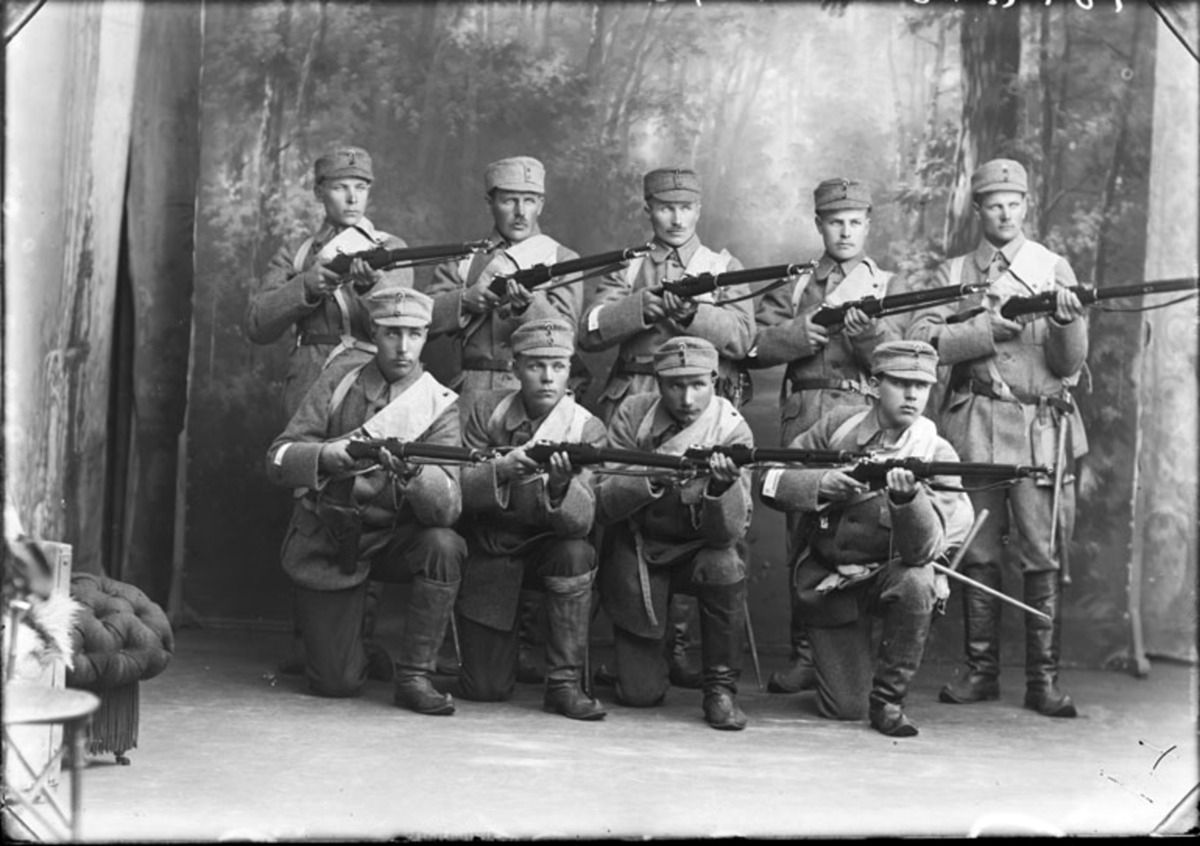


Last updated 6th of January 2026
Webmaster: JTV jtvalias@hotmail.com
Copyrights (text and graphics): Jaeger Platoon Website. Copyrights of photographs vary on case to case basis and are marked along each picture.