


FORMATIONS (TO&E), PART 4
World War II, Armour & Field Artillery
Finnish tank force was established in 1919 and equipped 32 Renault FT-17 light tanks bought from France that year. Even if Finnish tank corps started with name of Tank Regiment (Tankkirykmentti), the unit wasn't developed or its size increased. On the contrary - the unit got first reduced as Tank Battalion (Panssaripataljoona) in year 1925 and only two years later in 1927 as Tank Company (Panssarikomppania). Besides financing the apparent main reason for this shut-down of tank force was in wide-spread belief according which Finnish terrain was almost completely impassable for tanks. Finnish military also got very few new armoured vehicles before year 1938, when the Finns finally bought 32 Vickers 6 Ton Tanks. Unfortunately these 32 quite modern tanks were bought without weaponry, radios and some of them even without drivers seats. Because of this none of them was ready for combat when Winter War begun in 30th of November 1939. Following Finnish armoured units were mobilised before and during Winter War (Nov 1939 - March 1940):
Captured Soviet armour was used to equip Tank Battalion (Panssaripataljoona) for Continuation War (June 1941 - September 1944). The Finns managed to introduce 167 of the captured Soviet armour vehicles to their own use. Weaponry captured from Soviet tanks was also used to equipped all remaining Vickers 6 ton tanks - to reflect this change they were renamed as T-26E (E = English). When Continuation War started the main Finnish armour unit was Tank Battalion (Panssaripataljoona) formed and equipped during Interim Peace (March 1940 - June 1941). Besides the Tank Battalion, which was for concentrated use of armour, Finnish Army also had Armour Car Platoons and Light Tank Platoons in 1941. These platoon sized units were small (typically three vehicles of same model) units armed with captured Soviet armoured cars (light or heavy) and amphibious tanks (T-37 and T-38) issued to Army Corps and Divisions of Finnish Army. These platoon-size armoured units were abolished by spring of 1942. The first battle fought by Tank Battalion in Continuation War didn't happen until in September of 1941 - in the battle of Tuulos. Tanks of Tank Battalion spearheaded Finnish attack in route Tuulos - Syväri/Svir - Äänislinna/Petroskoi/Petrozavodsk. After short rest they spearheaded another attack in bitter winter conditions. Their attack finally ended to Poventsa in northern edge of Lake Ääninen/Onega in 6th of December 1941. Year 1941 along T-26E various models of captured Soviet T-26 tanks were main equipment of Tank Battalion, but also few captured BT-series tanks and two T-28 tanks were in its use. 1941 - 1942 5 more T-28, two KV-1 and two T-34/76 were introduced to Finnish use. 2nd Tank Battalion was formed, the two battalions united as Tank Brigade (Panssariprikaati) and the brigade incorporated as part of Armour Division (along Jaeger Battalion of bicycle/ski infantry, Heavy Artillery Battalion and Antitank-gun Battalion some other units). Finland's one and only Armour Division (Panssaridivisioona) was allowed to enjoy relative peace until summer of 1944. During this "trench war period" the Division took parts to battles every now and then, but with possible exception of 3rd Tank Company taking part to counter-attack against Soviets in Syväri/Svir in April of 1942 the attendance of Tank Brigade to battle was very small scale. Assault Gun Battalion first equipped with BT-42 and later (in September of 1943) with Stu 40G assault guns was formed in February of 1942. Its BT-42 assault guns were transferred to Separate Armour Company (Erillinen Panssarikomppania), which had been formed in July of 1943. Also Armoured Anti-aircraft Battery was formed and equipped with six Landsverk Anti II AA-tanks in May of 1942. One additional T-34/76 was captured and taken to Finnish use in 1943. Somewhat exceptionally Armour Division didn't use its time during "trench war period" at leisure, but kept vigorous training going at all times. Earlier experience and this hard constant training made Armour Division and its Tank Brigade elite units.
Soviet offensive in June of 1944 changed things. Finnish armoured units were well trained but poorly equipped: Large majority of their tanks were still now outdated variants of T-26. Three T-34/76 and two KV-1 were only modern tanks (unless one counts also seven T-28E as such). Besides them only Stu-40G assault guns of Assault Gun Battalion were able to combat against Soviet tanks on equal terms. Three additional T-34/76 tanks were bought from Germany in summer of 1944. During the summer of 1944 seven T-34/85 and one ISU-152 were captured and introduced to Finnish use. None of the T-34, KV-1 or T-28 tank were lost in battle. Assault Gun Battalion lost eight Stu 40G (five in Kuuterselkä, two in Nurmilampi and one in Vuosalmi), but also succeeded causing considerable losses to Soviets. Further deliveries of Stu-40G assault guns also more then replaced the losses. Viipuri battle in June of 1944 proved that BT-42 was totally unsuitable to be used in battle against other armoured vehicles - Separate Armour Company lost 8 out of its 18 BT-42 in a few days without succeeding to do any real damage. 25 out of 87 existing T-26 tanks were lost in combat as was third of Komsomolets A-20 tractors, which were used to tow antitank-guns. The Germans promised deliveries of T-34, PzKw IVJ and Stu 40G, so in 7th of July 1944 Finnish military declared all T-26, T-28E and BT-42 outdated and ordered them to be removed from combat use. However, the situation changed soon. Finland negotiated its own peace agreement in Soviets and this made the Germans stop deliveries in beginning of September 1944. The only delivery of fifteen PzKw-IVJ tanks arriving from Germany in August of 1944 came too late for them to see any action. Role of Finnish armoured vehicles in Lapland War (1944 - 1945) was quite minimal. The retreating Germans had destroyed all bridges and roads and placed landmines everywhere. Fighting delay action in one fortified position after another motorised German units usually succeeded slipping away before Finnish infantry moving on foot succeeded hitting to their flank or rear through unguarded forest and swamps. Finnish advance was slow and Stu 40G soon proved unable to wade through numerous rivers - so they were sent back to south. Finnish T-34/76, T-34/85, PzKw IVJ and T-26 tanks took part to Lapland war, but failed to play important role in it.
During World War 2 armoured vehicles of Finnish Army were repaired in four places:

PICTURE: T-26E tank heading to Aunus / Olonets Carelia. T-26 was the most common tank in Finnish use during World War, grand majority of them were captured, but T-26 was basically Vickers 6-Ton Tank re-equipped with Soviet 45-mm tank gun. 3rd Tank Company of Tank Battalion used painted skull and crossed bones insignia shown in this photo in its tanks. Photo taken in September of 1941. Armored hands and road wheel symbol was/is Finnish uniform marking for tank corps. (SA-kuva photo archive, photo number 44819).
Tank Battalion, during interim peace (*):
Battalion HQ
1st Tank Company (former 5th Company)
2nd Tank Company (former 4th Company)
3rd Tank Company
1st Detached Tank Platoon
Tank Repair Shop
Central Repair facility
Weapons repair facility
Reserve NCO school
Supplies Platoon
1st Antitank Company
2nd Antitank Company
Tanks on storage (reserve to be used for training and replacing losses):
(*) Interim peace was the period of piece in between Winter War and Continuation War.
Tank Company, as created in year 1941 mobilisation:
Command Tank (T-26)
3 Tank Platoons
In each tank Platoon:
5 tanks (T-26)
Command Squad
1 armored car
3 motorcycles
1 automobile
Supplies Platoon
1 Kitchen truck
2 Ammunition trucks
2 Fuel trucks
1 Office truck
1 Tent truck
1 Supplies truck
Engineer Squad
Mechanic Squad
2 Repair shop trucks
Armoured Car Platoon, 1941 - 1944: (*)
Equipment:
3 armourer cars
1 - 2 trucks
Personnel:
crews of three armoured cars (platoon commander among them)
2 - 4 truck drivers
2 messengers
2 mechanics
weapons NCO
(*) Some of these platoons had 4 armoured vehicles, but having 3 vehicles was much more common. Sometimes they also had mix of captured amphibious tanks and armoured cars.
Flamethrower Tank Platoon, 1941:
Platoon leader (pistol)
2 messengers (rifle + pistol)
Assistant of platoon leader (submachinegun)
4 captured OT-130 flame tanks, crew of each tank
Tank commander (submachinegun)
Driver (pistol)
Gunner (flamethrower-operator/machinegunner) (pistol
Support and supplies personnel:
Flamethrower mechanic (pistol)
4 mechanics (pistols)
3 - 5 truck drivers (rifles + 2 - 3 trucks)
Notice: This platoon belonging to Tank Battalion was one of a kind in Finnish Army. It existed only June 1941 - January 1942.
Armour Division, late 1943:
Division HQ
Supplies Company
Tank Brigade (1131 men)
1st Battalion
2nd Battalion
Detached Tank Company
Signal Company
Armour School Battalion
Jaeger Brigade
Jaeger Battalion 2
Jaeger Battalion 3
Jaeger Battalion 4
Jaeger Battalion 5
Panzer-Jaeger Battalion (anti-tank, AT-gun companies)
Signal Company
Armour AA-Battery (6 x Landsverk Anti II AA-tanks, 84 men)
Heavy Artillery Battalion 14 (12 x 150 H 40 howitzers)
Signal Battalion 6
Engineer Battalion 3
11th Detached Heavy Pontoon Platoon
11th Smoke Camoflage Platoon
Replacement Battalion
Assault Gun Battalion (402 men)
Supply Units
Total manpower of Armour Division: 9,345 men
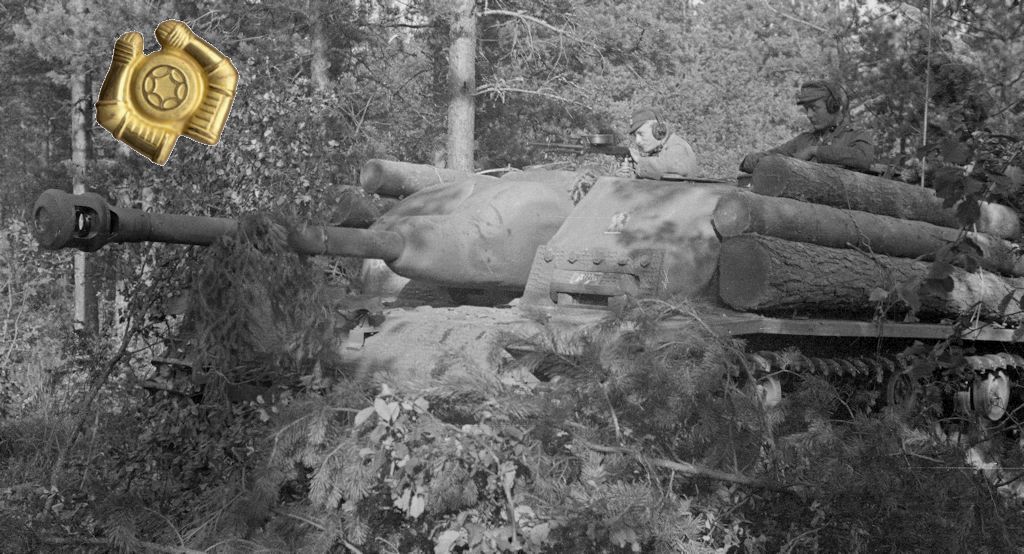
PICTURE: "Sturmi" (Stu 40G) assault gun waiting in ambush position during Battle of Vuosalmi in July of 1944. This assault gun has all the improvements that Finnish tank corps did to these assault guns, although machinegun-shield is missing. In summer of 1944 Assault Gun Battalion equipped with these assault guns was only Finnish armoured unit of any real size with up to date equipment. Many of Finnish assault guns had been named by their crews, usually after girlfriend or wife of crew member and name of the vehicle painted on driver's visor. This assault gun had been named in bit unusual manner as "Miller" after US actress Ann Miller, whose photo can also seen attached on add-on concrete protection on top of visor. (SA-kuva photo archive, photo number 156840).
Tank Brigade, late 1943:
Brigade HQ
HQ Platoon
1st Tank Battalion
1st Tank Company
2nd Tank Company
3rd Tank Company
2nd Tank Battalion
4th Tank Company
5th Tank Company
6th Tank Company
Supply Units
Weapons repair Squad
Engine repair Squad
Supplies Squad
10 trucks
Medical Squad
1 truck
Office Squad
2 trucks
Ammunition Supplies units
Other supplies units
Typical Tank Battalion:
Battalion HQ
3 Tank Companies
In each tank company
Tank Company HQ
3 Tank Platoons
5 tanks (T-26) in each Platoon
Exceptions (only tank companies with tanks other than T-26):
3rd Tank Company
1st Platoon
2nd Platoon
3rd Platoon
6th Tank Company
1st Platoon
2nd Platoon
3rd Platoon
Assault Gun Battalion, summer 1944:
Battalion HQ
HQ Company:
Signal Platoon
Telephone Squad
Supplies Platoon
Vehicle Squad
Medical Squad
Office Squad
Vehicle Squad
3 Assault Gun Companies
Assault Gun Company
Assault Gun Co HQ
HQ Platoon
1st Assault Gun Platoon
2nd Assault Gun Platoon
3rd Assault Gun Platoon
Supplies Units
FIELD ARTILLERY:
Finnish field artillery mobilised for Winter War had three basic unit types:
From units of Finnish Field Artillery the Field Artillery Regiment was most typical. According Finnish TO&E each Division was to have one. Full strength Field Artillery Regiment contained three Artillery Battalions, all of which had three Artillery Batteries - two of the Artillery Batteries were normally armed with light (75 - 76 mm) field guns and the third Artillery Battery usually had light (122-mm) howitzers. So in principle total heavy weaponry of Winter War era Field Artillery Regiment contained 24 light field guns and 12 light howitzers. However in reality the Artillery Battalions of Field Artillery Regiments were not necessarily full strength or their armament could be only light field guns and as war continued could also old guns, which lacked recoil systems, could be introduced to them as reinforcements. Field Artillery Regiments were horse-towed. Heavy Artillery Battalions of Winter War were units belonging under command of Finnish Army General-HQ. Only nine Heavy Artillery Battalions existed and they were concentrated to most important parts of the front. In principle full-strength Heavy Artillery Battalion had 12 heavy (105 - 107 mm) field guns or heavy (150 - 152 mm) howitzers, but in reality three of them were had less then 12 guns/howitzers to begin with. In principle the Heavy Artillery Battalions also had been divided in similar manner as Artillery Battalions: They each were to have three batteries each containing 4 guns/howitzers. Also Heavy Artillery Battalions were typically horse-towed. Separate Artillery Batteries had been formed as part of the Suojajoukot / Protective Corps, who were to delay the first attack in beginning of war. Only five units of this type existed. Four out of five Separate Artillery Batteries each had four guns (5th Battery had only two guns), which were either old 87-mm guns, which lacked recoil system, or 76-mm infantry guns. As usual also Separate Artillery Batteries were horse-towed.
Finnish Field Artillery units for Continuation War were partly different and partly similar as earlier. The same basic structure inside Artillery Battalions (/Patteristo / Psto), no matter their type remained: Each was to have 3 Artillery Batteries (/Patteri / Ptri) of 4 guns. And each Artillery Battery could be further divided to two Sections (/Jaos). Each division still got Field Artillery Regiment of its own and the basic structure of these units remained the same. But during the war Finnish Army reorganised 11 out of 16 Field Artillery Regiments in such manner that they had whole Artillery Battalions armed with same howitzer or field gun model - this was done to simplify ammunition supply. Another thing, which changed with them during the war was weaponry - they were full strength and most of them got one of their Artillery Battalions re-equipped with heavy (152-mm or 155-mm) howitzers before end of the war. However one thing didn't change - Field Artillery Regiments remained horse-towed. For Continuation War each Division also got Heavy Artillery Battalion of their own. Weaponry and structure of Heavy Artillery Battalions belonging to Divisions remained basically the same, but now they were full-strength units. Like the Winter War era Heavy Artillery Battalions also Continuation War era Heavy Artillery Battalions were horse-towed. Finnish Army HQ also had its own Heavy Artillery Battalions, which had rather similar (maybe bit more modern) weaponry as the ones belonging to Divisions, but the big difference was that these units were usually motorized. New unit type for Continuation War was Light Artillery Battalion (/Kevyt Patteristo / Kev.Psto), which were motorized Artillery Battalions. Fifteen of the existed during Continuation war. Early on Light Artillery Battalions were typically armed with 12 76-mm infantry guns, but later these were typically replaced with 12 new 105-mm howitzers. Super heavy (203-mm and 210-mm) howitzers were used first used in three Super-Heavy Artillery Battalions (/Järeä Patteristo / Jär.Psto) each having 8 - 9 super heavy howitzers. Year 1944 the Super-Heavy Artillery Battalions were divided to Separate Super Heavy Batteries (/Erillinen Järeä Patteri / Er.Jär.Ptri), which each had two super heavy howitzers.
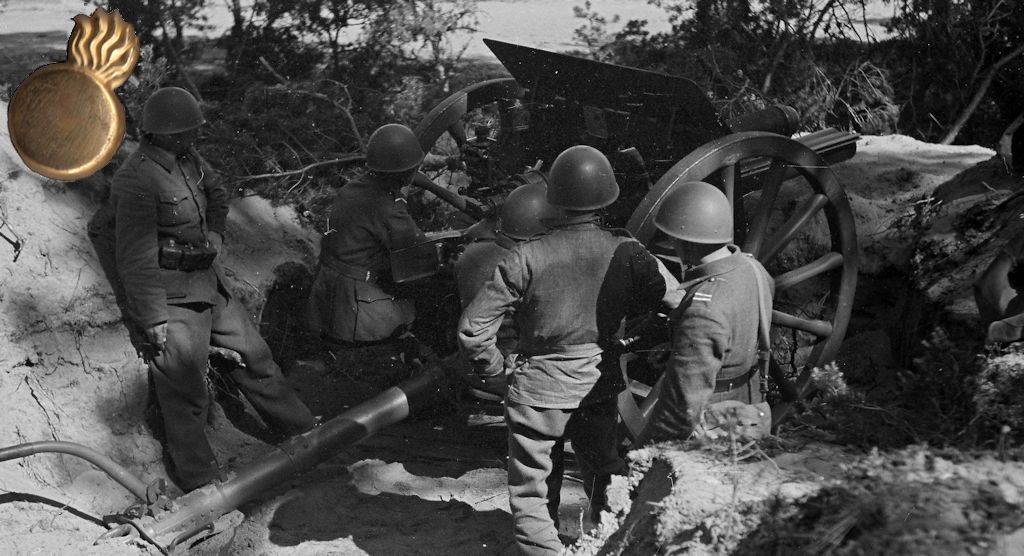
PICTURE: Finnish Army 75 K/17 field gun photographed in July of 1941. Finnish Army field artillery units used this sort of flaming bomb insignia in their uniforms. (SA-kuva photo archive, photo number 23478).
Light Field Artillery Regiment:
Regimental Commander
Regimental HQ & Weather station
Flash measuring unit
Leveling (radio deflection protraction) squad
3 Flash measuring squads
Telephone squad
2 Radio squads
3 Light Artillery Battalions
In each Light Artillery Battalions:
Arty Battalion Commander
Battalion HQ
Command section
Fire positions section
Signal section
Supplies section
3 Light Gun Batteries
In each Light Gun Battery:
FO Unit, 2 teams
Fire battery (4 guns)
Supplies Section
Regimental Column
Strengths of Light Artillery Regiment:
Motorised Heavy Field Artillery Battalion:
Battalion Commander
Battalion HQ
Command section
Fire position section
Signal section
Supplies section
3 Heavy gun or howitzer Batteries
In each Heavy Gun or Howitzer Battery:
FO Unit, 1 team
Fire battery (4 guns or howitzers)
Supplies section
Battalional Column
Strengths of Motorised Hvy Field Artillery Battalion:
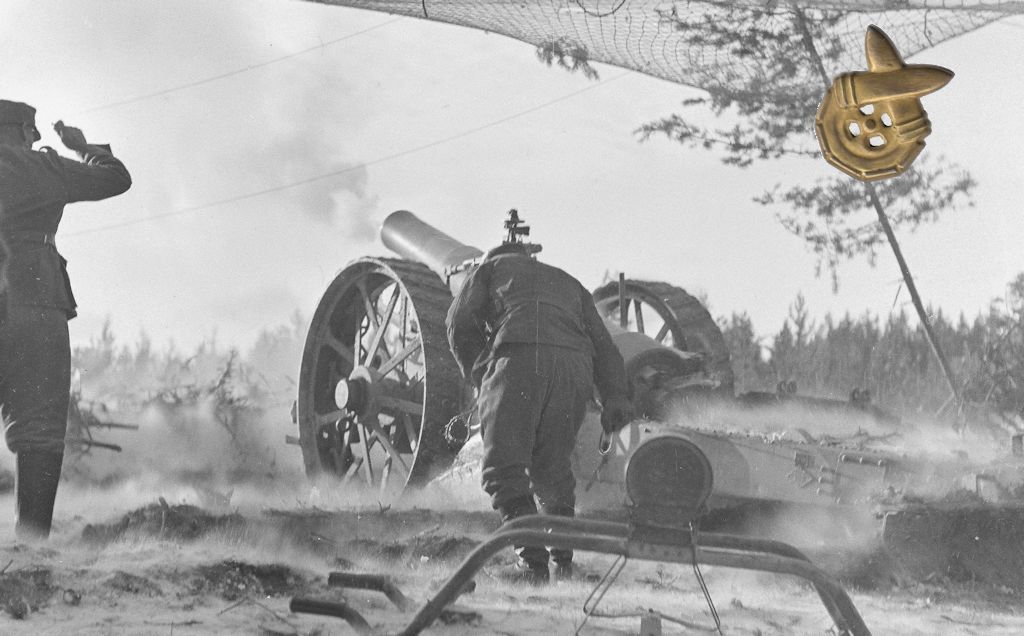
PICTURE: Finnish Army 203 H/17 super-heavy howitzer photographed in October of 1941 at the very moment when a shell has been fired. The insignia shown in right upper corner is Finnish Army uniform badge by soldiers of heavy field artillery units. (SA-kuva photo archive, photo number 56814).