


MINE THROWERS & MORTARS
PART 4
81 mm mortars:
81-mm mortars are the most mixed category of mortars, which was in Finnish use. Besides mortars manufactured by Tampella in Finland during World War 2 it contained also British, French, Hungarian, Italian and Polish mortars, which were all used by Finnish Army. Unfortunately practically none of the Finnish Army World War 2 era weapons inventory listings bothered to list number of each 81-mm mortar model used instead of just listing them all as mortar, 81-mm. This makes determining exact number of each 81-mm mortar model in Finnish use quite difficult. Below is the best listing of this type that I succeeded finding after lots of searching in Finnish military archives.
Inventory of Finnish Army 81-mm mortars, 12th of June 1940:
|
Mortar name used in 1940: |
How many: |
Official name later: |
|
81 Krh Swedish |
25 |
81 Krh/34 |
|
81 Krh Polish |
16 |
81 Krh/30 |
|
81 Krh mixed |
10 |
81 Krh/39 ? (*) |
|
81 Krh French |
227 |
81 Krh/36 |
|
81 Krh French |
12 |
81 Krh/31 |
|
81 Krh Italian |
109 |
81 Krh/36 |
|
81 Krh/30 Finnish |
118 |
81 Krh/32 ? (**) |
|
81 Krh/35 short barrel |
68 |
81 Krh/35 |
|
81 Krh/35 long barrel |
187 |
81 Krh/35 |
|
81 Krh/33 Finnish |
161 |
81 Krh/33 |
|
Total |
933 |
|
(*) This is educated guess - a British mortar model to which the number of mortars fits. I have not succeeded finding any other information about this "mixed" category used in 1940.
(**) This is reasonably certain educated guess. However as the number of mortars does not match it might contain also some other mortars (such as early deliveries of 81 Krh/38).
During Winter War (November 1939 - March 1940) 81-mm mortars formed the grand majority of mortars in use of Finnish Armed Forces. One could say that for all practical purposes for Winter War 81-mm mortar was the standard mortar of Finnish Army. When Winter War broke in November of 1939 Finnish Army had only 292 81-mm mortars, but due to mortars acquired abroad and confiscated from Tampella their number reached 691 by end of the war. During this war 81-mm mortars played very important role. With the acute shortage of field artillery and field artillery ammunition that Finnish Army suffered during Winter War 81-mm mortars often were the only heavy support weapons available and because of this often had to fill the role, which is was usually taken care by field artillery. In this use 81-mm mortar proved surprisingly effective against attacking infantry, providing covering fire to Finnish attacks and even knocking out Soviet tanks with them was not very uncommon. However field artillery they were not - they lacked the range and their ammunition proved less than effective against bunkers and dugouts build from ground and wood. Sensitive fuses made the ammunition reasonably effective even in deep snow, but still left something to desire effectiveness-wise. The heavy use and varied duties of 81-mm mortars resulted to quite high loss rate - 25 of 81-mm mortars were lost during Winter War. By the time Continuation War (June 1941 - September 1944) started in June of 1941 the number of 81-mm mortars had reached total of 911 weapons. From that on their number started to decline. During Continuation War the losses continued accumulating and since Tampella had basically stopped manufacturing 81-mm mortars by that time, these losses could not be easily replaced. By 1st of January 1944 number of 81-mm mortars had dropped to just 812. Issuing captured Soviet 82-mm mortars offered temporary relief, but did not solve the underlying problem. 1st of September 1944 Finnish military tried solving the issue by placing Tampella order of 250 new 81 Krh/38 (81 mm mortar model 1938) mortars, but this proved too late to have any major effect during the war, which soon ended. Another major project concerning 81-mm mortars during Continuation War was 81 Krh/42 (81 mm mortar model 1942), which had a shorter barrel and weight much less than other 81-mm mortars in Finnish inventory - making it notably more mobile, but not without reducing maximum range. If Continuation War had continued later large part of 81-mm mortars used by Finnish military might have been modified to 81 Krh/42, but since the war ended when it did this mortar model did not get beyond prototype series manufactured for field tests.
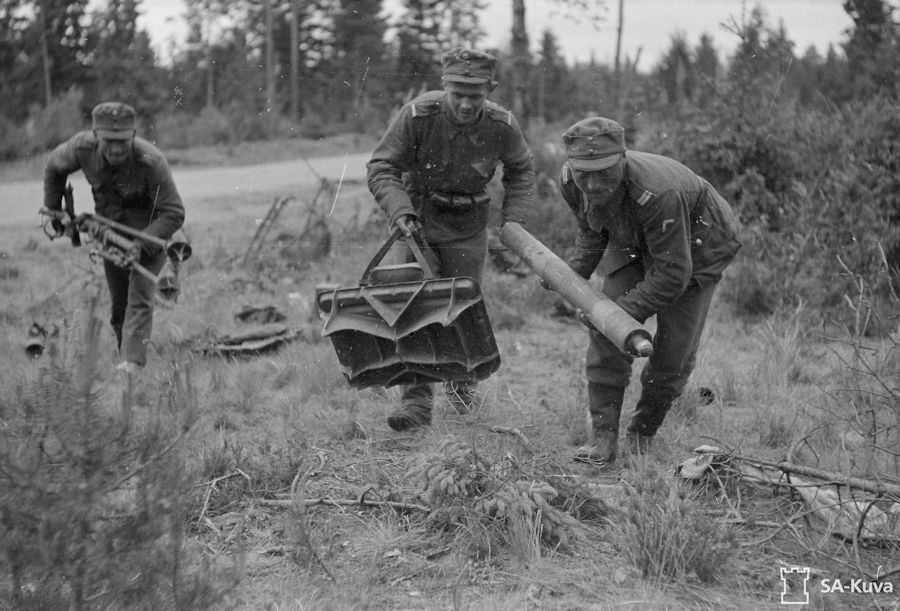
PICTURE: 81-mm mortar on the move. Corporal (alikersantti) on the right carries mortar barrel in his
hands, lance corpocal (korpraali) in the middle has base plate and private (sotamies) on the left carries a bipod.
The mortar appears to be 81 Krh/35. Photographed by Military official Osvald Hedenström
in Summa (Carelian Isthmus) in June of 1944. (SA-kuva.fi photo archive, photo number 153655). CLICK THUMBNAIL
TO SEE LARGER PIC (125 KB).
Finnish Army losses of 81-mm mortars 9th of June - 7th of July 1944:
|
Unit: |
Losses: |
||
|
II Army Corps |
1 |
||
|
III Army Corps |
0 |
||
|
IV Army Corps |
36 |
||
|
V Army Corps |
50 |
||
|
Aunus Group |
21 |
||
|
14th Division |
0 |
||
|
Finnish Navy |
9 |
||
|
Ladoga Coastal Brigade |
0 |
||
|
Total: |
117 |
||
After World War 2 Tampella continued developing mortars and Finnish military remained its main customer. Post-war Tampella 81-mm mortars approved by Finnish Defence Forces to military use include:
Also those 81-mm mortars that had survived World War 2 without completely wearing out, remained in Finnish use after the war. In post-war period wartime 81 Krh/36 and 81 Krh/38 mortars were modernised - and renamed 81 Krh 36 Y and 81 Krh 38 Y. Along them also so post-war 81 Krh 71 mortar design was modernised as 81 Krh 71 Y. When it comes to these modernised mortars letter "Y" signifies term ympäriampuva translating roughly as all around shooting. This reference means that the mortar can be used to shoot at any direction without rotating the base plate.
81 Krh/26:
(81 mm mortar model 1926)
(Brandt modele 1924-1925)

PICTURE: Finnish period photo showing 81 Krh/26 mortar. The pouch on top of base plate is presumably for mortar director (sight system).(Photo part of Jaeger Platoon Website photo collection). CLICK THUMBNAIL TO SEE LARGER PIC (146 KB).
|
Calibre: |
81.4 mm |
||
|
Barrel length: |
120.0 cm |
||
|
Weight in action: |
55.5 kg |
||
|
Muzzle velocity: |
? m/sec |
||
|
Max. rate of fire: |
Up to 30 shots / minute |
||
|
Traverse: |
6 degrees |
||
|
Elevation: |
+ 45 degrees, + 75 degrees |
||
|
Min. range: |
? |
||
|
Max. range: |
2600 meters |
||
|
Ammunition weight: |
3.2 kg |
||
|
Ammunition types: |
HE |
||
|
Country of origin: |
France |
These were the first modern mortars of Finnish Army. Acquiring of them was very much due to personal efforts of General V.P. Nenonen, who did a long career as Inspector of Artillery in Finnish Army. Due to recommendation of British General Sir W.M. Kirke he arranged that Finnish Army bought two 81-mm Brandt-Stokes mortars and had them tested in spring and summer of 1926. The test results were very positive, but many of Nenonen’s fellow officers were still uncertain about this new weapon and if it would fit to use of Finnish Army. Due to these wide-spread doubts and tight funding in a worst case scenario Finnish Army might have decided to stop right there to expect more foreign experiences or the whole matter could have been buried to some committee - Finnish defence planning of the time gives examples about these both. In either case the whole mortar project was in danger of getting delayed indefinitely. Autumn of 1926 Nenonen was appointed as substitute for Commander of Finnish Army and got his chance - the substitute-position authorised him to order defence materials for Finnish Army without needing permission from anybody else. He used the situation and personally ordered 70 Brant-Stokes mortars, which arrived in year 1927. These 70 mortars were same as Brandt modele 1924-1925 like the two mortars bought for tests a year earlier. Finnish Army named them first 81 Jvh/26 (81 mm jalkaväkihaupitsi malli 1926 = 81-mm infantry howitzer 1926), but soon their name was changed as 81 Krh/26 (81 mm kranaatinheitin malli 1926 = 81-mm mortar model 1926). Additional mortars of this type seems to have been acquired at some point, since just before Finland decided to sell them, there were 87 total of these mortars in Finnish inventory. Number of newly acquired 81 Krh/26 mortars were loaned by Army to Finnish Civil Guard - the first two mortars already in September of 1927.
Finland sold those 87 mortars to company Oy Transbaltic Ab with 15,000 mortar shells in November of 1936. Officially Transbaltic sold them to Estonia, but at least some may have ended up elsewhere (Spain?). Even if Finnish military never used them in war, 81 Krh/26 provided the important starting point not only for Finnish Army, but also for Tampella, which got into business of developing and manufacturing mortars because of this. Finnish Army became one of the first armed forces to include 81-mm mortars as part of its standard weaponry - but did this have any real significance? One could argue that it gave Finnish Army enough time to test and learn to hone its methods for using mortars in forests to near perfection already before World War 2. During Continuation War Finnish soldiers had experiences according which for example the German Wehrmacht was much less skilful in this area of expertise and had a lot to learn from Finnish Army.
Total weight of 81 Krh/26 was 55.5-kg, as typically mortars of this type for transport it was divided to three main parts, each of which was assigned to one of three men carrying the mortar:
1. Barrel and its bottom piece: weight 21 kg
2. Bipod + elevation & traverse mechanism: weight 16 kg
3. Base-plate: weight 18.5 kg
Mortar directors delivered with these mortars had lateral alignment division of 5400 mils. Small number of mortar shells had been bought with the first two mortars and larger number with the main delivery. These mortar shells were only 10.15-cm long, but weight 3.2 kg. Their tails had 8 stabiliser wings and they contained 600 grams of TNT. Fuse used in them was French S.R. (Schneider Remondy) design. As in all 81-mm mortars the basic propellant charge was packed in 12-gauge shotgun shell, which was attached to tail of the mortar shell before dropping it into barrel. Additional propellant charges were attached around tail of the mortar and they were used to increase muzzle velocity and thereby range of the mortar shell. The basic propellant charge contained eight grams of nitroglycerine-gunpowder and the additional propellant charges each contained 5.5 grams of the similar gunpowder. The maximum number of propellant charges that could be used with mortar shell simultaneously was four.
81 Krh/30
(81 mm mortar model 1930)

PICTURE: 81 Krh/30 mortar. Photographed by Osvald Hedenström in Weapons Depot 10. (SA-kuva
photo archive, photo number 113251). CLICK THUMBNAIL TO SEE LARGER PIC (78 KB).
Finnish manuals tell very little about this mortar, but apparently they were Polish 81-mm mortars wz. 1928. Like practically all 81-mm mortars, they were based to Stokes mortar, being a version developed and manufactured by Avia Machine Works for Polish military. Due to their small total number in Finnish inventory, Finnish Armed Forces apparently did not issue them to frontline troops during World War 2. Barrel length (measured from percussion plate to rounding in tip of the barrel) was 114.5 centimetres. They are presumably the same 81-mm mortars, which were listed in Finnish inventory as "81 Krh Polish" in year 1940. If so, at that time the total number of these mortars was only 16. Early 1944 there were only only five of the mortars still remaining in Finnish inventory. Year 1960 four mortars (likely all that remained at that time) were sold to Interarmco among other miscellanious mortars and exported.
81 mm Krh/31
(81 mm mortar model 1931)
(Mortier de 81 M 27/31 Brandt)

PICTURE: 81 Krh/31 mortar in use of Finnish Army. Photo taken by Military Official A. Tuhka in
Hanko / Hango / Gangut Peninsula July of 1941. (SA-kuva photo archive, photo number 28578). CLICK THUMBNAIL TO
SEE LARGER PIC (210 KB).
|
Calibre: |
81.4 mm |
||
|
Barrel length: |
99.4 cm |
||
|
Weight in action: |
About 60 kg |
||
|
Muzzle velocity: |
68 - 198 m/sec |
||
|
Max. rate of fire: |
Up to 30 shots / minute |
||
|
Traverse: |
? degrees |
||
|
Elevation: |
+ 40 degrees, + 90 degrees |
||
|
Min. range: |
100 meters |
||
|
Max. range: |
2600 - 2700 meters |
||
|
Ammunition weight: |
3.1 kg - 3.4 kg / 6.9 kg (*) |
||
|
Ammunition types: |
HE + smoke (1941) + flare (1943) + propaganda (1943) |
||
|
Country of origin: |
France |
(*) "Grand capacité" heavy mortar shell weight 6.71-kg without fuse and had much shorter maximum range than normal mortar shells, which had less than half its weight. Weights are weights of mortar shells with fuses.
This was the standard French Army 81-mm mortar of Brandt-Stokes pattern - Mle 1927-31. It saw large-scale use with French Army during battles of 1940. When Germany conquered France that year German military captured large number of these mortars and re-issued them. The Germans knew these mortars as 81.4 cm GrW 270/1(f).
During Winter War Finland succeeded buying about hundred 81-mm mortars from France. But rather surprisingly Finnish Army mortar inventory from 12th of June 1940 lists only dozen mortars of this model. It seems that while the French delivery included about 100 mortars Finnish Army considered most of them as 81 Krh/36, which seems to have been the category for standard 81-mm Brandt model also manufactured by Tampella for Brandt. The main difference between 81 Krh/31 and 81 Krh/36 seems to have been length of their barrel. This difference in length may have been large enough to effect ballistics and have served as the reason for different names in Finnish naming system. Even if they were small in number Finnish Army issued 81 Krh/31 mortars to frontline infantry for Continuation War. Remaining mortars of this model may have been sold to Interarmco in 1960 and exported from Finland or some may have remained modified in Finnish use until declared obsolete in year 1986.
81 mm Krh/32
(81 mm mortar model 1932)
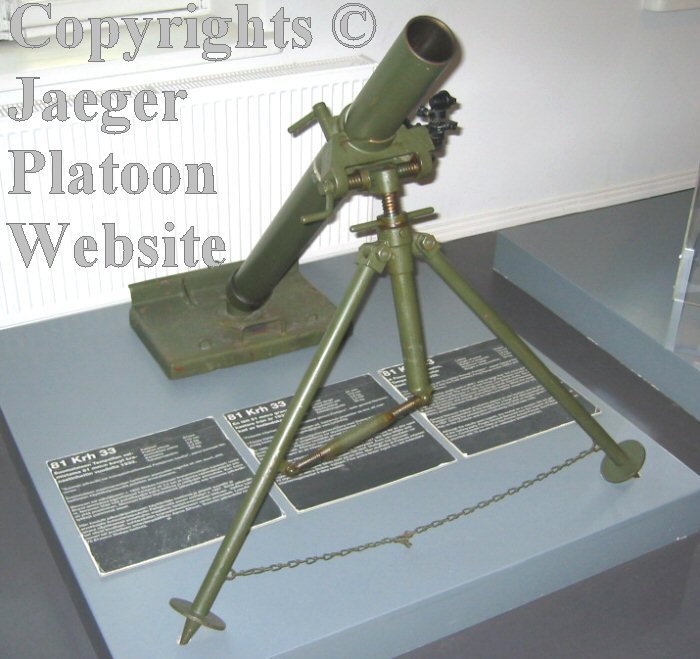
PICTURE: 81 Krh/32 mortar. Unfortunately it has been falsely marked as 81 Krh/33 and the base plate is wrong way. (Photo taken in Tykistömuseo). CLICK THUMBNAIL TO SEE LARGER PIC (135 KB).
|
Calibre: |
81.4 mm |
||
|
Barrel length: |
115.5 cm |
||
|
Weight in action: |
About 60 kg |
||
|
Muzzle velocity: |
70 - 203 m/sec |
||
|
Max. rate of fire: |
Up to 30 shots / minute |
||
|
Traverse: |
? degrees |
||
|
Elevation: |
+ 40 degrees or + 45 degrees, + 90 degrees |
||
|
Min. range: |
200 meters |
||
|
Max. range: |
2850 meters |
||
|
Ammunition weight: |
3.3 kg - 3.4 kg / 6.6 kg (*) |
||
|
Ammunition types: |
HE + smoke (1941) + flare (1943) + propaganda (1943) |
||
|
Country of origin: |
Finland |
(*) Heavy mortar shell (6.6-kg) had much shorter maximum range than with mortar shells of normal weight.
This mortar manufactured by Tampella is a prime sample how year-numbers in model marking can be sometimes be deceiving. This was actually the third or forth 81-mm mortar model developed by Tampella and model number doesn't seem to have anything to do with the year it was introduced or manufactured. Instead it might just a case of looking suitable gap in the naming system and using it. Presumably Tampella originally designed this cheap and easy to manufacture mortar referred as model M in Tampella inventory for export to China. The model M presumably refers to developer of this mortar model - Vesa Metsola. While the design had been intended for export, likely none had yet been exported when Winter War started in November of 1939. So when the war started Finnish military took over the order and 70 mortars of this model were delivered to Finnish Army in year 1939. This mortar may have been known as 81 Krh/30 suomalainen (81-mm mortar model 1930 Finnish) during Winter War, but as the number of mortars (118 in June of 1940) doesn't fit it may have included something else also. Usually Finnish military took the year number of its equipment from the year in which the particular piece of equipment was either introduced to production or to military use either in Finland or in the country from which it originated. But as can be seen the final name (81 Krh/32) given to this mortar during Continuation War and used since was completely artificial and based to utilising the suitable gap in the naming system.
Different sources give these mortars two different barrel lengths. They may have indeed been manufactured with barrels of two different lengths - during Winter War Tampella was swamped with workload and did its best to get Finnish troops as many mortars as possible in minimal amount of time. Or one of the sources may have error in its information. This was the simplest and easiest to manufacture 81-mm in Tampella inventory during World War 2. So when Tampella delivered Finnish Army spare-parts for 81-mm in year 1942, notable share of these parts (170 base plates) were model of 81 Krh/32. The plate used usually used for levelling the mortar properly had been replaced with simple universal shaft and the base-plate was just stamped steel plate of rectangular shape. These mortars were in use of Finnish infantry during Winter War, Continuation War and Lapland War. They remained in use of Finnish Armed Forces until remaining 52 mortars were declared obsolete in year 1986.
81 mm Krh/33
(81 mm mortar model 1933)
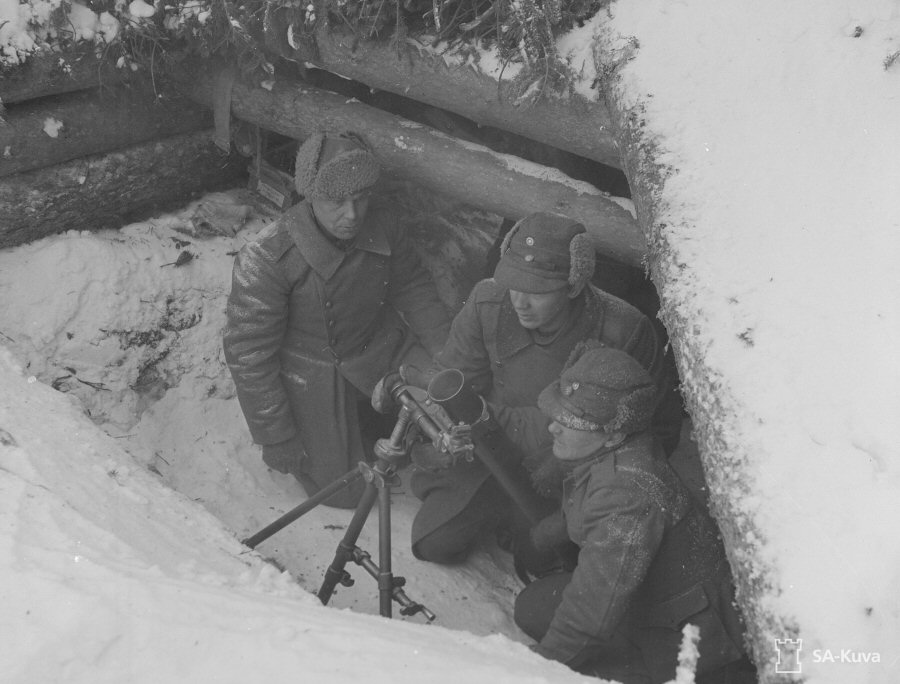
PICTURE: Finnish 81 Krh/33 mortar with its crew photographed during Winter War. 81 Krh/33
was the first mortar manufactured by Tampella. (SA-kuva photo archive, photo number 3988). CLICK THUMBNAIL TO
SEE LARGER PIC (144 KB).
|
Calibre: |
81.4 mm |
||
|
Barrel length: |
99.3 cm |
||
|
Weight in action: |
About 60 kg |
||
|
Muzzle velocity: |
68 - 198 m/sec |
||
|
Max. rate of fire: |
Up to 30 shots / minute |
||
|
Traverse: |
? degrees |
||
|
Elevation: |
+ 40 degrees, + 90 degrees |
||
|
Min. range: |
100 meters |
||
|
Max. range: |
2600 - 2700 meters |
||
|
Ammunition weight: |
3.3 kg - 3.4 kg / 6.6 kg (*) |
||
|
Ammunition types: |
HE + smoke (1941) + flare (1943) + propaganda (1943) |
||
|
Country of origin: |
Finland |
(*) Heavy mortar shell (6.6-kg) had much shorter maximum range than with mortar shells of normal weight.
This was the first 81-mm mortar manufactured by Tampella. In Tampella inventory it appeared as 81 Krh/32, but Finnish Army called it 81 Krh/33. It was almost direct copy of 81 Krh/31 delivered by Brandt to Finnish Army in 1926 - 1927. Only real differences to original Brandt-made mortars were in bipod attachment and in structure of levelling system. Tampella delivered 104 of these mortars to Finnish Army in year 1933. They remained in use of Finnish Army frontline troops for duration of World War 2 and after it until the last remaining 79 mortars were declared obsolete in year 1986.
81 mm Krh/34
(81 mm mortar model 1934)
(81 mm granatkastare m/29-34)

PICTURE: 81 Krh/34 mortar with Swedish volunteers in Kemi, January of 1940. (SA-kuva.fi photo archive,
photo number a_284). CLICK THUMBNAIL TO SEE LARGER PIC (77 KB).
|
Calibre: |
81.4 mm |
||
|
Barrel length: |
99.4 cm |
||
|
Weight in action: |
About 60 kg |
||
|
Muzzle velocity: |
68 - 198 m/sec |
||
|
Max. rate of fire: |
Up to 30 shots / minute |
||
|
Traverse: |
? degrees |
||
|
Elevation: |
+ 40 degrees, + 90 degrees |
||
|
Min. range: |
100 meters |
||
|
Max. range: |
2600 meters |
||
|
Ammunition weight: |
3.4 kg |
||
|
Ammunition types: |
HE + smoke (1941) + flare (1943) + propaganda (1943) |
||
|
Country of origin: |
Sweden |
This was Swedish 81-mm mortar M/29-34 (81mm GrK m/29-34). It was standard mortar for Swedish Army during World War 2. Relatively small number (likely 25 total) arrived to Finland during Winter War. Considering all other war materials sold or donated from Sweden to Finland at that time were meticulously documented and there is no sign of these in any of the archive documents concerning Finnish purchases of armaments from Sweden during Winter War, so they most likely arrived with Swedish volunteer unit (SFK). If this assumption is correct they were used by Swedish volunteers during the last weeks of Winter War and since SFK left its weaponry to Finland when Winter War ended, likely issued to Finnish Army combat units for Continuation War. While no certainty exists about their wartime use, they were likely declared obsolete in year 1986 at latest.
81 mm Krh/35
(81 mm mortar model 1935)

PICTURE: Crew of 81 Krh/35 mortar prepares to fire heavy mortar shell. Photo taken by
2nd Lieutenant K. Borg in area of River Syväri / Svir March of 1942. (SA-kuva photo archive, photo
number 75230). CLICK THUMBNAIL TO SEE LARGER PIC (165 KB).
|
Calibre: |
81.4 mm |
||
|
Barrel length: |
114.3 cm (shot-barrel) / 125.8 cm (long barrel) (*) |
||
|
Weight in action: |
About 60 kg |
||
|
Muzzle velocity: |
70 - 208 m/sec |
||
|
Max. rate of fire: |
Up to 30 shots / minute |
||
|
Traverse: |
? degrees |
||
|
Elevation: |
+ 36 degrees, + 90 degrees |
||
|
Min. range: |
140 meters |
||
|
Max. range: |
2900 meters |
||
|
Ammunition weight: |
3.3 kg - 3.4 kg / 6.6 kg (**) |
||
|
Ammunition types: |
HE + smoke (1941) + flare (1943) + propaganda (1943) |
||
|
Country of origin: |
Finland |
(*) Two versions of this mortar existed - short barrel version and long-barrel version.
(**) Heavy mortar shell (6.6-kg) had much shorter maximum range than with mortar shells of normal weight.
This was second mortar model designed and manufactured by Tampella in Finland. Tampella inventory listed it as 81 Krh/34, but Finnish Army called it 81 Krh/35. It was manufactured in two versions - short-barrel version with 114.3-cm barrel and long-barrel version with 125.8-cm barrel. Unlike earlier 81 Krh/33 it had considerable design differences when compared to Brandt-Stokes mortars. Base-plate had been redesigned, mortar director was Tampella’s own design and elevation system had been relocated. In addition the screws of elevation and levelling systems were covered. Finnish Army frontline units used these mortars in Winter War, Continuation War and Lapland War.
81 mm Krh/36
(81 mm mortar model 1936)
(Italian: Mortaio da 81/14 modello 35)
(Polish: 81 mm mozdierz wz. 31)
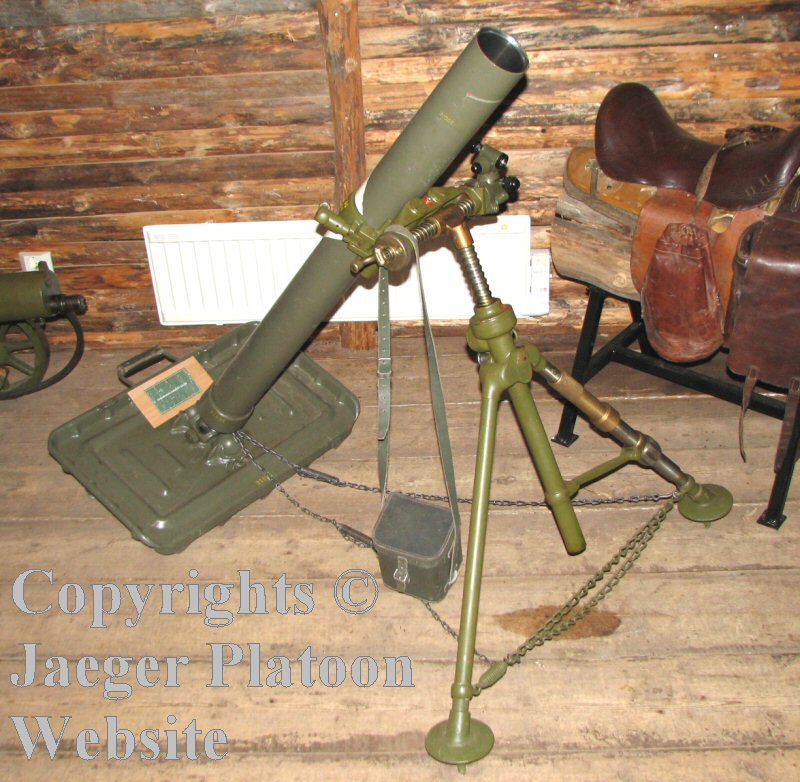
PICTURE: 81 Krh/36 mortar. Like most in Finnish museums unfortunately this mortar has post-WW2 markings painted in it. The greyish leather satchel is for mortar director (sight). (Photo taken in Uudenmaa/Nyland Brigade). CLICK THUMBNAIL TO SEE LARGER PIC (200 KB).
|
Calibre: |
81.4 mm |
||
|
Barrel length: |
114.3 cm |
||
|
Weight in action: |
About 60 kg |
||
|
Muzzle velocity: |
70 - 203 m/sec |
||
|
Max. rate of fire: |
Up to 30 shots / minute |
||
|
Traverse: |
8 degrees |
||
|
Elevation: |
+ 36 degrees, + 90 degrees |
||
|
Min. range: |
200 meters |
||
|
Max. range: |
2900 meters |
||
|
Ammunition weight: |
3.1 kg - 3.7 kg / 6.6 kg - 6.8 kg (*) |
||
|
Ammunition types: |
HE + smoke (1941) + flare (1943) + propaganda (1943) |
||
|
Country of origin: |
Finland, France, Italy, Poland |
(*) Heavy mortar shells (6.6 - 6.8 kg) had much shorter maximum range than with mortar shells of normal weight.
This seems to have a category under which Finnish Army named all rather similar Brandt-Stokes pattern 81-mm mortars of 1930's. It included Tampella manufactured mortars (which were sometimes called 81 Krh/36 T), French mortars (81 Krh/36-R), Italian mortars (81 Krh/36-I) and even small numbers of Polish mortars (81 Krh/36-P) and Hungarian mortars (81 Krh/36-U). The characters used in these abbreviations came from manufacturer or country of origin:
The French mortars of this model originated Finland buying hundred 81-mm mortars from France during Winter War. Also during Winter War another one hundred 81-mm mortars were bought from Italy. From these mortars bought from France and Italy at least 50 mortars from France had arrived by the time Winter War ended 13th of March 1940 and may have seen use already in Winter War. The origin for relatively small number of Polish 81-mm mortars in unknown - they may have arrived with some other delivery or may have been captured from the Soviets. In addition 16 mortars used were bought from Hungary during Winter War. During World War 2 German military relied heavily to captured weapons, so they used also mortars of this type. The Germans called Italian model of these mortars 8.14 cm GrW 276 (i) and Polish model 81.4 cm GrW 31(p).
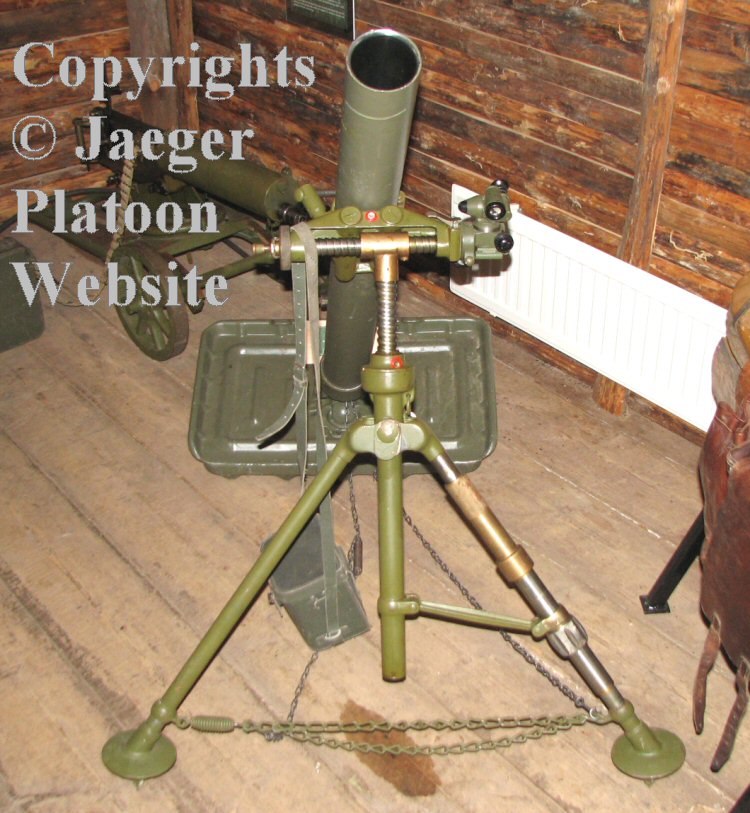
PICTURE: Another view of the same 81 Krh/36 mortar. (Photo taken in Uudenmaa/Nyland Brigade). CLICK THUMBNAIL TO SEE LARGER PIC (190 KB).
81 Krh/36 was the most common 81-mm mortar in use of Finnish Army during Continuation War. Practically only good World War era inventory document I have succeeded locating suggests that June of 1940 the total number of mortars of this type was around 370, which would have been more than one third of all 81-mm mortars in Finnish use at that time. Hence they were common in use of Finnish infantry through World War 2. They remained in use of Finnish military also after the war and most went through post-war modifications (most important of which were intended for widening sector to which the mortar was able to fire without relocating the base plate. Those of these mortars that went through these modifications were renamed 81 Krh 36 Y. Another modified version of this mortar is 82 Krh 36 RT, which is version re-calibrated to 82-mm calibre, this version also known as fortification mortar is still in use of Finnish coastal artillery today.
81 mm Krh/38
(81 mm mortar model 1938)

PICTURE: 81 Krh/38 mortar. The mortar director seems to be post World War 2 model. (Photo taken in Jalkaväkimuseo). CLICK THUMBNAIL TO SEE LARGER PIC (147 KB).
|
Calibre: |
81.4 mm |
||
|
Barrel length: |
114.3 cm |
||
|
Weight in action: |
About 60 kg |
||
|
Muzzle velocity: |
70 - 203 m/sec |
||
|
Max. rate of fire: |
Up to 30 shots / minute |
||
|
Traverse: |
? degrees |
||
|
Elevation: |
+ 36 degrees, + 90 degrees |
||
|
Min. range: |
200 meters |
||
|
Max. range: |
2850 meters |
||
|
Ammunition weight: |
3.3 kg - 3.4 kg / 6.6 kg (*) |
||
|
Ammunition types: |
HE + smoke (1941) + flare (1943) + propaganda (1943) |
||
|
Country of origin: |
Finland |
(*) Heavy mortar shells (6.6 - 6.8 kg) had much shorter maximum range than mortar shells of normal weight.
This mortar manufactured by Tampella for Finnish military was based to earlier 81 Krh/36 T on certain level. But in practical terms it was really a combination of most successful part designs from various Stokes-Brandt and Tampella 81-mm mortars built into a single mortar design. Namely it had mortar barrel from 81 Krh/36, slightly modified bipod from 81 Krh/35, base plate from 81 Krh/36 and Finnish (Tampella) mortar director m/35-38. Tampella referred to this mortar as 81 Krh/36/38 (81 mm mortar model 1936/1938), while Finnish Armed Forces named it 81 Krh/38. The director used in this mortar became known as so-called Tampella-model. Presumably 81 Krh/38 had been intended as the new standard mortar model for Finnish Army, but due to limited production capacity it could be manufactured in only relatively small numbers until late Continuation War. 1st of September 1944, in other words just days before ending of Continuation War Finnish Army ordered 250 of these mortars from Tampella. When the war ended this order was later reduced to 150 mortars. Due to late manufacturing these mortars did not become common in use of Finnish Army until ending of Continuation War. They were issued to Finnish Army frontline troops only in small numbers during World War 2. But it is worth noting that after World War 2 81 Krh/38 became the standard mortar model for Finnish Army and any worn out or broken parts of 81-mm mortars were routinely replaced with those of this mortar model. New long-range mortar shells developed in post-war era increased maximum range of 81 Krh/38 mortars up to 4.9 kilometres. They have remained in use of Finnish Army to this day. Most if not all of them went through post-war modifications after which they were renamed 81 Krh 38 Y.

PICTURE: Another 81 Krh/38 mortar. This one is missing its mortar director. (Photo taken in Sotamuseo). CLICK THUMBNAIL TO SEE LARGER PIC (78 KB).
81 mm Krh/39
(81 mm mortar model 1939)
These were British mortars. Finnish Army had only small of them (ten listed in inventory document from late 1940 calling them 76 Krh/39), which Great Britain presumably donated or sell to Finland during Winter War. Finnish military had ordered 10 of them during Winter War, but they did not arrive until after ending of that war. Inventory list from March of 1941 indicates that by that time their total number had climbed to 22 mortars, from which one was either undergoing or waiting repairs. Finnish military never issued these mortar to frontline troops. This was likely due to small total of these mortars, too many differences when compared to other 81-mm mortars and ammunition non-compatibility. Unlike other mortars these did not have a hammer in their percussion plate, instead they had hammer in tail of their mortar shells. Due to this ammunition of other 81-mm mortars could not originally be used with these mortars and British mortar shells delivered with these mortars were equally incompatible with other 81-mm mortars. At some point 81 Krh/39 mortars were equipped with new Finnish-made hammers, which were added to their percussion plates, which allowed use of same ammunition as used with other 81-mm mortars. But this was not the only noteworthy difference in between this and other 81-mm mortars in Finnish inventory. While other 81-mm mortars had lateral alignment marked as mils these mortars had them marked as degrees. Elevation settings were also marked as yards instead of meters for two British-used mortar shell types. Barred length (measured from percussion plate to rounding in muzzle) was 114.2-cm. These mortars were likely included to miscellanious 81-mm mortars sold to Interarmco in year 1960 and exported at that time.
81 Krh/42
(81 mm mortar model 1942)

PICTURE: 81 Krh/42 mortar. Mortar director is missing. (Photo taken in Sotamuseo). CLICK THUMBNAIL TO SEE LARGER PIC (96 KB).
This was Finnish lightweight version of 81-mm Tampella mortar. The idea behind developing it was presumably to develop mortar, which could mobility-wise challenge Soviet 50-mm mortars, but in 81-mm calibre. On the other hand it is quite possible that the idea was assumed from the Germans, which had also short-barrel mortar called 8 cm Granatwerfer 42 (8 cm mortar model 1942). Anyway, the big difference to other 81-mm mortars in Finnish use was, that while they demended three man crew for transporting the weapon, 81 Krh/42 had been designed to be carried by a single man. First version 81 Krh/42 mortar weight only about 13 kg and later version still only about 17.5-kg while normal 81-mm mortars weight about 60 kg. But the reduced weight came with a price - 81 Krh/42 also had shorter range than other 81-mm mortars in Finnish inventory. While the idea was good this mortar never reached mass-production. Tampella manufactured 14 mortars 81 Krh/42 in year 1943, these could be called development series, or simply prototypes. Mortars of this development series were not only light, but also very economic in typical Finnish manner (build from recycled materials which basically would in large extent otherwise been scrap) - and as often happened with economic material use of this kind, this proved to be a serious mistake. Typically when mortar barrels reach end of their service life their breech-end become seriously worn, the barrels used in first version of 81 Krh/42 were manufactured from old mortar barrels worn down this way - the worn part had been just cut off and new breech had been installed. The development version had also base plate and bipod recycled from captured Soviet 50 Krh/39 mortar. As mentioned once tested these prototypes proved unsuccessful. The main problems found during testing were:

PICTURE: 81 Krh/42 mortar in a carry. As seen this mortar could be carried by single man. Photo
taken by 2nd Lieutenant Sjöblom in Mikkeli. (SA-kuva.fi photo archive, photo number 115500).
CLICK THUMBNAIL TO SEE LARGER PIC (57 KB).
Improved version was designed and VTT (Valtion Tykkitehdas = State Artillery Factory) manufactured ten mortars of this second version series, which could well be called field test series. 81 Krh/42 of field test series had new base plate about 30 % larger and mortar director (build from director of 50 Krh/39) modified to allow shooting with elevations of 30 - 90 degrees. All ten mortars were delivered in beginning of February 1943 and they were tested 17th of February 1943. Knowing the problems that previous version had proved to have when fired from soft ground, this was exactly the ground type selected for this testing. Both the new larger base plate and modified mortar director proved a success - according test report the weapon rocked during the first two shots, but then settled. Nothing broke during the shooting and even removing and re-attaching of the new mortar director did not effect aim. Recommended maximum propellant charge was determined to be primary propellant charge + 2 secondary propellant charges. Mortar ammunition used with these mortars was normal 81-mm mortar shells. After these successful tests nine out of ten field test series mortars were issued to frontline units for field tests. They were issued to following units:

PICTURE: 81 Krh/42 of field test series about to be fired. Photo taken by Military Official
P. Jänis in Rukajärvi April of 1943, which makes this the mortar delivered to 14th Division.
(SA-kuva.fi photo archive, photo number 126420). CLICK THUMBNAIL TO SEE LARGER PIC (151 KB).
Ordnance Department of Finnish Armed Forces GHQ kept the 10th mortar of field-test series for possible further testing and development. Feedback from the units to which the other nine had been issued was expected by 1st of May 1944. In these field tests the mortar proved to have yet another problem - due to short barrel the muzzle blast, sound and pressure wave were anything but pleasant and plain dangerous to ear drums of the mortar crew. Soviet offensive that started in June of 1944 changed plans and delayed continuing of this mortar project until end of the war. For a while Ordnance Department had considered modifying as many as 500 of the existing 81-mm mortars to new 81 Krh/42 standard, but once the war ended so did this project. Year 1960 Finnish Defence Forces sold mixed 81-mm mortars to Interarms, which exported them. Among these mixed mortars were all 14 mortars of development series and 9 of the field test series mortars.
81-mm mortar ammunition used by Finnish military:
If Finnish inventory of 81-mm was versatile the inventory of 81-mm mortar ammunition used was even more so. The main reason for this was ammunition shortage during Winter War. As with artillery ammunition pre-war plans of domestic ammunition production fell short during Winter War since starting of the production proved much more time-consuming than anticipated. Since domestic production could not deliver enough 81-mm mortar shells, their propellant charges and fuses Finnish military had to buy these from various European countries. Largest number of 81-mm ammunition arrived from Italy, which depending sources sold Finland either 75,000 or 150,000 mortar shells of this calibre. Sweden sold Finland 9,000 mortar shells and 15,000 tails for these shells in December of 1939. Finland also bought 30,000 mortar shells from Hungary and half of these were delivered in February of 1940. The last but not least important source of 81-mm ammunition during Winter War was France, which sold 50,000 normal mortar shells and 500 Grand Capacité heavy mortar shells. French mortar ammunition was delivered to Finland in February of 1940.
At the time Grand Capacité heavy mortar shells by Brandt were still so new that the French demanded the Finns to maintain secrecy when it came to using this ammunition and report them the results. These kind of heavy mortar shells were suitable for destroying wood-and-earth bunkers, machinegun nests and other similar targets, which required bigger bang than the usual soft targets. Brandt Grand Capacité heavy mortar shell delivered to Finland weight about 6.85 kg and contained about 2 kg of explosives. Due to their weight their maximum range was quite limited. These French heavy mortar shells proved quite unsuccessful as their stability during flight left much to hope, which had considerable negative range to accuracy of the mortar fire. Officially the estimated maximum range for early Brandt Grand Capacité shell was about 1,200 meters. During early World War 2 Finnish industry developed its own heavy mortar shell based to Brandt design and succeeded solving the related stability problem. It turned out that due to shape of the mortar shell it created a void of sort in rear part of the mortar shell - which pretty much eradicated the stabilising effect of its tail. Finnish industry developed opening tail with fins that extended only after the mortar shell had left barrel. This solved the accuracy problem of heavy 81-mm mortar shells, even if maintaining consistent quality in manufacturing of opening tails for heavy mortar shells proved difficult. The maximum range for Finnish heavy 81-mm mortar shell was about 1,100 meters.
After Winter War Finland bought also 81-mm mortar shells from Germany. At least one delivery happened when S/S Lütjehörn delivered 21,000 mortar shells from Germany in August of 1941. Once Finland industry got its ammunition manufacturing truly up and running around 1940 - 1941 domestic production could deliver more than enough mortar ammunition for Finnish military. The number of Finnish industrial plants taking part in manufacturing 81-mm mortar shells was rather large - for example during early Winter War 14 companies milled mortar shells of this calibre from shell blanks. During World War 2 Finnish industry manufactured some 4.9 million 81-mm mortar shells, from which Finnish military spent about 3.3 million shells. About 61,000 of these mortar shells manufactured in Finland during the wars were heavy 81-mm mortar shells - another delivery batch of 60,000 heavy shells was not finished until after ending of Continuation War. The most important manufacturer of 81-mm heavy mortar shells in Finland was Ammus Oy.
81-mm mortar shells used by Finnish Army during World War 2:
|
Normal 81-mm high explosive shells: |
|||||||
|
name of mortar shell: |
weight (*): |
shell length: |
fuse: |
# of secondary charges: |
# of wings: |
filled with: |
country of origin: |
|
81 tkr-6-23/31-33 |
3.13 kg |
29.0 cm |
Finnish 23/31 |
6 x 81 Krh lp / 6 x 81 Krh lpr |
6 |
TNT / amatol |
Finland |
|
/ 6 x 81 Krh lpra |
|||||||
|
81 skr-6-Ra 24/31 |
3.13 kg |
29.0 cm |
French 24/31 |
6 x 81 Krh lp / 6 x 81 Krh lpra |
6 |
schneiderite |
France |
|
81 prk-6-Ra 24/31-Ra |
3.13 kg |
29.0 cm |
French 24/31 |
6 x 81 Krh lp / 6 x 81 Krh lpra |
6 |
picric |
France |
|
81 tkr-6-P 24/31-Ra |
3.13 kg |
29.0 cm |
French 24/31 |
6 x 81 Krh lp |
6 |
TNT |
Poland |
|
81 tkr-6-I 24/31-Ra |
3.13 kg |
29.0 cm |
French 24/31 |
6 x 81 Krh lp |
6 |
amatol |
Italy |
|
81 tkr-6-R 30/32-R |
3.13 kg |
29.0 cm |
Swedish 30/32 |
6 x 81 Krh lpr |
6 |
TNT |
Sweden |
|
81 srk-7-Ra 24/31-Ra |
3.06 kg |
29.0 cm |
French 24/31 |
4 x 81 krh lp / 4 x 81 Krh lpra |
8 |
schneiderite |
France |
|
81 tkr-8-P 24/31-Ra |
3.20 kg |
29.0 cm |
French 24/31 |
4 x 81 Krh lp |
8 |
TNT |
Poland |
|
81 tkr-12-U 36/48-U |
3.64 kg |
28.5 cm |
French 36/48 |
3 x 81 Krh lpu |
12 |
TNT |
Hungary |
|
81 tkr-12-Sa 28/33-Z |
4.36 kg |
30.8 cm |
German 28/33 Z |
6 x 81 Krh lpsa |
12 |
TNT |
Germany |
|
81 tkr-6-Ra 38/49-PDM |
2.86 kg |
27.6 cm |
French 38/49 |
6 x 81 Krh lpra-e / 6 x 81 Krh lp |
6 |
TNT |
France |
|
81 tkr-6-E 35/40-138 |
4.18 kg |
36.5 cm |
British 35/40 |
6 x 81 Krh lpe |
6 |
TNT |
British |
|
81 fsakr-6 35/46-150 |
4.18 kg |
46.5 cm |
British 35/46 |
6 x 81 Krh lpe |
6 |
phosphorus |
British |
|
81 tkr-6-A 38/49-PDM |
2.92 kg |
27.4 cm |
Soviet 38/49 PDM |
6 x secondary readily attached |
6 |
TNT |
USA |
|
US shell H.E. M43 A 1, added to manuals 1st of September 1944 |
|||||||
|
Heavy 81-mm high explosive shells: |
|||||||
|
name of mortar shell: |
weight (*): |
shell length: |
fuse: |
# of secondary charges: |
# of wings: |
filled with: |
country of origin: |
|
81 tkr-4a 23/31-33 |
6.42 kg |
53.5 cm |
Finnish 23/31 |
4 x 81 Krh lp |
4 opening |
TNT |
Finland |
|
81 p prk-4a 24/31-Ra |
6.73 kg |
54.5 cm |
French 24/31 |
4 x 81Krh lp |
4 opening |
picric |
France |
|
81 p tkr-4a-P 24/31-Ra |
6.61 kg |
54.5 cm |
French 24/31 |
4 x 81 Krh lp |
4 opening |
TNT |
Poland |
|
Special 81-mm shells: |
|||||||
|
name of mortar shell: |
weight (*): |
shell length: |
fuse: |
# of secondary charges: |
# of wings: |
filled with: |
country of origin: |
|
81 sakr-12-Sa 28/33-Z |
2.83 kg |
30.8 cm |
German 28/33 Z |
? |
12 |
smoke shell |
Germany |
|
added to manuals 30th of October 1941 |
|||||||
Another Finnish special mortar shells for 81-mm mortar were SRT-shells better known with their nickname "pomppa" ("bounce"). As the nickname suggests these mortar shells had small secondary propellant charge, which after hitting to ground bounced them back to air and caused them to explode mid-air. This airburst-type explosion made them considerably more lethal than normal mortar shells. German mortar shells (Wurfgranate 38 and Wurfgranate 39) with similar function may have inspired the design, but the Finnish-manufactured mortar shell does not seem to have been a direct copy. Colonels A.E. Saloranta and M. Tiukka developed their own versions, which were thoroughly tested before introduction. Finnish industry manufactured these mortar shells 1943 - 1944 in considerable secrecy. Likely due to the same they reason were also left out from normal Finnish Army ammunition manuals. Two versions of 81-mm "pomppa" shell existed:
Only about 50,000 shells of the 1st model were manufactured before the manufacturing effort was transferred to 2nd version. Early on the sole manufacturer was Jylhävaara Engineering Works (Jylhävaaran konepaja) in Valkeakoski, but after its manufacturing capacity proved too small also Pori Engineering Works (Porin konepaja) and Oulu Engineering Works (Oulun Konepaja) started manufacturing 81-mm SRT-shells in June of 1943. Ultimately Finnish Ordnance Department reports from end of Continuation War note that the design of SRT-mortar shell was never completely satisfactory due to performance issues when fired on deep snow or soft ground.
Manufacturing of 81-mm SRT-type mortar shells during World War 2:
|
Manufacturer: |
1943: |
1944: |
Total: |
|
Jylhävaara Works |
100000 |
0 |
100000 |
|
Oulu Works |
75000 |
65710 |
140710 |
|
Pori Works |
66000 |
56000 |
122000 |
|
Total: |
241000 |
121710 |
362710 |
During World War 2 the rarest 81-mm mortar shells in Finnish use were flare- and propaganda shells. Matti Saurio Oy manufactured these two special mortar shell types for Finnish Army in 1943 - 1944. During those two years Matti Saurio Oy manufactured 6,506 flare shells and 1,500 propaganda shells (used for spreading propaganda leaflets). The flare-shell for 81-mm mortars, which Matti Saurio Oy manufactured, was named 81 vala-lv-2 x 6 20/20 aps MS in Finnish Army inventory. It had two six wing tails, it weight 6.35-kg and contained flare with parachute. This flare-shell had a time fuse with settings for every 0.5 seconds in between delay of 5 and 20 seconds.
The first 81-mm smoke mortar shell in Finnish use seems to have been German 81 sakr-12-Sa 28/33-Z, which was introduced to use of Finnish Army in autumn of 1941. While Finnish industry doesn't seem to have manufactured 81-mm smoke shell just for mortars of this caliber, Finnish smoke shell m/43 P introduced in year 1943 could be fired both from normal 81-mm mortars and 81-mm smoke throwers. It provided covering smoke for 2 minutes and when fired from 81-mm mortar had maximum range of 950 meters.

PICTURE: Two Finnish 81-mm smoke shells m/43 P. These shells could be fired with both 81-mm mortars and smoke throwers of the same caliber. Photo provided by JHONNI. CLICK THUMBNAIL TO SEE LARGER PIC (38 KB).
Source materials used for making these mortar pages listed on bottom of MINETHROWERS AND MORTARS PART 7.
.