


FORMATIONS (TO&E), PART 7
World War II, Antitank Formations
Finnish antitank warfare was developed in 1930's. Second emergency program made in 1935 listed the at-weaponry that Finnish Army needed, but actual buying of weaponry was slow to start. With 37-mm antitank guns domestic manufacture was preferred, which delayed getting them and argument concerning calibre of at-rifle delayed also at-rifle introduction. When Winter War started Finnish Army had less then half of the at-guns it needed and practically no at-rifles at all. Molotov cocktails and satchel charges were the main Finnish antitank weapons during Winter War. As there were very little troops trained to use antitank-rifles and antitank-guns Antitank Training Centre (Panssarintorjuntakeskus) was promptly established in town of Hämeenlinna and it started training reservists in October of 1939. Shortage of all types of weaponry (including even rifles) delayed forming battle units leaving large amount of reservists waiting in training centres of infantry and artillery. From those reservists Antitank Training Centre got its trainees, offering possibility for getting to front very soon proved good incentive in this. Training of gun crews in the centre lasted only week or two. Aiming of the gun got very much focus in training, everybody in the gun crew got training for that, but only best one of the crew got the job. During Winter War antitank-gun crews from the front send feedback to Captain Lehtinen sharing their experiences about antitank-warfare and offering ideas for improving training, this proved very valuable, as methods of best using the at-guns were still somewhat unclear at that point. The introduction of panzerschreck and panzerfaust in Finnish use went poorly in summer of 1944 because of too much secrecy. The Germans wanted Finnish military to keep these new weapons top secret, even if the Russians had already captured them in numbers. Finnish military following German wishes kept them warehoused and trained only handful of people to their use. When the Soviets started their offensive against the Finns in Karelian Isthmus in June of 1944 Finnish soldiers didn't have these new weapons and when first deliveries to frontline arrived the men who got typically had no training for using them. Those Finnish soldiers that got at least some training before their first shot usually survived it and soon learned to use these new weapons very successfully.
Basic Finnish antitank gun formations of Winter War were called:
Basic antitank gun formations of Continuation War was called:
Maybe the most important of Winter War era antitank-formations were detached antitank (gun) companies. In a way their name is misleading, since most of them were given to specific divisions. By February 1940 each Finnish division had received one of these companies. Some units outside normal division and infantry regiment structure like jaeger battalions and cavalry regiments had platoon of antitank-guns. In case of jaeger battalions these were organised in tykkikomppania, which included platoon of antitank-guns (2 x 37 PstK/36) and mortar platoon (2 - 3 x 81 mm mortar). As mentioned during Winter War Winter War Antitank Training Centre trained new antitank-gun crews from available reservists - these new antitank-crews and their guns were sent to the front as antitank-gun platoons (tykkijoukkue) and typically each of these platoons was given to some specific infantry regiment. While officially Finnish Winter War era infantry regiment didn't have antitank-gun company of its own, sometimes when infantry regiment was lucky enough to have more than one platoon of antitank-guns (and 37-mm infantry guns), these were organised as (antitank) gun company (tykkikomppania). Winter War era antitank-gun formations could be either motorised or horse-towed, from these two alternatives horse-towed was more common. Lower in this page are good samples of both horse-towed and motorised platoons used in these companies.
From the (antitank) gun companies of Continuation War the ones belonging to infantry regiments were typically horse-towed, while the ones belonging to Divisions were typically motorised or mechanised. Motorised gun companies were towed with trucks, but early on also passenger cars were (quite unsuccessfully) used as towing vehicles. Those (antitank) gun companies, which could be considered mechanised used captured Soviet A-20 Komsomolets armoured tractors as their towing vehicles.
Notice: Basic field artillery unit of similar size was patteri (artillery battery) and artillery units were never companies. Also infantry gun companies were called tykkikomppania if they were not part of field artillery (in addition of field artillery formations the other main user of 76-mm infantry guns was forfication artillery). The actual difference between infantry guns and antitank guns was quite flexible in Finnish military. The small calibre (37-mm - 45-mm) antitank-guns, which had lost their edge against improving Soviet tanks, were mainly appointed to tasks in which they were used against easier targets such as enemy infantry and field fortifications.
Practical unit sizes that were used (unit send to specific mission):
When it came to issuing of antitank-rifles to Finnish infantry formations in beginning of Continuation War, the antitank platoons of machinegun companies had higher priority than antitank squads of rifle companies. Year 1941 the difference was between the two was quite clear:
Around 1942 - 1943 weaponry of rifle company antitank-squads improved large number antitank-rifles (20-mm L-39) still remaining in use of frontline infantry units was transferred to antitank-platoons of machinegun companies. This tranfer of antitank-rifles happened mainly in 1943. Even after this many of these antitank-platoons and squads, which were officially supposed be equipped with at-rifles had either smaller number of at-rifles than they should have, or had no at-rifles at all. These shortages in armament were usually compensated with use of molotov cocktails and satchel charges. Starting June of 1944 antitank-units started receiving panzerfaust and panzerschreck, but not in numbers that would have allowed completely replacing 20-mm L-39 antitank-rifles and satchel changes by end of the war. Hence new panzerfaust and panzerschreck served along these older weapons until of the war.
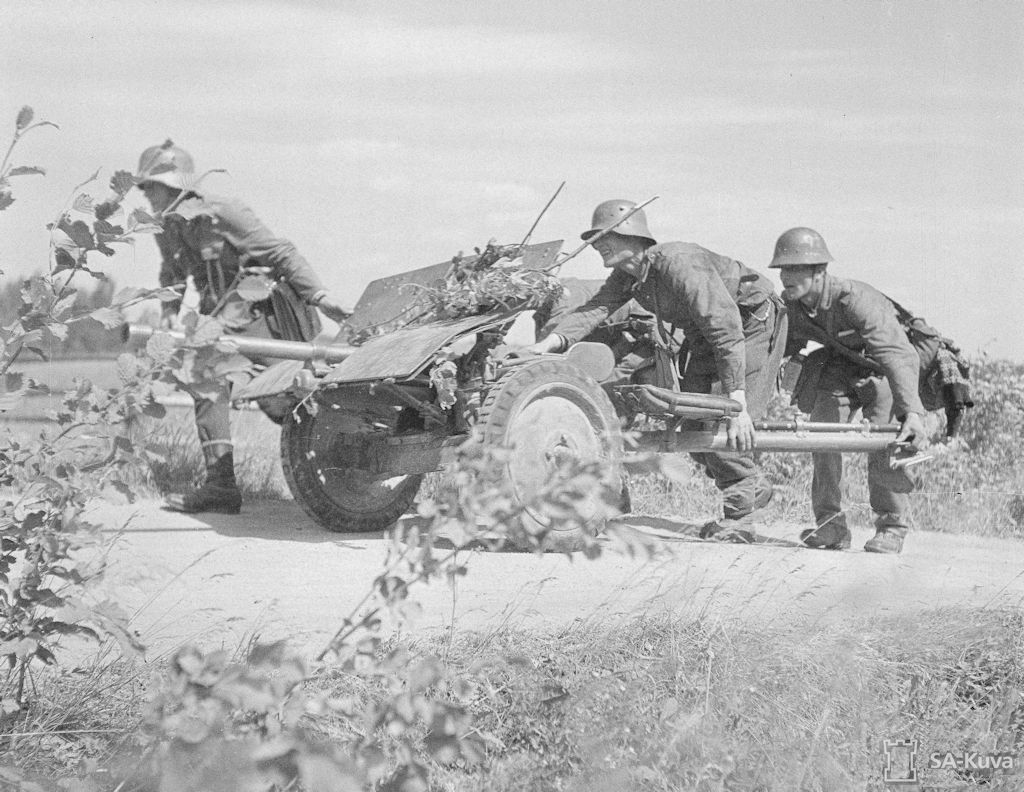
PICTURE: Gun crew seen manhandling their 37 PstK/36 anti-tank gun towards new gun position. Weighting 375 kg this sort of pre-war anti-tank guns were relatively easy to manhandle, but new tanks introduced during World War 2 were too well armored for them. This gun model was the most common anti-tank gun model in use of Finnish Army during Winter War. Photographed by 2nd Lieutenant Kim Borg in Soanlahti at July of 1941. (SA-kuva.fi photo archive, photograph number 26281).
Antitank-gun platoon (horse-towed, equipped with 37 PstK/36 at-guns), 1939 - 1940:
Platoon Leader
Messengers (2 men)
Scouts + observers (1 NCO + 3 men)
1st Gun Squad (one antitank gun)
Crew (1 NCO + 8 men)
1 horse for towing the gun
2 horses with carts/sledges for transporting ammunition
2nd Gun Squad (one antitank gun)
Crew (1 NCO + 8 men)
1 horse for towing the gun
2 horses with carts/sledges for transporting ammunition
Spare horse and its handler (1 man)
Vehicles:
Manpower:
Antitank-gun platoon (motorised, equipped with 37 PstK/36 at-guns), 1939 - 1940:
Platoon Leader
Messengers (2 men)
Scouts + observers (1 NCO + 3 men)
1st Gun Squad (one antitank gun)
Crew (1 NCO + 8 men)
1 truck for towing the gun
1 ammunition truck for transporting ammunition
2nd Gun Squad (one antitank gun)
Crew (1 NCO + 8 men)
1 truck for towing the gun
1 ammunition truck for transporting ammunition
Vehicles:
Manpower:
(Detached) Antitank Company / Gun Company, 1939 - 1945:
Company Commander
Office (Supply Unit)
1st Gun Platoon
in each gun platoon:
1st Gun Squad (with one antitank gun)
2nd Gun Squad (with one antitank gun)
2nd Gun Platoon
3rd Gun Platoon (*)
Close Defence Platoon
Equipped with satchel charges and molotov cocktails. Starting from summer of 1944 could also be equipped with panzerfausts and panzerschrecks.
(*) Notice: During Winter War Antitank Company or Detached Antitank Company sometimes had only 2 Gun Platoons. Around 1942 - 1943 Close Defence Platoon was sometimes used to form 4th Gun Platoon.
Gun Company of Infantry Regiment (horse-towed), 1942:
Company Commander (pistol)
Company HQ
Messengers (runners)
NCO + man (SMG + rifle)
Motorcycle-messenger (pistol + motorcycle)
HQ Squad
NCO + 2 men (pistol + SMG + rifle)
3 Gun Platoons
In each Gun Platoon:
Platoon leader (SMG)
Platoon leaders assistant (rifle/SMG)
2 messengers (runners), (rifles)
2 Gun Teams (one team per gun)
In each Gun Team:
Gun Chief (SMG)
8 men gun crew (rifles) (**)
2 horse men (rifles, 2 horses + towing equipment)
Man with spare horse (rifle, horse)
Close Defence Platoon
Platoon leader (SMG)
Platoon leaders assistant (rifle)
2 messengers (runners), (rifles)
4 Close Defence Squads
In each Close Defence Squad
Squad leader (rifle)
6 men (satchel charges, SMG + 5 rifles)
2 ammunition men (rifles, 2 horses + carts/sledges with ammunition)
Supplies Platoon
Company Sergeant Major (pistol)
Weapons and ammunition NCO (rifle)
Medical NCO (rifle)
Clerk (rifle)
Supplies Squad
Supplies NCO (rifle)
Truck and veterinarian NCO (rifle)
Shoemaker (rifle)
2 cooks (rifles, field kitchen)
2 drivers for supplies trucks (rifles, 2 trucks)
(**) Notice: NCO + 8 men in a gun-crew was standard crew size for 37-mm and 45-mm at-guns. Larger at-guns had larger crews.
Divisional Gun Company, 1941 - 1942:
Company Commander (pistol)
Company HQ
Messengers (runners)
NCO + man (SMG + rifle)
Company Commanders driver (rifle, passenger car)
3 Gun Platoons
In each Gun Platoon:
Platoon leader (SMG)
Platoon leaders assistant (rifle)
2 messengers (runners), (rifles)
2 Gun Teams
In each Gun Team:
Gun Chief (SMG)
8 men gun crew (rifles) (***)
2 truck/tractor drivers (rifles, 2 trucks or 2 Komsolets A-20 tractors)
Truck driver (rifle, ammunition truck)
Close Defence Platoon
Platoon leader (SMG)
Platoon leaders assistant (rifle)
2 messengers (runners), (rifles)
4 Close Defence Squads
In each Close Defence Squad:
Squad leader (rifle)
6 men (satchel charges, SMG + 5 rifles)
Truck driver (rifle + truck)
Supplies Platoon
Company Sergeant Major (pistol)
Weapons and ammunition NCO (rifle)
Medical NCO (rifle)
Clerk (rifle)
Supplies Squad
Supplies NCO (rifle)
Truck and veterinarian NCO (rifle)
Shoemaker (rifle)
2 cooks (rifles, field kitchen)
2 drivers for supplies trucks (rifles, 2 trucks)
(***) Notice: NCO + 8 men crew was standard crew size for 37-mm and 45-mm at-guns. Larger at-guns had larger crews.
Divisional Gun Company (equipped with 50 PstK/38 at-guns), 1943:
Company Commander (pistol)
Company HQ
Messengers (runners)
NCO + man (SMG + rifle)
Company Commanders driver (rifle, passenger car)
3 Gun Platoons
In each Gun Platoon:
Platoon leader (SMG)
Platoon leaders assistant (rifle)
2 messengers (runners), (rifles)
2 Gun Teams
In each Gun Team:
Gun Chief (SMG)
10 men gun crew (rifles) (****)
2 tractor drivers (rifles, 2 Komsolets A-20 armoured tractors)
2 truck drivers (rifles, 2 trucks)
Close Defence Platoon
Platoon leader (SMG)
Platoon leaders assistant (rifle)
2 messengers (runners), (rifles)
4 Close Defence Squads
In each Close Defence Squad:
Squad leader (rifle)
6 men (satchel charges, SMG + 5 rifles)
Truck driver (rifle + truck)
Supplies Platoon
Company Sergeant Major (pistol)
Weapons and ammunition NCO (rifle)
Medical NCO (rifle)
Clerk (rifle)
Truck maintenance NCO (rifle)
Supplies NCO (rifle)
2 cooks (rifles, field kitchen)
2 drivers for supplies trucks (rifles, 2 trucks)
(****) Notice: NCO + 10 men gun crew was standard size for 50 PstK/38 at-gun. Other at-guns had crews of different size.
Divisional Gun Company (equipped with 75-mm at-guns), 1944:
Company Commander (pistol)
Company HQ
Messengers (runners)
NCO + man (SMG + rifle)
Company Commanders driver (rifle, passenger car)
3 Gun Platoons
In each Gun Platoon:
Platoon leader (SMG)
Platoon leaders assistant (rifle)
2 messengers (runners), (rifles)
2 Gun Teams
In each Gun Team:
Gun Chief (SMG)
12 men gun crew (SMG + 11 rifles) (*****)
2 tractor drivers (rifles, 2 Komsolets A-20 armoured tractors)
2 truck drivers (rifles, 2 trucks)
Supplies Platoon
Company Sergeant Major (pistol)
Weapons and ammunition NCO (rifle)
Medical NCO (rifle)
Clerk (rifle)
Motor vehicle NCO (rifle)
Supplies Squad
Supplies NCO (rifle)
2 provisions men (rifles)
2 cooks (rifles, field kitchen)
2 drivers for supplies trucks (rifles, 2 trucks)
(*****) Notice: NCO + 12 men gun crew was standard size for 75 PstK/97-38 and 75 PstK/40 at-guns. Other at-guns had crews of different size. In this case two men of the each gun crew had also training as driver of towing vehicle.
Notice: In August of 1944 orders were given for changing 75-mm at-gun equipped gun companies so that they had only two gun platoons. At least some went through this change in August or September of 1944.
Antitank-rifle unit, Winter War 1939 - 1940:
Unit Commander
1st Antitank rifle Squad
1st Half-Squad
Squad leader (rifle or pistol)
Antitank-rifle shooter (with at-rifle)
1st Assistant of shooter (rifle)
2nd Assistant of shooter (rifle)
2nd Half-Squad
Leader of half-squad (with SMG or LMG)
5 men with satchel charges (and rifles)
2nd Antitank rifle Squad
1st Half-Squad
Squad leader (rifle or pistol)
Antitank-rifle shooter (with at-rifle)
1st Assistant of shooter (rifle)
2nd Assistant of shooter (rifle)
2nd Half-Squad
Leader of half-squad (with SMG or LMG)
5 men with satchel charges (and rifles)
Separate Antitank-rifle Company of Division from Winter War, 1939 - 1940:
Company Commander
Supply Unit
1st Antitank rifle Platoon
in each antitank rifle platoon:
3 Antitank rifle Squads
in each antitank rifle squad
1st Half-Squad
Squad leader (NCO with rifle or pistol)
Antitank-rifle shooter (with at-rifle)
1st Assistant of shooter (rifle)
2nd Assistant of shooter (rifle)
2nd Half-Squad
Leader of half-squad (with SMG or LMG)
5 men with satchel charges (and rifles)
2nd Antitank rifle Platoon
3rd Antitank rifle Platoon
Panzerschreck Platoon, 1944:
Platoon leader (officer, SMG + pistol)
1st Squad
In each Squad:
Squad leader (NCO, SMG)
8 men (3 panzerschreck, rifles and/or SMGs)
2nd Squad
3rd Squad
4th Squad
(Notice: This is official TO&E, the actual units were often somewhat improvised. However the 3-men panzerschreck crew seemed to work: 1st man had panzerschreck and shot with it, 2nd man acting as loader carried extra rockets and possibly also panzerfaust as back-up weapon, 3rd man had SMG and he concentrated keeping enemy infantry from getting too close).
Panssarijääkäripataljoona (Panzer Jaeger Battalion = AT-gun Battalion), June 1944:
Notice: This unit was antitank-gun unit of Jaeger Brigade / Armour Division and was one of a kind. When established the Panzer Jaeger Battalion was attached to 1st Jaeger Brigade and remained so until end of Continuation War. First the battalion had 37 PstK/40 (3,7 cm Pak 35/36) at-guns. During 1941 some of the guns were replaced with captured 45-mm at-guns. Towing vehicles used for towing the guns early on were Soviet made captured Ford AA and US-made (6-wheel) International trucks. 4th Gun Company was re-issued with 50 PstK/38 (5,0 cm Pak 38) at-guns at September of 1942. The Battalion started got its trucks replaced with A-20 Komsomots towing tractors at 1942 and it seems that all were probably replaced before battles of 1944. Gun Company of 1st Jaeger Brigade was added to Panzer Jaeger Battalion at 30th of June 1942 and renamed as 7th Gun Company. This made the battalion four gun companies strong, around the same the battalion's HQ Platoon was enlargened to HQ Company.
Battalion Commander
Battalion HQ
HQ Company
1st Gun Company
6 x 75 PstK/40 antitank-gun
4th Gun Company
6 x 50 PstK/38 antitank-gun
6th Gun Company
6 x 75 PstK/40 antitank-gun
7th Gun Company
6 x 75 PstK/40 antitank-gun
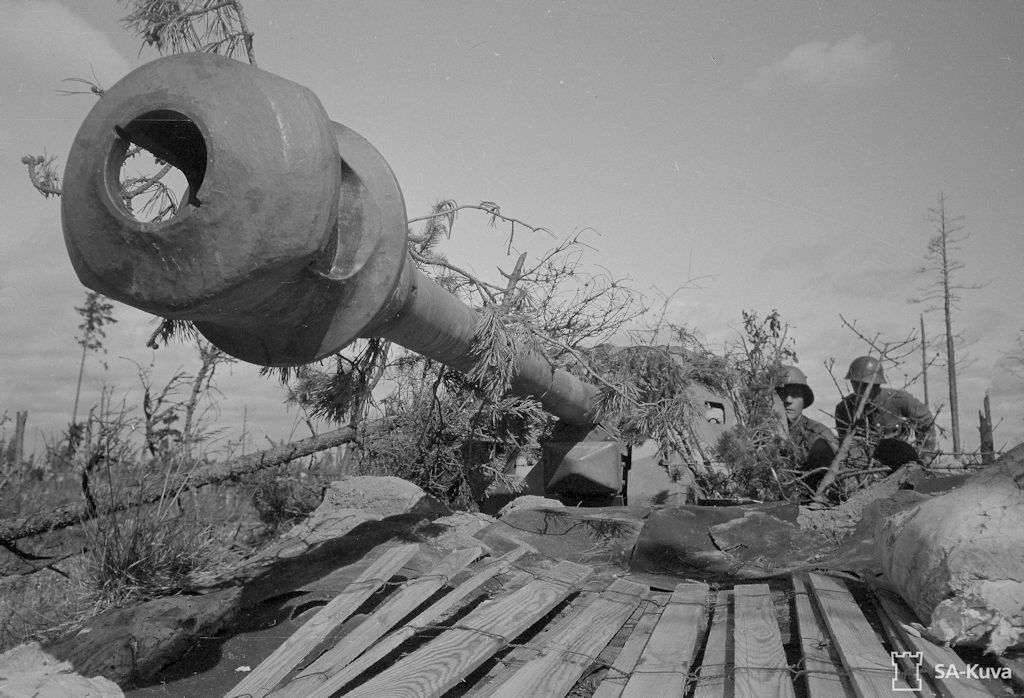
PICTURE: German 75 K/40 anti-tank gun of Finnish Army in Summa at June of 1944. This was the most powerful anti-tank gun in inventory of Finnish Army during World War 2 and hence capable knocking out even Soviet late-war heavy tanks, but due to its weight the gun was also much more difficult to move in between gun positions. It was also the most common late war large-caliber anti-tank gun of Finnish Army. Photographed by Military official Oswald Hedenstöm. (SA-kuva.fi photo archive, photograph number 153640).
Last updated 21st of October 2025
Webmaster: JTV jtvalias@hotmail.com
Copyrights (text and graphics): Jaeger Platoon Website. Copyrights of photographs vary on case to case basis and are marked along each picture.