


Portable Flame-throwers
Modern portable flame-thrower was German pre World War 1 invention. Its basic structure in all its simplicity: Three containers, two of them contained fuel and third one had flammable pressurised gas (usually nitrogen). Flame tube connected with hose to containers was used to aim the flame. During World War 1 portable flame-throwers become more common and gained popularity as one of the most feared and hated weapons of battlefield. The weapon was dangerous also those carrying it and had short range when compared to other infantry weapons, but inside its short range it proved brutally effective. It is worth noting that portable flame-throwers were not all-around weapons, but highly specialized weapon type used for reducing fortifications. Their flame would get through even narrowest of portholes or vision slots and if the flames would not kill soldiers inside the defensive structure, it could burn off oxygen and suffocate them. Flame-thrower operators were hated priority targets to their adversaries. During World War 2 all major players had portable flame-throwers among weaponry used by their engineer corps. Originally portable flame-thrower was designed as a weapon to be used against fortifications, but they proved also somewhat suitable as antitank weapons. Finnish military did not yet have flame-throwers in its inventory when Winter War started in November of 1939, but that was about to change.
Flame-thrower M/40 (Italian Lanciafiamme Spalleggiabile Model 35)

PICTURE: Finnish soldier poses with flame-thrower M/40 in Märkälä in July 1941.
Phhotographer Military official Tervo. (SA-kuva photo archive, photo number 24478). CLICK THUMBNAIL TO SEE LARGER
PIC (148 KB).
|
Maximum range: |
20 meters |
|
|
|
Flame: |
20 - 30 bursts of 1 second |
|
|
|
|
20 sec of constant flame |
|
|
|
Weight: |
25.5 kg in action |
|
|
|
|
10.0 kg empty |
|
|
|
Working pressure: |
20 at |
|
|
|
Liquid capacity: |
12,0 - 12,5 litres |
|
|
Finnish use: 176 bought from Italy during Winter War. Only 28 of those 176 flame-throwers arrived during that war and the rest only after it. Do not seem to have seen any use yet in Winter War, but were in extensive combat use during Continuation War.
As mentioned when Winter War started at end of November 1939 Finnish military did not yet have flame-throwers. At the time Germany was still leading the development of this weapon, but because of its treaty with the Soviets it was unwilling to deliver military equipment to Finland. So, Finnish Army decided to acquire its first flame-throwers from Italy. The Italians had portable flame-throwers in large-scale use (some 1,500 in inventory of Italian Army at year 1940) and were quite willing to do business with the Finns. As a result the Finns bought 176 portable flame-throwers type Lanciafiamme Spalleggiabile Model 35, which Finnish military named as liekinheitin M/40 (flame-thrower M/40). From those 176 flame-throwers ordered from Italy only 28 arrived during Winter War and likely did not yet see any combat-use during it. The remaining 148 arrived during the peacetime between Winter War and Continuation War. These flame-throwers were issued to Engineer Battalions of Finnish Army for Continuation War and saw extensive combat use during it.

PICTURE: Flame-thrower M/40 being used in Märkälä in July 1941. Photographer
Military official Olle Salmi. (SA-kuva photo archive, photo number 24224). CLICK THUMBNAIL TO SEE LARGER
PIC (117 KB).
The main parts of flame-thrower M/40 were:
The fuel tank consists two cylinder shape containers. These were divided by horizontal inner wall to two chambers, from which the upper chamber contained nitrogen gas and lower chamber contained fuel. Hose leading to the flame tube was attached low to right hand side container. Nitrogen and fuel filling vents and nitrogen pipe connecting the two cylindrical containers were on top of the fuel tank. Flame tube was obviously the part from which the flame burst out. The basic system used in this flame-thrower was the typical to flame-throwers of that era - nitrogen provided pressure for spraying the fuel and once this was ignited it produced a considerable flame. Earlier Italian flame-throwers had used fling-system for igniting the fuel, but the model delivered to Finland had been equipped with a lighter system, which was powered with electricity. This electric lighter could be powered by either with dry batteries (one 18-volt battery, four 4.5-volt batteries connected in series or two 9-volt batteries connected in series) or high-voltage inductor. This powerpack containing batteries or high-voltage inductor was integral part attached to this flame-thrower. The empty fuel tank weighted about 10 kg.

PICTURE: Finnish Army flame-thrower M/40. Drawing based to those in Finnish military
manuals. Colours are the best guess - Finnish "field grey" was probably used, but to what extent is
difficult to say. Drawing based to drawings in military manuals. CLICK THUMBNAIL TO SEE LARGER PIC (70 KB).

PICTURE: Flame tube of Finnish Army M/40 flame-thrower. Drawing based to drawings in military
manuals. CLICK THUMBNAIL TO SEE LARGER PIC (37 KB).
The fuel tank contained 12 - 12.5 litres of flame-thrower fuel. The nitrogen gas in upper chambers of its containers could be loaded up to 20 at. According manuals filling of the flame-throwers tanks had to be just before use, because the pressure would leak from the tank if it was storaged for a long time. The typical way of using portable flame-thrower in combat were short (about 1 second) bursts of flame and in this M/40 proved quite good - it could do as many as 20 - 30 bursts with one fill. However range-wise it was not quite as effective. Mainly due to low working pressure the maximum range of flame was only about 20 metres or so, which was beyond average for portable flame-thrower of World War 2 era. Also, as usual with portable flame-throwers weight of the weapon was an issue and slowed movement of the flame-thrower team in combat. Due to weight and location of valves operating of the flame-thrower M/40 demanded crew of two men.
Later the Italians also developed Lanciafiamme spaglleggiabile Model 1940 (which had electric lighter with high-voltage inductor) and Lanciafiamme spaglleggiabile Model 1941 portable flame-throwers, but none of those was ever acquired for Finnish military.
Flame-thrower M/41-R (Soviet ROKS-2)
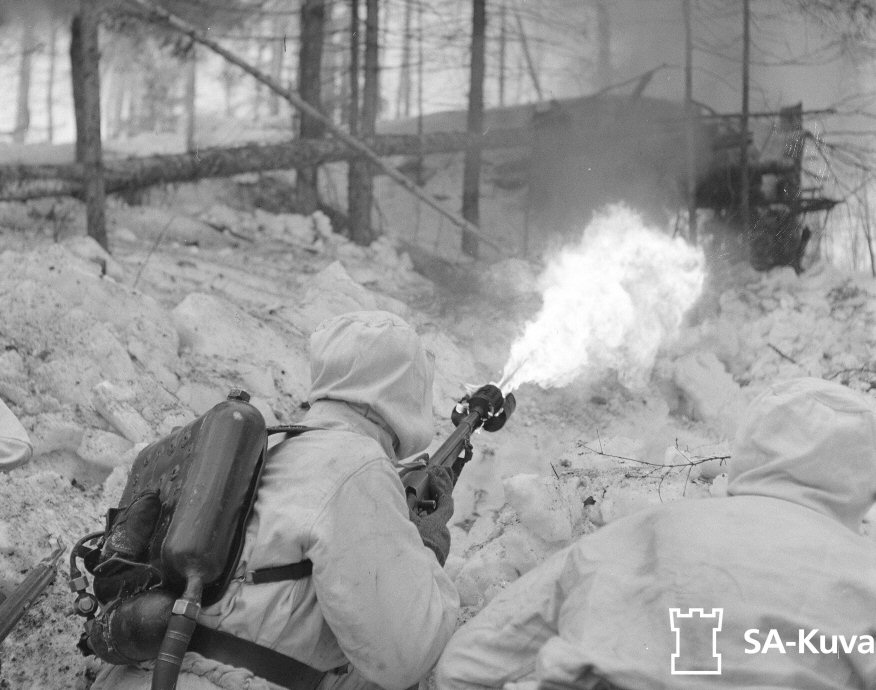
PICTURE: Captured flame-thrower M/41R in use of Finnish Army sappers in July 1941.
Photo taken during strike team excercise of jaeger engineer platoon in Aunus / Olonets Carelia March of 1943.
Photographer Kim Borg. (SA-kuva photo archive, photo number 123267). CLICK THUMBNAIL TO SEE LARGER PIC (159 KB).
|
Maximum range: |
30 - 35 meters |
|
|
|
Flame: |
6 - 8 bursts of 1 second |
|
|
|
|
5 - 6 sec of constant flame |
|
|
|
Weight: |
26.7 kg in action |
|
|
|
|
18.2 kg empty |
|
|
|
Working pressure: |
115 at |
|
|
|
Liquid capacity: |
10,0 litres |
|
|
Finnish use: Finnish Army captured unknown number of this Soviet flame-thrower and re-issued them to own troops. What is known these flame-throwers were first captured in September of 1941 and remained in use of flame-thrower platoons of Finnish Engineer Corps at least until end of World War 2.
During Continuation War Finnish Army also captured Soviet ROKS-2 portable flame-throwers, which were then adopted to Finnish use. Apparently the first mentioning of this flame-thrower in Finnish publications is in leaflet Taktisia ym. tietoja vihollisesta N:o 20 (Tactical and other information of the enemy number 20), which is dated 19th of September 1941. The leaflet suggests that Finnish troops had first time faced a nd captured some ROKS-2 flame-throwers (referred as "flame-thrower rifle" in the leaflet) just recently - hence quite likely in September of 1941. The speciality of ROKS-2 was that the Soviets had tried to camouflage it as M/91-30 military rifle and a rucksack. Because of this purpose the flame tube was shaped to remind rifle and fuel tanks had been attached to frame made from thin steel plate, which covered them somewhat hiding their structure. The Finns presumably captured most if not all ROKS-2 in their inventory during year 1941. Finnish Army named these flame-throwers as liekinheitin M/41-R (flame-thrower model 1941 Russian). Captured M/41-R flame-throwers remained in combat-use with Finnish Engineer Corps to the end of World War 2.

PICTURE: Soviet ROKS-2 flame-thrower captured by Infantry Regiment 5 of Finnish Army in region of
Patajärvi / Padozero in Soviet Carelian in late September of 1941. Photographer Hans Lindh.
(SA-kuva photo archive, photo number 51555). CLICK THUMBNAIL TO SEE LARGER PIC (182 KB).
Main parts of M/41-R flame-thrower:
Just as with flame-thrower M/40, also fuel tank of this flame-thrower had two cylindrical vertical containers. However the containers of ROKS-2 were in metal frame and had smaller cylindrical horizontal nitrogen tank under them. Each fuel container had filling valve on top of it. The hose containing fuel tank to flame tube was attached low at right hand side fuel container. Pipe connecting nitrogen tank to fuel tank was at the left-hand side. The lighting system contained two special cartridges, which started the flame and could be fired by pulling trigger of the rifle-shaped flame tube. These special cartridges had been made in cartridge cases of standard Soviet 7.62 mm x 25 Tokarev pistol/submachinegun cartridge. The empty fuel tank weight 8.5 kg. Length of the flame tube was 111 centimetres and it weight 3.6 kg.
The nitrogen tank placed vertically under the fuel tank contained 1.3 - 1.8 litres of nitrogen gas packed to pressure of 115 at. Using working pressure this high had its ups and downs: The range with Finnish flame-thrower fuel was about 30 metres (with Soviet developed flame-thrower fuel up to 36 - 45 metres), but the high pressure also spent lot of fuel real fast. The weapon could only produce 6 - 8 short (one second) bursts of fire without refill. The nitrogen tank weight 2.8 kg. Effectiveness of camouflage used with ROKS-2 in real battles was highly questionable. The nitrogen tank was not covered by steel frame and hose leading from fuel tank to the flame tube was still in plain view. And once the flame was ignited, the true nature of weapon must have been quite obvious. Like with M/40 also M/41-R demanded crew of two men to operate it.

PICTURE: Finnish Army flamethrower M/41-R (ROKS-2). Drawing based to drawings of military
manuals. CLICK THUMBNAIL TO SEE LARGER PIC (71 KB).

PICTURE: Flame tube of flame-thrower M/41-R. Drawing based to drawings of
military manuals. CLICK THUMBNAIL TO SEE LARGER PIC (36 KB).
Finnish military used two kinds of flame-thrower fuel mixes during World War 2:
Summer-mix:
Winter mix:
Flame-thrower fuel was readily mixed for 50-litre tanks, in which it was both transported and storaged.

PICTURE: Captured flame-thrower M/41-R in use of Finnish sappers in training centre of
Niinisalo. Photographed by Hedenström in July of 1942. (SA-kuva photo archive, photo number 96295). CLICK
THUMBNAIL TO SEE LARGER PIC (129 KB).
From these two flame-thrower models used by Finnish Army, the Soviet M/41-R proved more popular. Finnish sappers preferred it for its better reliability and design, which reduced the chance of being spotted and becoming priority target for the enemy. During World War 2 flame-throwers remained rather rare weapons for Finnish military. Typical Finnish Continuation War era Engineer Battalion had first separate Liekinheitin joukkue (Flame-thrower Platoon), which was replaced with Jääkaripioneeri joukkue (Jaeger Engineer Platoon) in September of 1943. These platoons had each had 6 flame-thrower crews (with 2 men in each crew). Each of these platoons had 12 flame-throwers in their disposal. While these number may feel strange, having two flame-throwers per crew was important part of tactics. If a flame-thrower crew run out of fuel in their first flame-thrower, they could simply take their second flame-thrower and continue fighting instead of more time-consuming process of refueling fuel containers and nitrogen tank. The flame-throwers needed to be refueled only after also the second flame-throwers had run out of fuel. Typically each Continuation War era Finnish Army engineer battalion had one of these platoons. One could say that flame-throwers played relatively small role as weapon of Finnish engineers during World War 2 and the number of soldiers operating them was also very small compared to size of the whole Army. By the book TO&E strength whole Finnish Engineer Battalion of that time was 579 men and in total 24 Engineer Battalions total were mobilized for Continuation War in 1941. Flame-thrower Platoon of each Engineer Battalion had only 19 men, from which two were mechanics and three served as truck drivers. Hence the total number of soldiers serving in all Flame-thrower Platoons of Finnish Army at the time was at most only 456 men, from which 120 were mechanics or truck drivers. Apparently during World War 2 portable flame-throwers were usually repaired in Weapons Depot 1 (Asevarikko 1) located in Helsinki.
There was a serious training accident with flame-thrower M/41-R, which took place in Non-commissioned Officer School of 21st (Infantry) Brigade in 6th of June 1944, with flame-throwers tank exploding mid-use. Due to the accident all flame-throwers of this model were inspected and additional instructions were issued. The instructions specified that particular care had to be taken in not releasing pressure from the flame-thrower until the flame was completely out and if any of the valves was leaking, the valve absolutely needed to be replaced before the flame-thrower being taken in use.
OTHER PORTABLE FLAME-THROWERS:
Captured ROKS-3: The Soviets continued development of their ROKS flamethrowers after ROKS-2. The development work produced ROKS-3, which was performance-wise apparently quite similar to ROKS-2, but easier to mass-produce. This flame-thrower has notably simpler fuel container design with single large tubular vertical fuel container and nitrogen tank attached to it also in vertical position. Finnish Army captured small number of ROKS-3 flame-throwers, but it is not known of they ever saw use with Finnish sappers.

PICTURE: ROKS-3 flame-thrower captured by Finnish Army in June of 1943. According
original photo caption 13 such flame-throwers were captured from the particular battlefield in Rukajärvi /
Rugozero Region in Soviet Carelia. The soldier also has captured PPSh-41
submachine gun hanging on his back. Photographed by Military official P. Jänis. (SA-kuva photo
archive, photo number 131383). CLICK THUMBNAIL TO SEE LARGER PIC (154 KB).
Finnish flame-thrower M/44: This is relatively light-weight Finnish World War 2 era flame-thrower, which was designed to be attached into Suomi m/31 submachine gun. The design is also referred as flame-thrower M/Kuusinen due to its inventor, Sergeant M. Kuusinen. It never saw large-scale use, because ending of Continuation War in September halted Finnish military weapons production. More info on this page about experimental Finnish heavy weapons projects.
SOURCES:
Military leaflet: Taktisia ym. tietoja vihollisesta N:o 20 (dated 19th of September 1941).
Military manual: Aseopas V, liekinheitin (1940)
Military manual: Liekinheitinopas (M/40), (Printed by Otava in 1941)
Military manual: Liekinheitinopas, kalustot m/40 ja M/41-R. 4. (Printed 1942)
Jatkosodan historia, part 1
Pioneerit sodassa 1939 - 1944, part II
Brassey’s Infantry Weapons 1950 - 1975
Archive folder T-19187, Finnish National Archives.